EXPLORE
Plastic Surgery
Dr. Barry Eppley

Explore the worlds of cosmetic
and plastic surgery with Indianapolis
Double Board-Certified Plastic
Surgeon Dr. Barry Eppley

Archive for the ‘sternoplasty’ Category

Case Study: Injectable Sternoplasty with Kryptonite Bone Cement

Thursday, February 10th, 2011

Background:  The chest deformity, pectus excavatum (funnel chest) is seen as a deep depression of the sternum, usually involving the lower half or two thirds of the sternum. Its deepest indentation is at the junction of the chest and the abdomen. The lower four to six rib cartilages dip backward abnormally to increase the deformity or depression and push the sternum posterior or backward toward the spine.

In most significant cases, pectus deformities are treated surgically with excellent success. The most popular surgical technique today is the Nuss procedure where a rigid titanium bar is placed behind the sternum and pushes it forward. But not all pectus problems are significant enough to either warrant surgery or would pass insurance criteria for it. These more minor pectus deformities are limited to just the very end of the sternum and the xiphoid process.

Treatment options for these more limited pectus deformities are few. Solid types of implants can be hand carved intraoperatively or preformed prior to surgery off of 3-D CTs and inserted. But this requires a resultant visible incision which may not be a good trade-off form a small sternal indentation. In addition, such sternal implants do have a history of potential problems such as mobility and seromas. (fluid collections)

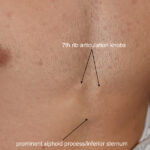
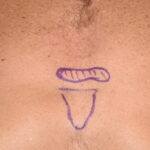
Case Study: This is an 18 year-old male who wanted cosmetic improvement of his sternal deformity. He had been evaluated by a pediatric surgeon who felt his problem was not significant enough to justify sternal recontouring/repositioning. He had no pulmonary problems or limitations with exercise. The lower sternal indentation measured 7cms in height and 5 cms in width. It was a well-defined indentation that measured by water displacement of 10 mls.  

He opted for a new injectable sternoplasty approach which had not been previously done. The concept was to place Kryptonite Bone Cement through an injectable technique and allow it to be set and molded as it cured. This calcium carbonate-based material has the flow properties to be mixed and then injected through a small plastic tube. Once set, the material is very adherent to bone and becomes as rigid as the bone to which it attaches. Its porosity (a feature that develops as it sets) allows the potential for bone ingrowth over time.

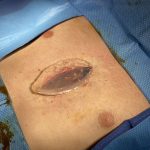
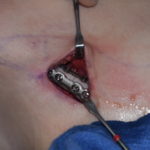
Prior to surgery, the sternal defect was measured in volume and with a playdoh cast to get an idea of the material to be injected. During surgery, a 5mm incision was made over the lower end of the sternal at the edge of the indentation. An elevator was used to make a pocket at the bone level with an effort to be subperiosteal. Then using 5 grams of Kryptonite powder, it was mixed with its two liquid components and mixed for two  minutes. It was then transferred to a syringe which was attached to a 12 French plastic catheter and injected. The material was allowed to cure to a doughy state for 15 minutes and then molded by external pressure on the overlying skin. A lightly compressive circumferential chest wrap was then placed.

The entire procedure took 45 minutes. The results were immediate with elimnination of the lower sternal indentation. He was discharged as an outpatient. He reported no pain afterwards.  

Case Highlights:

1)      Pectus excavatum presents as a whole range of sternal deformities. More minor manifestations of it affect just the lower third of the sternum and do not usually qualify for surgical repair.


2)      Injectable augmentation of the lower third of the sternum can be easily and successfully done with Kryptonite Bone Cement. Its firm adherence to the sternal bone and its high impact resistance make it a good material for use in the chest.


3)       This injectable sternoplasty technique may also be useful for secondary revision of pectus excavatum repair in which the ideal contour has not been obtained.

Dr. Barry Eppley

Indianapolis, Indiana

Injectable Sternoplasty (Pectus Excavatum Repair) – Kryptonite Bone Cement as a Sternal Augmentation Material

Wednesday, August 18th, 2010

Pectus excavatum, also known as funnel chest, is a defect characterized by differing levels of sternal depression. The deepest area of the sternal depression is always on the lower third of the sternum near the upper abdominal area. The lower costal or rib cartilages dip backward to increase the deformity or depression and push the sternum posterior backward towards the spine.

Significant pectus deformities are treated when the patient is young, usually between 12 to 18 years of age. At this age, the plasticity of the cartilages make this age group the ideal period for repair. While extensive cartilage resection (Ravtich approach) has been the historic approach. This radical operation has been replaced by the Nuss Procedure which involves the placement of a large curved bar through incisions on the chest wall. The bar is rotated into position and kept in place for 2 to 3 years.

But not all sternal reconstructive surgery leaves a perfectly flat or well curved sternum. In addition, some patients have very small sternal depressions that were either not recognized for early treatment or were not significant enough for any form of sternal reshaping and respositioning. Such cosmetic sternal deformities have been traditionally treated with onlay implants usually composed of preformed or custom carved silicone. Gore-tex blocks and sheets have also been used as sternal inserts.

But these synthetic materials have not been without their complications including infection, seroma formation, and capsular contracture. This has resulted in either their need for removal or the outcome of a hard and unnatural feeling implant. This is largely because these synthetic materials are not intended to be bone substitutes or replacements so they never integrate and become an extension of the natural sternal bone. Better sternal onlay materials would be an asset and could provide a better option for smaller sternal depressions that don’t warrant invasive bone reshaping.

The ideal sternal onlay augmentation material would adhere to the bone surface, have bone-like firmness and fracture resistance, and be injectable. The need to be delivered into the sternal site by injection is critical as any incision across the sternum is a cosmetic deformity by itself. Of all available bone substitute materials historically used, none fulfill all of these criteria. Most are hydroxyapatite-based which are neither injectable or fracture-resistant.

The recent commercial introduction of Kryptonite bone cement has the potential to fulfill these sternal criteria. Kryptonite Bone Cement is a non-toxic, porous, adhesive bone substitute material that possesses bone-like mechanical properties. It is composed of naturally occurring fatty acids and calcium carbonate. It’s three ingredients are mixed together at the time of surgery to create an initial liquid material that converts into a firm putty within minutes. It is Kryptonite’s liquid phase after mixing that makes it injectable.

Kryptonite bone cement has been shown experimentally to be an easily injectable material for limited incision or minimal access cranioplasty. It can flow through small diameter (3mms) plastic tubing, can be easily molded through the skin by outward digital molding pressure, adheres to the bony pocket created, and does not stick to the overlying skin. Its success for a cranial surface suggests that it would work equally well on the sternum, which represents just another flat bone surface. Through a small (< 10mm) lower sternal incision, a subperiosteal pocket can be easily created and injected. The material can be molded to fill a sternal defect and harden in 15 minutes. Once set, it will feel like natural bone and will encapsulate with the underlying sternum

Kryptonite bone cement represents a viable sternal augmentation material. Its ability to be placed by injection opens up treatment possibilities for those with sternal depression deformities that would not otherwise merit more extensive surgical reconstruction. 

Dr. Barry Eppley

Indianapolis, Indiana


Dr. Barry EppleyDr. Barry Eppley

Dr. Barry Eppley is an extensively trained plastic and cosmetic surgeon with more than 20 years of surgical experience. He is both a licensed physician and dentist as well as double board-certified in both Plastic and Reconstructive Surgery and Oral and Maxillofacial Surgery. This training allows him to perform the most complex surgical procedures from cosmetic changes to the face and body to craniofacial surgery. Dr. Eppley has made extensive contributions to plastic surgery starting with the development of several advanced surgical techniques. He is a revered author, lecturer and educator in the field of plastic and cosmetic surgery.

Read More


Free Plastic Surgery Consultation

*required fields


Pricing

The cost of any type of elective plastic surgery plays a major role in the decision to undergo the procedure(s).

Get Your Quote Here


My Plastic Surgery Story

Military Discount

We offer discounts on plastic surgery to our United States Armed Forces.

Find Out Your Benefits


Categories