EXPLORE
Plastic Surgery
Dr. Barry Eppley

Explore the worlds of cosmetic
and plastic surgery with Indianapolis
Double Board-Certified Plastic
Surgeon Dr. Barry Eppley

Archive for the ‘jaw angle implant’ Category

Case Study: Strong Male Jawline Enhancement

Wednesday, March 6th, 2013

Background: A well-defined and strong jawline is a desireable male feature. While modern culture and media have made it seem a recent attractive male trait, it has been so for as far back in history as pictures have been drawn and sculptures have been created. A strong lower facial structure provides not only good aesthetic proportions but implies increased masculinity and facial attractiveness.

Total or complete male jawline enhancement can improve the structural shape of the lower jaw by increased chin and jaw angle projection through the use of implants. Since the mandible has somewhat of a parabolic curved shape, the front and back ends of the curve must be changed to give it greater angularity. The chin needs a more square form horizontally and the jaw angles need a more square form vertically as well as more outward horizontal flare.

The amount of ‘strength’ of the jaw line that any particular male wants is a very individual decision. There are some general guidelines as to how much chin and jaw angle flare is aesthetically acceptable. The square width of the chin should stay within a vertical line dropped down from the pupil of each eye. The outward flare of the jaw angles should not go past a vertical line dropped down from the midpoint of the zygomatic arch. The lower vertical edge of the jaw angle should sit above the lowest point of the chin in side view so that the mandibular plane angle is not flat.

While these aesthetic jawline guidelines stay within the proportions of the balanced face, some patients may desire a stronger jawline look. To achieve a very strong or extreme jawline enhancement, implants have to be selected that exceed these aesthetic facial boundaries but also stay proportionate.

Case Study: This 50 year-old male wanted to achieve more of a stronger facial look with greater skeletonization and prominence of his facial features. A big part of his desired look was a significant change to his jawline. While his chin was not unduly deficient, his jaw angles were significantly narrow, vertically short and ill-defined.

Under general anesthesia, his chin was changed by performing an intraoral vertical reduction osteotomy onto which was overlaid a medium silicone square chin implant to provide width and an additional 3mms of horizontal projection. Jaw angle implants were placed intraorally that added 10mms of vertical lengthening and 11mms of increased width. He also had cheek implants placed to his new jawline did not overwhelm his upper face.

He had the typical jawline implant recovery with a first week of significant swelling and trismus. (limited jaw opening) By three weeks after surgery, however, much of his swelling subsided and the outlines of the augmentations were more discernible. By six weeks the final shape of the jawline could be seen. While the time period of three months after surgery is the real final evaluation point, 90% to 95% of the result is evident by six weeks.

Strong jawline enhancement requires a square chin and prominent jaw angles. One of the key features to a stronger jawline is to increase the vertical length and flare of the jaw angles. To keep the face proportionate and to stay within its aesthetic boundaries, cheek augmentation may be needed to prevent too heavy of a lower facial look.

Case Highlights:

1) Total jawline augmentation involves chin and jaw angle implants.

2) Creating a strong and well defined jawline in men involves a more square chin and a three-dimensional change to the posterior jaw angles.

3) Strong jawline augmentation creates a prominent flair and vertical lengthening of the jaw angles and a square chin that will create more of a square shape to the face.

Dr. Barry Eppley

Indianapolis, Indiana

Jaw Angle Augmentation: Matching Implant Styles and Jaw Angle Changes

Saturday, February 2nd, 2013


A well-defined jawline is a desired aesthetic feature of a male face. A strong lower skeletal profile not only provides a well balanced facial profile but also portrays an image of strength and virility. A strong jawline is created by the horizontal portion of the mandible (lower jaw) and composed of threee main components, the chin and a paired set of jaw angles. Because they come from the same bone and embryologic branchial arch origin, it is not surprising that there is a developmental relationship between them. A stronger chin will usually have better defined and lower positioned jaw angles, a weak chin usually has smaller and more highly positioned jaw angles.

The surgical creation of an improved jawline usually includes chin and jaw angle implants. In a minority of cases, jaw angle implants alone are all that is needed. Isolated jaw angle implant surgery usually occurs when a chin implant was initially done and, although there was anterior jawline improvement, the realization is that jaw angle augmentation is needed as well for a more complete jawline enhancement.

While chin implants come in a variety of styles and sizes, the selection of jaw angle implants is much more limited. With only a few manufacturers, jaw angle implants are available in just two basic styles and a handful of sizes. While this limited selection of implants can actually work for most patient’s jaw angle augmentation needs, it is important to match the right style of jaw angle implant with the patient’s anatomy and their aesthetic desires.

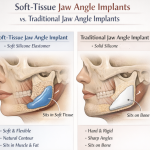
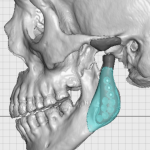
One style of jaw angle implant, and the first that was ever introduced over 15 years ago, is the lateral augmentation design. This implant will make the jaw angle wider, a horizontal increase only. It takes the existing skeletal jaw angle outline and merely adds to it. For the patient who is happy with the position of their jaw angles and wants them to be more prominent or fuller, the lateral augmentation style is ideal. It is the ‘easiest’ jaw angle implant to surgically place as it does not require release of the periosteum from the inferior border of the mandible.

While the lateral augmentation style has been around for a long time, it is actually the least useful as what most patients need (want) is not a width increase only. When the jaw angles are weak they are often highly positioned as well with an obtuse angle shape to them. This type of aesthetic jaw angle deficiency needs a vertical elongation and not just width increase alone. In essence, a new jaw angle needs to be created that is partially below the existing one. This style of jaw angle implant is an inferolateral style that changes the jaw angle to a lower and more acute one. This is the ‘hardest’ type of jaw angle implant to surgically place because the tissues along inferior and posterior portion of the jaw angle must be released. The jaw angle implant must then be properly inserted, without an exact bony guide to the best position, and then secured there by screw fixation.

Jaw angle augmentation today requires an understanding of the patient’s bony anatomy and the style of implant that is best suited to make the desired changes. The inferolateral jaw angle implant is what most male patients need for recreating a lower and more prominent jaw angle that creates a stronger and more horizontal jawline.

Dr. Barry Eppley

Indianapolis, Indiana

Postoperative Instructions for Jaw Angle Implant Surgery

Friday, January 25th, 2013

Jaw angle augmentation with implants changes the shape of the back part of the jaw. By placing specially shaped implants through an incision in the back part of the mouth, the jaw angles can be accentuated by either making them wider, longer or a combination of both. Different jaw angle changes requires different implant shapes and sizes.

The following postoperative instructions for jaw angle implants are as follows:

1.  Jaw angle implants usually have a modest amount of postoperative discomfort. Most patients require pain medication for several days after surgery due to the stretching of the jaw masseter muscles. Take your pain medications as directed and as often as you need them.

2.  Your jaw (face) will have a circumferential wrap placed to help swelling right after surgery and as a method to hold cold compresses in place. This wrap is to be left on for the first night after surgery. It may be removed the following morning. Be prepared that your face will get swollen, perhaps even considerably so.

3. Be aware that your jaw will get increasingly swollen over the next few days after surgery, this is normal. Facial swelling does not start to go down until three days after surgery and will many weeks to go away completely. You may continue to use ice packs if they make you feel more comfortable and as long as you like.

4. After taking off the head wrap, you may shower, wash your hair and shave (men) as you desire. The skin over the implants may feel numb for awhile but there is no harm in getting it wet.

5. The incisions inside the mouth have resorbable sutures. You may gently brush your teeth and use ½ strength (diluted) mouth wash for oral hygiene.

6. Your jaw opening will feel a little tight when you open your mouth widely. That will take several weeks to return to normal. You may stretch open your jaw as much as feels comfortable.You may eat whatever you like although chewing foods in the first few days after surgery can be difficult. Focus on liquids and soft foods for the first few days after surgery.

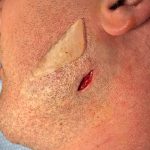
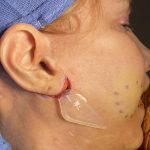
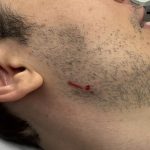
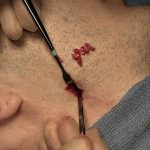
7. There will usually be a small suture on the skin outside of the jaw angle implants where the screw to secure the implants was inserted. There is no special care for that suture. It will be removed one week after surgery.

8.   You may return to any physical activity and work as soon as you would like based on your comfort level with pain and your facial appearance.

9.   You may drive when you feel comfortable and can react normally and are off pain medication.

10. If any facial redness, tenderness, or drainage develops after the first week of surgery, call Dr. Eppley and have your pharmacy number ready.

Consent for Plastic Surgery: Jaw Angle Implants

Friday, January 25th, 2013


Every plastic surgery procedure has numerous issues that every patient who is undergoing a procedure should know. These explanations are always on a consent form that you should read in detail before surgery. This consent form, while many perceive as strictly a legal protection for the doctor, is actually more intended to improve the understanding of the jaw angle implant procedure. The following is what Dr. Eppley discusses with his patients for this procedure. This list includes many, but not all,of the different outcomes from surgery. It should generate both a better understanding of the procedure and should answer any remaining questions that one would have.

ALTERNATIVES

Jaw angle augmentation can be done by temporary fillers although they do not produce the same angular and well defined effect as an actual implant. There are no bony moving alternatives to creating a jaw angle enhancement effect. Another alternative would be to not place an implant at all.

GOALS

The goals of jaw angle implant surgery is to create a more visually apparent L-shape to the back part of the lower jaw. This could be to simply widen the jaw angle one already has, to vertically lengthen the existing jaw angle, or some combination of both. Jaw angle implants are often part of an overall jawline enhancement effort.

LIMITATIONS

The amount that the shape of one’s jaw angles that can be changed is limited by the thickness of the skin covering the implant and the size and shape of the underlying jaw angle bone. While different sizes and styles of jaw angle implants exist, the final shape that the back part of the jaw will assume after augmentation is limited by the size and shape of the  underlying bone on which it sits as well as the thickness of the soft tissues over it.

EXPECTED OUTCOME

Expected outcomes include the following: temporary bruising and swelling around the jaw and neck, temporary  numbness of the inside of the cheek, and the skin over the jaw angle and a fine small scar inside the mouth through which the implant was placed. Jaw opening will be stiff for a few weeks after surgery. It often takes weeks to several months for the swelling from surgery to completely resolve and the final shape and contour of the jaw angles to be seen.

RISKS

Significant complications from jaw angle implant surgery are rare but  may include postoperative bleeding and infection. More likely but also uncommon complications include aesthetic deformities such as asymmetry and irregularities of the jaw angles due to either a natural asymmetry to the jaw angles or differences in implant placement between the two sides. The implants may also be either too big, too small or otherwise do not create the desired aesthetic effects. Any of these risks may require revisional surgery for improvement.

ADDITIONAL SURGERY     

Should additional surgery be required to adjust the position of the implant or change its size or shape, this will generate additional costs.

Case Study: Jaw Angle Implants For Complete Jawline Enhancement

Tuesday, January 22nd, 2013


Background: Enhancement of the jaw is historically perceived as a chin augmentation procedure. But the chin occupies less than 1/3 of the jawline and neglects the back part of the jaw which is much larger and makes up a significant part of the lower face. This jaw angle area is having increased recognition as being an important part of an aesthetically desireable jawline, particularly in men.

The jaw angles are uniquely different than the chin, not only in its shape, but because there are two of them. Its shape is created by the intersection of the horizontal lower border of the jaw with the posterior or vertical border of the jaw. This entire area is known as the ramus of the mandible. When the ramus is underdeveloped, it creates a high or obtuse jaw angle that is vertically short. (as judged by its position to the anterior chin) When it is developed more strongly, the ramus is vertically longer and the jaw angle is sharper and more defined. When the ramus is longer it often has a wider flare at the angle point as well.

Of all the facial implants, jaw angle implants are the least commonly done and have the fewest options of styles and shapes to use. It is also the hardest facial implant to place, being deep in the oral cavity and have to disinsert part of the masseteric muscle attachments for proper placement. To ensure implant stability, small screws are usually placed through a percutaneous approach to prevent after surgery displacement from the strong maasster muscle action.

Case Study: This 23 year-old male had a prior history of rhinoplasty and chin and cheek implant augmentation. While he was pleased with these facial improvements, he felt that his jawline was still deficient and wanted more visible and flared jaw angles for a more masculine appearance.

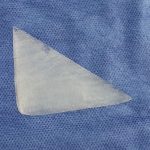
Under general anesthesia, intraoral incisions were made along the ascending ramus of the mandible but leaving a good cuff of tissue away from the teeth. The masseter muscles using subperiosteal dissection was raised over the entire ramus as well as along the inferior and posterior borders of the bone. Medpor RZ angle implants of 7mms width were trimmed, presoaked in a combined antibiotic and betadine solution and inserted into place making sure that their cupped lower border design wrapped around the lower edge of the bone. Once their position was ensured, a 1.5mm self-tapping screw was placed through the skin securing the upper part of the implants to the bone. The intraoral incisions were then closed with resorbable sutures in two layers.

The results of this jaw angle implant surgery showed enhanced angular definition with a moderate amount of increased jaw angle flare. This change fit nicely with the rest of his face and was not too strong a change. (jawline stronger than the upper face)

While jaw angle implants are the hardest facial implant to place, they are also the hardest to recover from due to prolonged swelling. As a general rule, 70% of the swelling goes down in 3 weeks, 90% in 6 weeks and 100% by three months. This prolonged recovery can be difficult for some men who do not understand that the final result is not seen in just a few weeks after surgery.

Case Highlights:

1)      Jaw angle implants are often needed to complete a total jawline enhancement.

2)      Creating a better defined jaw angle usually means that it must have vertical lengthening that creates a sharper and more visible 90 degree shape.

3)      Jaw angle implants are placed from inside the mouth and under the masseter muscle.

Dr. Barry Eppley

Indianapolis, Indiana

Contemporary Implant Concepts For Surgical Jawline Enhancement

Monday, November 26th, 2012

‘All societies in history were and are preoccupied with facial beauty’

‘ Facial balance and symmetry are the key features to attractiveness’

‘All people regardless of race, class or age share a similar sense of what is attractive’

‘Square jawed males are viewed as more masculine, gain higher ranks in the military and have earlier and more frequent sex’

‘ A square chin and jawline frames the lower face, making it more symmetrical and defined’

‘Defined jaw points and angles are more attractive in both men and women’

These are just a few of the well known facial facts of beauty that are often quoted and specifically address the merits of a strong and well defined jawline. While some have it naturally, the vast majority of us don’t and must seek a surgical solution. While there are a variety of facial implants for jawline enhancement, there are numerous misconceptions about how they work and how a better jawline is achieved.

‘The jawline consists of three parts, the chin, body and angles, all which can be implanted although not equally effectively or in all dimensions’

The most well known jawline implant is that of the chin. It is the most frequently done of all facial implants and has been surgically implanted for over fifty years. While the styles and size of chin implants have improved dramatically over this time, chin augmentation only affects the front 1/3 of the jawline. While one could argue that this is the most important part of the jawline and has its U-shape provides very visible forward projection, a chin implant provides no change for the posterior 2/3s of the jawline.(body and angles) Even today’s extended anatomic designs rarely provide any augmentation to the body even though the tail of the implants may lay upon it. Today’s chin implants, while providing projection and even square shapes through increased width, can not provide vertical lengthening…an overlooked feature of chin implant designs.

Three-dimensional chin reshaping can be done by a sliding genioplasty which can add vertical lengthening as well as horizontal projection. In extreme chin deficiencies, an osteotomy can be combined with an implant in front of it for a few more millimeters of projection or the implant can serve to fill in the notching that often occurs in the bone in the prejowl area.

Jaw angle implants are the least performed augmentations of any of the facial prominences. (chin, cheek, nose and jaw angles) While jaw angle implant designs have been around for nearly fifteen years, they have not garnered great use because their surgical implantation is more difficult and aesthetic interest is more recent. Current jaw angle implants produce mainly lateral augmentation (width) which actually is indicated for only the minority of patients seeking jaw angle enhancement.  For someone with a favorably low jaw angle point, width alone may produce a satisfactory enhancement.

Jaw angle deficiencies, however, almost always are the result of a high jaw angle which by definition implies a vertical deficiency as well. Getting current implant designs low enough is difficult if the surgeon does not do adequate soft tissue release and the implant does not have a design that can engage the lower border of the jaw angle for positional security. Jaw angle implant designs that provide both horizontal and vertical augmentation (inferolateral) are most useful to a larger number of patients, particularly men, who seek a more defined and prominent jaw angle area.

While chin implants augment the anterior two-thirds and jaw angle implants enhance the posterior two-thirds of the jawline, the missing area is the middle or the body of the jawline.  Sandwiched between the chin and the jaw angle, the body area has not specific implant for it. There is no ‘connector’ implant between the two. For those seeking a perfectly straight line back from the chin to the jaw angle point, this may be an aesthetic problem. While chin implants have extensions that go back and jaw angle implants have a forward reaching design, the two only connect over the body by overlapping their feathered edges if done together. This is why many jawline enhancement patients may have a visible step-off or break in their new surgically created jawline. For some combined chin and jaw angle patients, this body discrepancy is minimal and not an aesthetic issue.

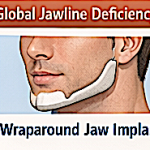
The body gap becomes most manifest when the jawline deficiency has a vertical deficiency component to it, areas that are not optimally augmented with current chin and jaw angle implant designs. When a perfectly straight and well defined jawline is desired, a custom two-piece implant is ideally needed that augments the entire jawline from front to back in a perfectly smooth fashion. These are particularly effective when the lower jaw is vertically short and the implant can be made to extend the entire lower border of the jaw. These ‘wrap-around’ jawline implants can produce some dramatic jawline changes.

The most unique jawline problem that can only be addressed by custom implants is when the entire jawline is vertically deficient, creating a small lower face. This almost always is associated with a lot of overbite of the anterior teeth, indicating that the lower jaw is small and fits partially inside the upper jaw. This creates an overclosing of the lower jaw making it too short vertically. Making a custom implant that fits only on the lower border of the jaw and lengthening it from front to back is the only effective solution.

Jawline enhancement must be assessed carefully in every patient to get the right jawline implant(s) design and size. For many patients, a chin implant may only be needed. For others seeking a three-point prominence change, off-the-shelf chin and jaw angle implants will suffice. Improving implant designs and sizes will make using this implants even more effective in the near future. For those seeking a completely new jawline with existing front to back deficiencies, wrap around jawline implants are designed and custom made for each patient’s specific jaw anatomy.

Dr. Barry Eppley

Indianapolis, Indiana

Case Study: Jawline Enhancement in the Thin Male Face

Friday, November 2nd, 2012


Background: A strong jawline is perceived as a sign of masculinity and is a commonly desired feature of some men. Using implants is the only way to create a well-defined jawline through the triple approach of chin and jaw angle implants. While these implants are available in different materials from various manufacturers, their most important feature is the style and size that they offer. Picking these implant features for any male patient is a lot more art that it is science.

When picking implants for any facial area, it is important to take into account their facial shape and the overlying soft tissue thickness. Thick faces blunt the effects of implants and may simultaneously benefit from some defatting procedures as well. Thinner faces have less overlying soft tissue and the effects of implants can more easily be seen. These facial characteristics are particularly important at the jawline which is essentially a transition point between the face and the neck. Augmenting the front (chin) and the back part (jaw angles) of the U-shaped jawline can change its appearance dramatically.

The thin face and jawline has the benefit of being more easily skeletonized by implants. But implant size must be tempered lest their effects become too pronounced or big. The lower face must not overpower the upper face by being too wide or extending beyond the upper zygomatic width. It must also not become too square in appearance and still maintain some element of being thin and somewhat narrow, just with a more defined jawline.

Case Study: This 45 year-old male felt that his entire jawline was weak. He had a chin implant placed four years ago and, while it provided some benefit, it was still not satisfactory. As part of the discussion about how to improve his chin, his highly angled jaw angle area was pointed out and it was agreed that jaw angle implants would be beneficial as well. He remembered that his prior chin implant was of mersilene mesh composition and that it was ‘large’ according to his original surgeon.

A square silicone chin was chosen to replace his existing chin implant. At least 9mms of additional horizontal augmentation was needed with a more square frontal shape. Silicone jaw angle implants that dropped the angle border down was also chosen but with a width that was not more than 7mms, keeping in line with the rest of the width of his face. The implants would have some overlap across the body of the mandible but with no augmentation effect in this area, which is common.

During surgery, the chin was approached through his existing submental scar. The mersilene mesh implant was heavily ingrown with tissue and was near the dermis of the skin. Removing it was felt to leave too little soft tissue between the skin and any new implant. It was elected to leave it in place and place the new square silicone implant between the underside of the mesh implant and the bone. The wings of the square chin implant went well beyond that of the mesh implant and had no problem providing a more square shape effect. The jaw angle implants were placed through an intraoral incision behind the molars. Dissection released muscular attachments off the angle and the inferior border so the jaw angle implants could be placed low enough. They dropped the border 5mms and had 7mms width. A single screw secured them in place to keep them low and to the back of the angle.

He had some moderate facial swelling, but like in all thin faces, it resolved fairly quickly within three weeks after surgery. He had a much improved jawline with better definition but a jawline width that stayed in line with his upper facial width.

Case Highlights:

1)      Jawline enhancement in men is most commonly performed by a combination of off-the-shelf chin and jaw angle implants.

2)      The style and size of chin and jaw angle implants must be chosen carefully and with an appreciation of the patient’s natural anatomy and soft tissue thickness.

3)      In the thin male face, jawline implants should not be too wide or over-sized as small implant can produce dramatic effects.

Dr. Barry Eppley

Indianapolis, Indiana

Case Study: Jaw Angle Implants in Jawline Enhancement

Tuesday, April 17th, 2012

Background:

The aesthetic appearance of the lower third of the face is defined largely by the size and shape of the underlying jaw bone. The support that the bone provides in the transition of the face into the neck creates one of the face’s most distinctive features. There are three aesthetic zones to this jawline including the chin, body and jaw angles. Like the chin in the front, the jaw angles provide the definition to the back of the jaw.

There is usually some correlation between the strength of the chin and the prominence of the jaw angles. As the overall mandible becomes weaker or more underdeveloped, the jaw angle area rotates upward. (becomes shorter) Known as the mandibular plane angle, stronger jaws have less of a plane angle than those that are weaker. This makes them vertically longer and slightly more wide.

Thus when evaluating the jaw angle area, it is important to determine if the deficiency is just one of overall width (desire for more flare or prominence) or whether the problem is more three-dimensional. (combination of vertical shortness and width) The clue to that diagnosis is almost always in the forward position of the chin. The weaker the chin, the shorter the jaw angles and the greater vertical deficiency they have.

In patients seeking jaw angle enhancement, the correct diagnosis of the jaw angle anatomy is critical for this controls the style of jaw angle implant selected. While the size of the implant is also important, no good result can be achieved if the proper style is not selected.

Case Study:

This 35 year-old male presented for multiple facial enhancements from the temples down to the jawline. His jawline concerns were that of it being weak. On examination he had a moderate chin deficiency with a mentalis muscle strain evident. His jaw angles were high (1.5 cms above the horizontal chin position) and narrow.

Under general anesthesia, he initally had a large square silicone chin implant placed through a submental incision. The forward projection of the implant was trimmed back to 5mms. This allowed for a more square effect to be seen at the sides of the chin but without too strong of a horizontal change. Through an intraoral approach, jaw angle implants were placed beneath the masseter muscles. Because he needed vertical lengthening, the tendinous attachments of the masseter muscle were released back at the angle area. A vertical lengthening Medpor jaw angle implant was used that was 7mms in width and 10m in vertical length. Once properly positioned, it was secured into place with a single screw on each side.

His postoperative course was typical for every jaw angle implant patient, one of considerable facial swelling and masseter muscle tightness. This took three weeks to look less surgical and six weeks to really look normal and be completely in the ‘benefits’ phase of recovery. While he had good improvement, he felt the jaw angles were too strong and requested some reduction in them. This was done by cutting down the size of the implants in a revisional procedure.

Jaw angle implants can make a dramatic difference in the jawline and be very complementary with chin augmentation. Choosing the right implant style is critical. Size estimation with jaw angle implants, however, remains very subjective and lacks any objective method for selection. Over-correction and asymmetry remains the biggest reasons for revisional surgery with this type of facial implant.

Case Highlights:

• Jaw angle augmentation is a part of overall jawline enhancement and is often done in combination with chin augmentation.

• Jaw angle augmentation can be done either as a two-dimensional change (width and greater angle definition) or three-dimensional. (width, vertical length and angle definition)

Jaw angle implants are placed through an intraoral approach in a submuscular position. The greatest risks with their use are the aesthetics of symmetry and size.

Dr. Barry Eppley

Indianapolis, Indiana

Shaping The Male Face

Monday, October 17th, 2011

Superman has been an American cultural icon since he first appeared in comic books back in 1938. His appearance is absolutely distinctive, most notably that of his red, white and blue colors and the stylized S shield on his chest. The shield is so symbolic of his character than its appearance alone immediately brings image of the comic character.

But beyond the colors and the symbol, many of his other features are particularly iconic of what masculinity and attractiveness is supposed to be. His face is absolutely chiseled and proportioned and exudes strength and power. Such Man of Steel facial features appear to have galvanized one male fan to undergo numerous plastic surgery procedures to try and look like this popular superhero.

Hebert Chavez, a superfan of Superman from the Phillipines, has dramatically altered his face to look more like Superman. New agencies have reported that he has undergone a series of operations since 1995. These have included a chin implant to get a strong chin with a cleft, nose reshaping, injections for fuller lips, cheek and jaw implants and eyelid surgery. As bizarre as this sounds, his surgical results actually look pretty good and not as unnatural as one would think.

Such a plastic surgery story brings to mind another face changer, Michael Jackson, and there is no doubt that they both share the similar malady of Body Dysmorphic Disorder. In this mental illness, a person can’t stop thinking about how their appearance is flawed and that perfection is just a surgery away.

But beneath these extreme cases of facial plastic surgery lies some basic truths about what makes a male face more appealing. It starts with an overall facial shape that has more definition and a square to inverted triangular shape. The three bony highlights of the male face are the chin, cheeks and jaw angles. Some degree of prominence in all of them is important to create a sense of overall angularity. Therein lies the frequent use of chin, cheek and jaw angle implants to create those prominences if they are weak, flat or recessed.

In the more lean male face, creating these prominences with implants alone may be adequate. As the chin, cheek and jaw angles become more visible, the non-bony supported areas (submalar and lateral face and neck) will appear more concave as the amount of subcutaneous facial fat in these areas is thin. In the rounder or fuller face, however, some fat removal will need to be considered. This could include procedures such as buccal lipectomies, lateral face and neck liposuction to try and change a convex shape in these areas to at least one that is flat or ideally a little bit concave.

Not every male face can be made more ‘super’. These facial plastic surgery techniques work best in a face that is not too overly round or thick. Such facial shapes are the kryptonite for obtaining the well defined male face that is deemed in both comic books and in real life as desireable.

Dr. Barry Eppley

Indianapolis, Indiana

The Value of a Strong Jawline Appearance in Male Political Candidates

Friday, September 23rd, 2011

The shape and strength of the jawline is an essential component of male facial attractiveness. This is evidenced not only in the images that we see today in male models and advertisements but in many of our most popular male celebrities and actors. This is not only a contemporary desireable male feature but has been so for a long time. It is also fair to say that a weak chin or a short and poorly defined jawlone has never been viewed as a favorable male facial feature.

The value of a strong male jawline can be seen all around us through the use of facial hair. The styling of beards and goatees is often a reflection of the desire to create a stronger chin and jawline appearance. Some men grow it as a conscious effort to do so but other men do it because they feel it makes look better…but without really knowing why.

This brings me to a call I received today from a member of the media. The query was about whether someone who underwent jaw reconstruction for a medical reason could come out from surgery with a better jawline appearance. The answer to that depends on what type of jaw reconstruction was done. If it was done for orthognathic or jaw alignment reasons (e.g., bringing forward a short lower jaw and fixing a bad bite), then an improved jaw appearance will result. This occurs as a natural result of the surgery because the chin becomes more prominent afterwards as the jaw comes forward. However, if the jaw reconstruction is done to fix a fracture then the answer would be no as the jaw shape is returned to what it looked like before the injury.

As it turns out, the basis of the question had to do with a political figure…specifically Texas Governor and Presidential candidate Rick Perry. The reporter wanted to know if I thought he had ever undergone any jaw enhancement surgery. It was detailed to me that Governor Perry had at one time been involved in a plane crash and had suffered a broken jaw. He was treated by wiring his jaws together. (closed reduction of a mandible fracture) The reporter was comparing photos of how he looks today and what he looked like before this injury. He wanted my opinion on what he thought or suspected was a change in his jaw shape after surgery.

In looking at these same photos, it is apparent that Governor Perry does currently have a very masculine jawline and that is certainly a part of his physical appeal from a facial standpoint. However, photographs of him in the military and even at a younger age show that he has always had a well defined jawline. He has a strong chin and jaw angles and a smooth straightline connection between the two. Having done a lot of chin and jawline cosmetic surgeries, the type of jawline the Governor naturally has is sought after by many male patients. The Governor is blessed to have it naturally, numerous type of jaw implants are available for those men who are not so fortunate.

Dr. Barry Eppley

Indianapolis, Indiana


Dr. Barry EppleyDr. Barry Eppley

Dr. Barry Eppley is an extensively trained plastic and cosmetic surgeon with more than 20 years of surgical experience. He is both a licensed physician and dentist as well as double board-certified in both Plastic and Reconstructive Surgery and Oral and Maxillofacial Surgery. This training allows him to perform the most complex surgical procedures from cosmetic changes to the face and body to craniofacial surgery. Dr. Eppley has made extensive contributions to plastic surgery starting with the development of several advanced surgical techniques. He is a revered author, lecturer and educator in the field of plastic and cosmetic surgery.

Read More


Free Plastic Surgery Consultation

*required fields


Pricing

The cost of any type of elective plastic surgery plays a major role in the decision to undergo the procedure(s).

Get Your Quote Here


My Plastic Surgery Story

Military Discount

We offer discounts on plastic surgery to our United States Armed Forces.

Find Out Your Benefits


Categories