
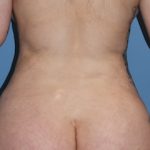
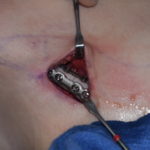
What is the most important tib to remove/modify in waist narrowing surgery?
If the goal is to achieve the greatest reduction in structural waist width, the 10th rib is the single most important rib to modify or remove. While aesthetic rib surgery has historically focused on removing the free-floating 11th and 12th ribs because they are technically easier and farther away from the pleura, experience and anatomical analysis have shown that these two ribs alone often do not create the maximum waistline narrowing.
The reasons are primarily anatomical:

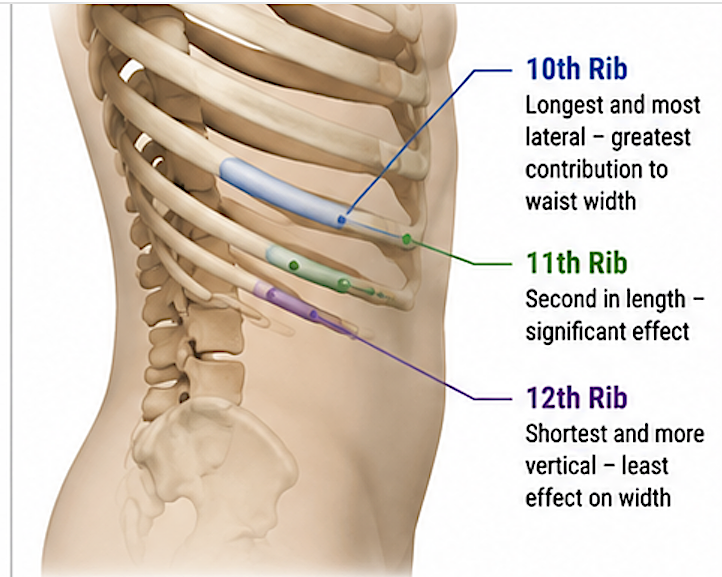
- Rib #10 is the longest and widest of the lower three ribs. It contributes the greatest amount to the lateral projection of the lower thoracic cage.
- Rib #11 is the second most important. Although free-floating, it has a long bony segment that significantly influences the side profile of the waist.
- Rib #12 is the least important structurally. It is much shorter and more vertically oriented. While its removal contributes to contouring, by itself it has the smallest effect on waist narrowing.
Relative importance
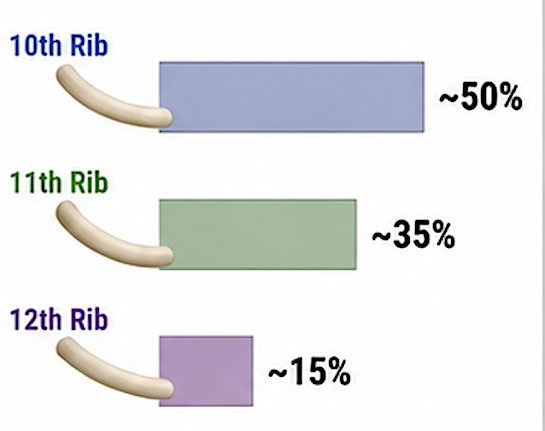
- 10th rib – approximately 50% of the skeletal waistline effect
- 11th rib – approximately 35%
- 12th rib – approximately 15%
These percentages are conceptual rather than exact, but they reflect the relative contribution each rib makes to the external contour.
Why the 10th rib matters
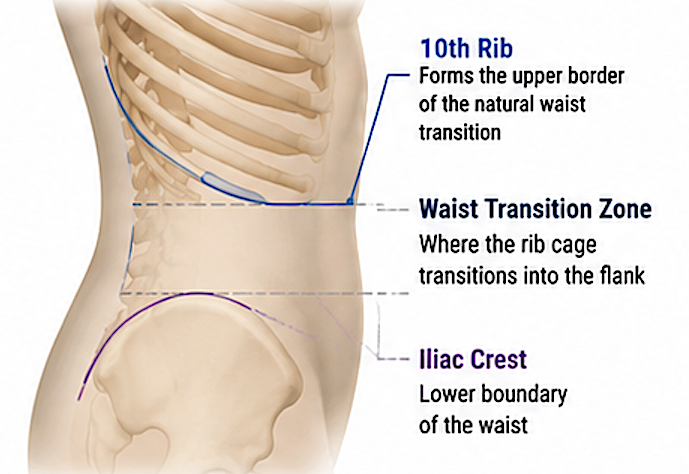
The natural waist is not simply the space between the ribs and the iliac crest. It is defined by the transition from the lower rib cage into the flank. Rib #10 forms the upper border of this transition. By reducing the lateral projection of rib #10, the waist begins to narrow higher on the torso, producing a smoother inward curve instead of only a reduction low near the floating ribs. This creates a much more natural “hourglass” contour.
Practical surgical implications
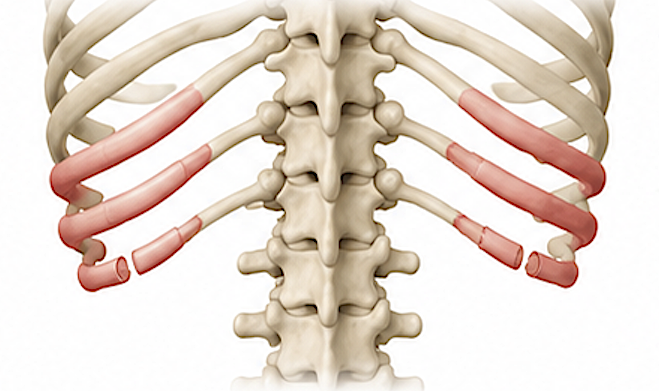
In my experience, the most effective structural waist narrowing typically involves:
- Partial removal or modification of ribs 10, 11, and 12
- Release of the muscular and fascial attachments at the rib ends
- Combination with flank liposuction when appropriate to address the overlying soft tissue
This combined approach produces a greater change than removing ribs 11 and 12 alone because it addresses both the upper and lower boundaries of the waist.
A useful way to visualize their contributions is to think of the lower ribs as forming a descending staircase:
10th rib ?????????????? (largest influence)
11th rib ?????????? (moderate influence)
12th rib ???? (smallest influence)
This is why modern structural waistline narrowing procedures have increasingly evolved from treating only the floating ribs to routinely including the 10th rib when anatomy permits. It is the key rib that transforms the contour from a subtle narrowing into a more pronounced, continuous inward waistline
Dr. Barry Eppley
Plastic Surgeon