
For a male “high cheekbone” look, I would design the implant quite differently from one intended to create generalized midface fullness or any other standard cheek implant. The key is a high, lateral, relatively angular zygomatic augmentation, not simply a bigger or more highly positioned malar implant.
The implant’s maximum projection should sit high on the zygomatic body, near the lateral orbital rim–malar eminence junction, then extend laterally toward the anterior zygomatic arch. Patient-specific implants are particularly useful because the malar, infraorbital, and submalar components can be controlled independently rather than simply increasing the whole cheek.
For a masculine result, I’d generally think in terms of:
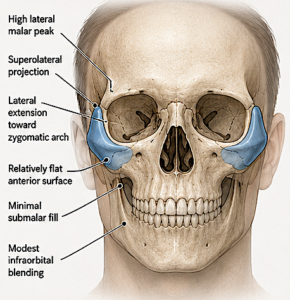
- High lateral malar peak: concentrate projection over the superolateral zygomatic body rather than the anterior apple of the cheek.
- Horizontal/lateral extension: blend the augmentation toward the zygomatic arch. This makes the cheekbone read as a wider skeletal structure rather than a round mound.
- Relatively flat anterior surface: avoid excessive central/anterior malar convexity, which tends to produce a fuller or more youthful “apple-cheek” appearance.
- Limited to no submalar augmentation: too much volume inferior to the zygoma fills the natural hollow and actually makes the cheekbone look less prominent.
- Moderate infraorbital component: enough to create continuity between the lateral orbital rim and malar eminence, but generally not a large anterior infraorbital shelf unless there is true negative-vector deficiency.
- Crisp skeletal apex with long feathering: the implant can have a defined point of maximal projection, but its peripheral edges should taper gradually to avoid visibility or palpability.
Conceptually, the cross-section is closer to a wedge or shallow ridge than a dome:
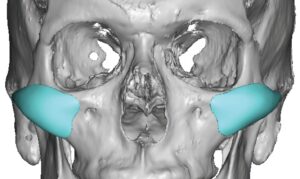
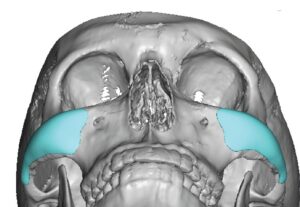
lateral orbital rim ? high malar peak ? zygomatic arch
with comparatively little augmentation below that line.
That distinction is important. Augmenting the entire malar/submalar surface may increase cheek size, but it does not necessarily create the appearance of a higher zygoma. Published work on facial skeletal augmentation similarly distinguishes the malar/zygomatic, infraorbital, and submalar subunits, which can be independently manipulated in custom implant planning.
If the aesthetic target were something like a Henry Cavill / male-model high zygoma rather than a broad cheek augmentation, I would therefore bias the CAD toward superolateral projection + lateral width + submalar restraint/avoidance.
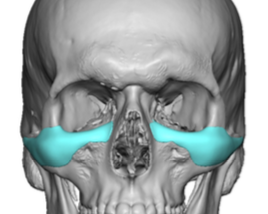
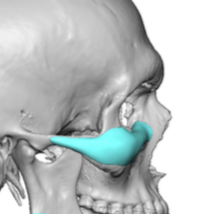
Many males that seek the hjgh cheekbone look also have undereye hollowing or a concomitant infraorbital skeletal deficiency. This requires a more extensive infraorbital extension that does all the way over to just short of the nasal bones. A key part of this extension is that it saddles the infraorbital rim. This is now known as the infraorbital-malar implant design which provides a complete high horizontal augmentation of the midface. This is essentially the wrap around implant of the midface which creates the most visible definition above the concave maxilla below it.
Dr Barry Eppley
Plastic Surgeon