
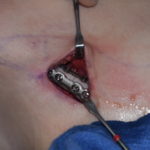
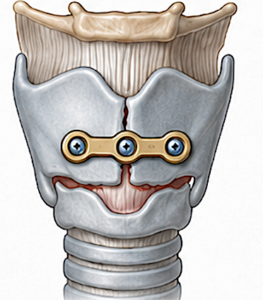
 Titanium miniplates used to stabilize thyroid-cartilage fractures are generally left in place when they are asymptomatic. The published laryngeal-fracture literature does not establish routine removal at 6–12 months; reports describe retained plates with good airway, swallowing, and voice outcomes at follow-up extending from several months to two years. Evidence specifically addressing elective plate removal from the larynx is limited.
Indications for removal
Plate removal may be considered for:
- Infection, persistent drainage, or abscess involving the hardware.
- Plate or screw exposure through the skin or laryngeal mucosa.
- Persistent focal pain, tenderness, or palpable hardware.
- A loose, displaced, or broken plate or screw.
- Airway, swallowing, or voice symptoms shown to be related to the hardware.
- Revision laryngeal surgery requiring access to the repaired framework.
Routine removal solely because a certain amount of time has passed is not usually done or recommended. In broader titanium-miniplate practice, asymptomatic hardware is also usually retained because removal requires another operation and introduces additional risk.
Preoperative assessment
Before removal, the surgeon should determine that the fracture has healed and the laryngeal framework is stable. Assessment commonly includes:
- CT imaging when cartilage union, plate position, screw penetration, or framework alignment is uncertain.
- Documentation of baseline voice, swallowing, and respiratory function.
Typical operative approach
Plate removal is usually performed under general anesthesia.
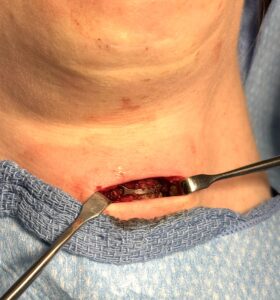
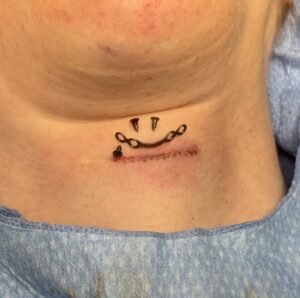
- Exposure: The previous cervical incision is reopened, and scar tissue is carefully dissected to expose the plate while protecting the strap muscles, perichondrium, and laryngeal mucosa.
- Screw removal: Screws are removed sequentially. Loose, stripped, or cartilage-overgrown screws are commonly seen.
- Plate removal: The plate is gently elevated after confirming that the thyroid cartilage remains stable without fixation.
- Closure: The cartilage and soft tissues are repaired as needed, hemostasis is secured, and the incision is closed in layers.
Key point
Laryngeal fracture plates are not routinely removed after a fixed interval. Removal is most appropriate when the plate is causing a demonstrated problem and the cartilage has healed sufficiently to remain stable without fixation. It is a straightforward procedure with limited risks.
Dr. Barry Eppley
Plastic Surgery