Fat grafting and custom infraorbital implants are both used to improve the under-eye region, but they solve different problems. The choice depends on whether the deficiency is primarily soft tissue, bone, or a combination of both.
Fat Grafting
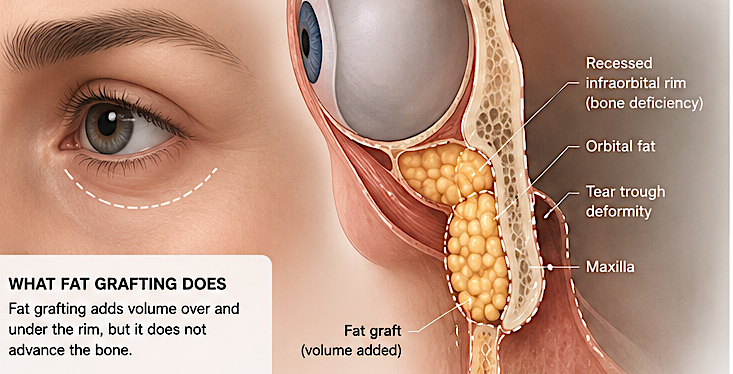
Fat grafting adds living tissue beneath the skin.
Advantages
- Uses your own tissue.
- Soft, natural feel.
- Excellent for age-related hollowing.
- Can improve skin quality.
- No implant.
Limitations
- Cannot move the bony orbital rim forward.
- Fat survival is unpredictable (typically 50–80% retention).
- Often requires multiple sessions.
- May become lumpy or irregular.
- Can resorb over time.
Fat grafting is best for patients with:
- Tear trough hollowing
- Aging-related volume loss
- Thin soft tissues
- Good underlying skeletal projection
Custom Infraorbital Implants
Custom implants replace missing skeletal projection.
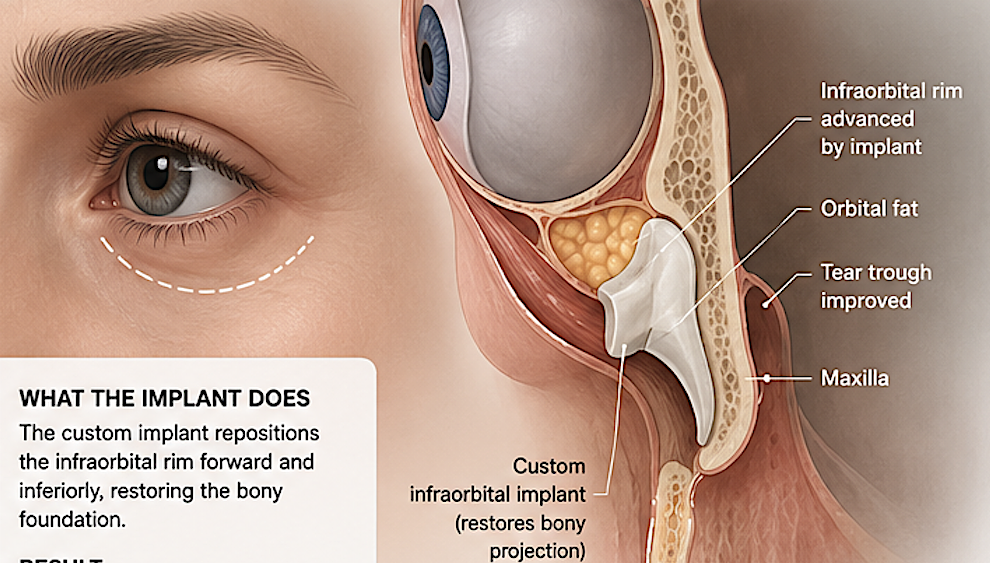
Using a CT scan, the implant is designed to match the patient’s anatomy and extend the infraorbital rim exactly where augmentation is needed.
Advantages
- Restores true bony support.
- Moves the infraorbital rim forward.
- Improves negative orbital vectors.
- Supports the lower eyelid.
- Permanent.
- Symmetric.
- Predictable.
The implant can be designed to increase:
- anterior projection
- inferior projection
- lateral extension
- medial extension
- orbital rim contour
Each region can be adjusted independently in 0.5–1 mm increments.
Negative Orbital Vector
This is where implants clearly outperform fat.
In patients whose globe projects farther than the infraorbital rim:
Fat adds tissue behind the skin but does not move the bone.
Custom implants actually reposition the skeletal framework beneath the eyelid, providing structural support that can improve lower eyelid contour and reduce the appearance of a recessed midface.
Effect on Tear Troughs
Fat grafting:
- Fills the groove.
Custom implant:
- Eliminates the underlying bony depression that contributes to the groove.
For deep tear troughs caused primarily by skeletal deficiency, implants often provide a more durable and anatomically corrective solution.
Aging
Fat grafting addresses volume loss associated with aging.
Custom implants address lifelong skeletal deficiency.
Many patients actually have both problems.
Which Lasts Longer?
Fat graft
- Some survives permanently.
- Some resorbs.
- Results may change with weight fluctuations and aging.
Custom implant
- Permanent.
- Does not shrink.
- Maintains its shape and position over time.
Appearance
Well-designed custom implants should not look “implanted.” Because they are built from a patient’s CT scan, they can create subtle, natural improvements in infraorbital projection without visible edges or abrupt transitions.
Fat grafting generally feels very natural but can be less precise, particularly when larger volumes are required.
Can They Be Combined?
Yes—and they often are.
A common strategy is:
- Place a custom infraorbital implant to correct the skeletal deficiency.
- Add a small amount of fat grafting (or another soft tissue filler) several months later, if needed, to fine-tune the overlying soft tissue contour.
This combination allows each technique to address what it does best: the implant restores the bony foundation, while fat refines the soft tissue envelope.
Which Patients Benefit Most?
|
Feature |
Fat Grafting |
Custom Infraorbital Implant |
|
Corrects soft tissue volume loss |
Excellent |
Limited |
|
Corrects skeletal deficiency |
No |
Excellent |
|
Long-term permanence |
Variable |
Permanent |
|
Predictability |
Moderate |
High |
|
Precision |
Limited |
Very high |
|
Can treat negative orbital vector |
Minimal |
Excellent |
|
Changes lower eyelid support |
No |
Yes |
|
Revision ease |
Moderate |
Moderate |
Fat grafting
- Age-related under-eye hollowing
- Mild tear trough deformities
- Good cheekbone and infraorbital projection
- Desire for a less invasive procedure
Custom infraorbital implants
- Congenital infraorbital rim deficiency
- Negative orbital vector
- Flat midface due to skeletal underprojection
- Persistent tear troughs despite fillers or fat grafting
- Patients seeking a permanent, highly customized correction
Bottom Line
Fat grafting and custom infraorbital implants are complementary rather than competing treatments. Fat grafting is best for replacing soft tissue volume, while custom infraorbital implants restore skeletal support. For patients with significant infraorbital retrusion or a negative orbital vector, custom implants generally provide a more definitive correction because they address the underlying bone deficiency. In patients with age-related volume loss and otherwise normal facial skeleton, fat grafting alone may be sufficient. Many of the most natural and durable results come from combining a precisely designed custom implant with selective fat grafting when additional soft tissue refinement is needed.
Dr. Barry Eppley
Plastic Surgeon