
Custom infraorbital-malar implants are designed to permanently correct bone-based undereye hollowing by rebuilding the deficient skeletal support beneath the lower eyelid and extending onto the upper cheek when necessary. Unlike fillers or fat grafting, which add soft-tissue volume, these implants restore the underlying facial framework. This approach is particularly effective in patients whose hollow appearance is caused by a recessed infraorbital rim, a negative orbital vector, or insufficient malar projection rather than age-related soft tissue volume loss alone.
Who Benefits Most?
The ideal candidate has one or more of the following features:
- Congenital undereye hollowing
- Negative orbital vector anatomy
- Recessed infraorbital rims
- Flat upper cheeks with poor lid-cheek support
- Thin lower eyelid soft tissues
- Persistent tear troughs despite fillers or fat grafting
- Hollowing after lower eyelid surgery due to underlying skeletal deficiency
Patients with primarily soft-tissue aging and adequate bone support are generally better treated with lower blepharoplasty, fat repositioning, or fillers rather than implants alone.
Why “Infraorbital-Malar” Instead of Just “Infraorbital”?
True undereye hollowing rarely exists as an isolated infraorbital rim problem.
The infraorbital rim is part of the zygomatico-maxillary complex, meaning deficiencies often involve:
- infraorbital rim
- anterior cheek
- upper maxilla
- medial malar region
If only the infraorbital rim is augmented, the transition from eyelid to cheek may still appear abrupt. Extending the implant onto the anterior malar surface creates a much smoother lid-cheek junction and a more natural appearance.
Custom Implant Design
Using a high-resolution 3D CT scan, a patient-specific implant is digitally designed to match the exact skeletal deficiency.
Design goals include:
- Raising the infraorbital rim vertically
- Increasing anterior projection
- Blending seamlessly onto the upper cheek
- Correcting asymmetry
- Avoiding overprojection that creates an artificial appearance
Unlike stock implants, custom implants precisely follow the patient’s anatomy and can vary in thickness over different regions to create a smooth three-dimensional contour.
Surgical Placement
The implants are typically inserted through a lower eyelid (subciliary) incision.
After subperiosteal exposure:
- the implant is positioned directly on bone,
- fit is verified,
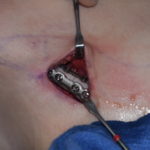
- fixation is achieved with one or two titanium microscrews,
- lower eyelid support procedures (orbicularis suspension, canthopexy, or cheek resuspension when indicated) help maintain proper eyelid position.
Rigid fixation prevents implant movement during facial expression or smiling.
Advantages
Compared with fillers or fat grafting, custom infraorbital-malar implants offer:
- Permanent correction
- Precise restoration of skeletal anatomy
- Better improvement in negative orbital vectors
- Smoother lid-cheek transition
- Increased lower eyelid support
- Improved facial balance
- No risk of filler migration or resorption
In appropriately selected patients, they address the underlying structural cause rather than simply camouflaging the hollow.
Limitations
These implants do not correct:
- lower eyelid skin laxity
- excess skin
- festoons
- malar bags
- pigmentation or dark circles caused by thin skin or vascular show
- orbital fat prolapse
Additional procedures such as lower blepharoplasty, skin resurfacing, or fat repositioning may be required to address these concerns.
Recovery
Typical recovery includes:
- Moderate swelling for 2–3 weeks
- Bruising for 10–14 days
- Most social recovery within 2–3 weeks
- Progressive refinement over 2–3 months
- Final tissue adaptation by approximately 4–6 months
Temporary numbness of the cheek or upper lip can occur but usually improves as sensory nerves recover.
Long-Term Results
Because the implants are custom fit and rigidly fixed to the facial skeleton, they generally become imperceptible over time. They do not move with facial animation, are not visible under the skin when properly designed, and provide a permanent improvement in lower eyelid support and midfacial contour.
Key Concept
The most successful correction of undereye hollowing comes from identifying whether the problem is skeletal or soft tissue in origin. Patients with congenital infraorbital rim retrusion, negative orbital vectors, and deficient upper cheek projection often achieve the most dramatic and natural-looking improvement with custom infraorbital-malar implants because the treatment restores the facial foundation rather than simply adding soft-tissue volume.
Dr Barry Eppley
Plastic Surgeon