

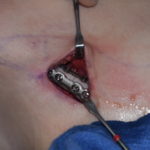
Custom facial implants are manufactured from several biocompatible materials, most commonly solid silicone, PEEK, porous polyethylene, and titanium. Each has unique advantages and limitations, and no single material is best for every patient or every procedure.
The most important factor in a successful custom facial implant is not the material—it is the implant’s design. A perfectly manufactured implant with the wrong shape will still produce a poor aesthetic result. Material selection should always support the implant’s design, the anatomy being treated, and the goals of surgery.
For most cosmetic facial and skull augmentation procedures, solid silicone is most frequently used because it offers excellent design flexibility, can be inserted through smaller incisions, is securely fixed to bone with titanium screws, and is generally the easiest material to revise if future changes are desired.
Why Implant Material Isn’t the Most Important Decision
Patients often ask, “What is the best material for a custom facial implant?”
It is a reasonable question, but it is not the most important one.
Custom implants succeed because of several factors working together:
- accurate diagnosis
- thoughtful implant design
- precise CT-based customization
- stable fixation
- meticulous surgical placement
The material is only one part of that process.
A custom implant designed with the wrong dimensions will not produce an attractive result regardless of whether it is made from silicone, PEEK, titanium, or porous polyethylene.
This is particularly true in cosmetic facial surgery. Unlike reconstructive surgery, where an implant may need to replace missing bone or support the orbit after trauma, cosmetic implants are placed over an intact facial skeleton to improve contour and proportion. The quality of the design has a far greater impact on the final appearance than the name of the material.
For that reason, surgeons should first determine what shape the implant needs to create, then select the material that best delivers that design.
The Four Major Custom Facial Implant Materials
Solid Silicone

Solid silicone has been the workhorse material for cosmetic facial implants for decades and remains my preferred material for most custom facial implant procedures.
It is important to understand that solid silicone facial implants are completely different from silicone gel breast implants. They are made from a solid medical-grade silicone elastomer that cannot leak or rupture like a gel-filled device.
The greatest advantage of silicone is its flexibility. Even very large custom implants—such as jawline, forehead, or skull implants—can be gently folded during insertion and then return to their original shape once positioned on the bone. This often allows placement through significantly smaller incisions than would be required for rigid materials.
Silicone also works exceptionally well with modern CT-based manufacturing. Implant thickness, border transitions, asymmetry correction, fixation holes, and contour can all be precisely incorporated into the digital design before manufacturing.
Because silicone is nonporous, the body forms a thin fibrous capsule around it rather than allowing tissue to grow into the implant. While some view this as a disadvantage, it provides one major benefit: revision surgery is usually much easier. If a patient later desires a different implant size or shape, the implant can generally be removed or exchanged with considerably less tissue disruption than porous materials.
Like every implant material, silicone can become infected. It is not immune to complications, nor does it prevent bone remodeling if an implant is excessively large or poorly designed. These outcomes depend far more on surgical technique, implant design, and fixation than on the material itself.
For most cosmetic facial implants, silicone offers the best balance of customization, flexibility, permanence, and revisability.
PEEK
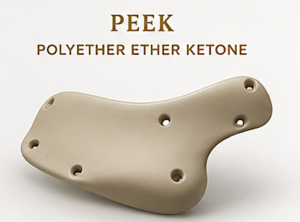
PEEK (polyetheretherketone) is a high-performance medical polymer widely used in craniofacial reconstruction.
Unlike silicone, PEEK is rigid and cannot be folded during insertion. Large implants often require longer incisions or multi-piece designs to fit through limited surgical access.
Its strength makes it particularly valuable when replacing missing bone or reconstructing large cranial defects. Because it closely maintains its engineered shape, PEEK is commonly used for complex craniofacial reconstruction where structural support is important.
For cosmetic facial augmentation, however, this same rigidity may become a disadvantage. Most cosmetic implants do not need structural strength—they need precise contour, smooth transitions, and insertion through the smallest possible incision.
PEEK is also more difficult to modify or replace during revision surgery and generally costs more to manufacture than silicone.
While PEEK is an outstanding reconstructive material, its additional strength does not automatically produce a better cosmetic result.
Porous Polyethylene
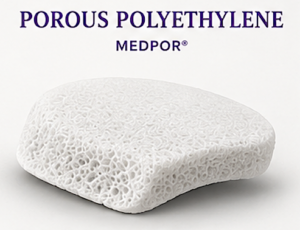
Porous polyethylene (best known by the trade name Medpor) differs from silicone because its microscopic pores allow fibrous tissue and small blood vessels to grow into the implant after placement.
This tissue ingrowth stabilizes the implant and decreases the likelihood of long-term movement. However, the same characteristic that makes the implant more secure also makes it more difficult to remove or revise.
In cosmetic surgery, revision is sometimes requested simply because a patient wants more or less projection years later. Once tissue has grown throughout a porous implant, removal may require more extensive dissection and carries a greater risk of injury to surrounding tissues.
Porous polyethylene has a long history in facial and orbital reconstruction and remains an excellent material in selected situations. However, tissue ingrowth should not be viewed as an automatic advantage. It represents a tradeoff between long-term biological attachment and future revisability.
Titanium
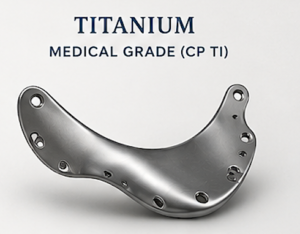
Titanium is one of the strongest and most durable implant materials available.
It has become indispensable in craniofacial surgery for fixation plates, screws, orbital reconstruction, and patient-specific implants used after trauma or tumor removal.
For cosmetic facial augmentation, however, its exceptional strength is often unnecessary. Facial implants placed over normal bone are designed to improve contour rather than support weight or replace missing skeletal structures.
Titanium implants are rigid, require larger surgical exposure for insertion, may create imaging artifact on CT scans, and are generally more difficult to revise than silicone implants.
Where titanium excels is in reconstruction—not routine cosmetic augmentation.
Which Material Is Best?
There is no universal answer because the best material depends entirely on the clinical situation.
For reconstructive procedures involving missing bone, large cranial defects, or orbital support, rigid materials such as PEEK or titanium often provide important structural advantages.
For cosmetic augmentation of the forehead, cheeks, jawline, chin, or skull, I have found that solid silicone consistently provides the best combination of precision, flexibility, reliable fixation, and long-term revision options. It allows complex custom implant designs to be inserted through relatively small incisions while remaining permanent and stable once secured.
Patients often assume that newer or more expensive materials must be better. That is rarely true. The success of a custom facial implant depends much more on the quality of its design than on the material from which it is manufactured.
Dr. Batrry Eppley
Plastic Surgeon