

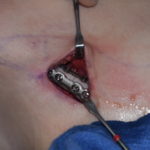
Although considerable individual variation exists, the forehead remains one of the most sexually dimorphic regions of the craniofacial skeleton. Its shape contributes substantially to the perception of facial masculinity and femininity, often more than the nose or chin because of its size and central location within the facial profile. Understanding these anatomical differences is essential, not because every patient desires stereotypical masculine or feminine features, but because surgical planning begins with recognizing the skeletal characteristics that define facial identity.
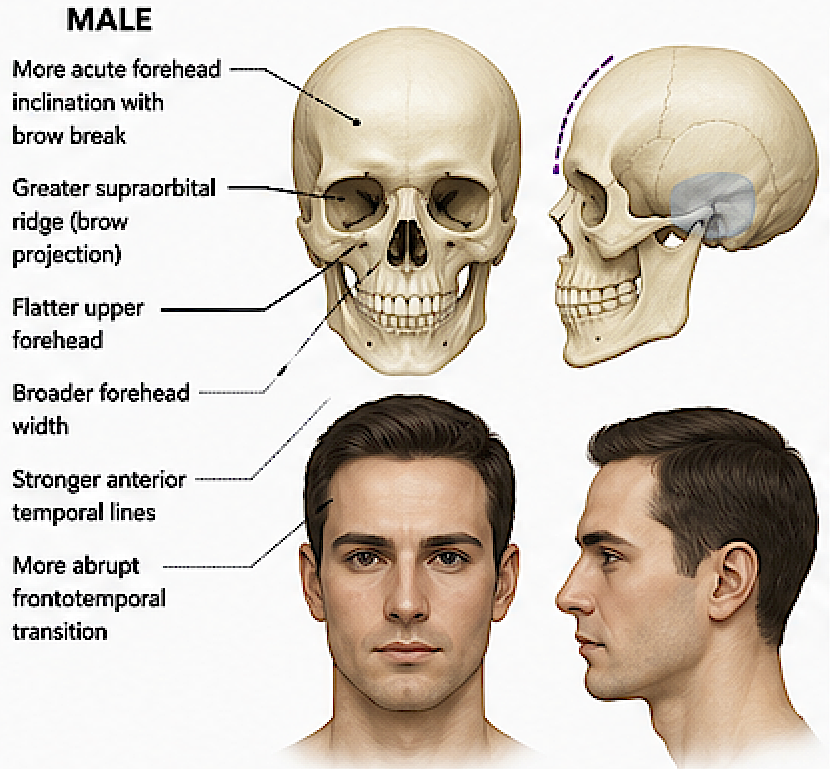
The most recognizable distinction between the male and female forehead is its sagittal profile. The typical male forehead demonstrates a posterior inclination beginning at a distinct brow break created by prominent supraorbital ridges. Rather than forming a continuous curve, the male forehead consists of two separate aesthetic planes: a horizontal or slightly projecting brow complex followed by a backward-sloping frontal bone. This change in inclination creates the characteristic angular profile associated with masculine facial architecture.
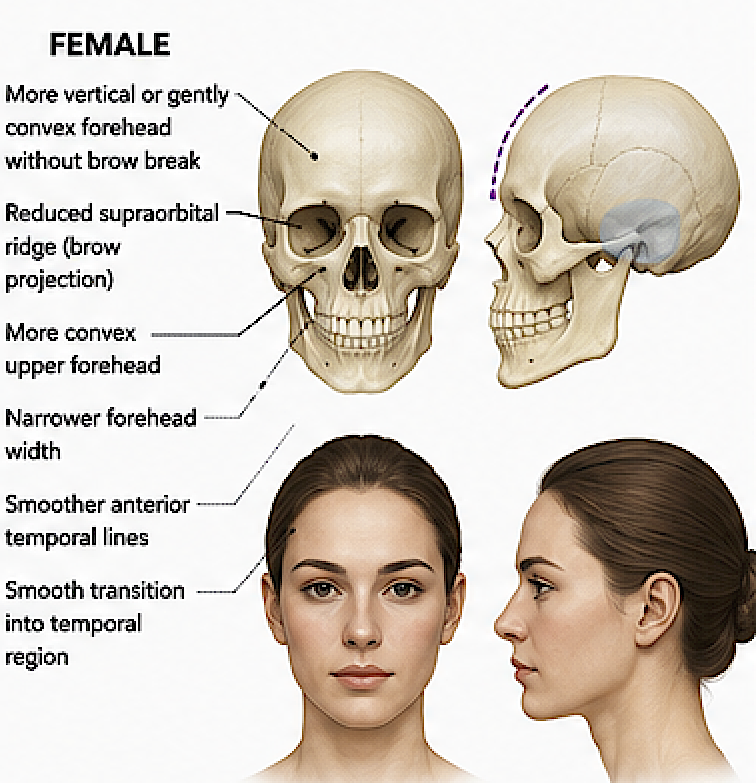
In contrast, the female forehead usually lacks a significant brow break. The transition from the supraorbital rims into the frontal bone is smoother, producing a forehead that appears more vertical or gently convex. Instead of emphasizing skeletal projection at the brow, the female forehead derives its aesthetic appeal from uninterrupted surface continuity and graceful curvature extending from the eyebrows to the hairline.
These differences are not absolute but exist along a continuum. Many attractive male foreheads exhibit only modest brow prominence, while some naturally feminine foreheads possess subtle supraorbital projection without appearing masculine. Consequently, aesthetic analysis should focus on achieving facial harmony rather than reproducing rigid anthropometric ideals.
Beyond profile shape, differences also exist in forehead width and contour. Male foreheads generally appear broader and more rectangular because of greater lateral expansion of the frontal bone and more prominent anterior temporal lines. The lateral forehead often transitions abruptly into the temporal region, creating a square upper facial outline that complements a wider jawline. Female foreheads more commonly demonstrate smoother lateral convexity with rounded temporal transitions, contributing to an oval facial silhouette.
The relationship between the forehead and the brow bones is equally important. The brow complex should not be viewed as an isolated structure but rather as the inferior boundary of the forehead. In men, greater horizontal projection of the supraorbital rims increases the apparent depth of the eyes and contributes to a stronger upper facial appearance. In women, reduced brow projection allows the eyes to appear more open while emphasizing smooth continuity between the forehead and upper orbit.
The frontal hairline introduces another important variable. Although hairline position is often discussed separately from forehead morphology, it significantly influences the visual perception of forehead shape. A high or posteriorly positioned hairline increases the apparent vertical height of the forehead regardless of the underlying skeletal anatomy. Conversely, a low hairline may partially conceal forehead deficiencies or exaggerate frontal bossing by altering visible proportions. In men, progressive temporal recession and frontal hairline loss frequently expose skeletal characteristics that were previously obscured, making even minor contour irregularities increasingly noticeable with age.
An often-overlooked component of forehead morphology is the transition between the forehead and the cranial vault. The upper forehead should blend naturally into the curvature of the skull without abrupt changes in inclination or localized contour abnormalities. This relationship has become increasingly important with the development of extended custom forehead implants, which permit augmentation beyond the frontal bone onto the superior skull. Rather than treating the forehead as an isolated region, modern implant design recognizes that the forehead and anterior cranial vault function as a continuous aesthetic unit.
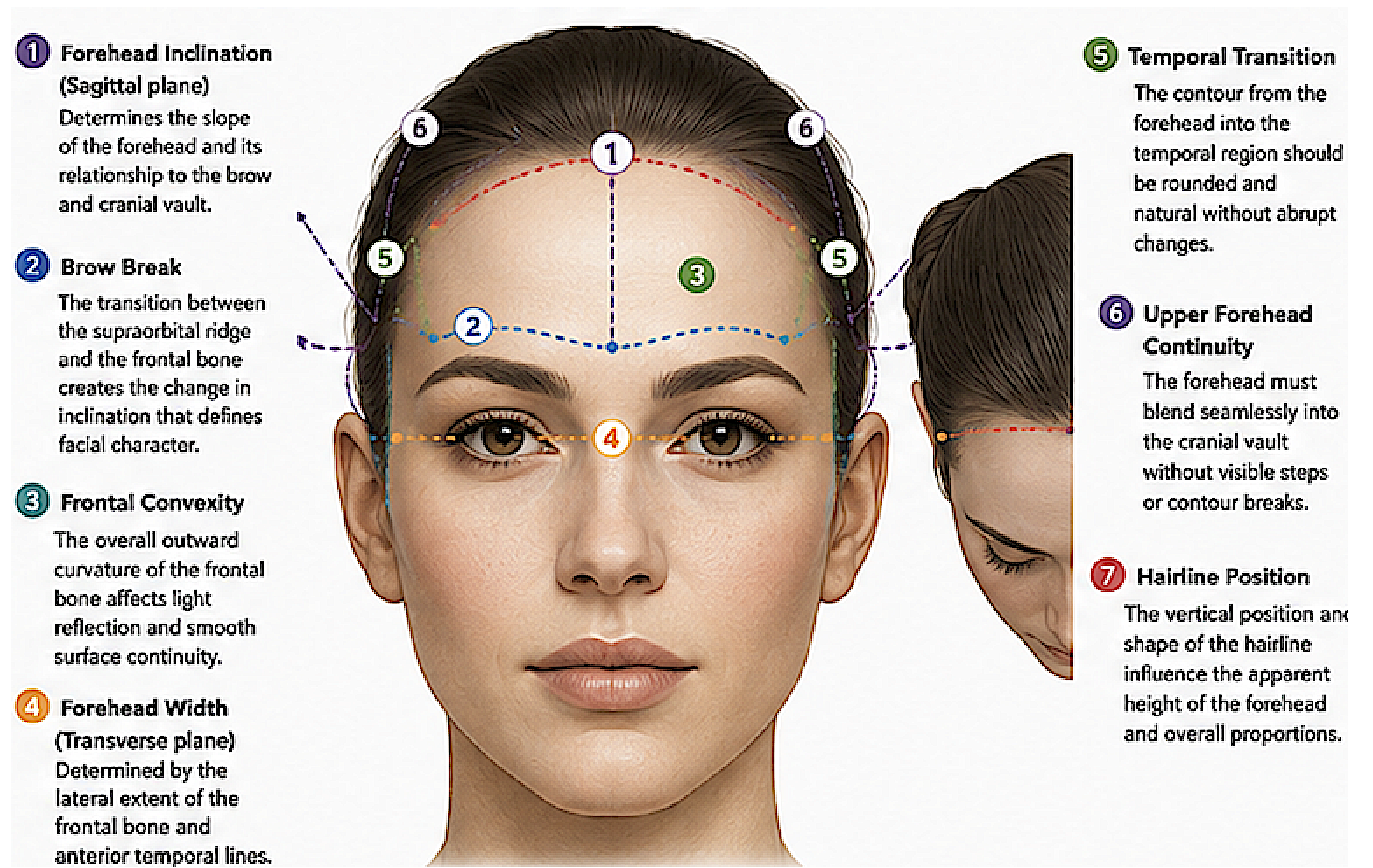 Contemporary surgical planning therefore evaluates multiple morphological parameters simultaneously rather than relying on isolated measurements. These include forehead inclination, brow projection, frontal convexity, forehead width, temporal transition, upper forehead continuity, and hairline position. No single feature determines whether a forehead appears attractive. Instead, aesthetic success results from achieving proportional relationships among all components of the upper facial skeleton.
Perhaps the greatest advance in forehead analysis has been the transition from two-dimensional observation to three-dimensional skeletal evaluation. Standard clinical photographs remain indispensable, but they cannot accurately demonstrate underlying bone deficiencies or excesses. High-resolution computed tomography allows precise assessment of frontal bone thickness, frontal sinus anatomy, brow projection, forehead asymmetry, and temporal contour. More importantly, three-dimensional imaging provides the foundation for patient-specific implant design and objective surgical planning rather than relying solely on visual estimation.
For this reason, contemporary forehead surgery has shifted from describing foreheads as simply “high,” “sloping,” or “prominent” to defining them as three-dimensional skeletal forms that can be quantitatively analyzed and selectively modified. This transition from descriptive anatomy to structural analysis represents one of the most significant advances in modern forehead reshaping surgery.
Dr. Barry Eppley
Plastic Surgeon