
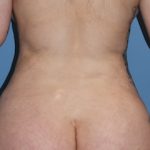
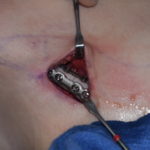
One material property i occasionally hear about implants and infection risk is surface energy. This is usually mentioned in regard to silicone materials and their low sueface energy which may help them be more infection resistant.
Not necessarily. Silicone’s low surface energy does not make ordinary medical-grade silicone inherently infection resistant. In many biologic environments, the opposite can happen.
Silicone/PDMS has low surface energy and is strongly hydrophobic. Once implanted, however, proteins from blood and tissue fluids readily adsorb onto that hydrophobic surface. Those proteins can then provide binding sites for bacteria, promoting bacterial attachment and eventual biofilm formation. Reviews of biomedical silicone specifically identify its hydrophobicity and low surface tension as contributors to protein adsorption and bacterial adhesion.
For example, studies have found greater bacterial adhesion on hydrophobic silicone-containing materials than on more hydrophilic surfaces, including increased adhesion of organisms such as S. epidermidis, S. aureus, P. aeruginosa, and E. coli under various experimental conditions.
The important distinction is:
Low surface energy leads to low adhesion of many ordinary materials
but
low surface energy does not equal low biological fouling.
Inside the body, the sequence is more like:
silicone… protein adsorption… bacterial attachment… possible biofilm
This is one reason efforts have been made to modify silicone surfaces to make them more hydrophilic or strongly hydrated, for example with PEG, zwitterionic materials, or other coatings. Those modifications can reduce protein adsorption and bacterial attachment.
Surface roughness/topography also matters substantially, so infection risk can’t be predicted from surface energy alone.
In regard to silicone facial implants versus materials such porous polyethylene, PEEK, or ePTFE the surface-energy question gets especially interesting with each material behaving differently in regards to bacterial adhesion and biofilm.
For facial implants, I would not rank silicone, ePTFE, porous polyethylene, and PEEK simply by surface energy. The clinically important combination is surface texture/porosity + tissue integration + bacterial adhesion + what happens if contamination occurs. The comparative evidence is imperfect because implantation sites, surgical approaches, surface finishes, and study designs differ substantially. A 2025 systematic review of 117 facial-implant studies specifically noted this heterogeneity.
|
Material |
Surface / tissue behavior |
Biofilm considerations |
Practical infection perspective |
|
Smooth silicone |
Very smooth, nonporous, hydrophobic; develops a fibrous capsule rather than tissue ingrowth |
Bacteria can adhere and form biofilm, but there are few physical recesses in which organisms can become sheltered |
Probably the easiest of these to sterilize biologically and remove if infected |
|
ePTFE (Gore-Tex) |
Microporous; permits some soft-tissue incorporation |
Greater internal surface area and protected spaces than silicone; organisms can enter pores |
Infection rates clinically can still be low, but an established infection is potentially harder to eradicate |
|
Porous polyethylene (Medpor) |
Highly porous, substantial fibrovascular ingrowth |
Large surface area + interconnected pores create favorable bacterial-retention sites |
Most concerning for bacterial retention before integration; difficult problem if deep biofilm becomes established |
|
PEEK |
Usually solid/nonporous when machined; relatively hydrophobic; surface finish varies |
Not intrinsically antimicrobial; readily supports biofilm. Milling/printing roughness can materially change adhesion |
Probably intermediate; smoother PEEK is much different biologically from rough/porous PEEK |
Silicone

This is where its surface-energy has some practical validity, but probably for the wrong reason.
Smooth implant-grade silicone is hydrophobic and certainly isn’t antibacterial. Once implanted, it gets coated by host proteins, and bacteria can adhere to that conditioned surface. But it has an enormous advantage: it is smooth and nonporous.
In a direct laboratory comparison of eight oculoplastic materials, bacteria adhered significantly more strongly to porous high-density polyethylene than to implant-grade silicone. Implant silicone actually showed the least adhesion for several tested organisms, including S. epidermidis and S. aureus.
Low surface energy itself does not make silicone infection-resistant, but smooth, nonporous implant-grade silicone can nevertheless be relatively unfavorable for bacterial retention compared with porous implant materials.
There is also a major practical surgical advantage: because silicone becomes encapsulated rather than extensively incorporated into tissue, an infected implant can usually be removed more completely than an integrated porous implant.
Porous polyethylene / Medpor
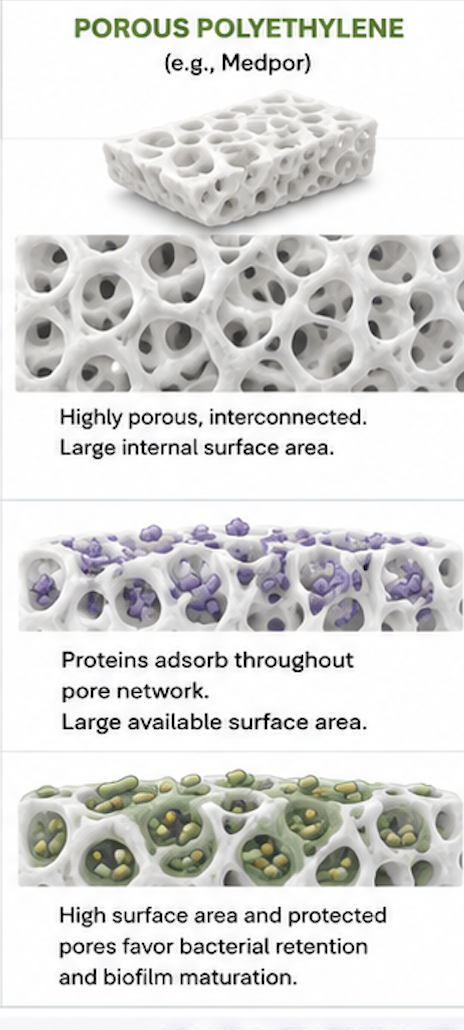
Porous polyethylene deliberately creates interconnected pores so fibrovascular tissue can grow through the implant. That is excellent for stability and incorporation. But from the bacteria’s perspective, those pores also mean:
much greater true surface area ? microscopic recesses ? bacterial attachment/protection ? potential biofilm reservoir.
The direct oculoplastic experiment above found significantly greater bacterial adhesion to porous polyethylene than implant silicone. The investigators specifically attributed the difference to porosity and roughness.
There is an interesting paradox, though. Once vascularized, the tissue growing into porous polyethylene potentially provides immune access that smooth silicone doesn’t have.
So you cannot conclude:
more bacterial adhesion in vitro = more clinical infections.
That distinction is important.
ePTFE / Gore-Tex
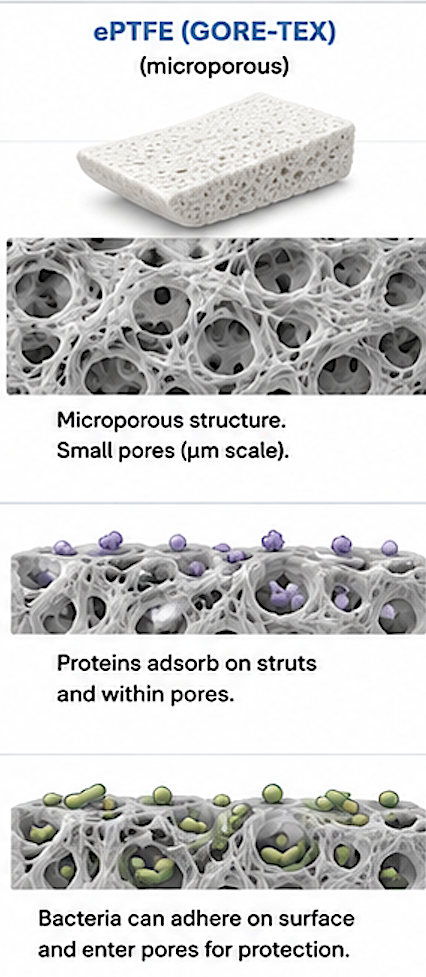
ePTFE lies somewhere between smooth silicone and highly porous polyethylene.
It is hydrophobic and microporous, allowing limited tissue incorporation. Those pores improve fixation relative to completely smooth silicone but also provide more surface area and potential bacterial attachment sites.
Interestingly, the clinical data don’t demonstrate a dramatic infection penalty. A systematic review comparing silicone with ePTFE in nasal augmentation found comparable infection rates, despite theoretical concerns regarding ePTFE’s porosity; silicone had more malposition and a higher overall complication rate in that analysis.
Thus ePTFE illustrates why surface microbiology alone doesn’t predict the patient’s infection rate.
PEEK
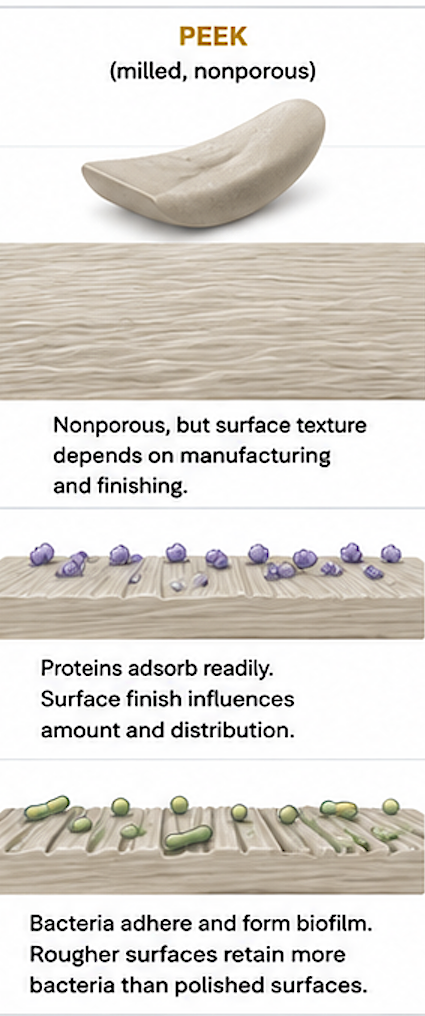
PEEK is particularly interesting for custom facial implants.
A milled PEEK implant can be solid and nonporous, making it conceptually closer to smooth silicone than Medpor in terms of bacterial hiding spaces. But PEEK is also hydrophobic and has no intrinsic antimicrobial activity. Reviews of PEEK biofilm research find that unmodified PEEK readily supports bacterial colonization; consequently, considerable research has focused on coatings and surface modification to make it more resistant to biofilm.
Its actual behavior depends heavily on the finish:
highly polished PEEK….. milled PEEK with machining grooves….or 3-D-printed porous PEEK.
That’s a critical distinction when discussing custom facial implants.
The broader craniofacial literature has sometimes reported more infection with PEEK, although comparisons are confounded by the fact that PEEK is frequently used for large, complex cranial defects rather than the relatively straightforward aesthetic augmentation cases in which silicone is commonly used.
The distinction I think matters most
Consider what happens to a tiny bacterial inoculum during implantation.
Smooth silicone
Bacteria
?
smooth external surface
?
some attach
?
biofilm possible
?
but essentially nowhere inside the implant to hide
versus:
Porous polyethylene
Bacteria
?
surface
?
pores / interconnected spaces
?
much larger effective surface area
?
protected microenvironment
?
biofilm can extend into the implant structure
That difference may matter more than whether the virgin polymer has a surface energy of X versus Y.
So which virgin implant surface should physically retain the fewest bacteria during an early contamination event?, my approximate expectation would be:
smooth silicone ? very smooth PEEK ? ePTFE ? porous polyethylene
with considerable uncertainty around silicone versus PEEK and ePTFE because bacterial species, surface finish, protein conditioning, and manufacturing process can change the result. The strongest direct evidence among these comparisons is the finding that porous polyethylene retains significantly more bacteria than implant-grade silicone.
But Which gives the lowest clinical facial-implant infection rate?”, I would not use that ranking. Contemporary clinical evidence doesn’t support a clean material hierarchy; surgical site, oral/nasal contamination, implant size, dead space, fixation, soft-tissue coverage, prior surgery, and operative technique can overwhelm the relatively subtle contribution from polymer chemistry.
For custom aesthetic facial implants specifically—jaw angle, chin, cheek, temporal, infraorbital—I think the silicone vs PEEK comparison is particularly worth digging into because both can be produced as smooth, nonporous patient-specific implants, which removes much of the porosity confounding and gets closer to the urface-energy question.
Dr. Barry Eppley
Plastic Surgeon