

Why do PEEK wrap around jawline implants need to be placed in multiple pieces?
The main reason is PEEK is too rigid to safely insert a full wraparound jawline implant as one continuous piece through the small surgical access incisions.
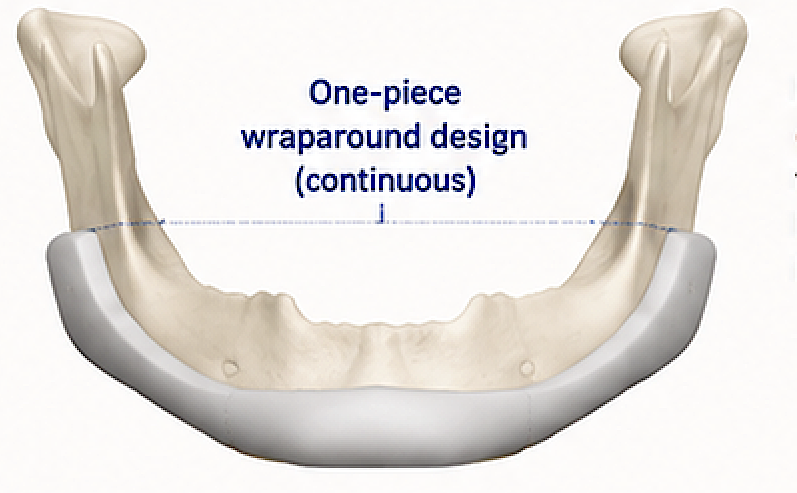
 A custom wraparound implant may extend from one mandibular angle, across the body and chin, all the way to the opposite angle. With a flexible material such as silicone, the implant can bend substantially and be passed through relatively small incisions and subperiosteal tunnels. PEEK does not have that degree of flexibility. A full-size rigid PEEK wraparound would therefore require much larger surgical exposure to get it around the mandible intact.
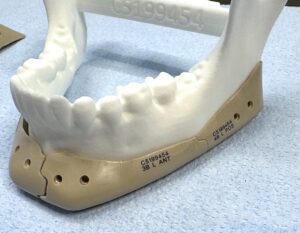
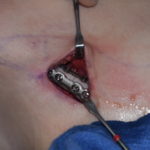
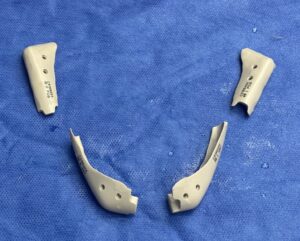 Instead, the design remains a continuous wraparound augmentation geometrically, but the physical implant is manufactured in multiple segments. Typically, the pieces can be introduced through the submental and posterior intraoral incisions, positioned against the mandible, aligned to recreate the CAD-designed contour, and then rigidly stabilized with screw fixation.
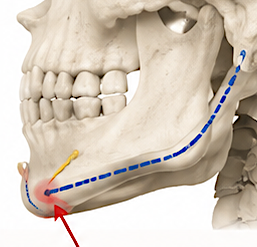 There is also an important mental-nerve issue. Passing a large jaw-angle portion through the long tunnel toward the chin can require getting it past the mental nerve region. With a large or rigid implant, that maneuver can place unnecessary traction on the nerve. Segmenting the implant allows smaller components to be introduced from the most appropriate incision instead. Published patient-specific mandibular implant literature similarly recommends splitting implants when the mental nerve would otherwise be at risk.
So the distinction is:
One-piece design ? one-piece physical implant.
A multi-piece PEEK implant can still be designed on the CT scan as one continuous jawline contour. The segmentation is primarily an implant-delivery/surgical-access requirement caused by PEEK’s rigidity, rather than a desire to create separate chin and jaw-angle augmentations. There are also published examples of custom PEEK implants deliberately designed as multiple interlocking pieces specifically to permit insertion through limited surgical access.
That’s also why PEEK and silicone wraparound implants can have essentially the same planned external geometry while requiring very different insertion strategies.
Dr. Barry Eppley
Plastic Surgeon