
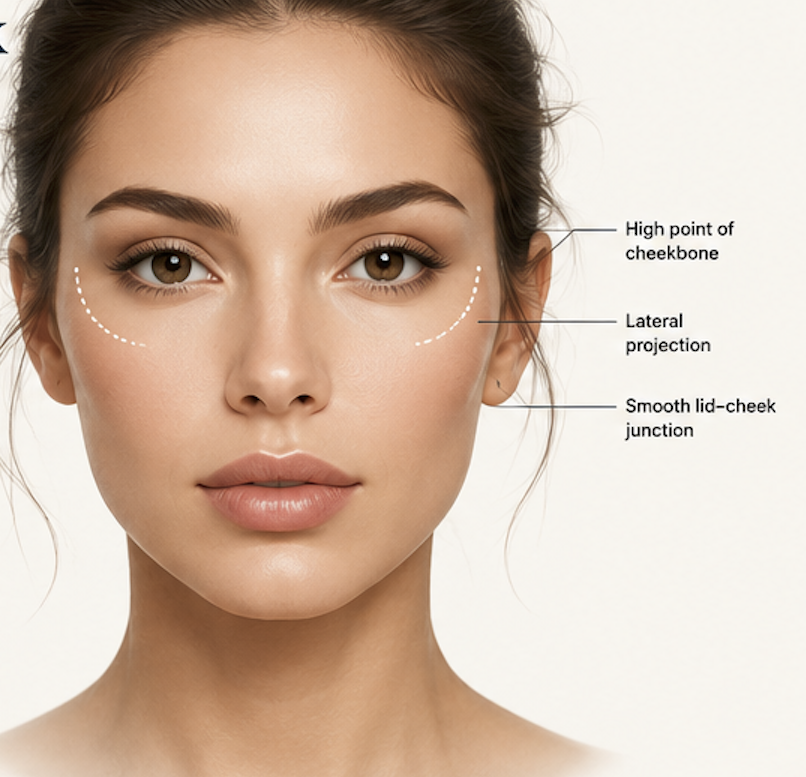
 The “high cheekbone” look that many women seek is less about having large cheekbones and more about the relationship between the cheekbone, the under-eye area, and the lower face. Models and actresses with striking cheekbones typically have a combination of skeletal anatomy, soft tissue distribution, and low facial fat that creates light-shadow definition.
The desired aesthetic usually includes:
- High malar prominence, with the greatest projection at or just below the outer corner of the eye.
- A smooth transition from the lower eyelid to the cheek, with minimal tear trough hollowing.
- Moderate lateral cheek projection rather than excessive fullness directly over the apples of the cheeks.
- A gently tapered lower face that makes the cheekbones appear more prominent by contrast.
- Good skin quality and relatively thin soft tissues that allow the underlying bone structure to show.
Ways to create a higher cheekbone appearance
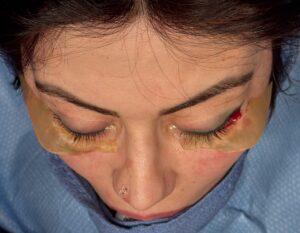
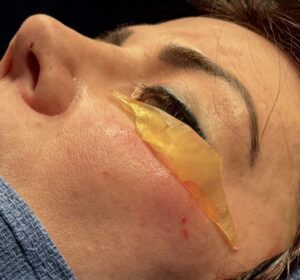
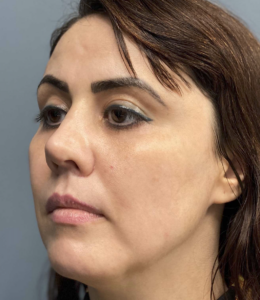
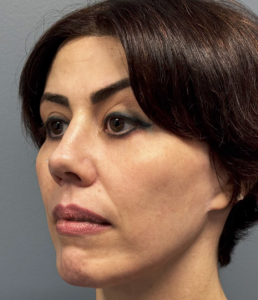
1. Custom infraorbital-malar implants (most powerful skeletal solution)
This is the most effective option when the underlying cheekbones are naturally flat or low.
Advantages include:
- Raises the visual position of the cheek.
- Improves under-eye support.
- Creates a more sculpted midface.
- Permanent result.
- Can be designed to match the patient’s anatomy precisely.
The implant is typically designed to augment:
- the infraorbital rim,
- the anterior zygoma,
- and the upper malar eminence,
rather than simply making the cheeks larger.
2. Fat grafting
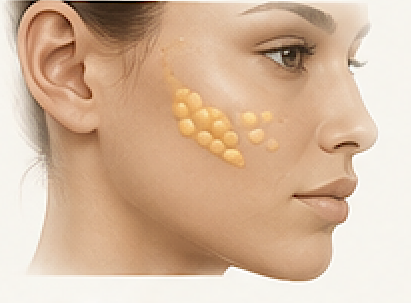
Useful for mild volume loss.
Pros:
- Natural tissue.
- Soft appearance.
Cons:
- Cannot move the cheekbone higher.
- Variable survival.
- Can produce a rounder rather than sculpted appearance if overdone.
3. Hyaluronic acid fillers
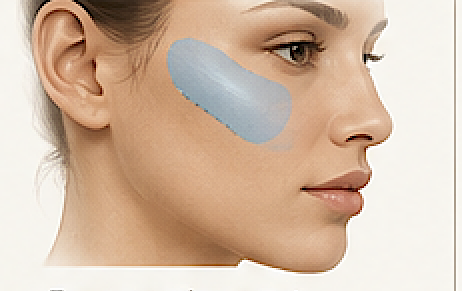
Good for temporary enhancement.
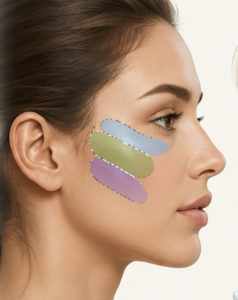
Best placed:
- laterally over the zygoma,
- not directly into the front of the cheek.
Poor filler placement can create:
- overly round “apple cheeks,”
- widened facial appearance,
- or the so-called “pillow face.”
4. Lower eyelid and midface procedures
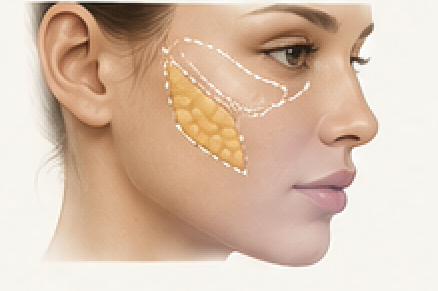
When cheek volume loss is combined with aging:
- lower blepharoplasty,
- fat repositioning,
- and limited cheek augmentation
can restore youthful cheek definition.
5. Facial contouring
Sometimes reducing adjacent structures enhances the appearance of the cheekbones more effectively than enlarging them.
Examples include:
- buccal fat reduction (selected patients only),
- masseter reduction,
- jaw angle reduction (common in East Asian facial feminization),
- neck contouring.
What actually creates the “model cheekbone”
The appearance comes from three-dimensional contour rather than simply adding volume.
An ideal female cheek typically has:
- Vertical position: highest projection just below the lateral lower eyelid.
- Forward projection: moderate, not excessive.
- Lateral projection: extends toward the zygomatic arch.
- Smooth lid-cheek junction.
- Gentle Ogee curve from the temple to the cheek and down to the jawline.
Common mistakes
Many patients ask for “higher cheekbones” but receive:
- filler placed too low in the cheeks,
- implants that only increase anterior cheek fullness,
- excessive medial augmentation,
- overcorrection that makes the face appear wider instead of more elegant.
The goal should be elevation of the upper lateral cheek complex, not simply increasing cheek size.
Best options by patient
|
Patient anatomy |
Best treatment |
|
Naturally flat cheekbones |
Custom infraorbital-malar implant |
|
Mild volume loss |
Fat grafting |
|
Wants temporary enhancement |
Hyaluronic acid filler |
|
Aging with under-eye hollows |
Lower blepharoplasty with fat repositioning ± implant |
|
Round face seeking more definition |
Selective contouring plus modest lateral cheek augmentation |
For women born with low or flat cheekbones, custom infraorbital-malar implants provide the most anatomically accurate way to create a naturally high-cheekbone appearance because they reposition the visual apex of the midface by augmenting the underlying bone, rather than simply adding soft-tissue volume. When designed conservatively, they can create the refined, sculpted cheek contours associated with naturally high cheekbones while maintaining facial harmony.
Dr. Barry Eppley
Plastic Surgeon