
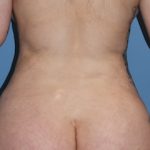
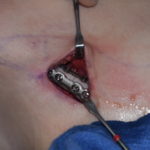
For an onlay aesthetic facial implant, having an elastic modulus closer to bone is potentially helpful, but the benefit is somewhat different—and arguably less important—than it is for a load-bearing orthopedic implant.
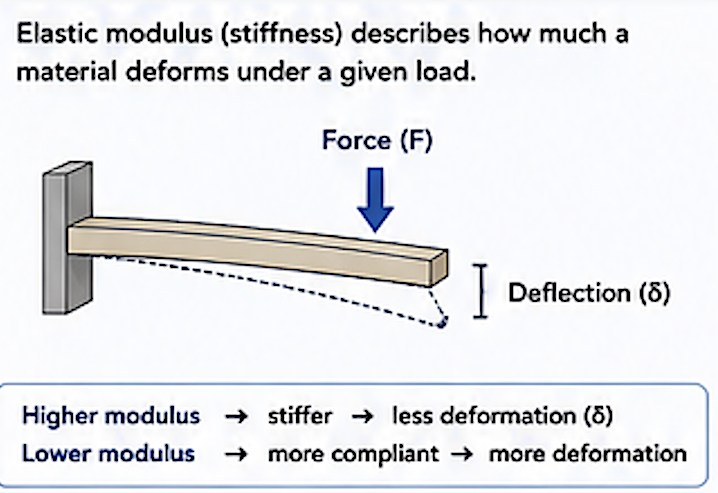
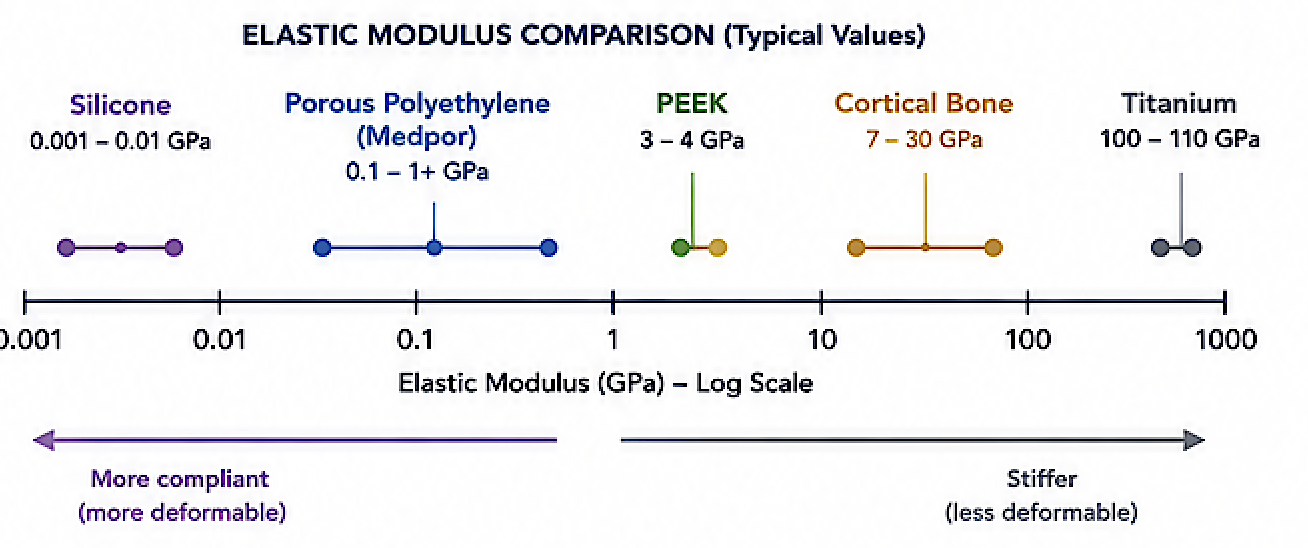
Elastic modulus is essentially stiffness: how much a material deforms for a given stress. PEEK (~3–4 GPa) is dramatically less stiff than titanium (~100–110 GPa), although it is still generally less stiff than cortical bone (~7–30 GPa, depending on location and measurement).
For an onlay implant—such as a custom chin, jaw-angle, cheek, or forehead implant—the practical advantages are:
- More bone-like load transfer. When forces are transmitted through the implant, a less extreme stiffness mismatch means the implant and underlying facial skeleton deform more compatibly. Titanium behaves much more like a rigid plate sitting on bone.
- Less stress concentration at the implant–bone interface. A very stiff implant can concentrate forces around its edges, fixation points, or transitions between implanted and non-implanted bone. PEEK’s lower modulus can distribute those stresses more gradually.
- Potentially less stress shielding. With a very stiff implant, some mechanical load can bypass the underlying bone. In theory, a more bone-compatible modulus reduces this effect. However, stress shielding is probably not a major clinical issue for most aesthetic facial onlays, because they aren’t carrying loads like a hip or spinal implant.
- Enough rigidity to maintain the designed contour. This is particularly important aesthetically. PEEK is stiff enough that a relatively thin custom implant retains its CAD-designed projection and shape rather than behaving like a soft elastomer.
- Some mechanical compliance without being soft. That’s an interesting middle ground: it can provide a very stable skeletal augmentation while being substantially less rigid than a metallic implant.
There is an important nuance, though: I wouldn’t make “PEEK has the same modulus as bone” the central argument for using PEEK in aesthetic facial augmentation. It doesn’t really have the same modulus, and an aesthetic onlay isn’t usually functioning as a structural bone substitute.
For aesthetic facial implants, PEEK’s more compelling mechanical advantage is probably the combination of relatively high stiffness, strength, machinability, dimensional stability, and precise patient-specific geometry. Its lower modulus relative to titanium is an additional favorable characteristic rather than necessarily the primary reason for choosing it.
For example, imagine a custom mandibular-angle implant fixed with screws. You want it stiff enough that the designed gonial projection doesn’t appreciably deform, strong enough that the screw holes and implant don’t fracture, but you don’t actually need the ~110 GPa stiffness of titanium. PEEK provides ample structural rigidity for the application without the enormous stiffness mismatch of a metal implant.
If you’re comparing PEEK vs silicone vs Medpor specifically for aesthetic facial onlays, the modulus question gets particularly interesting because the ideal mechanical properties depend heavily on whether you want the implant to behave like an extension of the skeleton or simply maintain an external contour.