

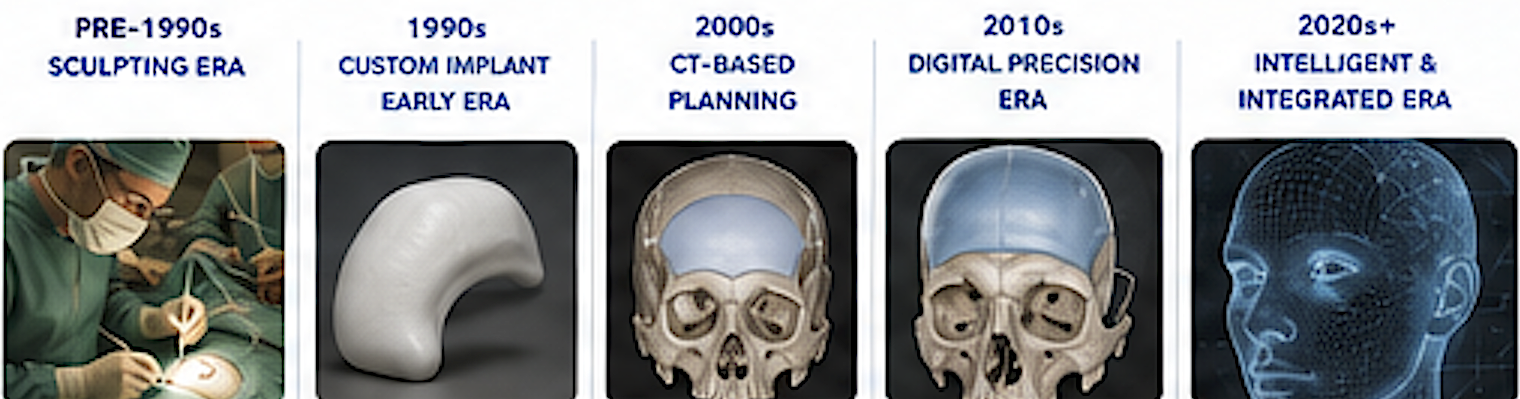
Forehead reshaping has undergone a remarkable transformation over the past three decades. What began as a procedure based largely on intraoperative sculpting of bone cements has evolved into a digitally planned, patient-specific discipline in which implant geometry, skeletal anatomy, and aesthetic analysis are integrated before the patient ever enters the operating room. As imaging technology, digital design, and manufacturing continue to advance, the future of forehead surgery will be defined less by new implant materials than by increasingly sophisticated methods of diagnosis, planning, and personalization.
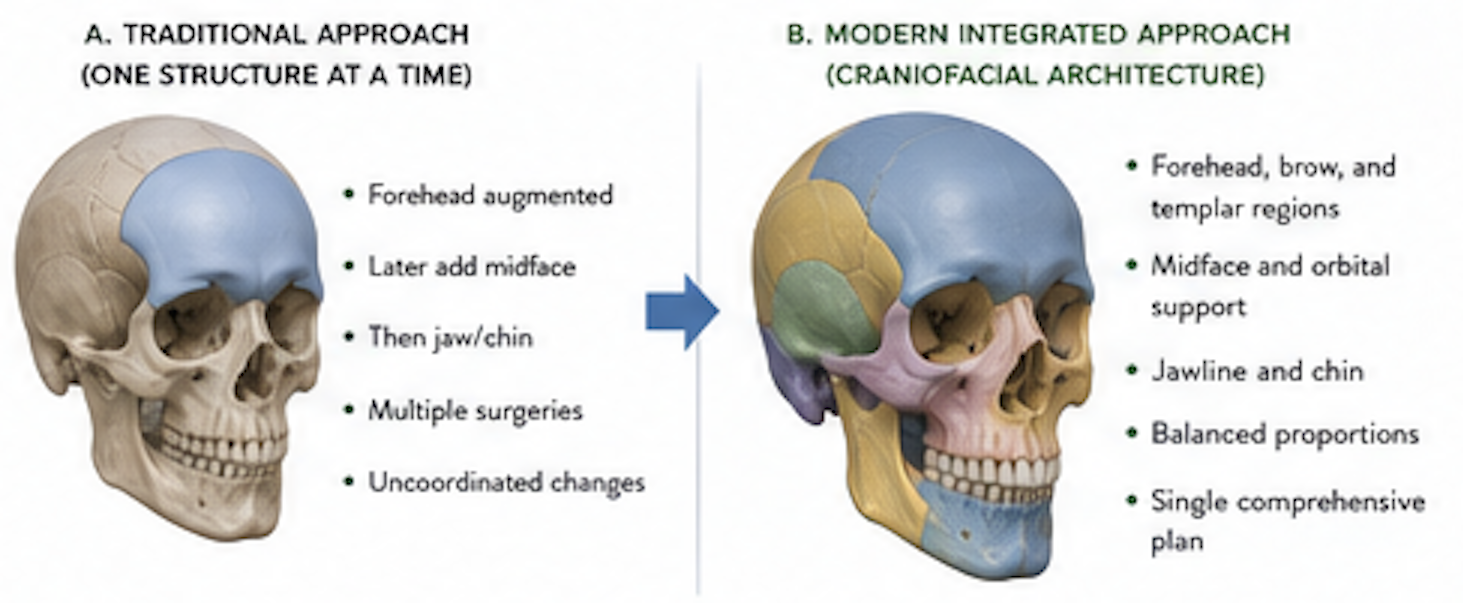 Perhaps the greatest change has been the recognition that forehead augmentation is fundamentally an exercise in skeletal architecture rather than simple volume enhancement. Earlier techniques focused primarily on increasing projection, whereas contemporary planning seeks to optimize the relationships among forehead inclination, brow projection, frontal convexity, temporal transition, cranial continuity, and overall facial balance. This architectural approach has fundamentally changed how surgeons evaluate patients and design implants.
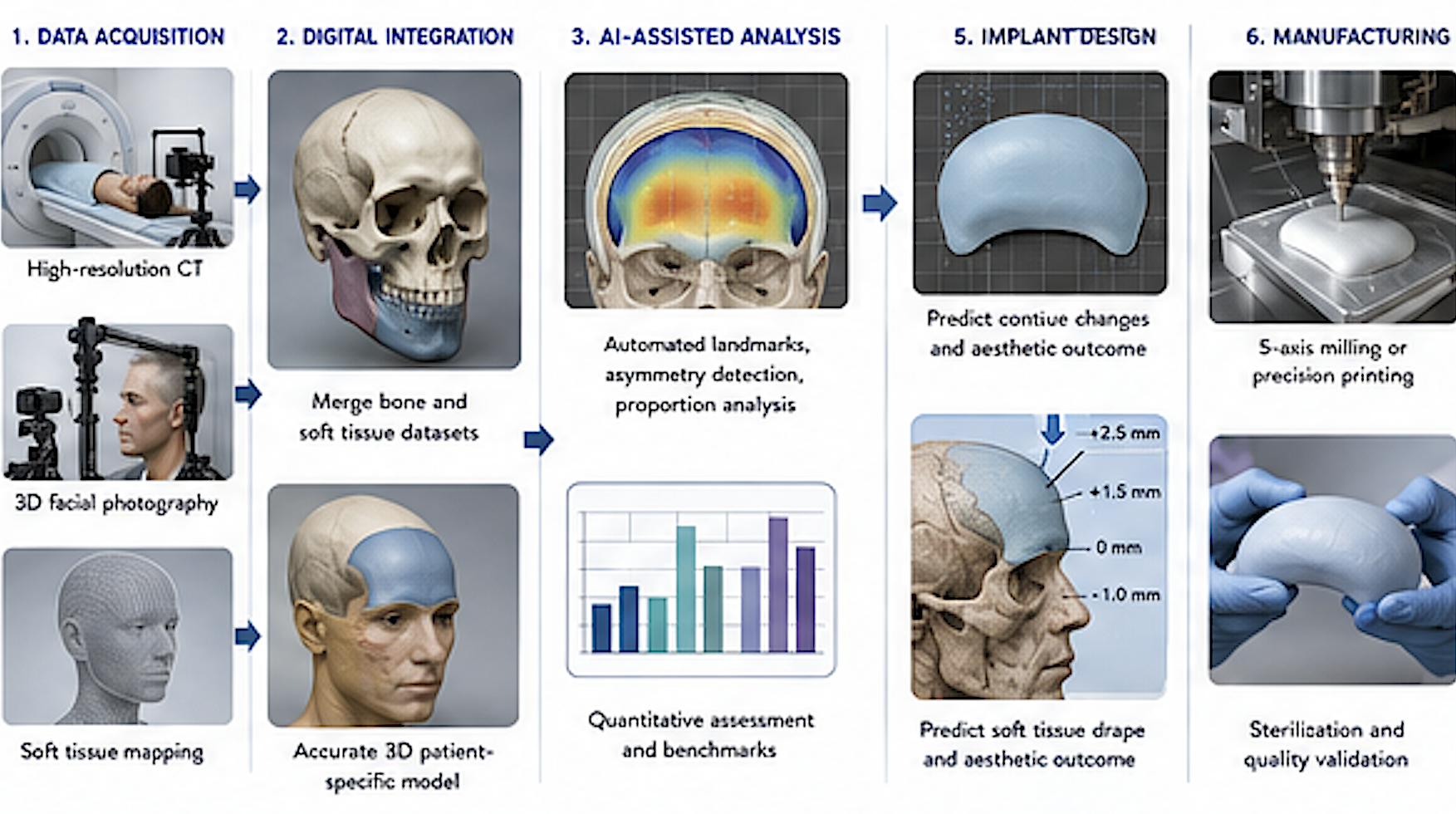
The next major advance will likely occur in digital facial analysis. Three-dimensional facial photography, CT imaging, and stereophotogrammetry are increasingly being combined into comprehensive virtual models that simultaneously evaluate both the facial skeleton and the overlying soft tissues. Rather than planning surgery from the skull alone, future software platforms will integrate bone anatomy, skin thickness, facial expression, and dynamic soft tissue behavior into a single planning environment. Such systems will allow surgeons to predict postoperative appearance with greater accuracy than is currently possible.
Artificial intelligence will play an increasingly important role in this evolution. Machine-learning algorithms are already capable of automating image segmentation, identifying anatomical landmarks, generating three-dimensional surface models, and detecting subtle asymmetries that might otherwise escape visual inspection. As these technologies mature, AI will become an indispensable assistant during implant planning by rapidly performing repetitive analytical tasks and providing quantitative comparisons among thousands of anatomical variables.
Despite these advances, artificial intelligence is unlikely to replace surgeon-directed implant design. Algorithms can recognize anatomical patterns, but they cannot define beauty, appreciate individual patient preferences, or determine the most aesthetically appropriate facial proportions. The creation of an attractive forehead remains an artistic exercise grounded in anatomy, experience, and clinical judgment. AI will improve efficiency and precision, but the surgeon will continue to determine the aesthetic objective and approve the final implant design.
Advances in manufacturing technology are equally likely to influence future practice. Improvements in additive manufacturing, higher-resolution milling, and patient-specific biomaterials may eventually permit implants with graded flexibility, optimized edge characteristics, or region-specific mechanical properties. Although current solid silicone implants provide excellent long-term performance, future implant technologies may further improve insertion through smaller incisions while maintaining precise contour reproduction.
Navigation systems and augmented reality may also become valuable adjuncts during surgery. Real-time visualization of implant position relative to the preoperative digital plan could improve accuracy in complex reconstructions or revision procedures. Intraoperative navigation has already demonstrated value in craniofacial surgery, and similar technologies may eventually become practical for aesthetic skeletal augmentation.
The future of forehead reshaping will also be characterized by increasingly comprehensive facial planning. Rather than designing isolated forehead implants, surgeons will increasingly evaluate the forehead within the context of the entire craniofacial skeleton. Integrated digital planning of the forehead, brow bones, temporal region, midface, jawline, and chin will permit optimization of overall facial architecture rather than sequential modification of individual structures. This systems-based approach more closely reflects the way facial harmony is perceived and is likely to become the standard for complex aesthetic skeletal surgery.
Perhaps the most significant future development, however, is educational rather than technological. As patient-specific implant surgery becomes more widely adopted, success will depend increasingly on understanding aesthetic diagnosis rather than simply mastering implant placement. Digital tools will continue to improve, but they cannot compensate for inaccurate analysis or poor design decisions. Future surgeons will therefore require expertise not only in operative technique but also in three-dimensional facial analysis, digital planning, and craniofacial aesthetics.
Ultimately, the evolution of forehead reshaping surgery reflects a broader transformation occurring throughout aesthetic surgery. Procedures are becoming increasingly individualized, digitally planned, and anatomically precise. Yet despite extraordinary technological advances, the fundamental principles remain unchanged. Successful forehead reshaping still depends on accurate diagnosis, thoughtful design, meticulous surgical execution, and an appreciation that the objective is not simply to alter bone, but to create harmonious facial architecture that appears entirely natural.
Final Conclusion
The forehead is one of the defining structural elements of the human face, exerting a profound influence on facial balance, gender characteristics, and overall aesthetic perception. Contemporary forehead reshaping has progressed from a procedure focused on isolated augmentation or reduction to one based on comprehensive three-dimensional analysis of craniofacial architecture. High-resolution CT imaging, patient-specific implant design, and digitally guided surgical planning have transformed both the precision and predictability of these operations.

Throughout this nine part series, the central theme has been that successful forehead surgery is fundamentally a process of architectural design. Accurate diagnosis precedes implant design, implant design precedes surgery, and surgery serves as the precise execution of a carefully developed three-dimensional treatment plan. The quality of the final result depends less on the magnitude of skeletal change than on the harmony of contour, the continuity of anatomical transitions, and the integration of the forehead with the surrounding facial skeleton.
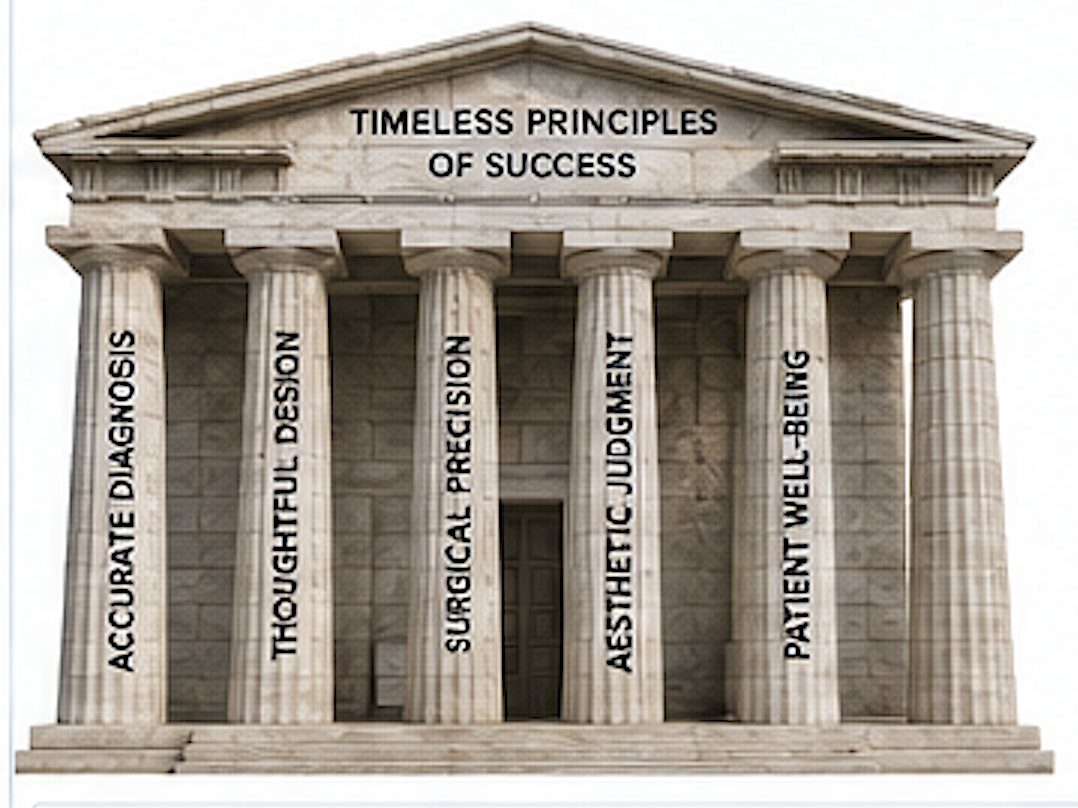 Although technological advances—including artificial intelligence, digital simulation, and increasingly sophisticated manufacturing methods—will continue to enhance surgical planning, they will not replace the importance of surgical judgment. The surgeon remains responsible for interpreting facial anatomy, defining aesthetic goals, and translating those objectives into individualized skeletal reconstruction. Technology provides powerful tools, but successful outcomes continue to rely on experience, anatomical understanding, and artistic vision.
The future of forehead reshaping surgery is therefore not simply one of improved implants or more advanced software. It is the continued integration of engineering precision with aesthetic principles to create patient-specific solutions that restore balance, preserve natural appearance, and redefine the possibilities of facial skeletal surgery.
Dr. Barry Eppley
Plastic Surgeon