

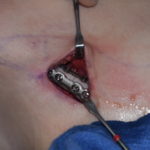
Most publications on forehead augmentation, the few that exist, emphasize surgical technique rather than aesthetic analysis. Yet, in myexperience, the difference between a good and an exceptional outcome is almost always the design philosophy rather than the operation itself.
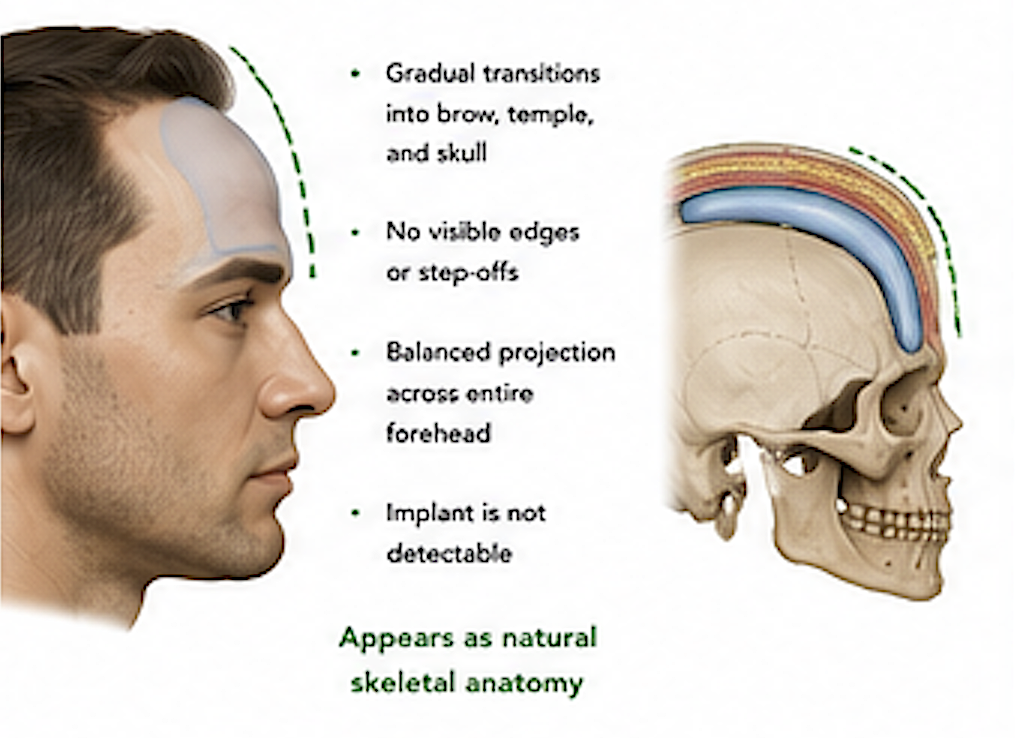 The success of forehead augmentation cannot be judged simply by measuring the increase in projection or implant thickness. Unlike many facial procedures in which improvement can be quantified by linear measurements, the aesthetic outcome of forehead reshaping is determined by harmony of contour. The observer should perceive a naturally balanced upper face rather than recognize that augmentation has been performed. The most successful forehead implant is therefore one that is not noticed as an implant.
This principle distinguishes forehead augmentation from many other forms of facial skeletal enhancement. A chin implant may intentionally create a stronger point of projection, and a jaw angle implant may deliberately emphasize mandibular width. In contrast, the forehead occupies a broad, uninterrupted surface extending across the entire upper face. Because the eye naturally follows this continuous contour, even small irregularities become immediately apparent. Successful forehead ugmentation therefore depends less on the amount of augmentation than on the quality of the transitions that surround it.
The Importance of Contour Continuity
The human eye is remarkably sensitive to abrupt changes in surface contour. Throughout the forehead, smooth transitions between adjacent anatomical regions are more important than maximum projection.
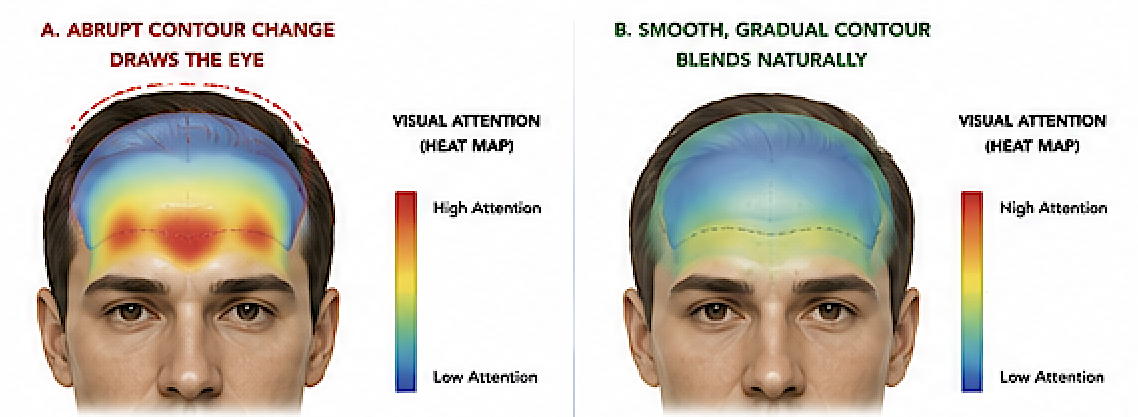 The implant should blend seamlessly into the native forehead at every margin. There should be no visible step-offs, localized fullness, or abrupt changes in inclination. This principle applies equally to the inferior brow transition, the lateral temporal region, and the superior extension toward the cranial vault.
A useful design philosophy is to imagine that the implant does not begin or end at any specific location. Instead, it should appear as though the patient’s own frontal bone developed with the desired contour from the beginning.
The Profile Is Only One Dimension
Patients frequently evaluate forehead augmentation by viewing profile photographs, and profile correction often represents the primary motivation for surgery. While sagittal improvement is important, it is only one component of successful forehead reshaping.
Frontal and oblique views often contribute even more to the perception of naturalness. The relationship between forehead width, temporal transition, brow contour, and upper facial symmetry becomes increasingly evident from these perspectives.
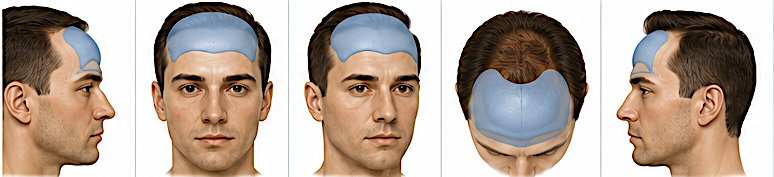
For this reason, implant design should never be based solely on profile correction. Every design must be evaluated simultaneously in frontal, oblique, superior, and lateral perspectives before final fabrication.
Less Is Often More
One of the most valuable lessons learned from extensive experience with custom forehead implants is that patients frequently overestimate the amount of augmentation required to achieve meaningful aesthetic improvement.
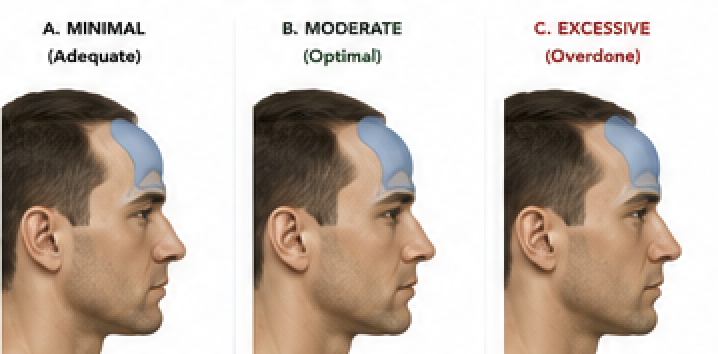 Because the forehead influences facial balance across such a large surface area, modest changes often produce dramatic improvements in facial harmony. Increasing implant thickness by only 2 to 3 mm over a broad region may create a more pleasing result than increasing projection by 6 or 7 mm within a localized area.
Surgeons should therefore resist designing implants according to numerical thickness alone. Instead, projection should be distributed strategically across the forehead to create proportional rather than maximal augmentation.
When uncertainty exists, conservative augmentation generally provides the better long-term aesthetic result.
Symmetry Versus Naturalness
Perfect bilateral symmetry is neither anatomically normal nor aesthetically necessary. Careful analysis of CT imaging demonstrates that nearly every skull possesses measurable asymmetries involving the frontal bone, brow projection, temporal contour, or orbital position.
The objective of implant design is therefore not mathematical symmetry but visual balance.
Selective regional modification frequently improves facial harmony while intentionally preserving subtle anatomical asymmetries that contribute to a natural appearance. Attempts to eliminate every measurable asymmetry may paradoxically produce an artificial result.
Forehead Balance Within the Face
The forehead should never dominate the face.
Its projection must remain proportional to the brow bones, nasal dorsum, cheekbones, and chin. Excessive forehead augmentation may make the nose appear smaller, flatten the apparent brow break, or reduce the perceived prominence of the midface. Conversely, insufficient augmentation may leave lower facial skeletal enhancements visually disconnected from the upper face.
Consequently, forehead augmentation should be planned as one component of comprehensive facial skeletal architecture rather than as an isolated procedure.
Patients undergoing simultaneous chin, jawline, or cheek augmentation frequently achieve greater overall improvement because multiple skeletal relationships are optimized together instead of independently.
Defining Success
Successful forehead augmentation produces several consistent characteristics:
- A natural forehead inclination appropriate for the patient’s facial goals.
- Smooth transitions into the brow, temples, and anterior cranial vault.
- Balanced facial proportions in frontal, oblique, and profile views.
- Stable long-term contour without visible implant borders.
- Improved facial harmony rather than isolated forehead prominence.
- An appearance that suggests favorable skeletal anatomy rather than previous surgery.
Ultimately, the objective is not to create a larger forehead. The objective is to create a forehead that appears as though it has always belonged to the patient.
This distinction represents the difference between technically successful augmentation and truly successful aesthetic surgery.
Dr.Barry Eppley
Plastic Surgeon