
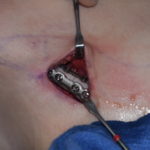
While the bone movement in a sliding genioplasty is usually very predictable, the soft tissue response is far more variable and is the source of most aesthetic concerns after surgery. These issues occur because the chin muscles, fat, skin, and lower lip must adapt to a new skeletal position.
Potentisl soft tissue problems include:
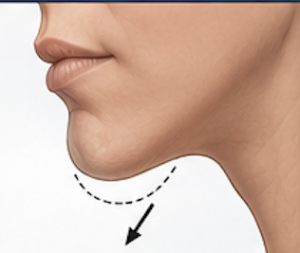
Chin Ptosis (“Witch’s Chin”)
-
- The most recognized complication.
- Results from inadequate mentalis muscle resuspension or excessive soft tissue stretching.
- Appears as a hanging or drooping chin pad below the new bony chin.
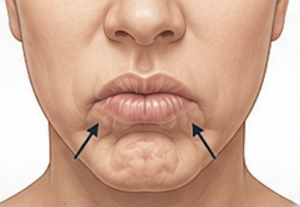
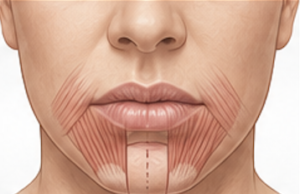
Mentalis Muscle Dysfunction
-
- Incomplete muscle repair can lead to dimpling, puckering, or difficulty maintaining lower lip competence.
- Patients may notice abnormal movement when speaking or smiling.
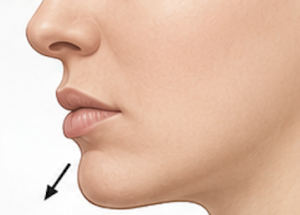
Lower Lip Incompetence
-
- Difficulty keeping the lips comfortably closed.
- More common after large vertical lengthening or excessive advancement.
- Usually improves over several months but may persist if the movement is excessive.
Deepened Labiomental Fold
-
- Forward movement of the bone without proportional soft tissue adaptation can exaggerate the crease between the lower lip and chin.
- Often seen after large advancements.
Soft Tissue Bunching
-
- Excess chin fat and muscle may fold over the advanced bone.
- More common in older patients or those with thicker soft tissues.
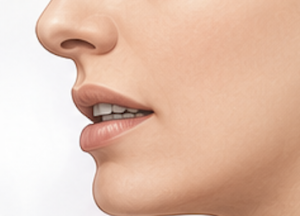
Lower Lip Retraction
-
- The lower lip may appear shortened or pulled downward.
- Usually related to mentalis muscle tension or scar contracture.
Asymmetric Soft Tissue Contour
-
- Even when the bone is perfectly centered, unequal muscle thickness or scarring can create visible asymmetry.
Persistent Chin Fullness
-
- Swelling usually resolves within several months, but a bulky appearance may result from excess soft tissue rather than bone position.
Submental Step-Off
-
- A palpable or visible transition between the advanced chin segment and the remaining mandible.
- More noticeable in thin patients.
Scar Adhesion
-
- Internal scarring may tether the mentalis muscle or chin pad, causing an unnatural contour during facial animation.
Factors That Increase the Risk
- Large chin advancements (>8–10 mm)
- Significant vertical lengthening
- Revision genioplasty
- Thin soft tissue coverage
- Inadequate mentalis muscle repair
- Extensive soft tissue dissection
Prevention
Modern techniques focus on minimizing these problems by:
- Preserving as much mentalis muscle attachment as possible.
- Using a limited soft tissue dissection.
- Performing meticulous layered mentalis muscle closure.
- Avoiding excessive skeletal movements when possible.
- Limiting teh length of the mucosal incision
- Keeping the iuciison on the lip side away from the vestibule
Dr. Barry Eppley
Plastic Surgeon