

 AI has several promising applications in shoulder narrowing surgery by clavicle shortening osteotomies, although its role is primarily in planning and execution rather than replacing the surgeon’s judgment or technique. Because shoulder narrowing surgery depends on precise bone cuts, accurate shortening, and symmetric reconstruction, it is well suited for AI-assisted surgical planning.
Here are the areas where AI can provide meaningful value:
1. Predicting the Aesthetic Result
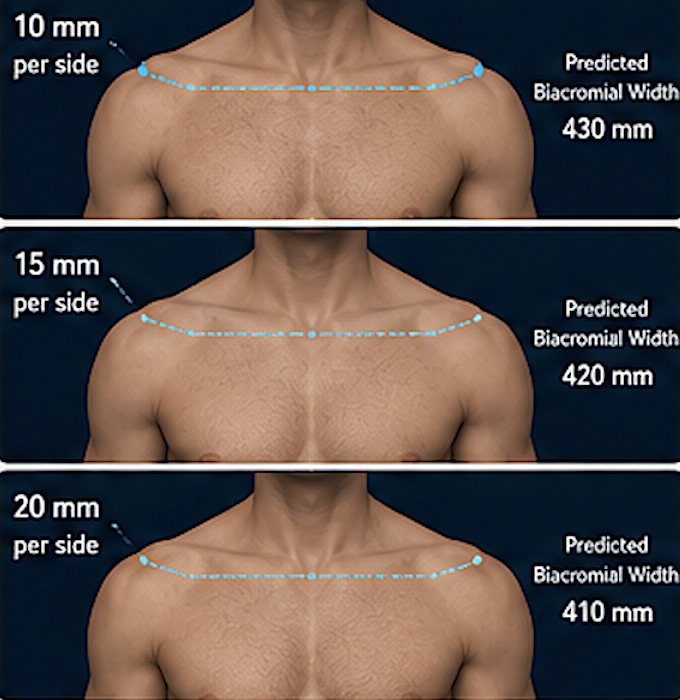
The greatest challenge in shoulder narrowing surgery is answering the patient’s question:
“How much narrower will my shoulders actually look?”
AI can analyze:
- 3D body scans
- Skeletal anatomy from CT scans
- Shoulder width measurements
- Soft tissue thickness
- Gender-specific body proportions
It can then simulate shortening of each clavicle by different amounts (10 mm, 15 mm, 20 mm, etc.) and estimate the resulting biacromial width and external shoulder appearance. While the prediction would not be perfect, it would be much more informative than relying on measurements alone.
2. Surgical Planning
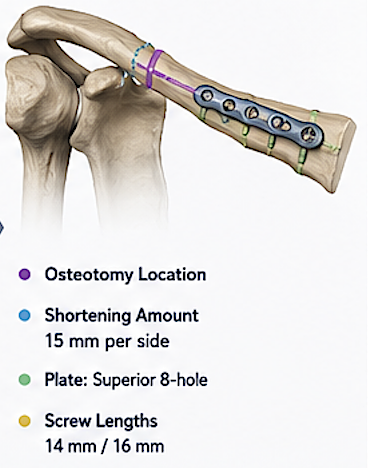
AI can assist in determining:
- Optimal shortening length for each clavicle
- Whether equal or unequal shortening is needed
- Location and orientation of the osteotomy
- Plate size and position
- Screw trajectories
- Predicted postoperative clavicle alignment
This is similar to AI-assisted planning now being developed for orthopedic joint replacement surgery.
3. Patient-Specific Surgical Guides
Using the CT scan, AI could automatically generate:
- Cutting guides
- Drill guides
- Reduction guides
These would be 3D printed and fit precisely onto each clavicle, ensuring that both osteotomies are performed in exactly the planned location and orientation.
This would improve surgical accuracy while reducing operative time.
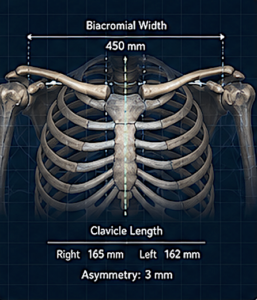
4. Symmetry Analysis
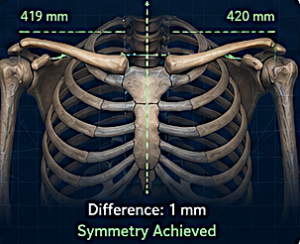
One of the most difficult aspects of shoulder narrowing surgery is obtaining perfect right-left symmetry.
AI can compare:
- Clavicle length
- Curvature
- Rotation
- Shoulder height
- Scapular position
and recommend subtle adjustments before surgery.
5. Implant and Plate Selection
AI could evaluate:
- Bone diameter
- Cortical thickness
- Bone density
- Amount of shortening
and recommend:
- Plate length
- Plate shape
- Screw lengths
- Number of fixation points
This may reduce implant-related complications.
6. Risk Prediction
By analyzing thousands of previous cases, AI could estimate the patient’s individualized risk for:
- Delayed union
- Nonunion
- Hardware irritation
- Plate prominence
- Neurovascular complications
- Need for plate removal
This would improve preoperative counseling.
7. Recovery Prediction
AI could estimate:
- Time to bone healing
- Return to exercise
- Return to weight training
- Plate removal likelihood
- Functional recovery
based on patient-specific factors such as age, bone quality, smoking status, and shortening length.
Where AI Cannot Replace the Surgeon
AI cannot determine the patient’s aesthetic goals or safely perform the operation. It cannot:
- Protect the brachial plexus and subclavian vessels
- Execute the osteotomy
- Reduce the bone segments
- Achieve rigid fixation
- Manage unexpected anatomical variations or intraoperative complications
These tasks require surgical experience and judgment.
The Future: AI-Driven Personalized Shoulder Narrowing
The most exciting future application would combine several technologies into a fully personalized planning workflow:
- A low-dose CT scan of the clavicles and shoulder girdle.
- A 3D surface scan of the torso.
- AI analyzes skeletal anatomy, shoulder proportions, and aesthetic goals.
- The surgeon selects the desired shoulder width reduction.
- AI generates multiple simulations (e.g., 10 mm, 15 mm, 20 mm shortening per side).
- Patient-specific cutting guides and fixation plans are automatically created.
- Surgery is performed according to this customized plan, maximizing symmetry and precision.
For a procedure like clavicle shortening osteotomies—where millimeter-level accuracy directly influences the final shoulder width—AI has the potential to make the operation more predictable, more reproducible, and more individualized. While AI will not replace the surgeon, it is likely to become an important tool for preoperative planning, surgical guidance, and outcome prediction.
Dr Barry Eppley
Plastic Surgeon