

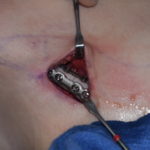
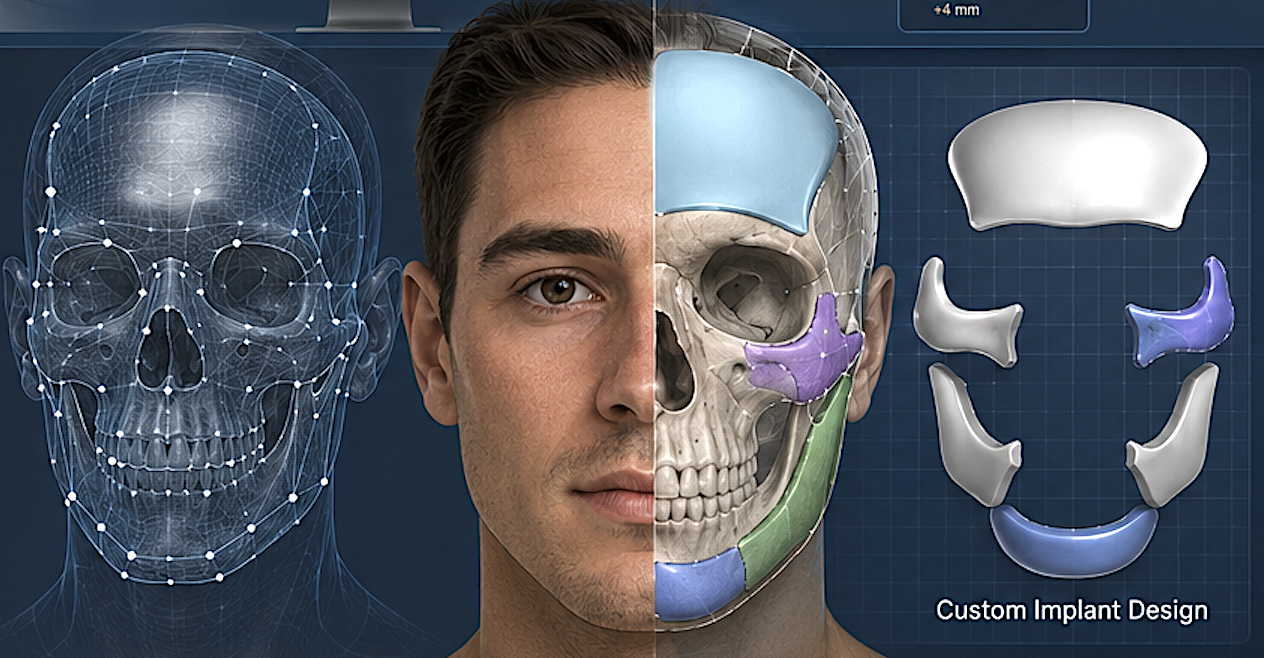
Artificial intelligence is beginning to change many aspects of medicine, but nowhere is its potential more exciting than in the design of custom facial implants. While AI cannot independently create a perfect implant from a CT scan, it is becoming an increasingly valuable tool that enhances the surgeon’s ability to analyze facial anatomy, simulate outcomes, improve implant design efficiency, and personalize treatment plans. The future of custom facial implants will almost certainly be a partnership between surgeon expertise and AI-assisted engineering rather than one replacing the other.
AI Does Not Replace the Surgeon
One of the biggest misconceptions is that AI can simply “look” at a patient’s CT scan and automatically design the ideal implant. Facial aesthetics are not governed by mathematical formulas alone.
Every custom implant requires subjective decisions such as:
- How masculine or feminine should the result appear?
- How much projection looks natural?
- Where should transitions begin and end?
- Which asymmetries should be corrected and which should remain?
- How will soft tissues respond?
These are artistic and surgical decisions that depend on experience, not simply anatomy.
Today’s AI is an assistant—not the designer.
Where AI Already Excels
1. Rapid Anatomical Analysis
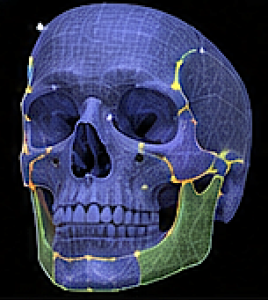
AI can analyze a patient’s CT scan within seconds.
It can automatically identify:
- Facial skeletal landmarks
- Existing asymmetries
- Areas of deficiency
- Surface curvature
- Bone thickness
- Nerve locations
- Previous implants or hardware
Tasks that once required considerable manual effort can now be performed much more quickly.
2. Automated Measurements
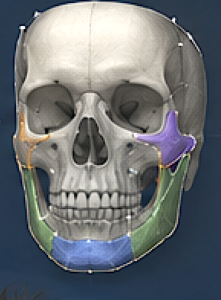
Instead of manually measuring dozens of distances, AI can instantly calculate:
- Chin projection
- Jaw width
- Bigonial width
- Facial thirds
- Orbital position
- Infraorbital deficiency
- Forehead slope
- Midface projection
- Facial symmetry indices
This creates a detailed anatomical report before implant design even begins.
3. Predictive Implant Suggestions
Using databases of previous implant designs, AI can recommend an initial implant shape.
For example:
Patients with similar skeletal anatomy often benefited from 6–8 mm of chin projection and 10–12 mm of jaw angle width.
These are starting points—not final treatment plans.
4. Surface Optimization
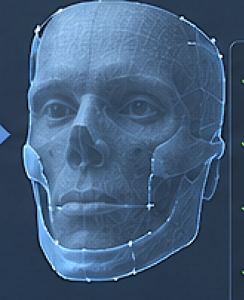
One of AI’s greatest strengths is recognizing complex three-dimensional geometry.
It can:
- Smooth transitions
- Eliminate sharp edges
- Improve implant blending
- Optimize thickness gradients
- Maintain anatomical curvature
This reduces manual CAD work while producing cleaner, more anatomically harmonious designs.
5. Implant Fit Verification
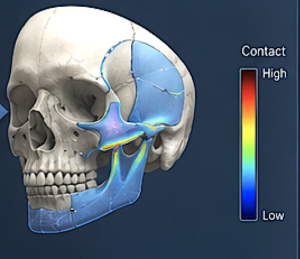
Poor implant fit can lead to:
- rocking
- dead space
- instability
- palpable edges
AI can compare the implant surface with the patient’s bone and identify areas where contact is suboptimal, allowing refinements before manufacturing.
AI Can Learn from Thousands of Previous Cases
Perhaps the greatest future advantage of AI is pattern recognition.
A surgeon may perform hundreds or even thousands of custom implant cases during a career.
AI has the potential to analyze tens of thousands of implants.
It can recognize relationships such as:
- Implant thickness versus patient satisfaction
- Common revision patterns
- Frequently requested refinements
- Long-term design success
- Anatomical trends across different populations
This collective experience could improve future implant planning.
AI-Assisted Surgical Simulation
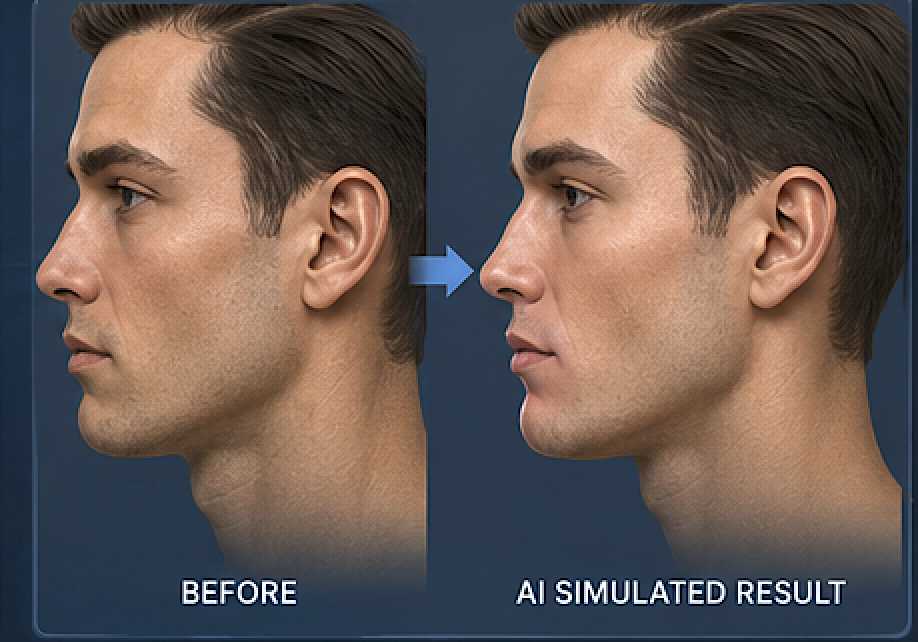
Future systems will likely generate highly realistic surgical simulations.
Instead of simply placing an implant on the skull, AI could predict:
- Soft tissue expansion
- Skin stretch
- Lip position
- Jawline definition
- Cheek contour
- Forehead curvature
- Facial balance
These simulations will provide more realistic expectations than today’s static bone models.
AI Can Improve Communication
One of the biggest challenges in facial implant surgery is translating a patient’s goals into an implant design.
Patients often describe goals using phrases like:
- “more defined”
- “stronger jawline”
- “less flat”
- “more masculine”
- “more balanced”
AI can help convert these subjective descriptions into measurable design parameters and generate visual mock-ups, making discussions between patient, surgeon, and implant engineer more precise.
AI Will Speed the Design Process
Traditional custom implant design may require multiple rounds of revisions.
AI can automate many repetitive CAD tasks, including:
- edge blending
- contour smoothing
- symmetry adjustments
- landmark identification
- implant positioning
- thickness mapping
This allows the surgeon to spend more time refining the aesthetic goals rather than performing routine engineering tasks.
AI Will Never Replace Surgical Judgment
The final implant design must consider factors that AI cannot fully appreciate, including:
- Skin thickness
- Muscle dynamics
- Surgical exposure
- Incision limitations
- Tissue tension
- Scar tissue from previous operations
- Healing characteristics
- Patient expectations
These variables require clinical judgment developed through surgical experience.
The Future: Surgeon + AI + Engineer
The most effective workflow is likely to combine the strengths of all three:
- The surgeon defines the aesthetic vision, determines candidacy, and makes the final clinical decisions.
- AI rapidly analyzes anatomy, automates measurements, suggests design refinements, and simulates outcomes.
- The biomedical engineer transforms the surgeon’s plan into a precise, manufacturable implant while ensuring structural integrity and production quality.
Each contributes expertise that the others cannot fully replace.
Looking Ahead
The future of AI-assisted custom facial implants extends beyond simply designing implants. AI will increasingly support the entire patient journey—from identifying ideal candidates and assisting with preoperative planning to refining implant geometry, simulating postoperative appearance, guiding surgical placement, and analyzing long-term outcomes across thousands of cases. As these capabilities mature, patients can expect more personalized designs, greater precision, shorter planning times, and increasingly predictable results.
Ultimately, the goal of AI is not to replace the surgeon’s artistic vision or clinical judgment. Instead, it serves as a powerful tool that enhances decision-making, streamlines complex engineering tasks, and leverages vast amounts of anatomical and clinical data. The future of custom facial implant surgery lies in this collaboration, where human expertise and artificial intelligence work together to create safer procedures, more individualized implants, and better aesthetic outcomes than either could achieve alone
Dr. Barry Eppley
Plastic Surgeon