

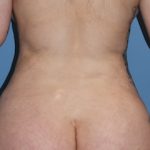
Masseteric muscle dehiscence is one of the more frustrating soft tissue complications that can occur after custom jaw angle implant surgery. While meticulous muscle dissection and ligamentous release is the primary method of prevention, muscle retraction over the implant can still occur.
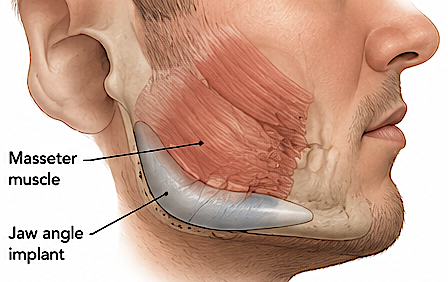 The masseter muscle normally inserts onto the lateral surface of the mandibular angle. During placement of a jaw angle implant, this insertion must often be elevated. If the insertion is too agressively released or a signnificanrt vertical lengthening jaw angle mplant is placed the patient may develop:
- Palpable soft tissue thinning over the implant
- Visible implant edges, particularly when clenching
- Dynamic contour irregularities
- Tenderness or discomfort during chewing
- A feeling that the implant is “moving” despite being rigidly fixed
Certain types of jaw angle implant patients are at particular risk, which includes anyone that has had prior jawcangle surgery. One of the highest risk groups is those who have had prior V line surgery. With the bone vertically reduced the muscle contract superiorly and becomes fibrotic. Then when the patient desires subtotal or total V line,reversal animplant can be replaced to re-lengthen the bone, but the muscle is at risk for not following it down over the implant jaw angle elongation.
Masseter muscle dehiscence is a soft tissue contour deformity that has no functional significance for jaw function. But it is aesthetically disturbing for a patient to have an indentation over a now better jaw angle shape. There are two approaches to treating this jaw angle contour deformity, which include either a muscle repair or soft tissue contour augmentation. In mild cases, Botox injections may be sufficient to reduce a modest muscle bulge higher up on the jaw angle. But in more significant cases a surgical approach is needed. Muscle repair is challenging and often unsuccessful. Soft tissue augmentation of the contour defect is far more successful and much easier to undergo. The only question is what type of soft tissue augmentation is going to be used. One such well-known method is that of an acellular dermal matrix (ADM) graft such as AlloDerm.
Case Study
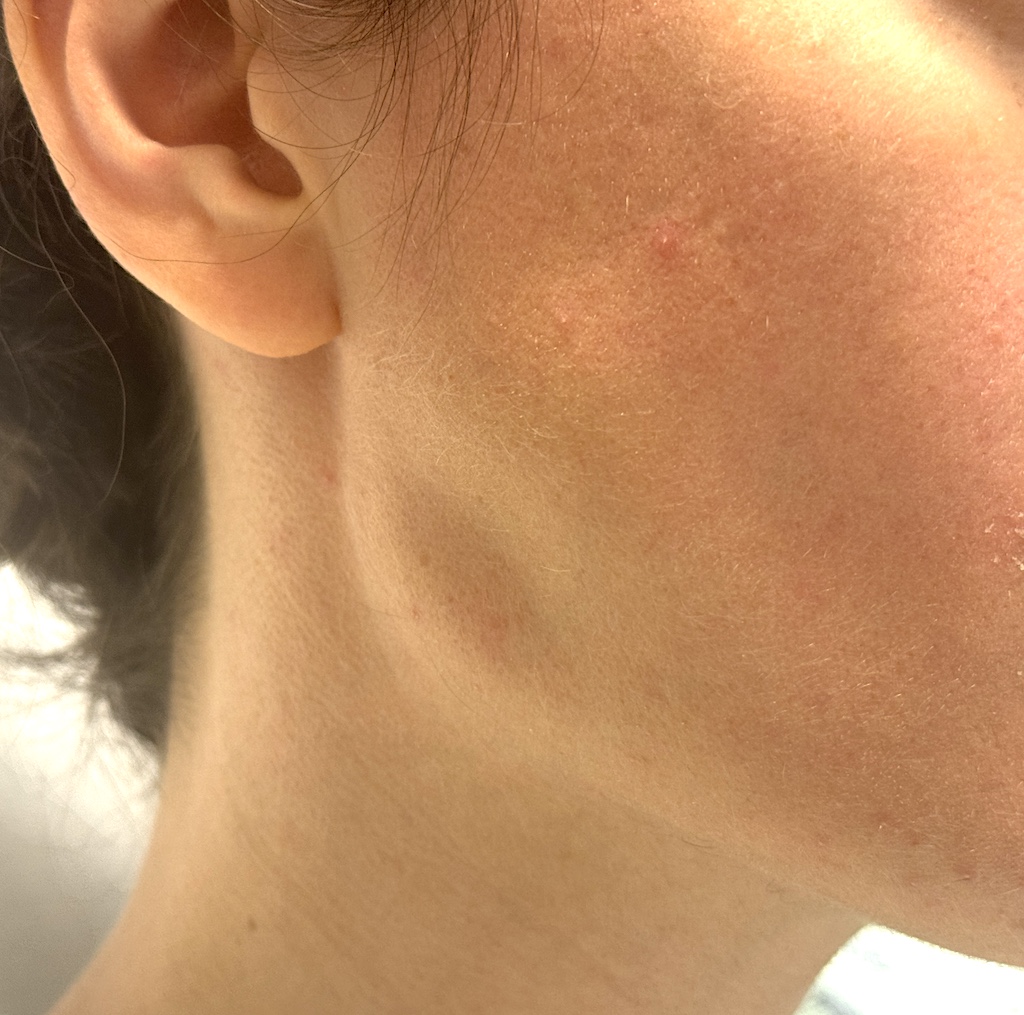 This young female had a prior jaw reduction procedure that was secondarily partially restored with custom jaw angle implants. While a good jaw shape was created she developed significant masseteric muscle dehiscence, particularly on the right side.
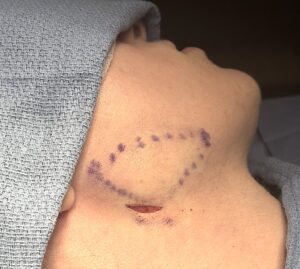
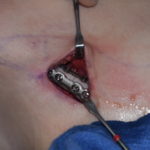
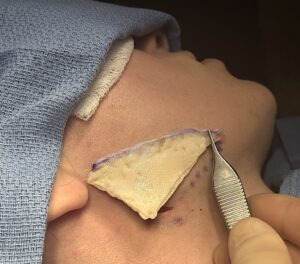 Under local anesthesia through a small skin incision on the back end of the jaw angle a subcutaneous pocket was developed over the jaw angle contour deformity. Alloderm grafts (2mm thick) were cut to the shape of the soft tissue defect and two pieces were sewn together for maximum thickness on the right side. On the left side only a single layer was used.
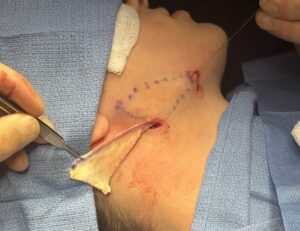
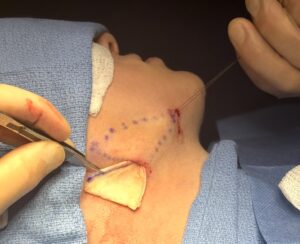
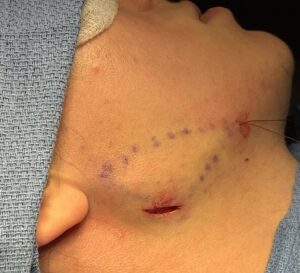 Using a suture pull through technique the grafts were passed through the incision and into proper placement. The small skin incisions were closed with dissolvable sutures.
Discussion
An AlloDerm graft acts as a biologic soft tissuescaffold rather than a structural implant. Over several months it becomes vascularized and incorporated into the patient’s own tissue, creating a thickened soft tissue layer between the overlying skin/subcutaneous tissues and the implant. Even though it is a biological graft and becomes vascularized, I have seen very little if any resorption of the material long-term. In my observation, it acts more like an implant than it does as a highly active graph material like fat.
Advantages
Compared with attempting muscle repair, AlloDerm offers several benefits:
- Improves long-term soft tissue thickness
- Helps camouflage inferior muscle edge
- Integrates into native tissue without remaining as an inert foreign body
- Does not require harvesting the patient’s own tissues
Limitations
AlloDerm is not a muscle repair method nor is its purpose is to act as an elongation of the muscle. It is a more reliable soft tissue augmentation method than fat injections, but it does have several limitations
It also has several limitations:
- Material cost
- Can only add up to 4 mm of soft tissue augmentation
- May partially remodel over time
Alternatives
Other soft tissue options include:
- Fat injections (autologous and allogeneic)
- Dermal-fat grafts (when additional thickness is desired)
- Synthetic injectable fillers
- Soft tissue implants
Clinical Perspective
In my experience with revision custom jaw angle implant surgery, AlloDerm is best viewed as a biologic sheet material which can help restore a smoother soft tissue contour over the implant. Because it comes in sheets of various thicknesses, it can be cut to the size of the defect and even double stacked to optimize its thickness. It also has little risk of infection and canned secondarily be further augmented with additional Durm or fat grafting if needed
Key Points
1) soft tissue augmentation of the retracted, massive or muscle over a jaw angle implant is most reliably treated by a soft tissue augmentation method to improve the contour defect,
2) Alloderm sheet grafting remains an effective treatment for mild to moderate cases of masseteric muscle dehiscence.
3) The small external skin incision at the back end of the jaw angle for graft placement heals in a near inconspicuous fashion
Barry Eppley, MD, DMD
Plastic Surgeon