
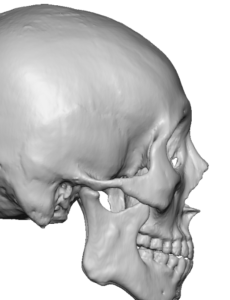
One of the moat common reasons patients seek forehead augmentation is to change the forehead slope in profile. They often seek to correct a more backward forehead slope into a more vertical one. The key question is where does the slope of the forehead start to become retroclined. Does it begin to do so at the brow bones or does it start higher up at the mid-forehead level as this will affect the custom forehead plant design to treat it.
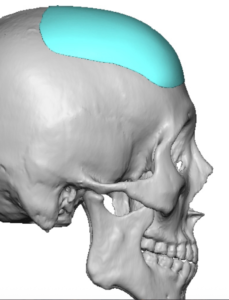 A high forehead implant is a custom-designed forehead augmentation implant that specifically increases the projection of the upper half of the forehead to correct a backward-sloping (retrusive) forehead. Unlike standard forehead implants that augment the entire forehead evenly, a high forehead implant is designed to selectively add volume superiorly while blending smoothly into the existing forehead and scalp.
Indications
This implant is most appropriate for patients who have:
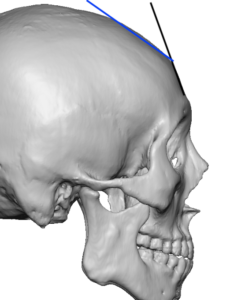
- A forehead that slopes backward starting at the mid-forehead.
- A high hairline with inadequate upper forehead projection.
- A desire for a stronger, more vertical forehead profile without changing the brow prominence.
Implant Design
The implant is custom designed from a 3D CT scan and has several characteristic features:
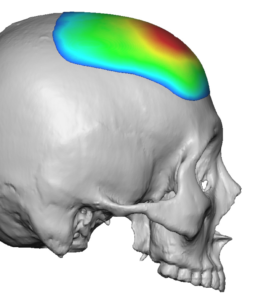
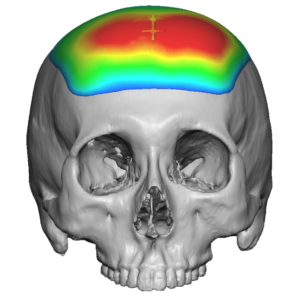
- Maximum thickness in the upper forehead, typically between the midpoint of the forehead and the hairline.
- No augmentation over the brow bones, avoiding an overly masculine or heavy appearance.
- Smooth feathered edges that taper into the surrounding skull.
- Can provide 5–12 mm of projection, depending on the severity of the forehead retrusion and the patient’s goals.
Surgical Technique
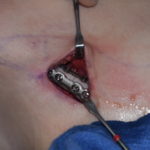
The implant is inserted through a small incision hidden within the scalp.
- A precise subperiosteal pocket is created.
- The custom solid silicone implant is positioned directly on the frontal bone.
- The implant does not lock or snap into position just because of its patient-specific design. It requires an orientation method as well how it looks visually on the outside to judge its placement (designed) position.
- Once positioned dual screw fixation is essential to maintain the chosen placement.
- The incision is closed with the implant completely concealed beneath the scalp.
Advantages
- Creates a more vertical forehead profile.
- Improves overall facial balance, especially when viewed from the side.
- Produces a natural transition from the forehead into the hair-bearing scalp.
- Does not alter the position of the eyebrows or affect facial expression.
- Can be combined with brow bone, temporal, or occipital implants as part of comprehensive skull reshaping.
The ideal candidate has a normal brow projection but an upper forehead that recedes posteriorly. By selectively increasing upper forehead projection rather than simply enlarging the entire forehead, the implant restores a more balanced craniofacial profile while maintaining a natural appearance.
Discussion
In designing a forehead implant for slope correction a relevant issue is what is normal slope of the male forehead
There is no single “normal” forehead slope because it varies with sex, ethnicity, age, and facial type. However, in aesthetic facial analysis there are accepted ranges that define an attractive male forehead.
Normal adult male forehead characteristics:
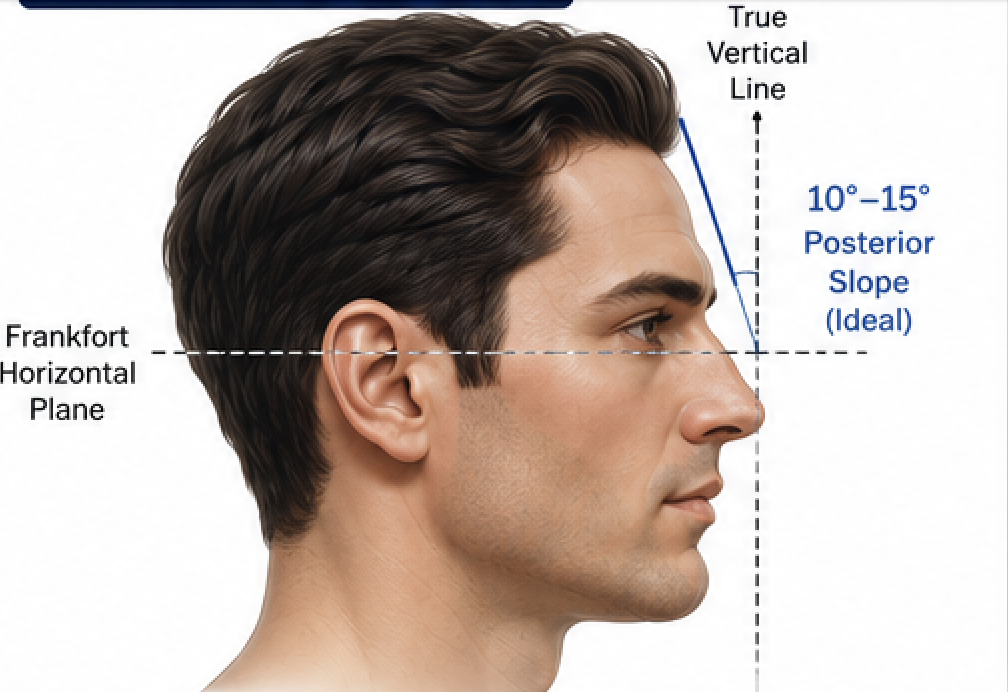
- Forehead inclination: approximately 10° to 15° posteriorly from a true vertical line when viewed in profile.
- Forehead profile: usually appears relatively straight or very gently convex from the brow to the hairline.
- Brow prominence: the supraorbital ridge projects slightly, creating a subtle transition into the forehead.
- Upper forehead: should not continue to slope progressively backward. The upper one-half of the forehead should become more vertical, creating a balanced profile.
Aesthetic Classification
|
Forehead Type |
Approximate Slope |
|
Very vertical |
0–5° |
|
Ideal male |
10–15° |
|
Average |
15–20° |
|
Backward sloping |
20–30° |
|
Markedly retrusive |
>30° |
A forehead that slopes greater than about 20° begins to appear noticeably retrusive. This is the type of forehead that benefits most from a high forehead implant, because the implant selectively increases projection in the upper half of the forehead rather than simply enlarging the entire forehead.
From a surgical planning standpoint, the goal is not to create a perfectly vertical forehead. Instead, the objective is to convert a forehead with a 25–35° backward slope into one that has approximately a 10–15° inclination, preserving a masculine appearance while producing a more balanced craniofacial profile.
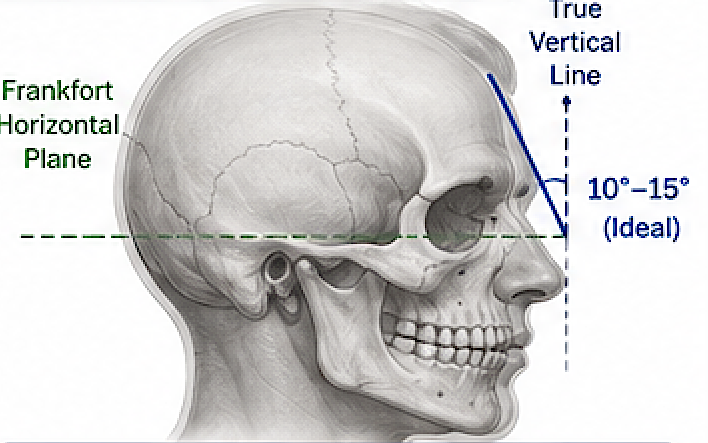 For custom implant design, I typically use the Frankfort Horizontal plane as the reference and evaluate the angle of the upper forehead relative to a true vertical line. This provides a reproducible method for determining how many millimeters of augmentation are required at the upper forehead to achieve the desired final contour.
Dr. Barry Eppley
Plastic Surgeon