
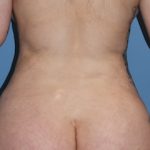
Lower lip tightness is an uncommon but frustrating complaint that most often occurs after prior surgery (chin implant, genioplasty, V-line surgery, chin reduction, lip procedures), trauma, burns, or scarring from fillers or infections. Patients typically describe a sensation of the lip feeling “stiff,” or “pulled tight” associated with increased lower incisor show and with some perception of loss of lip volume.While fat grafting is not the first treatment that comes to many surgeon’s and patient’s minds, it should be as it offers effective improvement in carefully selected patients.
The rationale for fat grafting is the lower lip tightness is a result of scar contracture. By definition, most scarred contractures involve loss of normal tissue volume and suppleness. Therefore, transplanted fat acts as a biologic soft tissue filler that can improve tissue pliability and reduce tethering between the skin, muscle (mentalis muscle) and the intraoral vestibule. Fat also contains adipose-derived stem cells and growth factors that may improve the quality and elasticity of scarred tissues. This regenerative effect has been well documented in reconstructive surgery for radiation injury, burn scars, and traumatic scars.
The best candidates are patients whose lower lip tightness is caused by:
- Tight stiff lip soft tissues after chin surgery
- Intraoral scar contracture with vestibular deepeningV
- Contour irregularities
Fat grafting is less successful when:
- Significant muscle dysfunction or denervation exists.
- Mechanical restriction from an oversized chin implant or implant malposition.
- Severe fibrosis extending into the mentalis muscle.
Expected Results
Patients often notice two separate benefits:
- Improved softness and flexibility, which may continue to improve over several months.
- Modest increase in lower lip fullness, which is usually desirable in patients with a tight, thin lower lip.
Clinical Perspective
In my experience, lower lip tightness responds best to fat grafting when the primary problem is a lack of soft tissue volume and compliance rather than a structural problem. If the lip is being mechanically tethered fat grafting is an excellent adjunct to improve tissue quality and restore a more supple, naturally mobile lower lip.
For patients with postoperative lower lip tightness, fat grafting should be viewed as a biologic tissue restoration procedure, not simply a volume enhancement technique. Its greatest value lies in improving the quality and elasticity of the tissues, allowing the lower lip and chin to feel and move more naturally.
Case Study
This young male had a prior history of an intraoral chin reduction procedure, which left him with lower lip tightness, a deepened vestibule, and excessive lower lip tooth show. His lower lip was tight and felt restricted when pulling on it
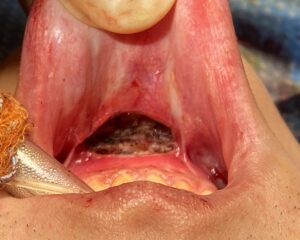
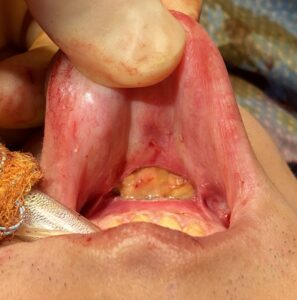
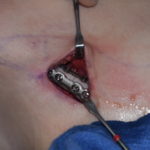
To treat his lower lip tightness a small dermal paragraph is harvested from his lateral flank. The oral vestibular incision was opened and wide release was done down over the chin bone until the lip no longer felt tethered. The dermal fat craft was prepared by removing the thin outer epithelial layer and then was placed into the release pocket and suture position.
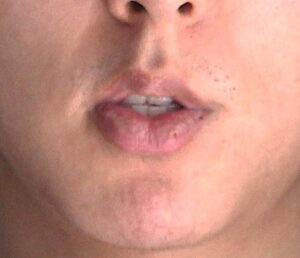
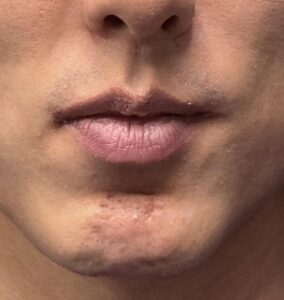 When
When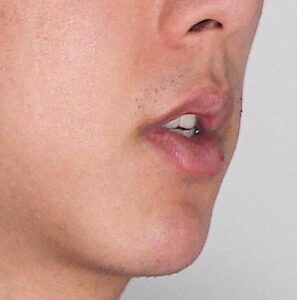
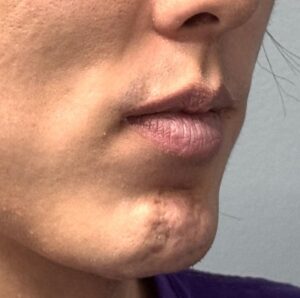 seeing six months later, his lower lip was much more supple, was no longer tethered, and his tooth show had decreased.
Discussion
The most common approach for fat grafting is an injection technique. But this can be problematic in lower lip and chin scarring because a full surgical release which fat injections do not do very effectively. This is where dermal – fat grafting is far more effective for this clinical problem.
Dermal-fat grafts can be an excellent alternative to injectable fat grafting for selected patients with lower lip tightness, particularly when the problem is related to scar contracture, significant soft tissue deficiency, or wh
en a more predictable, permanent increase in tissue volume is desired.
Unlike fat injections, which disperse small parcels of fat throughout the lip, a dermal-fat graft is a single composite graft consisting of dermis with attached subcutaneous fat, usually harvested from the lower abdomen, groin crease, or gluteal crease. The epidermis is removed before implantation, leaving only the dermis and fat. The graft is then inserted through small commissure or intraoral incisions into a precisely created submucosal or intramuscular pocket within the lower lip.
Advantages of Dermal-Fat Grafts
- Provides structural expansion rather than diffuse volume enhancement.
- Greater resistance to long-term resorption than injected fat because the dermal-fat component serves as a biologic scaffold.
- Predictable increase in lip thickness, especially useful for severely thinned lower lips.
- Releases scar contracture by physically expanding tight tissues.
- Single-piece graft avoids the irregular distribution that can occasionally occur with injectable fat.
- Particularly useful after:
- Chin implant or genioplasty surgery with soft tissue thinning
- Traumatic or burn scars
- Multiple previous lip surgeries
- Congenital or acquired lower lip atrophy
Surgical Technique

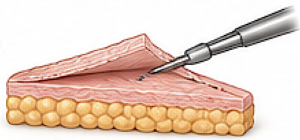 A narrow elliptical dermal-fat graft is harvested, typically measuring 4–6 cm in length and 8–12 mm in width, depending on the required augmentation. After removing the epidermis, a tunnel is created across the lower lip through small incisions placed inside the mouth or at the oral commissures. The graft is gently pulled through the tunnel so the dermis faces superficially toward the mucosa and the fat lies deeper adjacent to the orbicularis oris muscle. The graft is trimmed as needed and secured with fine absorbable sutures.
Advantages Compared with Fat Injection
|
Dermal-Fat Graft |
Fat Injection |
|
Better for severe tissue deficiency |
Best for mild-to-moderate tightness |
|
Creates a permanent tissue “spacer” |
Provides diffuse soft tissue expansion |
|
More predictable contour |
Easier office or outpatient procedure |
|
Less volume loss over time |
30–50% resorption is expected |
|
Better at releasing scar tethering |
Better for improving tissue quality and elasticity |
Clinical Perspective
For patients with significant lower lip tightness associated with tissue deficiency, I generally favor a dermal-fat graft over injectable fat. The graft functions as a biologic spacer that permanently increases lip thickness while reducing scar contracture and improving tissue compliance. Fat injections remain valuable for milder cases or as a secondary procedure to refine contour and further improve tissue quality after structural restoration.
In essence, fat injections are primarily a regenerative volume-restoration technique, whereas dermal-fat grafts provide both regeneration and structural soft tissue replacement, making them particularly well suited for lower lips that are thin, scarred, and mechanically tight.
Dr. Barry Eppley
Plastic Surgeon