
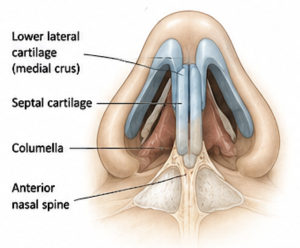
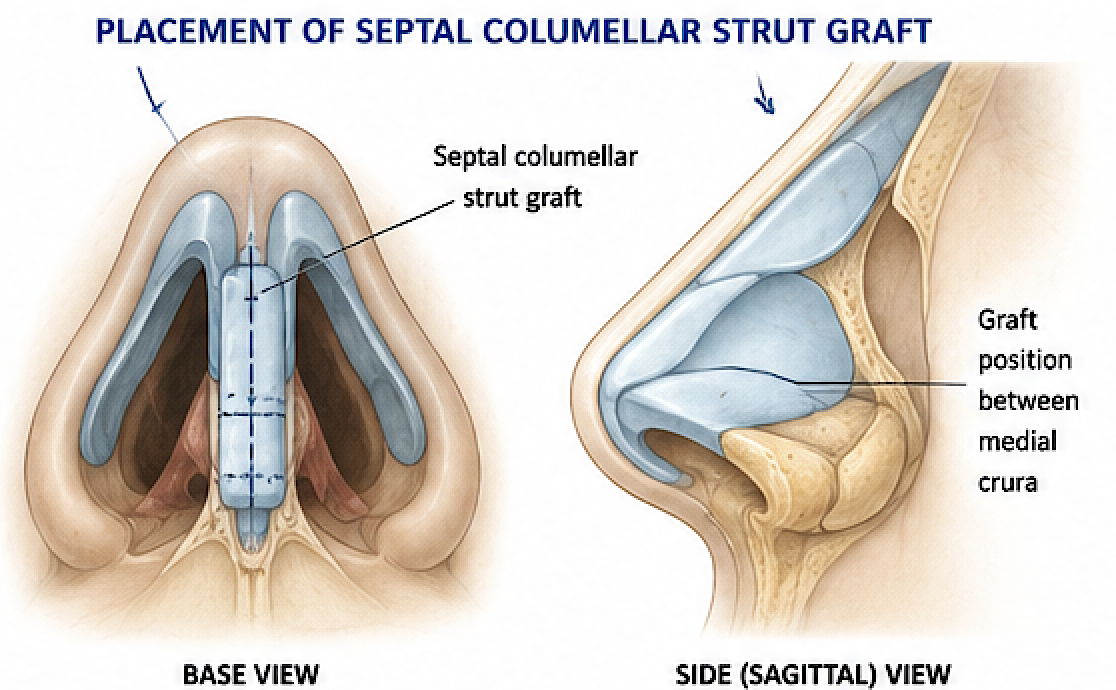
 A septal columellar strut graft is one of the most fundamental structural grafts in rhinoplasty. Positioned between the medial crura of the lower lateral cartilages within the columella, it acts as an internal support beam for the nasal tip. While it does not directly create a new tip shape, it provides the stable framework upon which predictable tip refinement can be performed.
Primary Functions
1. Tip Support
The principal purpose of the graft is to strengthen the central support of the nasal tip. This is especially important when:
- The native lower lateral cartilages are weak or thin.
- Tip cartilages have been divided during surgery.
- Tip projection needs to be maintained long-term.
- Previous rhinoplasty has weakened the tip support mechanisms.
Without adequate support, the tip may gradually lose projection over time due to scar contraction and gravity.
2. Control of Tip Projection
A columellar strut allows the surgeon to:
- Increase tip projection.
- Preserve existing projection.
- Fine-tune the final position of the tip.
The amount of projection is primarily determined by the relationship between the lower lateral cartilages and the strut rather than the graft itself.
3. Control of Tip Rotation
The graft helps establish:
- Upward (cephalic) rotation
- Downward (caudal) rotation
- Maintenance of the desired nasolabial angle
This is particularly valuable in patients with:
- Drooping tips
- Long noses
- Aging noses with loss of support
4. Improves Tip Symmetry
Because both medial crura are sutured to the same rigid structure, a strut:
- Equalizes asymmetries
- Centers the tip
- Creates a more balanced tip-defining complex
5. Maintains Long-Term Stability
One of the greatest advantages is long-term maintenance of the surgical result.
It resists:
- Scar contracture
- Tip drooping
- Loss of projection
- Progressive asymmetry
For this reason, columellar struts are frequently used in both primary and revision rhinoplasty.
Septal Cartilage: The Ideal Material
Septal cartilage is considered the preferred donor source because it is:
- Straight
- Strong
- Readily available
- Harvested through the same surgical exposure
- Resistant to warping
- Sufficiently rigid without being excessively stiff
When septal cartilage is unavailable, alternatives include:
- Ear (conchal) cartilage
- Rib cartilage
- Cadaveric costal cartilage
Typical Dimensions
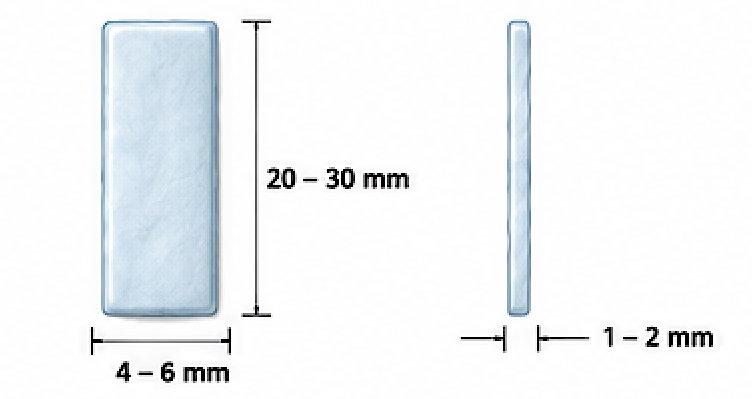
Although customized to each patient, a typical septal columellar strut measures:
- Length: 20–30 mm
- Width: 4–6 mm
- Thickness: 1–2 mm
The graft usually extends from just above the anterior nasal spine toward the tip without reaching the tip-defining point itself.
Surgical Placement
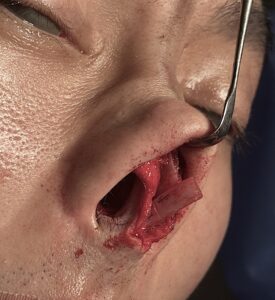
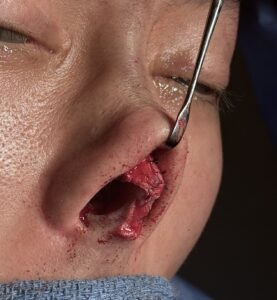
The graft is placed:
- Between the medial crura
- Secured with permanent or long-lasting absorbable sutures
- Positioned without excessive rigidity to preserve a natural degree of tip mobility
It should not be tightly fixed to the anterior nasal spine in most cases, allowing slight physiologic movement of the nasal tip.
Indications
A septal columellar strut is particularly useful for:
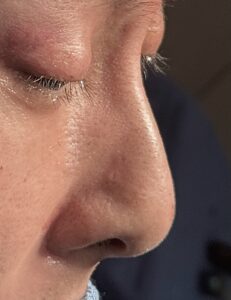
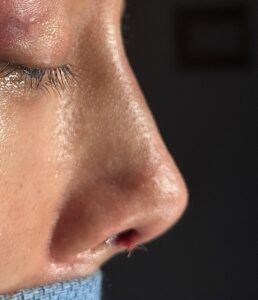
- Tip refinement
- Tip projection increase
- Drooping nasal tip correction
- Thick-skinned noses
- Weak lower lateral cartilages
- Ethnic rhinoplasty
- Revision rhinoplasty
- Aging nose correction
- Cleft rhinoplasty
Limitations
A columellar strut is not intended to:
- Narrow a bulbous tip by itself
- Create tip definition without additional cartilage suturing
- Correct major septal deviation
- Replace major support lost from severe trauma
Additional techniques—such as cephalic trim, dome-binding sutures, lateral crural repositioning, shield grafts, or septal extension grafts—are often combined with a strut to achieve the desired aesthetic result.
Columellar Strut vs. Septal Extension Graft
|
Columellar Strut |
Septal Extension Graft |
|
Passive support |
Active structural support |
|
Supports medial crura |
Extends the septum itself |
|
Moderate control of projection |
Precise control of projection |
|
Moderate control of rotation |
Excellent control of rotation |
|
Allows natural tip mobility |
Creates a firmer, more fixed tip |
|
Simpler to perform |
Technically more demanding |
Septal extension grafts have become increasingly popular for cases requiring precise tip positioning, particularly in Asian rhinoplasty and revision surgery. However, the traditional columellar strut remains an indispensable technique because it provides reliable support while preserving a softer, more natural tip feel.
Key Point
The septal columellar strut is best thought of as the foundation of nasal tip surgery. Like the frame of a building, it is rarely visible in the final result, but it provides the structural stability that allows the surgeon to create—and maintain—a refined, symmetrical, and durable nasal tip.
Dr. Barry Eppley
Plastic Surgeon