
Custom forehead implants in women are fundamentally different from those designed for men. The objective is not to create a prominent brow ridge, but rather to create a smooth, gently convex forehead with improved upper facial harmony while preserving feminine skeletal characteristics.
The Ideal Female Forehead
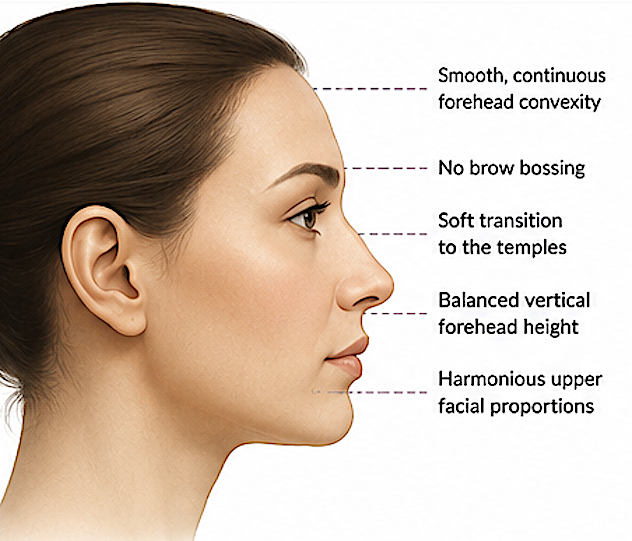 An aesthetically pleasing female forehead typically has several defining characteristics:
- Smooth, continuous convexity from the hairline to the brows
- Minimal or absent brow bossing
- Soft transition into the temples
- Appropriate vertical forehead height
- Good central fullness without appearing “bulging”
- Symmetry across the forehead
Unlike male forehead implants, female implants usually avoid adding projection over the supraorbital rims.
Common Reasons Women Seek Forehead Implants
Congenitally Flat Forehead
Some women naturally have a forehead that slopes backward from the eyebrows, producing:
- Reduced forehead convexity
- Less upper facial projection
- A profile that appears less balanced
A custom implant can restore a more rounded contour.
Forehead Asymmetry
This may result from:
- Developmental asymmetry
- Previous trauma
- Prior surgery
- Positional plagiocephaly
Custom implants are particularly effective because thickness can vary millimeter by millimeter across the implant.
Temporal Hollowing
Many women develop hollowing along the sides of the forehead, especially with aging or weight loss.
A forehead implant can often be extended laterally to:
- Blend into the temporal region
- Reduce visible depressions
- Produce a smoother transition between forehead and temples
In more significant cases, separate temporal implants may provide better correction.
Flat Upper Forehead
Some patients have adequate lower forehead projection but lack fullness superiorly near the hairline.
These implants selectively increase:
- Upper forehead projection
- Forehead curvature
- Vertical facial balance
Design Principles
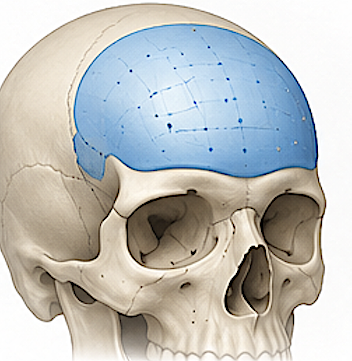
Every implant is designed from a high-resolution 3D CT scan.
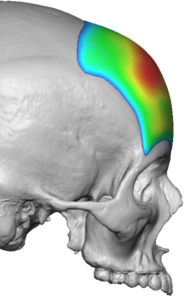
The implant can selectively augment:
- Entire forehead
- Central forehead only
- Upper forehead
- Lateral forehead
- One side only (for asymmetry)
Thickness can change continuously across the implant, allowing extremely precise contour changes.
Typical augmentation ranges are:
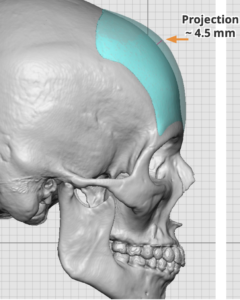
- Mild: 2–4 mm
- Moderate: 5–8 mm
- Significant: 8–12 mm
- Major reshaping: 12–15+ mm (selected cases)
The implant edges taper gradually to become essentially imperceptible.
Implant Material
Solid silicone remains the preferred material because it is:
- Precisely milled from the CAD design
- Smooth and biocompatible
- Easy to insert
- Easy to remove or modify if necessary
- Stable over decades
- Resistant to fracture
Unlike porous materials, silicone allows easier revision should aesthetic goals change.
Surgical Technique
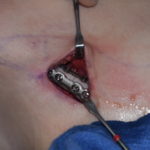
Most implants are inserted through:
- A small incision several centimeters behind the hairline
The implant is placed directly on bone beneath the periosteum.
Fixation generally involves one or two tiny titanium microscrews to prevent movement.
Typical operative time:
- 60–90 minutes
Most procedures are outpatient surgery.
Recovery
Typical recovery includes:
- Forehead swelling for 1–2 weeks
- Mild numbness that gradually resolves over several months
- Return to office work within about one week
- Exercise after 3–4 weeks
- Final contour apparent over approximately 3 months as swelling resolves
Case Example
Discussion
Advantages of Custom Implants
Compared with fat grafting or injectable fillers, custom implants offer:
- Permanent volume
- Exact control of shape
- Symmetric correction
- No unpredictable resorption
- Ability to create large-volume changes
- Precise correction of complex asymmetries
Ideal Candidates
Women who tend to benefit most include those with:
- Naturally flat foreheads
- Upper facial asymmetry
- Forehead contour deficiencies after trauma
- Congenital forehead irregularities
- Desire for a smoother, more rounded feminine forehead
- Insufficient correction with fat grafting or fillers
Limitations
Forehead implants improve skeletal contour but do not address:
- Skin quality
- Forehead wrinkles
- Brow position
- Hairline height (unless combined with hairline advancement)
- Significant temporal hollowing requiring dedicated temporal implants
These concerns may be addressed with complementary procedures when appropriate.
Why Custom Design Matters
No two female foreheads have the same curvature, asymmetry, or aesthetic goals. A custom implant allows the augmentation to be tailored in all dimensions, producing a result that enhances facial harmony while maintaining feminine forehead anatomy. The greatest advantage over stock implants or injectables is the ability to precisely control where—and by how many millimeters—the forehead is augmented, creating a natural, individualized contour that is stable long term.
Dr Barry Eppley
Plastic Surgeon