


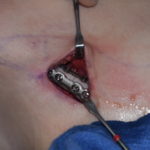
One of the key elements of beauty which is well known is that of facial symmetry. Many patients that present for facial reshaping surgery have various degrees of facial asymmetry, some greater than others. As a result a common question patients often ask is why do they have such facial a symmetries? Once the embryologic development of the face is understood the question may then become why aren’t facial asymmetries more common. Or to phrase it another way it is a miracle the the face develops as reasonably symmetric as it does in the majority of people.
During embryologic facial development, five primary facial processes (also called facial prominences) grow, migrate, and fuse in a highly coordinated manner. Symmetry of the face depends on these paired structures developing equally and meeting precisely along the midline.
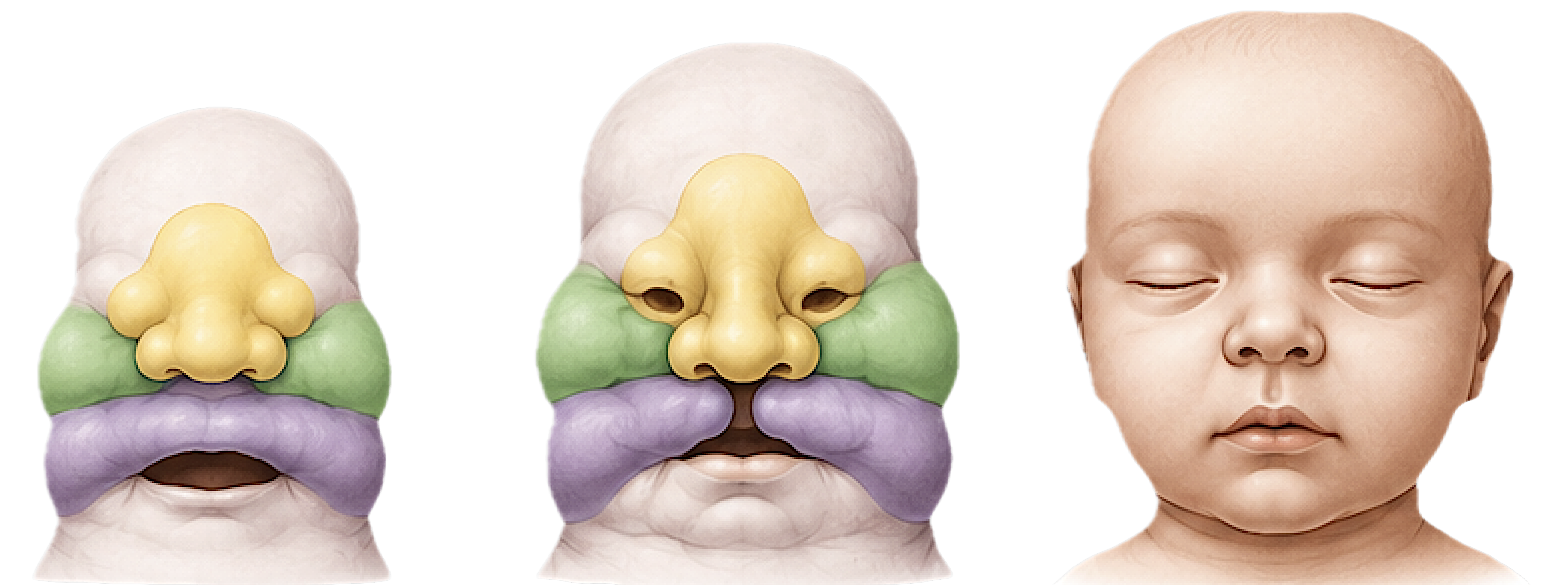
The five facial processes are:
- Frontonasal Process (1)
- Forms the forehead, bridge of the nose, and gives rise to the medial and lateral nasal processes.
- Paired Maxillary Processes (2)
-
- Right and left.
- Derived from the first pharyngeal arch.
- Form the upper cheeks, lateral upper lip, most of the upper jaw, and contribute to the palate.
- Paired Mandibular Processes (2)
-
- Right and left.
- Also derived from the first pharyngeal arch.
- Fuse to form the lower lip, chin, and mandible.
Together these comprise the five primary facial prominences.
Secondary facial processes
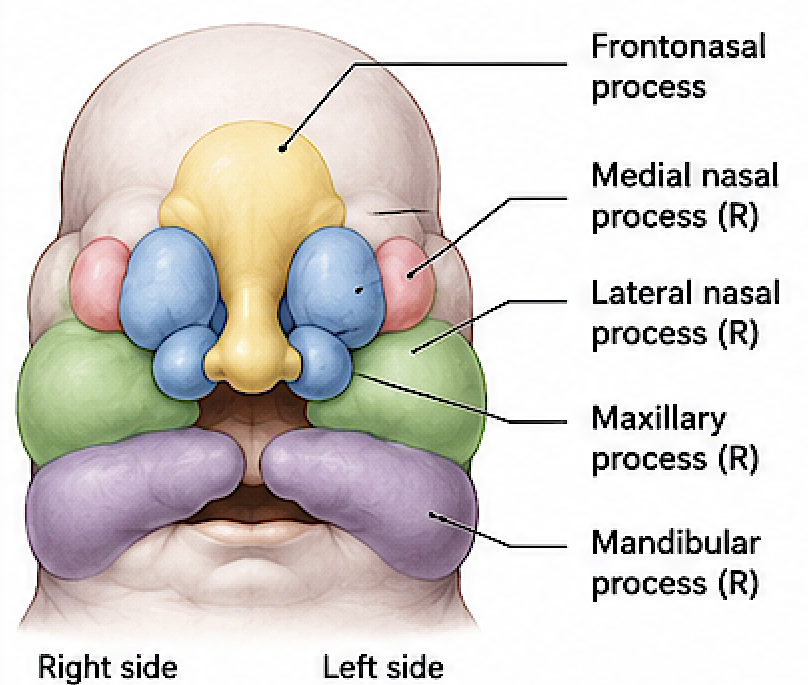
The frontonasal process subsequently subdivides into:
- Right medial nasal process
- Left medial nasal process
- Right lateral nasal process
- Left lateral nasal process
These subdivisions are critically important because they participate in forming the nose and central upper lip.
How many fusion events occur?
Rather than five structures simply “meeting in the middle,” facial formation requires multiple coordinated fusion events, including:
- Right and left mandibular processes fuse ? lower lip and chin
- Right and left medial nasal processes fuse ? philtrum, premaxilla, primary palate
- Each maxillary process fuses with its adjacent medial nasal process ? upper lip continuity
- Each maxillary process fuses with its lateral nasal process ? side of the nose and nasolacrimal region
- Right and left palatal shelves fuse ? secondary palate
In total, there are at least six major fusion events, each occurring during a narrow developmental window between approximately 4 and 10 weeks of gestation.
Why facial symmetry is so remarkable
One of the most fascinating aspects of facial embryology is that nearly every facial feature is built by paired right and left structures that must:
- Grow at the same rate
- Reach the same size
- Rotate into the proper position
- Meet with submillimeter precision
- Fuse without gaps or overlap
Any disruption in timing, growth, or fusion can produce asymmetries ranging from subtle differences in chin position or nasal shape to congenital anomalies such as cleft lip, cleft palate, or craniofacial microsomia.
This remarkable developmental choreography explains why the human face is one of the most complex structures formed during embryogenesis and why perfect facial symmetry is uncommon—even minor differences in growth between the paired facial processes can lead to detectable asymmetries in adulthood.
Dr. Barry Eppley
Plastic Surgeon