
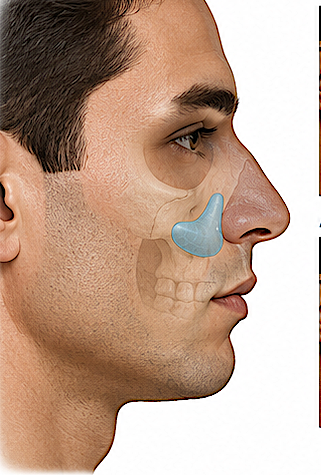
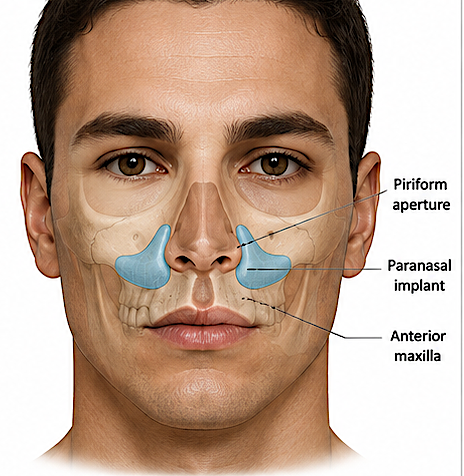
Paranasal implants are custom-designed or standard implants placed over the piriform aperture and paranasal (premaxillary) region to increase support and projection beside the base of the nose. They are among the most effective procedures for correcting a recessed central midface.
What They Correct
Paranasal implants improve:
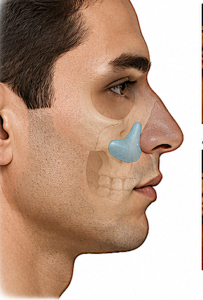
- Deficient projection around the nasal base
- A deep nasolabial angle or hollow beside the nostrils
- Midface retrusion due to maxillary deficiency
- An overly prominent nose caused by a recessed maxilla (relative nasal prominence)
- Poor upper lip support
- Mild negative vector of the central midface
They are especially valuable in patients with a normal-sized nose but an underprojected maxilla, where rhinoplasty alone would not create facial balance.
Anatomy
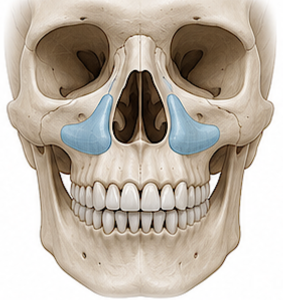
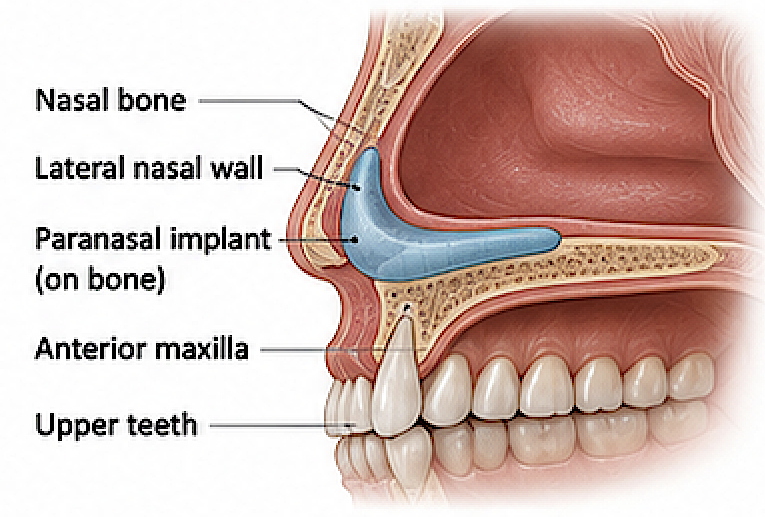
The implant rests directly on bone over the:
- Piriform aperture
- Lateral nasal wall
- Anterior maxilla
Unlike cheek implants, paranasal implants increase projection centrally, immediately adjacent to the nostrils.
Types of Paranasal Implants
Standard implants
- Silicone oe ePTFE materials
- Limited shapes and sizes
- Best for mild deficiencies
- Lower cost
Custom implants
Designed from a patient’s CT scan.
Advantages include:
- Exact fit to the bone
- Precise control of projection (often 3–8 mm)
- Ability to correct asymmetry
- Smooth blending into surrounding facial skeleton
- Can extend inferiorly into the premaxillary region if needed
For moderate to severe deficiencies, custom implants are usually superior.
Surgical Approach
The procedure is typically performed through:
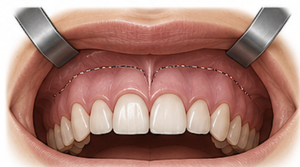
- Small intraoral incisions in the upper gingivobuccal sulcus
- No external scars
The implant is placed beneath the periosteum and secured with one or two titanium screws to prevent movement in most cases.
Recovery
Typical recovery includes:
- Swelling peaks during the first 3–5 days.
- Most bruising resolves within 1–2 weeks.
- Normal activities usually resume within about a week.
- Implant stability is achieved once the soft tissues heal around it.
Common Combinations
Paranasal implants are frequently combined with:
- Rhinoplasty
- Custom infraorbital implants
- Custom cheek implants
- Midface mask implants
- Custom jawline implants
- Chin augmentation
Together these procedures can rebalance the entire face rather than treating only one region.
Case Example
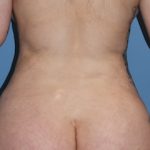
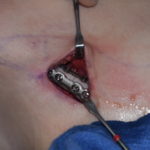
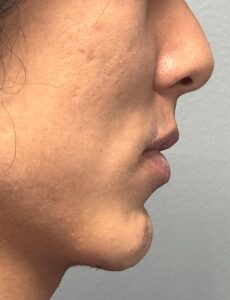
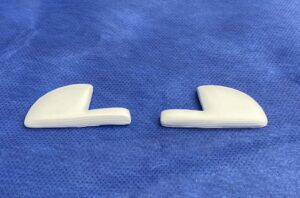 This male was to undergo multiple facial reshaping procedures with the primary one being a custom jawline implant. At the same time he desired increasing his central midface projection around the base of his nose..Standard ePTFE paranasal implants wer chosen with 5mms projection.
They wer e palaced theoiugh an intraoral small paited mucosal incisions. Screw fixation was not needed due to the tissue attachments of the ePTFE material and the limited subperiosteal pocket.
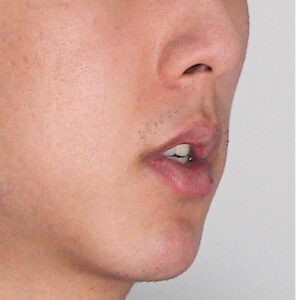
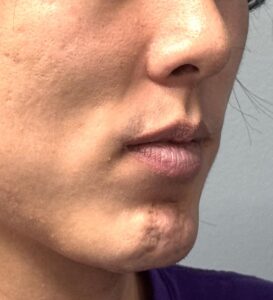 While the jaweline implant has the major effect the paranasal implants had subtle but visible projection of the lower pyriform aperture area.
Discussion
Ideal Candidates
Patients who commonly benefit from paranasal implanyts include those with:
- Flat central midface
- Recessed upper jaw without requiring orthognathic surgery
- Congenital maxillary deficiency
- Previous orthodontic treatment with persistent midface retrusion
- Mild skeletal Class III appearance
- Desire for stronger facial profile without moving the jaws
Advantages Over Fat Grafting
Compared with fat grafting, paranasal implants:
- Produce permanent skeletal projection
- Do not resorb unpredictably
- Provide greater structural support for the upper lip and nasal base
- Create a sharper, more defined facial contour
Fat grafting adds soft-tissue volume, whereas implants reposition the apparent skeletal foundation.
Limitations
Paranasal implants cannot:
- Correct significant dental malocclusion
- Replace orthognathic surgery when major maxillary advancement is needed
- Narrow the nose
- Change nasal tip shape
When substantial maxillary advancement is indicated for both function and aesthetics, Le Fort I osteotomy remains the definitive treatment.
Aesthetic Effect
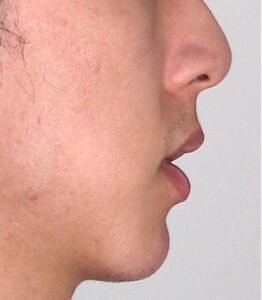
Well-designed paranasal implants often create:
- Better facial profile balance
- A less prominent-appearing nose
- Softer nasolabial folds
- Improved upper lip support
- A more projected central midface
- A stronger transition from the nose to the cheeks
The change is often subtle but has a disproportionately positive effect because it restores balance to the center of the face.
For patients with generalized midface deficiency, I often view paranasal implants as one component of a comprehensive skeletal augmentation plan, frequently combined with custom infraorbital and cheek implants. Addressing all three regions together generally produces a more harmonious and natural result than augmenting only one area.
Dr. Barry Eppley
Plastic Surgeon