
Recent advancements in lip enhancement surgery include:
- Hyaluronic acid fillers with refined injection techniques: More emphasis on lip shape, support, and proportion rather than simply adding volume.
- Lip lift procedures: Particularly subnasal (“bullhorn”) lip lifts that shorten the distance between the nose and upper lip, increasing upper tooth show and lip definition.
- Micro-fat grafting to the lips: Uses the patient’s own fat for longer-lasting augmentation in selected patients.t.
- Combination approaches: Lip lift, fillers, fat grafting, and perioral rejuvenation are increasingly combined to create more natural results.
- Regenerative techniques: Early interest in platelet-rich plasma (PRP) and nanofat applications for lip quality and perioral skin improvement, though evidence is still evolving.
But it is in structural lip augmentation, which focuses on enhancing the vermilion border, Cupid’s bow, and mouth corners t rather than uniform enlargement, has been the most useful. For aesthetic lip enlargement, the major advancement in vermilion-based surgery has been the evolution from simple full-length “gullwing” excisions to selective, customized vermilion advancement designs that reshape specific aesthetic subunits of the lip rather than just making the entire lip larger.
Key developments include:
1. Segmental Vermilion Advancement
Instead of advancing the entire lip border, surgeons can selectively enlarge:
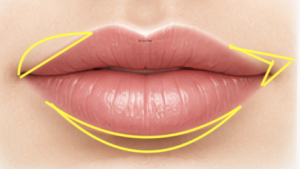
- The central Cupid’s bow
- The lateral upper lip
- The lower lip pout zone
- The oral commissure region
This allows correction of vermilion show disproportion and creation of a more balanced lip shape.
2. Vermilion Advancement for Filler Fatigue
A growing indication is patients who repeatedly receive fillers but have inherently poor vermilion show. In these patients, additional filler often creates projection without adequate visible red lip. Vermilion advancement physically relocates the vermilion-cutaneous border and increases visible lip height permanently.
3. Hybrid Lip Lift + Vermilion Advancements
It is inportant to recognize that:
- A bullhorn lip lift improves central upper lip position and tooth show.
- Vermilion advancement increases actual red lip display.
Combining the two procedures addresses both vertical lip length and vermilion deficiency, especially in aging patients and congenital thin-lip anatomy. It is the complete approach to upper lip augmentation and is absolutely necessary in some subnasal lip lift patients to avoid abn A-frame lip deformity.
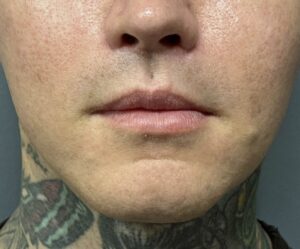
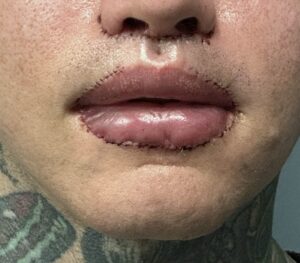
Such a strategy is also relevant to the patient who is seeking ‘extreme’ lip augmentation results.
4. Refined Scar Placement and Closure
Modern techniques emphasize:
- Precise white-roll preservation
- Two-layer closure
- Microscopic alignment of the vermilion-cutaneous junction
- Conservative advancements (often 2–4 mm)
These refinements have substantially improved scar quality compared with older direct lip lift techniques.
5. Male-Specific Vermilion Advancement
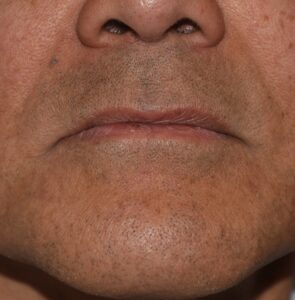
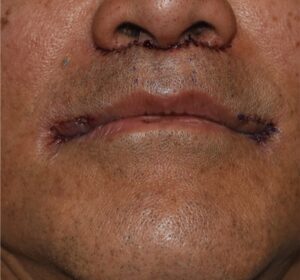
More recent approaches recognize sex-specific lip aesthetics. Male procedures generally use:
- Smaller advancements
- Flatter Cupid’s bow contours
- Limited central pout enhancement
to avoid feminization while still increasing vermilion show.
6. V-Y Mucosal Advancement Techniques
Internal V-Y advancement remains useful for increasing lip projection and pout without an external scar. Quantitative studies have shown increases in vermilion height and surface area, although the effect differs from direct vermilion advancement because it enhances protrusion more than visible red-lip height.
Current Conceptual Shift
The biggest conceptual advancement is that surgeons now view lip enlargement less as a volume problem and more as a vermilion display problem. Many patients with thin lips do not lack volume—they lack visible vermilion exposure. Direct vermilion advancement surgically repositions the border to create permanent red-lip show that fillers often cannot reliably achieve.
From a surgical innovation standpoint, the most sophisticated contemporary procedures are customized partial vermilion advancements that selectively alter Cupid’s bow shape, lateral lip taper, and lower lip pout rather than performing a uniform full-length advancement.
Dr. Barry Eppley
Plastic Surgeon