EXPLORE
Plastic Surgery
Dr. Barry Eppley

Explore the worlds of cosmetic
and plastic surgery with Indianapolis
Double Board-Certified Plastic
Surgeon Dr. Barry Eppley

Archive for the ‘paranasal implants’ Category

Facial Implants for Correction of Midface Deficiency

Monday, September 7th, 2009

Implants are very useful for producing three-dimensional facial changes. By extending the outer boundaries of bony prominences, the proportions and shape of the face can be changed dramatically. Implants essentially camouflage facial bony deficiencies or enhance a normal prominence. Traditional and well known facial implants are that of the chin, cheeks, or  nose. Jaw angle implants are also becoming more commonplace today.

Most facial implant use is for one region only (e.g., chin) even if the area of enhancement has two sides. (e.g., cheeks) Multiple sites of enhancement at one procedure can also be done and are associated with more significant facial changes. The use of combination cheek and chin augmentation or even chin, cheek and jaw angle augmentation are traditional implant duets and trios.

Another good facial implant combination is in the use of camouflaging a midface deficiency. Some midface hypoplasias are obvious, other are more subtle. Either way, there is an apparent flatter or less convex facial profile. In its severest form, the facial profile will actually be concave. The degree of midface underdevelopment is most evident by looking at one’s teeth or bite relationship. There may be an underbite or an edge-to-edge bite at the incisors. Someone may have had prior orthodontics so the ‘true’ bite relationship may have become obscured.

Midface deficiency is marked by flatter cheekbones and a ‘sunken’ base to the nose, known as the paranasal region. The entire midfacial skeleton is recessed from below the eyes down to the upper teeth. This bony position will have an impact on other facial areas making the nose and chin look bigger and the upper lip look smaller and thinner.

In young patients or more severe midfacial deficiencies, one should consider moving part or all of the midfacial bones. Traditional LeFort osteotomy patterns in conjunction with orthodontics is the standard approach. For patient’s with less significant deficiencies or who are not desirous of making that degree of surgical effort, augmenting the deficient bone is another option.

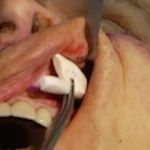
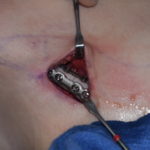
The combination of cheek and paranasal implants is a good facial augmentation combination for this problem. Using four implants (two cheek and two paranasal) placed through two incisions under the upper lip, the midface area can be brought out for greater facial convexity. It is important to secure these implants to the cheek and maxilla with small screws to prevent movement or migration after surgery.  The choice of implant material is not important but good sizing and placement position is.

With an improved midfacial profile, the nose will appear smaller and may not require any alteration. For others, changing the shape of the nose through a rhinoplasty may be simultaneously beneficial. This can be determined before surgery through computer prediction imaging.

 Dr. Barry Eppley
Indianapolis, Indiana


Maxillary, Premaxillary and Paranasal Implants for Facial Augmentation

Tuesday, August 11th, 2009

Facial implants remain a good and simple way to highlight existing or deficient facial anatomy. While everyone  knows the most common facial implants, such as cheeks and chins, there are numerous other areas of the face that can implanted.

In the midface, there are the standard implants of the cheeks and nose. These areas represent convex facial areas that are more commonly implanted because their lack of prominence is well recognized and aesthetically more obvious.

The midface also has areas of concavities that can benefit from bony augmentation. These areas are less well recognized because they are cancavities to begin with. As such, the benefits of their expansion or augmentation are not as apparent.

These midfacial areas are known as the maxillary, pre-maxillary, and paranasal areas. To some degree, these three areas all run together and are contiguous. But they are separate implants for each ‘subarea’. They all address areas of flatness or excess concavity to the midfacial area.

The paranasal implant addresses flatness underneath the base of the nose. This can occur from a congenital problem such as cleft lip and palate but most commonly is just the natural development of one’s face. The midface is flatter overall and one will frequently have cheek deficiencies as well. Most noticeable is that the nose is less pronounced and the base of the nose is positioned behind the projection of the upper front teeth in profile.

Premaxillary implants help bring out the entire base of the nose. They bring projection to the entire nasal base, most prominently the anterior nasal spine area. By using an implant across this area, the nasolabial angle is opened up by being brought forward. This can also give the illusion of increased nasal tip projection as well.

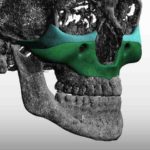
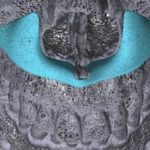
 The maxillary implant is the least used facial implant of them all. It is really an extended paranasal implant which extends back along the maxilla above the roots of the upper teeth. It can also be used for paranasal or base of the nose augmentation but adds more fullness to the entire lower midface as well. Their effects are somewhat similar to what a LeFort I advancement osteotomy (2 to 4mms) may do.

 Like all midface implants, they can be placed through an intraoral approach through a high vestibular incision. The periosteum needs to be elevated and the implants should be secured to the bone with screw fixation.

There are no definite methods of assessment that can determine the indications for these types of facial implants. Their use is based on an artistic or aesthetic sense of facial balance and the results can not be well predicted based on some form of computer analysis or prediction. In my Indianapolis plastic surgery practice, I find that their use is most commonly done with other facial procedures such as rhinoplasty, chin and cheek augmentation and mid- and lower facelifts.   

Dr. Barry Eppley
Indianapolis, Indiana


Paranasal Implants – The Facial Implant You Never Heard Of

Friday, September 26th, 2008

One type of facial implant, and a facial area that can be augmented, is the paranasal area which most have never heard of. The paranasal region is the area just to the side of your nose at the wings of the nostrils.  This is an area that is supported by the bone above the front and canine teeth. I became very familiar this area in treating cleft patients where on the side of the cleft the paranasal region was always deficient and sunken in. I frequently built this area back up with bone grafts or implants as an older child or teenager when I did their reconstructive rhinoplasty (nose ) surgery.  From this experience, I observed how building out this area affected the face.

Cosmetically, some patients have an overall middle of the face deficiency as the upper jaw is a little short and they have flatter cheeks. Other patients have more ideal facial bone development but, as they age, the overlying nasolabial folds become ‘deeper’ as the cheek tissue descends and falls over the more fixed upper lip tissue. In either case, the use of paranasal implants may be aesthetically helpful.

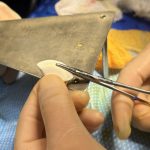
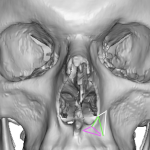
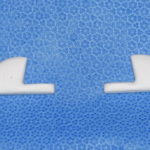
Paranasal imoplants are very small implants, about the size of a quarter, that are placed on the bone right up against the pyriform aperture through a small incision up under the lip. What is the pyriform aperture you ask? If you look at a skull, you will see the nasal passages in the middle of the face. The lower end of this large opening down near the upper teeth is known as the pyriform aperture. You can easily see the bone right next to them which slopes away. By building up this area, you increase the fullness under the side of the nose.

Paranasal implants, while not commonly done, can be useful as an overall strategy with cheek implants to build out the middle of the face or to help soften the deepest end of the nasolabial fold near the nose.

Dr. Barry Eppley

Indianapolis, Indiana


Dr. Barry EppleyDr. Barry Eppley

Dr. Barry Eppley is an extensively trained plastic and cosmetic surgeon with more than 20 years of surgical experience. He is both a licensed physician and dentist as well as double board-certified in both Plastic and Reconstructive Surgery and Oral and Maxillofacial Surgery. This training allows him to perform the most complex surgical procedures from cosmetic changes to the face and body to craniofacial surgery. Dr. Eppley has made extensive contributions to plastic surgery starting with the development of several advanced surgical techniques. He is a revered author, lecturer and educator in the field of plastic and cosmetic surgery.

Read More


Free Plastic Surgery Consultation

*required fields


Pricing

The cost of any type of elective plastic surgery plays a major role in the decision to undergo the procedure(s).

Get Your Quote Here


My Plastic Surgery Story

Military Discount

We offer discounts on plastic surgery to our United States Armed Forces.

Find Out Your Benefits


Categories