EXPLORE
Plastic Surgery
Dr. Barry Eppley

Explore the worlds of cosmetic
and plastic surgery with Indianapolis
Double Board-Certified Plastic
Surgeon Dr. Barry Eppley

Archive for the ‘custom facial implants’ Category

Contemporary Implant Concepts For Surgical Jawline Enhancement

Monday, November 26th, 2012

‘All societies in history were and are preoccupied with facial beauty’

‘ Facial balance and symmetry are the key features to attractiveness’

‘All people regardless of race, class or age share a similar sense of what is attractive’

‘Square jawed males are viewed as more masculine, gain higher ranks in the military and have earlier and more frequent sex’

‘ A square chin and jawline frames the lower face, making it more symmetrical and defined’

‘Defined jaw points and angles are more attractive in both men and women’

These are just a few of the well known facial facts of beauty that are often quoted and specifically address the merits of a strong and well defined jawline. While some have it naturally, the vast majority of us don’t and must seek a surgical solution. While there are a variety of facial implants for jawline enhancement, there are numerous misconceptions about how they work and how a better jawline is achieved.

‘The jawline consists of three parts, the chin, body and angles, all which can be implanted although not equally effectively or in all dimensions’

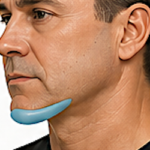
The most well known jawline implant is that of the chin. It is the most frequently done of all facial implants and has been surgically implanted for over fifty years. While the styles and size of chin implants have improved dramatically over this time, chin augmentation only affects the front 1/3 of the jawline. While one could argue that this is the most important part of the jawline and has its U-shape provides very visible forward projection, a chin implant provides no change for the posterior 2/3s of the jawline.(body and angles) Even today’s extended anatomic designs rarely provide any augmentation to the body even though the tail of the implants may lay upon it. Today’s chin implants, while providing projection and even square shapes through increased width, can not provide vertical lengthening…an overlooked feature of chin implant designs.

Three-dimensional chin reshaping can be done by a sliding genioplasty which can add vertical lengthening as well as horizontal projection. In extreme chin deficiencies, an osteotomy can be combined with an implant in front of it for a few more millimeters of projection or the implant can serve to fill in the notching that often occurs in the bone in the prejowl area.

Jaw angle implants are the least performed augmentations of any of the facial prominences. (chin, cheek, nose and jaw angles) While jaw angle implant designs have been around for nearly fifteen years, they have not garnered great use because their surgical implantation is more difficult and aesthetic interest is more recent. Current jaw angle implants produce mainly lateral augmentation (width) which actually is indicated for only the minority of patients seeking jaw angle enhancement.  For someone with a favorably low jaw angle point, width alone may produce a satisfactory enhancement.

Jaw angle deficiencies, however, almost always are the result of a high jaw angle which by definition implies a vertical deficiency as well. Getting current implant designs low enough is difficult if the surgeon does not do adequate soft tissue release and the implant does not have a design that can engage the lower border of the jaw angle for positional security. Jaw angle implant designs that provide both horizontal and vertical augmentation (inferolateral) are most useful to a larger number of patients, particularly men, who seek a more defined and prominent jaw angle area.

While chin implants augment the anterior two-thirds and jaw angle implants enhance the posterior two-thirds of the jawline, the missing area is the middle or the body of the jawline.  Sandwiched between the chin and the jaw angle, the body area has not specific implant for it. There is no ‘connector’ implant between the two. For those seeking a perfectly straight line back from the chin to the jaw angle point, this may be an aesthetic problem. While chin implants have extensions that go back and jaw angle implants have a forward reaching design, the two only connect over the body by overlapping their feathered edges if done together. This is why many jawline enhancement patients may have a visible step-off or break in their new surgically created jawline. For some combined chin and jaw angle patients, this body discrepancy is minimal and not an aesthetic issue.

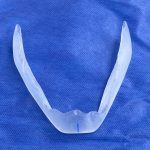
The body gap becomes most manifest when the jawline deficiency has a vertical deficiency component to it, areas that are not optimally augmented with current chin and jaw angle implant designs. When a perfectly straight and well defined jawline is desired, a custom two-piece implant is ideally needed that augments the entire jawline from front to back in a perfectly smooth fashion. These are particularly effective when the lower jaw is vertically short and the implant can be made to extend the entire lower border of the jaw. These ‘wrap-around’ jawline implants can produce some dramatic jawline changes.

The most unique jawline problem that can only be addressed by custom implants is when the entire jawline is vertically deficient, creating a small lower face. This almost always is associated with a lot of overbite of the anterior teeth, indicating that the lower jaw is small and fits partially inside the upper jaw. This creates an overclosing of the lower jaw making it too short vertically. Making a custom implant that fits only on the lower border of the jaw and lengthening it from front to back is the only effective solution.

Jawline enhancement must be assessed carefully in every patient to get the right jawline implant(s) design and size. For many patients, a chin implant may only be needed. For others seeking a three-point prominence change, off-the-shelf chin and jaw angle implants will suffice. Improving implant designs and sizes will make using this implants even more effective in the near future. For those seeking a completely new jawline with existing front to back deficiencies, wrap around jawline implants are designed and custom made for each patient’s specific jaw anatomy.

Dr. Barry Eppley

Indianapolis, Indiana

The Role of Custom Facial Implants in Aesthetic Facial Surgery

Friday, August 17th, 2012


Implants provide a wide array of options for facial augmentation. While initially only a chin implant was available forty years ago, today there are over fifty different styles and shapes that are available in more than one material composition. From the chin to the forehead, the options for bony enhancement now cover such obscure areas as the tear trough, paranasal and geniomandibular  areas. Such facial implants play a very valuable role in aesthetic facial augmentation whether it is the younger patient seeking a structural facial change or the older patient  in which an implant complements soft tissue lifting procedures.

Despite the tremendous diversity of facial implants, off-the-shelf styles and sizes can not fill all patient aesthetic needs. There are certain types of aesthetic problems in which stock implants are inadequate such as facial asymmetries, congenital and traumatic deformities and failed results using commercially-available implants. While stock facial implants, particularly those composed of silicone, are easy to intraoperatively shape and ‘customize’, the judgment of how they are to be shaped is still a matter of artistic adaptation.

The use of custom facial implants offers real advantages in challenging cases of facial augmentation. I classify custom facial implants into four types; 1) intraoperative modification of stock implants, 2) preoperative stock implant modification on a standard anatomic model, 3) preoperative stock implant modification on a patient-specific anatomic model, and 4) fabrication of an implant on a patient-specific anatomic model. Type #1 and #2 custom facial implant approaches have been done for decades and may even be questionable as to whether they are truly custom implants. Types #3 and #4 are a truly custom implant approach.

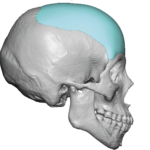
The basis of a truly custom facial implant approach is a patient-specific anatomic model. This requires the patient to first receive a 3-D facial CT scan based on a 1mm slice-taken protocol. These images are then sent to a manufacturer of craniofacial models. The manufacturer that I use is  Medical Modeling (Golden, CO) although there are others. The model can be made in either an Osteoview style (opaque) or a Clearview style. (clear acrylic) In the Clearview style, teeth, nerves, plates and screws and other implants can be colorized (red) so they stand out from the clear bone structures. The Osteoview is satisfactory if a custom implant is needed and the patient has not had prior surgery. The Clearview model is preferred when prior bone or implant work has been done and the bony anatomy has been altered.

Off of these models, the custom facial implants are made. While most patients think that there is a computer program that makes the implants, and this certainly exists, the cost and availability of this technology makes it currently not practical in aesthetic facial surgery applications.  Custom implant designs and prototypes are made by hand. I mold, shape and carved them out of clay or silicone elastomer which air dries to a hard set. If needed, they are further shaped and contoured by diamond wheels on a small hand drill. Finally they are covered by a lacquer which dries to a clear coat.

As part of this process, I often share images with patients of their implants in the fabrication process by e-mail or they may come in to see and handle the implant prototypes. It is important in the custom implant fabrication process for patients to participate in the decision process about the design. Once the design is agreed upon, the implant(s) are sent to a manufacturer for fabrication. Most custom implants can only be made from silicone. For many custom facial implants this is the best material  because their differing shapes and sizes may make them difficult to place. Flexibility and lack of frictional resistance on insertion are important implant insertion properties in any facial implant but is of critical importance in many custom designs. Besides the obvious benefit of creating an implant design that is as accurately accurate and symmetric as possible, the custom design process can also add features that make them able to be more effectively secured to the bone by screw fixation.

From the time that a 3-D anatomic model is obtained, a three week period is usually needed from design until the sterilized implants are returned from the manufacturer and ready for surgery. Depending upon the number of implants, the cost of custom designed facial implants can be from $3500 to $7500 in addition to other surgical costs.

Dr. Barry Eppley

Indianapolis, Indiana

Case Study: Orbital Floor Reconstruction with a Custom HTR Implant

Monday, July 19th, 2010

Background: Orbital defects are common from a variety of causes. Whether it be trauma (orbital floor fractures), congenital defects or tumor resection, the most common problem is that of loss of bone support at the floor level. As the bony orbit is a box (really a pyramid turned on its side), lowering the floor affects the position of its primary content, the eye. As the eye drops down, it causes double vision as the eyes no longer have binocular visual capability.

Reconstruction of the orbit floor has been successfully done by about every conceivable method. From autogenous bone grafts to synthetic implants, these ‘spacers’ build up the orbital floor and bring the eye up to a position closer to a horizontal level to the opposite eye. While there are advocates for each orbital reconstruction method, the frank answer is the best method is the one that works. The surgical method is secondary to the skill and experience of whomever performs it.

One craniofacial reconstruction method not commonly used or discussed, but equally effective, is that of fabricating a computer-generated implant. Using a 3-D model made from a patient CT scan, an implant can be made that mirrors the bone level of the opposite side. While this approach takes more time and expense, the exactness of this method may be justified in more complex orbital deformities.

Case Study: This is a case of a 60 year-old man who had a long-standing orbital problem after resection of an esthesioneuroblastoma ten years previously. Much of the orbital floor has been removed from the tumor resection as the inner eye bone as well. He had received radiation afterward and suffered from osteoradionecrosis and infections of the remaining orbital bone as well. It was not until seven years after his initial surgery that his eye drifted lower resulting in double vision. A 3-D CT scan and model showed that  all of the inner half of the orbital floor bone was missing and the outer half was lower than the opposite normal side.

A custom orbital implant was made from the material, HTR. HTR (Hard Tissue Replacement) is a porous acrylic material that has a very successful twenty year history of clinical use in craniomaxillofacial surgery. It is usually used as a custom-fabricated implant known as HTR-PMI. (HTR Patient Matched Implant)

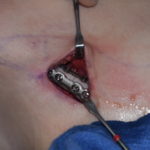
The implant was placed through a lower eyelid blepharoplasty incision. The scarred orbital contents was carefully dissected out to avoid entering the airspace at the inner aspect of the orbit from the previous resection. Once the orbital contents was released, the implant was tried in, trimmed as needed, and then secured to the outer orbital rim with 1.5mm titanium plates and screws. The eyelid incision was closed by orbicularis muscle suspension and lateral canthal suturing for support and to resist scar contracture afterwards.

There was a fair amount of orbital swelling as expected that required about six weeks until the tissues returned to normal. At that time, the eye was at a completely horizontal level to the opposite eye. The double vision was not completely eliminated but it was much improved.

Case Highlights:

1) Orbital reconstruction, particularly that of the lose floor bone, can be successfully done by a variety of materials. Getting the floor back up to a level to the opposite side can help improve double vision symptoms.

2) Custom HTR implants can be made from a 3-D model created off of the patient’s  CT scan. While some adjustment of the implant is almost always necessary, one has a good place to start that is anatomically accurate.

3) The end goal of orbital floor reconstruction is even eye levels between the normal and deformed sides. Success is defined by that criteria, not the method used to get there.


Dr. Barry Eppley

Indianapolis, Indiana


Dr. Barry EppleyDr. Barry Eppley

Dr. Barry Eppley is an extensively trained plastic and cosmetic surgeon with more than 20 years of surgical experience. He is both a licensed physician and dentist as well as double board-certified in both Plastic and Reconstructive Surgery and Oral and Maxillofacial Surgery. This training allows him to perform the most complex surgical procedures from cosmetic changes to the face and body to craniofacial surgery. Dr. Eppley has made extensive contributions to plastic surgery starting with the development of several advanced surgical techniques. He is a revered author, lecturer and educator in the field of plastic and cosmetic surgery.

Read More


Free Plastic Surgery Consultation

*required fields


Pricing

The cost of any type of elective plastic surgery plays a major role in the decision to undergo the procedure(s).

Get Your Quote Here


My Plastic Surgery Story

Military Discount

We offer discounts on plastic surgery to our United States Armed Forces.

Find Out Your Benefits


Categories