EXPLORE
Plastic Surgery
Dr. Barry Eppley

Explore the worlds of cosmetic
and plastic surgery with Indianapolis
Double Board-Certified Plastic
Surgeon Dr. Barry Eppley

Archive for the ‘chin osteotomy’ Category

Case Study: Extreme Chin Augmentation with Combined Osteotomy and Implant

Monday, December 3rd, 2012


Background: Chin augmentation is a very common plastic surgery procedure that helps bring into balance the lower face with more projecting upper facial features. It is by far most commonly done with synthetic implants that provide varying amounts of increased horizontal projection as well as some width changes. Less frequently, sliding genioplasties (chin osteotomies) are done for chin augmentation when more horizontal projection is needed than implants can provide and/or vertical lengthening is aesthetically beneficial as well.

In more extreme cases of chin deficiencies, neither implants or an osteotomy is really adequate. When the chin is really short, this indicates that the entire lower jaw is underdeveloped and an overlying malocclusion (bite deformity) exists as well. While this type of patient should ideally have orthodontics and subsequent orthognathic surgery for jaw correction, this may not be an option for many so afflicted patients. While one could argue that an implant or an osteotomy is better than nothing, and that is most certainly true, they will fall far short of the needed amount of augmentation.

Extreme cases of chin deficiences require a novel approach to get visible and satisfactory results that often must approach 20mms of increased horizontal projection. Combining an osteotomy with an implant is relatively unprecedented although there is no reason why they can not be done together. The implant can merely be placed on the front edge of the osteotomy which is naturally denuded of soft tissue for the execution of the bony cut. Because there is no defined soft tissue pocket, it would be critical to secure the implant to the bone to avert displacement later.

Case Study: This 35 year-old male presented for chin augmentation. He had seen other plastic surgeons who told him his chin was too small for an implant. He did not want at this point in his life to undergo the orthognathic surgery process. In addition, he did not have the quality of dentition that would support in good health a prolonged course of orthodontics. By measurement in photographs using the Frankfort horizontal plane, his soft tissue chin point was deficient by 29mms from an ideal horizontal position. At this amount of horizontal deficiency, he also had a vertical chin deficiency as well.

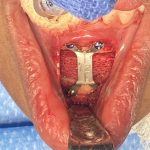
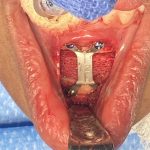
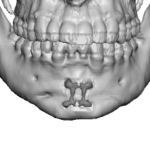
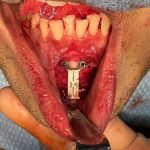
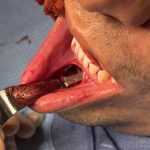
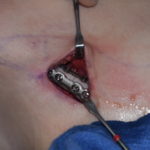
Through an intraoral approach, an obliquely-oriented horizontal chin osteotomy was done staying 5mms below the mental foramen. The chin was downfractured and then advanced and held into a maximally advanced position with a step plate secured with screws above and below the osteotomy line. A maximal advanced position is one in which there still remains a small amount of bony contact between the front edge of the upper chin bone and the back edge of the advanced chin segment. The step plate was bent downward to create some vertical lengthening as well.

To get more chin projection than just that of the bone, a 7mm extended synthetic implant was placed on the front edge of the advanced chin bone. It was secured to the chin bone with a screw on each side of the midline. The wings of the implant extended back along the advanced chin bone to ensure that they covered the end of the osteotomy site where a bony notch typically occurs. The mentalis muscle was then reattached and closed in two layers with a single mucosal layer closure.

His postoperative course was typical for any sliding genioplasty patient. There was swelling and bruising along they jawline and neck that persisted for about three weeks after surgery. When seen at three months after surgery, all swelling had resolved and he had no residual mental nerve numbness. He had dramatic improvement in the appearance and shape of his chin, even if it still was mildly deficient. At ten years after his surgery, he has not had any implant or bone healing problems.

Case Highlights:

1)      Severe chin deficiencies are not optimally treated by synthetic implants or osteotomies alone. Neither are capable of increasing the horizontal chin projection more than approximately 15mms.

2)      Combining a sliding genioplasty with an implant in front of it can achieve horizontal projection increases of up to 20mms.

3)      Combining implants with a chin osteotomy requires screw fixation of the implant to the advanced chin segment and long enough wings of the implant to cover the notch at the end of the osteotomy cut.

Dr. Barry Eppley

Indianapolis, Indiana

Case Study: Correction of Bony Chin Asymmetry

Thursday, June 14th, 2012

Background: The lower 1/3 of the face or the jawline plays a major influence on the shape and appearance of the face. The position and shape of the chin is the dominant feature of the jawline, sticking out like the nose does in the central third of the face. When the chin is too weak or too strong, it creates a strong impression and can lead to the desire for the very common chin augmentation procedure or the less commonly performed chin reduction.

But the chin really is a four-dimensional facial structure that can have balance and proportion problems that are more than just being too short or too long or too short or too tall. The chin can also be asymmetric or crooked, as seen by being deviated from a line drawn down from the nose, upper lip and midline of the upper teeth. When the chin is off to the side the face looks twisted and shorter on the deviated side.

While there can be soft tissue deformities that are the cause of chin asymmetry (e.g., involuted hemangioma, lymphangioma or just plain soft tissue differences), most are caused by a bony deficiency. This is commonly a developmental deformity of the entire lower jaw as the chin position is an indicator of overall jaw development in most cases. In some cases orthognathic surgery is needed to realign the entire lower jaw and with that movement the bony chin becomes more aligned as well.

But bony chin asymmetries can be associated with near a normal bite relationship or orthodontically corrected bites. This eliminates the possibility of moving the entire jaw for chin realignment and the focus must change to moving just the chin bone itself. This uses a variation of the well known sliding genioplasty or chin osteotomy. Rather than sliding the chin tip forward, the bone is slide towards the longer side of the face back to the midline. Often one side of the repositioned chin must be vertically lengthened or tilted to equal out the sides of the jawline to the sides of the chin.

Case Study: This 25 year-old female had long-standing chin asymmetry. She had orthodontics as a teenager with a corrected Class II occlusion. With frontal chin asymmetry, she also had a horizontal chin deficiency as well. By measurements, the chin was deficient by 9mms in horizontal shortness and 7mm deviated to the left side. A modified and asymmetrically placed chin implant was considered but the chin deformity was deemed too great to provide a good result with this approach.

Under general anesthesia she underwent a sliding genioplasty through an intraoral approach. The downfractured chin segment was moved forward the desired 9mms asymmetrically (rotated as it came forward with the short facial side moving further than the longer opposite side. This allowed the midline of the chin to move a full 7mms to fall into the facial midline. The chin was stabilized with a step chin plate and screws.

Her postoperative course had the typical chin swelling of which 50% was gone by three weeks and 90% by six weeks after surgery. At three months after surgery, her horizontal chin was dramatically enhanced and achieved the desired goal. Her chin point was in the midline but asymmetries existed on each side of the chin with a notch on they jawline from where the chin was moved and a soft tissue deficiency over the tail of the chin osteotomy on the original longer facial side. She went on to have revisional surgery to improve these residual chin asymmetries.

While moving the tip of the chin to the midline by an osteotomy is the correct treatment in significant chin asymmetries, there are often residual deficiencies at the lateral ends of the chin osteotomy and jawline that will exist no matter how well aligned the midline of the chin is. These can be addressed by either augmentation or fill-in with hydroxyapatite granules at the time of the osteotomy (which are often not seen then) or treated secondarily in a revisional procedure. It is best to wait a full three or six months after the procedure to fully appreciate the chin shape and give the patient time to adjust to their new facial look.

Case Highlights:

1) Asymmetry of the chin is most commonly caused by a deviation or deformity of the lower jaw. Rarely is it an isolated soft tissue problem.

2) Correction of chin asymmetry is best done with a shifting or rotational osteotomy, aligning the midline of the chin to superior facial midlines.

3) While an osteotomy technique centers the midline of the chin and corrects any horizontal deficiency, the sides of the chin may still have some asymmetry due to more posterior jawline differences between the two sides.

Dr. Barry Eppley

Indianapolis, Indiana

The Three-Dimensional Assessment of the Chin in Rhinoplasty

Saturday, November 13th, 2010

An important part of any rhinoplasty evaluation is that of the chin. Patients who pursue rhinoplasty to make their nose smaller should not be surprised that they may have a comparatively smaller chin by facial proportion assessment. This is because a ‘weak’ chin can make a nose appear more prominent. In patients that come in because they feel that their nose is too big, I ask them close to the end of the consult to take a close look atyour chin. It is simply a question of facial balance. A small or receding chin can make the nose appear bigger than what it really is. This is similar to the influence of the forehead on the appearance of the nose. A sloping or recessed forehead can make nasal projection seem bigger than what it really is.

The balance of the chin to the nose is almost always done in a profile view. A vertical line is mentally (or physically done on a picture) drawn down from the edge of the lower lip and the horizontal chin position is assessed by where it is in reference to this line. If the tip of the chin falls behind this line, chin augmentation will usually be aesthetically helpful. Conversely, if the tip of the chin is beyond this vertical line, chin reduction may be needed. Classic cephalometric analysis and tracings use the glabella, or lower portion of the forehead between the eyebrows, as the place to drop this vertical line to determine proper chin position. But the lower lip is easier and a more accurate reference.

But chin assessment in rhinoplasty should not be limited to just the profile view. This is an overly simplistic approach. Like the nose, chin assessment must be evaluated in the frontal view as well. The width and shape of the chin is also important. A more narrowed nose with a wide chin is not aesthetically ideal, particularly in a female. Conversely, too narrow a chin in a male even if brought ideally forward is similarly mismatched to many results of a male rhinoplasty.

The width of the chin is not as established an ideal as that of horizontal chin projection. But there are some guidelines to go by. The width of the chin should not usually be wider than a vertical line drawn down from the inner aspect of the iris in females or from the center of the pupils in males. There is a central pad of the chin that is discernible in most patients and it is usually close to the same width as that of the outside edge of the nostrils, known as alar width. The central pad chin width is not really changeable but the outside or lateral width of the chin is. A chin implant, based on the style chosen, can help widen or narrow the chin’s width. A chin osteotomy can do the same. Most chin osteotomy advancements will actually narrow the chin as it comes forward, unless midline expansion via a separate bone cut is made.

Rhinoplasty and chin augmentation are close cousins that impact each other’s appearance. Like the nose, the chin must also be assessed in three dimensions as well.

Dr. Barry Eppley

Indianapolis Indiana

Case Study: Combined Vertical and Horizontal Chin Lengthening in Men

Monday, August 30th, 2010

Background: The chin is one of the facial prominences and the most noticeable part of the lower jaw. Horizontal chin shortness has been recognized for many decades and has largely been improved through the use of synthetic implants. Placing an implant on the front edge of the bone is a simple and relatively uncomplicated method of horizontal increase.

Great results can be seen in many profile examples of chin implant augmentation but the chin and the face is more than just a side view. Patients see themselves more commonly in the front view and this perspective is becoming appreciated in chin surgery.The other dimensions of vertical length and transverse width have greater impact in the frontal view and also have an impact on chin appearance. Since a strong chin is a well recognized male facial characteristic, the chin should be enhanced from three-dimensional changes.

Case: This is a 28 year-old male who previously had an implant placed for a short chin. While there was an improvement, he was still not happy with the final appearance. He had an implant that provided 8mms of horizontal advancement. In assessing his chin with computer imaging, his chin was slightly short horizontally by 3mm to 4mms but was also vertically deficient by 5mm to 6mms. He also thought his chin was wide as well.

Given the needed changes to achieve a more pleasing three-dimensional change, it was decided that it could not be predictably done by a bigger implant. An implant could not provide enough vertical length improvement. An osteotomy was planned to not only make these desired changes but to replace what the existing implant has already created.

An intraoral approach was used to both remove the existing implant as well as perform the osteotomy. The existing pocket of the implant had already made most of the dissection needed for the osteotomy cuts. The capsule of the implant pocket was removed, exposing the raw bone surfaces. With a reciprocating saw an angled horizontal cut was made below the mental nerves. The chin segment was downfractured and then moved forward 11mms and opened up vertically 5mms. The backledge of the chin segment was put to the bone of the upper chin bone as a point of rotation for the vertical opening. It was secured using a custom-bent chin osteotomy plate. The chin implant was cut down in size and used as a fill for the step of the chin osteotomy. This was done to prevent further deepening of the labiomental crease.

Chin osteotomies create more swelling after surgery than implants. It usually takes about ten days after surgery until the chin returns to a more normal appearance and three weeks for most of the swelling to go away. While many patients can expect some temporary lower lip numbness, he experienced very little. The improvement in the side view shows the desired moderate horizontal advancement.

In the front view, however, the increase in vertical length is more apparent and gives the chin better facial balance. While it is often stated that the lower face should be 1/3 of vertical facial height, in men the lower facial height should be slightly greater than 1/3 of total facial height.

Case Highlights:

1) Changing the shape of the chin is more than just about horizontal advancement. Vertical length and width of the chin must also be considered for the best aesthetic result.

2) Mild vertical lengthening of the chin can be done with an implant that is secured on the inferior edge of the bony chin.

3)When more than a few millimeters of chin lengthening is needed, an opening osteotomy is best. It can be done to only lengthen the chin or bring it forward as well as with a vertical increase.

4)When a chin implant has failed to achieve the desired aesthetic outcome, a chin osteotomy can be considered which offers greater options for some chin changes.

Dr. Barry Eppley

Indianapolis Indiana

Case Study: Chin Implant Removal and Osteotomy Replacement

Sunday, December 20th, 2009

Background: Like all surgical implants used in the body, chin implants do have some long-term effects. This is particularly true when they are used improperly or are inadequately positioned. Long-term effects could be underlying bone resorption and loss of horizontal projection. This is most commonly seen with the chin implant is positioned too high and rests in thinner alveolar bone closer to or over the tooth roots.

Case Study: This is a 50 year-old female with the desire to improve her chin position. She had suffered with a short chin her entire life. But she had a history of having had a rhinoplasty and a chin implant in another country when she was 21 years of age. Despite this early surgery providing some improvement, she was still never really satisfied.

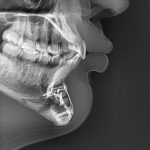
Because she was currently in orthodontics for teeth straightening (more older people are doing it than ever before, I have even see a 65 year-old in braces!), a lateral cephalometric x-ray was available for review. It clearly shows a small chin implant that is positioned above the most anterior point of the bone. The implant has eroded into the bone by about 50%, exhibiting a well-described phenomenon known as implant-related ‘pressure resorption’.

Her surgical options were to remove and replace her old implant with either a new larger one in a better position or to move the chin forward (advancement osteotomy) after implant removal. While either approach is a better option than what she had, the amount of chin advancement that she needed made a bone-based operation the best choice. (it could move the chin the furthest forward without using a lot of foreign-material to do it)

The operation was performed through an intraoral approach. The old chin implant was found exactly where the x-ray showed it to be, on the bone at the level of the labiomental crease significantly above where it should ideally be placed. It has settled into the bone over time from the pressure of the overlying soft tissues.

The implant was removed and a horizontal chin osteotomy was performed. The chin bone was brought forward as much as possible, keeping the back edge of the chin bone against the front edge of the bone above the moved segment. It was plated into this new position with a specially-designed chin plate with a built-in movement of 12mms forward.

While a bigger advancement could have been tolerated, the aesthetic change was a big improvement. It would have been possible to enhance the advancement even further by placing an implant in front of the osteotomized chin bone. When done together, I call this procedure an ‘extreme chin augmentation’.

Case Highlights:

1)      In cases of severe chin shortness, a large implant over time will eventually settle some amount into the underlying bone.

2)      Chin implants placed through the mouth can move upward from their desired position on the pogonion. This can be avoided by screwing them into position.

3)      When the chin deficiency is large (> 10mms), it may be better to consider a chin osteotomy long-term rather than an implant in some cases.

Dr. Barry Eppley

Indianapolis, Indiana


Chin Enhancement – Implant vs. Osteotomy

Saturday, September 19th, 2009

Chin augmentation is a popular procedure for bringing out the prominence of the lower third of the face. It can have a powerful effect on the facial profile, particularly in men. Most commonly, the chin is brought forward in a horizontal direction elongating the jawline and improving the look of the neck angle which lies underneath.

Chin augmentation can be done by two completely different methods and is the only facial area which can be enhanced by such diametric approaches. By far, the placement of a chin implant on top of the bone makes up how it is done by most plastic surgeons. Using a variety of different implant options, the chin can be quickly and reliably brought forward in similar dimensions and shape of the implant selected. Conversely moving the chin bone, known as an osteoplastic genioplasty, can also be done to create a similar effect. Cutting the bone is technically more involved and takes longer, but in experienced hands is just as reliable as an implant.

These two chin surgery methods have their proponents and the merits of each have been debated for years in plastic surgery circles. Chin implants are usually preferred because of their ease of placement and ‘easier’ recovery. But the choice of either approach should not be based on what is easiest but what is most anatomically correct and will have the least long-term risk of complications. Each has its own place in the properly selected patient.

For small to moderate amounts of horizontal advancement, regardless of patient age, the advantages of a chin implant makes it an easy choice. Moving the chin bone for the sake of 5mms or less of movement is not worth the greater complexity of the procedure or its increased risk and costs.  When the amount of chin advancement starts to get closer to 8 and 10mms, the consideration of an osteotomy starts to be a good consideration. This is particularly poignant in the younger patient in their teens and twenties. Large chin implants over a long lifetime are not without some risk of eventual problems.

What may tip the balance for an osteotomy over an implant is if there is a vertical dimension issue along with being horizontally short. While an implant can bring the chin forward, it can not obviously shorten it. Shortening a long chin can only be done by removing a wedge of bone with an advancement osteotomy. Conversely, however, an implant can lengthen a chin somewhat as it brings it forward. By positioning and securing the implant on the lowest edge of the bone, a few millimeters of vertical height can also be obtained. But more significant lengthening is best done by osteotomy where the whole chin complex and its attached soft tissue are brought down with it. This makes the vertical change in the chin more natural and physiologic.

This being said…which is better…implant or osteotomy? The answer is the blending of the considerations of patient age, the dimensions of the chin deficiency, and one’s tolerance of the amount of physical recovery. Large horizontal deficiencies, vertical changes that are needed, and a young age make the osteotomy preferred over the more commonly used method of implant augmentation.

Barry L. Eppley, M.D., D.M.D.

Indianapolis, Indiana

Vertical Chin Lengthening by Osteotomy and Downgrafting

Saturday, July 4th, 2009

When one thinks of a short or small chin, most are envisioning it deficient in the horizontal dimension. (profile view) While this does make up the majority of cases of chin augmentation, there are other dimensions in which a chin can also be ‘short’. The second most common cause of chin deficiency is in the vertical dimension or its height.

A vertically short chin is apparent in several ways. First, there is an apparent small lower face compared to the middle and upper face. As the aesthetically balanced face is divided into equal thirds, the lower third (between the lower lip and the bottom edge of the chin) will look small in height compared to the rest of the face. Second, the labiomental crease (the groove between the lower lip and chin prominence) will often be indented further in or deeper than normal. Lastly, a vertically short chin may also be associated with an underbite although not exclusively so.

Correction of the vertically short chin is primarily done by a chin osteotomy and downgrafting. Placing a chin implant further down on the chin prominence may help a little (a few millimeters) but can not make a big difference. Changing the vertical length of the chin bone addresses the actual problem and is far more effective.

A chin osteotomy is done through an incision on the inside of the lower lip. The chin bone is easily and quickly exposed and the mentalis muscle lifted off. A saw is used to make a horizontal cut way below the roots of the front teeth. The lower end of the chin bone is dropped down and the predetermined amount of vertical length needed (bone gap) is maintained by a small titanium plate and screws. This bone gap is best grafted and the usual choice is hydroxyapatite blocks wedged into the open space. These blocks will eventually become incorporated into the new bone which will eventually fill in between the cut ends of the chin. The mentalis muscle is resuspended up over the plate and the incision closed with dissolveable sutures.

This vertical chin lengthening method can be opened up to almost any distance, from a few mms to up to over a cm. As a general rule, it usually must be at least 6mms or more to see an appreciable change in the height of the chin. The amount of chin lengthening needed can be precisely determined beforehand by simple photographic analysis and a millimeter ruler. Cephalometric tracings are the most exacting method but does require that type of orthodontic x-ray to be available.

While the cost and recovery from a chin osteotomy is more than from a chin implant (an extra week or so of prolonged swelling and chin stiffness), its superior results are worth this short-term sacrifice.  Bringing the lower third of the face into proportionate balance can make for a very pleasing facial change in both profile and frontal views.

Dr. Barry Eppley
Indianapolis, Indiana


Vertical Lengthening of the Short Chin

Sunday, June 7th, 2009

Chin augmentation is a multi-dimensional procedure. While most chin enhancements are for horizontal movements, there is a small subset of people who need vertical lengthening only or a combination of vertical and horizontal increases. When the chin is short in height, the distance between the lower lip and the bottom of the chin is small. Careful inspection will reveal that the lower lip looks is slightly folded over, the crease below the lip (labiomental crease) is deep, and the chin looks small even though it may have good projection.

Vertical chin lengthening can be done by either an implants or actually lengthening the bone. Both can be effective but patient selection is critical.

Minor amounts of chin lengthening can be done with an implant. But the implant must be placed off the front edge, oriented more downward than normal. Because of this positioning on the ledge, so to speak, it is important that it be screwed into place. When an implant is placed in this position, I always use two screws spaced as far apart and as far back as the incision length will permit. To not have the increased chin length look too narrow, an extended or more wrap around chin implant style is used.

It is also possible to make a custom chin/jaw implant that is designed off of a computer model to make for vertical lengthening done completely by an implant….and it can be quite significant. In my Indianapolis plastic surgery practice, I have done this a handful of times but the motivation to custom make such an implant needs to be considerable given the increased expenses to do so. Such ‘motivation’ should be that the change wanted in the chin or jaw shape could not more easily be obtained by a bone procedure. (e.g., vertical lengthening of the jaw from one angle to the other)

When the chin height is more significantly short, a lengthening genioplasty is the proper procedure. From an incision inside the mouth, the chin bone is horizontally cut below the tooth roots. It is then lengthened in a cantilever fashion, making an open wedge of whatever length (bone gap) that one needs. The upper and lower bone edges are secured with small titanium plates and screws across the opened gap. Whether this bone gap needs to be filled with bone or an artificial graft material is a matter of debate. At most, I may put some porous hydroxyapatite blocks in two areas off the midline just to be absolutely sure the gap is maintained forever. Although the plates spanning the opened gap are pretty secure. Graft or no graft, this bone defect will fill in and heal on its own within a year after surgery.

Vertical lengthening of the chin increases lower facial height to make for a more balanced face. It also makes the labiomental crease more shallow and often improves the neck angle as well.

Dr. Barry Eppley

Indianapolis, Indiana

Chin Asymmetry – Options in Correction

Wednesday, June 3rd, 2009

The location and prominence of the chin makes it a most visible facial part. It has a significant influence on the appearance and perception of one’s face. While it is recognized that a chin can be horizontally short or too long, and even vertically too short or too long, its position and shape is also impacted by its width. The transverse position and shape of the chin affects its perception of being midline or symmetric.  An asymmetric chin is easily identifiable  and can make the face look skewed or off center.

When the chin is asymmetric, the first step is to determine whether this is a result of an overall jaw asymmetry or whether it is restricted to just the chin. Some jaw problems are correctable and the chin will swing back to the midline when that is done. But while many chin asymmetries are due to one side of the jaw being shorter than the other, the patient may have no desire to undergo such corrective jaw surgery.

Chin asymmetry can be corrected through two basic approaches. Camouflage it with the placement of an implant on top of the bone or move the chin bone itself. (osteotomy)  Either approach has its advantages and disadvantages.

While the use of an implant is simpler, it is more difficult to get good and accurate placement in some defects. Unlike a typical chin implant placement, the implant placement in chin asymmetry must be…..asymmetric. Either the implant must be placed in an asymmetric fashion or the implant itself must be shaped asymmetrically.  That determination must be made intraoperatively and often involves a little bit of both. The modified chin implant must be secured into position with not one, but two screws, to ensure it does not move from its critical position. This works best when the chin has a transverse or frontal deficiency. While most chin implants are placed through a small incision underneath the chin, correction of chin asymmetries with implants should be done from inside the mouth where the entire shape of the chin can be bettered appreciated from above.

Many chin asymmetries, however, have both a transverse and vertical component to it. This particularly true when the chin asymmetry is significant or one side of the jaw is obviously different than the other side.This is when an osteotomy is preferable. The chin bone can be cut, slide over, and opened vertically (or a wedge taken and closed down if the asymmetry is because it is too long) and secured into this new position with small plates and screws. Bone grafts are rarely necessary as most chin gaps will fill in and heal on their own. Chin osteotomies are always done from an incision inside the mouth.

In more minor cases of chin asymmetry due to overgrowth, a simple reduction with a burr can be done. But this method requires that the soft tissue may need to be resuspended to avoid postoperative sagging. Also burring down is usually left effective than one usually thinks while doing it. For these reasons, I prefer an intraoral chin osteotomy and wedge removal to avoid these potential problems.

 Dr. Barry Eppley

Indianapolis, Indiana

Extreme Chin Augmentation with Combined Implants and Osteotomies

Wednesday, May 20th, 2009

The treatment of a short chin is most commonly done with a synthetic implant. When the chin deficiency becomes larger, some plastic surgeons will move the small chin bone forward (osteotomy) to avoid using a larger chin implant. Both approaches are highly successful for chin augmentation and the use of either one is based on the degree of chin shortness, the surgeon’s experience, and the amount of surgery a patient wants to undergo.

In some rare cases of chin deficiency, neither an implant or an osteotomy are completely satisfactory. The magnitude of the chin deficiency may not allow the chin to come close to the most aesthetically ideal horizontal position. The thickness of the chin bone may be less than the chin deficiency or off-the-shelf chin implant options do not have enough thickness. While custom-designed chin/mandibular implants are one option for this problem, the amount of synthetic material needed may not be savory for some patients or their plastic surgeons.

In such cases of large chin deficiencies, the fundamental problem is always that the overall mandible is short. These patients are best treated by orthodontics and subsequent mandibular advancement osteotomies, with or without additional chin augmentation done at the same time. However, some patients do not have the resources for this standard approach or are seen later in life when they are not willing to undergo that multi-year treatment plan.

One option I have found helpful in my Indianapolis plastic surgery practice in these large chin deficiencies is to do a combination of an osteotomy with an implant in front of it. This type of ‘extreme’ chin surgery gives a horizontal result that is greater than either one alone. Adding an implant to an osteotomized and stabilized chin segment adds little extra time and no extra dissection to the procedure. The implant should be stabilized onto the chin bone with screws as it will easily displace if not done so.

Over the years, I have performed 11 such cases without any postoperative problems. I have observed no infections, implant shifting, or problems with the osteotomy healing. The chin skin will look quite stretched for awhile but it does eventually relax. Feeling to the lip and chin will be affected for awhile, primarily due to the osteotomy, but I have had no long-term complaints about permanent numbness.

Extreme chin surgery is reserved for those patients who cannot undergo proper treatment for a short jaw but still want aesthetic improvement. A large underbite will still exist after surgery. This combination of chin osteotomy/implant offers a less expensive option than a custom-design implant with less implantation of synthetic material.   

Dr. Barry Eppley

Indianapolis, Indiana


Dr. Barry EppleyDr. Barry Eppley

Dr. Barry Eppley is an extensively trained plastic and cosmetic surgeon with more than 20 years of surgical experience. He is both a licensed physician and dentist as well as double board-certified in both Plastic and Reconstructive Surgery and Oral and Maxillofacial Surgery. This training allows him to perform the most complex surgical procedures from cosmetic changes to the face and body to craniofacial surgery. Dr. Eppley has made extensive contributions to plastic surgery starting with the development of several advanced surgical techniques. He is a revered author, lecturer and educator in the field of plastic and cosmetic surgery.

Read More


Free Plastic Surgery Consultation

*required fields


Pricing

The cost of any type of elective plastic surgery plays a major role in the decision to undergo the procedure(s).

Get Your Quote Here


My Plastic Surgery Story

Military Discount

We offer discounts on plastic surgery to our United States Armed Forces.

Find Out Your Benefits


Categories