EXPLORE
Plastic Surgery
Dr. Barry Eppley

Explore the worlds of cosmetic
and plastic surgery with Indianapolis
Double Board-Certified Plastic
Surgeon Dr. Barry Eppley

Archive for the ‘cheek implants’ Category

Options for Natural Cheek Augmentation

Tuesday, March 19th, 2013


One of the key features of an attractive and youthful face is the cheek area. The desire for fuller cheeks, however, is driven more than just by that of model and celebrity faces. Part of the aging process is losing volume (fat) in the cheeks and temple areas, creating more hollowed or gaunt type look. For those that start out with thinner faces, this process is more accentuated even earlier in the aging process. This form of facial aging can not be treated by any form of a facelift or tissue shifting approach. It requires restoration of facial volume.

So it is no surprise that plastic surgeons over the years have used every available option in their armamentarium to reshape and lift the cheek area. While once only able to be treated by synthetic implants up to the early 1990s, injectable fillers of differing compositions for cheek enhancement became a dominant force over the past two decades as they have surged in popularity. The use of autologous fat in just a few short years has also become now a major tool for use in the cheek.

The single greatest advantage to synthetic injectable fillers for cheek enhancement is its immediate result. The hyaluronic acid-based fillers, such as Restylane or Juvederm, offer the greatest margin of safety because of their lack of inflammatory response and assured resorption profiles. Other fillers such as Radiesse and Sculptra offer longer results but a somewhat higher risk of soft tissue reactions to their particulated content. Composition aside, the biggest disadvantage to fillers is that they are temporary. (which is also their advantage) This makes them expensive to maintain over time if one likes the result. But they are actually a low cost approach to doing a trial cheek enhancement that is completely reversal. Using a microcannula delivery technique, injectable fillers can now be delivered painlessly and without bruising.

On the surface, fat carries with it many of the same features as synthetic materials because it is injected. But beyond being injectable, it is a very different filler material. Because it is harvested from each individual patient, there is no chance of any inflammatory reaction and a very low risk of infection. It’s other tremendous advantage is that there is no limit on the volume that can be injected (in the small face) and its inherent composition of stem cells has its own list of theoretical advantages. In addition, it is done for a set procedure price rather than by a cc cost for synthetic fillers. It is similarly injected by small cannulas so placement can be very exact without bruising. The best fat placement is down at the bone level and in the muscle, where survival is better. But with all these advantages comes two distinct disadvantages…it is a minor surgical procedure and there is no assurance as to how much fat will survive. For these reasons, fat grafting is often advocated when the patient is in surgery for other procedures (e.g., facelift, lkipsouction etc) or the patient has been previously qualified by having had successful cheek augmentation with synthetic fillers.

Implants offer the one permanent method of cheek enhancement. With no external scarring as a result of being placed from inside the mouth, implants are not only permanent but can provide the most dramatic of cheek augmentation effects. The most difficult aspect of using cheek implants is selecting the proper style and size. With dozens of implant options the choices can be overwhelming and there is no clear-cut quantitative way to know what effect the implant will create in any particular patient. It can also be surprising how much change can occur in the cheeks from what appears to be a relatively small implant.The cheek is a very volume-sensitive area. So it is always better to ‘undersize’ or choose a size below what you think you should use in many cases. The disadvantages to cheek implants are infection, displacement and asymmetry. Fortunately infections are very uncommon and displacement can be circumvented by securing the implant position with small self-tapping screw fixation. Avoiding asymmetry is a matter of experience and matching carefully the position of the implant in reference to various bony landmarks.

With three cheek augmentation options available, how does any patient know what is best for them? Cheek augmentation is a lot more art than it is science and appreciating the underlying bony anatomy, the overall facial shape and what look the patient is after is key. But you have to take the whole patient into analysis not just the cheeks. Thin people with low body fat may do poorly with fat grafting, the devout non-surgery patient can only have synthetic fillers, or those seeking the most efficient and long-term method may opt for implants. Good cheek results defy a cookie-cutter approach and the most natural outcomes come from knowing how to use all three…occasionally even blending two of the techniques together.

Dr. Barry Eppley

Indianapolis, Indiana

Understanding Cheek Implant Augmentation

Monday, December 31st, 2012


Implant augmentation of the cheeks provides a valuable facial structural enhancement as well as is useful for an anti-aging effect. For many women, it may be the most critical aesthetic facial prominence (short of the nose) in contrast to men where it is the chin and the jawline. The cheek in both genders, however, can make the face more bold, defined and attractive. But cheek augmentation is a procedure that is harder to predict the  implant’s effect on males or females because it is a curved facial feature that defies any exact mathematical measurement like most other facial features.

When one factors in the many different styles and sizes of cheek implants, not to mention the different manufacturers and materials, there may be upwards of near100 different cheek implants to choose from. How does one know what is the best cheek implant to choose for this midfacial area? There are numerous factors to consider but the first is to recognize the gender differences in desired cheek shapes. Men desire and look better with a more chiseled cheek appearance that is often described as angular . This is a high more sharply defined cheek look. Conversely, women usually desire and look better with a less angular fuller cheek. This round cheek creates a softer more feminine appearance.

Because the cheek is not seen at its best in either a frontal or a profile view, it defies any exact measuring system. The influence of the cheek is best seen in a quarter or oblique profile view which is how most people see your face anyway. It is possible to isolate the most optimal area of cheek enhancement by the intersection of an oblique line drawn from the corner of the mouth to the corner of the eye and a horizontal line drawn outward from the top of the nostrils. Higher up from this intersection is where male cheek prominence should be while more near the intersection is where female cheek prominence should be. But no measurement can tell one about the best cheek implant size. This is where the role of intraoperative implant sizers and the aesthetic judgment of the surgeon comes into play.

Cheek implants are used for four types of aesthetic facial issues. The most common indication is for inadequate cheek volume or an underdeveloped cheek area. The cheeks simply did not develop with the desired amount of aesthetic projection.  Asymmetry of the cheeks is another indication which can occur from mild to more severe forms of facial hypoplasia or from cheekbone fractures that were not adequately treated or not diagnosed at the time of the injury. Ethnic cheek augmentation is a third use of implants that represent a form of cheek ‘underdevelopment’ but is really more of an effort to change one’s basic facial shape.This is most commonly seen in Asian and African-American patients where improved cheek projection is desired as one of the maneuvers to change their facial shape. Lastly, which is not really a bone-problem, are the effects of aging. The soft tissues of the cheek are pulled downward towards the mouth area, revealing what appears to be a cheek deficiency. Pushing the soft tissue upwards with an implant is more important here than pure bone augmentation.

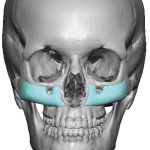
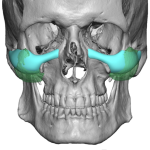
When selecting the style of cheek implants, it is important to realize what area of the cheek bone needs to be augmented. If it is a high angular look that one wants, then the cheek implant should be more narrow so that it does not augment the lower or front edge of the cheek bone. For rounder fuller cheeks, the implant needs to be wider to cover the entire cheek bone including its lower edge. To widen the face, which means the posterior edge of the cheek bone and onto the zygomatic arch, the implant design needs to extend further back or be positioned further back on the cheek bone. If the soft tissue of the cheek needs to be lifted, then the implant should have its greatest prominence on the bottom of the cheek bone or the submalar area. Thinking about how the shape of the cheek bone needs to be changed is how the style of cheek implant is selected and one can then easily work their way through the maze of implant options.

One cheek implant issue that is chronically debated is the choice of implant material, which is fundamentally either silicone or Medpor. While there are advocates of either material, what really matters is whether it have the right shape for the area of desired cheek augmentation. Your body does not really care which material is implanted. It will react the same by enveloping it a capsule of scar. The only real difference is that a Medpor implant will be harder to remove or adjust its position but not impossible. Regardless of the material, it is always best to secure the cheek implant into permanent position with a self-tapping 1.5mm screw, one for each side.

Dr. Barry Eppley

Indianapolis, Indiana

Cheek Augmentation – Preventing Complications and Improving Outcomes

Thursday, November 19th, 2009

Cheek augmentation is done for a variety of different aesthetic reasons. Besides the obvious need to fill out a sunken in cheek appearance and improve facial balance, they are just as commonly used for an anti-aging effect. By augmenting the soft submalar tissue to fill midfacial hollows, the lifting of this tissue provides a facial rejuvenating effect and may even soften the depth of the nasolabial fold beneath it. This tissue lifting or anti-aging effect is unique amongst facial implants.

The shape of the cheekbone and its location between the convex orbital rim and the concave maxillary wall make it the most complex facial area to augment from an aesthetic standpoint. Where along the cheekbone should the implant be positioned and what shape and size of implant should be used are what the plastic surgeon ponders. There really are no guidelines as to how to exactly to make these selections. Artistic technique is as important as any type of scientific approach. This high degree of variability lends to revision rates that are higher than any other facial implant currently used.

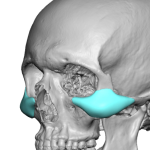
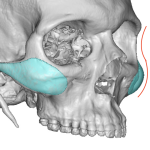
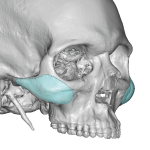
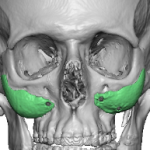
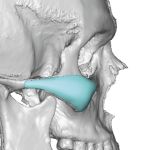
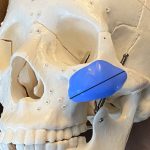
Cheek implant complications usually are of two types, undesired aesthetic outcome and implant shifting or migration. Unhappy outcomes come from either an implant that is too big or positioned in the wrong location. Either way, an unnatural appearance often results. Because of where cheek implants are located, they catch attention almost as much as one’s nose or eyes. Cheek implants come in a variety of sizes and shapes but can fundamentally be divided into malar and submalar implants. Malar implants being placed on top of the zygomatic bone and submalar implant highlighting the underside of the bone. (submalar hollow or buccal space) Malar implants have different extension that either go back further onto the zygomatic arch, up around the lateral orbital wall , or anteriorly along the underside of the orbital rim. Because of these variable implant shapes, it takes a good aesthetic eye and communication with a patient beforehand to get a good result.

Cheek implants are also unique because of where they are positioned on the zygomatic bone. They often are sort of hanging from the side of the cliff, which makes them prone to shifting. Shifting will usually occur in a downward direction from whence they were initially inserted, which is usually through the mouth. For this reason, it is possible for cheek implants to shift around and end up with asymmetry. This is particularly true if the implant is made from silicone which is very smooth and slippery. Other implant composition have a much greater frictional grip on the bone and will not move as easily.

One interesting silicone cheek implant design which can effectively address the shifting problem is that of the Conform midfacial implant. Its undersurface is not smooth silicone but rather a pebbly or nubbed surface. The many little ‘’fingers’ of silicone allow it to develop some degree of frictional gripping to the bone surface. Also when soft tissue grows around it, the capsule will absolutely lock it into place. This is very similar to the concept of placing a textured surface on a breast implant which was developed nearly twenty years ago. Its shape also allows it to be trimmed and used as either a malar or submalar implant. 

Dr. Barry Eppley

Indianapolis, Indiana


Midface Rejuvenation – Cheek Lifts vs Cheek Implants

Saturday, October 17th, 2009

As one ages, the entire face changes. Some parts of facial aging are more obvious than others as the face does differentially age. The forehead, brows, eyes, mouth, jawline and neck are all areas whose aging is well recognized. The aging of the midface and cheek areas, however, has only become more recently recognized.

With the aging process, the fatty tissue that normally drapes over the cheekbones can begin to sag. The result is less prominent cheekbones, and a droopy fold of skin and fat between the nose and the cheek (the nasolabial fold). The sagging cheek fat can also alter the appearance of the lower cheek. For example, bagginess of the lower eyelids often becomes more apparent after the fat of the upper cheek begins to sag. This in essence ‘unveils’ the bagginess of the lower lids, which have always been there. In addition to sagging of the skin and fat of the midface, there is also volume loss in the cheek due to loss of fat and muscle.

A number of cheek lift or midface lift procedures exist to address this aging area. The goal of all of them is to lift up droopy cheek tissue over the cheekbone restoring the more prominent youthful contour, improving the tear trough and bagginess of the lower lids, and softening the undesirable cheek fold. Fundamentally, they may be divided into lifting approaches vs volumetric addition. In some cases, they may even be done together.

Lifting approaches aim to reposition the sagging fat of the cheek over the cheekbone to restore the youthful fullness of the cheeks. Such midface lifts use differing access including the lower eyelid, scalp, and temporal incisions using open incisional or endoscopic instrumentation. Implants have also been devised to provide less invasive options including suspension sutures and bone-anchored lift devices. The plethora of differing lifting approaches suggests that no one of them is universally successful.

Contrarily, cheek implants have also been used to help create a degree of cheek lifting. By placing an implant through the mouth onto the cheek bone, some fullness is added to the volume-depleted cheek and the cheek tissue on top of the implant is pushed upward. While not creating as dramatic effect as a lifting procedure, it is far simpler and with fewer complications. This cheek lift approach, using a specially designed submalar implant which fits on the underside of the cheek bone, has been around for nearly two decades. When used in the right patient and properly sized, it can have a good cheek enhancement effect. But it is also easily overused and overdone (too large a size) as older celebrity faces are rife with examples of odd-looking and peculiar cheek prominences due to oversized implants.

Given the choices between cheek lifts and cheek implants, which is the most helpful for cheek rejuvenation? The answer is no one of them is best for all patients. Over the years, I have used almost of all of them in my Indianapolis plastic surgery practice….and have also seen and learned the downsides to each of them. Midface or cheek rejuvenation is as much an art form as almost any area of anti-aging facial surgery. Given the potential complications that can occur with lifting procedures, most specifically lower eyelid ectropion, their use should be reserved for the most severe sagging cheek problems. More moderate cases with less prominent cheekbones may benefit with a small to moderate-sized implant. In all cases, moderation is the key…not too much lift or too big of an implant. The midface is one area that does not look good overdone and is easy to do.

Barry L. Eppley, M.D., D.M.D.

Indianapolis, Indiana

Cheek Implants in Patients with Dentures

Thursday, October 15th, 2009

Cheek implants are a fairly simple and effective method for adding projection of various areas of the zygomatic midface. Because they are various shapes of cheek implants that are available, there is a fair amount of art as opposed to science in selecting style and size of implant to get the patient’s desired effect. Because these implants are placed on the side or underside of a bony surface, they are also prone to postoperative migration in an inferior direction of they are not secured.

Cheek implants are typically shown in textbooks, journals, and patient results in patients who have teeth. By having teeth, the vertical distance from a positioned implant to the maxillary vestibule (highest area under the upper lip) is maximized. There will always be a good soft tissue buffer between the implant and the inside of the mouth. This lessens the long-term likelihood of implant exposure should it ever migrate downward. (if one secures the implant with screws, this will not happen)

In the patient without teeth, however, the use of cheek implants can be more problematic as the facial anatomy has changed…unfavorably. The loss of upper teeth changes the structural integrity of the face. The vertical dimension of one’s occlusion (bite), or the height of the bite formed by the contact of the upper and lower rows of teeth, determines the shape and length of the cheeks. When a patient becomes edentulous, the mouth closes too fully with no teeth to separate the jaws, thus contributing to a sunken in appearance of the cheeks. Without teeth, the cheeks tend to wrinkle, the angle between the nose and the lips changes, the ridges that hold the teeth flatten, and the tongue may splay out to fill the open mouth space. These changed features often make the edentulous patient seek midface volume replacement.

The fundamental concern in placing cheek implants in a patient who wears an upper denture is two-fold. First, the distance between the cheek bone and the maxillary vestibule has shortened considerably. There is less soft tissue coverage between the implant and the oral mucosa. This makes the use of certain types of cheek implants, the submalar implant specifically, more risky. Because it sits on the underside of the zygomatic bone, it is even closer to the lining of the mouth. Secondly, the flange of an upper denture can be an erosive source causing implant exposure. A high-riding denture flange may eventually cause pressure necrosis of the thin soft tissue between it and the implant. At the least, it can be a source of irritation and discomfort.

Cheek implant selection is critical in the edentulous maxilla. The implant should be placed on the zygomatic prominence and its maxillary extension trimmed if necessary to keep it from hanging too low. The implant should absolutely be secured in place by a screw. If the implant needs to be extended for midface volume, it should go as close to the infraorbital nerve (without compression) as possible. The canine fossa area should be avoided, as tempting as it is to help this volume deficient area. Lastly, the patient’s dentist should be consulted to shorten the posterior flange of the maxillary denture before surgery. The broad palatal surface provides enough surface area for retention that the flanges can be shortened without sacrificing denture stability.

Cheek implants can work effectively in the typical older edentulous patient who usually suffers midfacial volume depletion and sag. Several alterations in surgical technique are necessary to avoid the increased risk of eventual implant problems caused by vertical maxillary shortening.

Barry L. Eppley, M.D., D.M.D.

Indianapolis, Indiana

Facial Implants for Correction of Midface Deficiency

Monday, September 7th, 2009

Implants are very useful for producing three-dimensional facial changes. By extending the outer boundaries of bony prominences, the proportions and shape of the face can be changed dramatically. Implants essentially camouflage facial bony deficiencies or enhance a normal prominence. Traditional and well known facial implants are that of the chin, cheeks, or  nose. Jaw angle implants are also becoming more commonplace today.

Most facial implant use is for one region only (e.g., chin) even if the area of enhancement has two sides. (e.g., cheeks) Multiple sites of enhancement at one procedure can also be done and are associated with more significant facial changes. The use of combination cheek and chin augmentation or even chin, cheek and jaw angle augmentation are traditional implant duets and trios.

Another good facial implant combination is in the use of camouflaging a midface deficiency. Some midface hypoplasias are obvious, other are more subtle. Either way, there is an apparent flatter or less convex facial profile. In its severest form, the facial profile will actually be concave. The degree of midface underdevelopment is most evident by looking at one’s teeth or bite relationship. There may be an underbite or an edge-to-edge bite at the incisors. Someone may have had prior orthodontics so the ‘true’ bite relationship may have become obscured.

Midface deficiency is marked by flatter cheekbones and a ‘sunken’ base to the nose, known as the paranasal region. The entire midfacial skeleton is recessed from below the eyes down to the upper teeth. This bony position will have an impact on other facial areas making the nose and chin look bigger and the upper lip look smaller and thinner.

In young patients or more severe midfacial deficiencies, one should consider moving part or all of the midfacial bones. Traditional LeFort osteotomy patterns in conjunction with orthodontics is the standard approach. For patient’s with less significant deficiencies or who are not desirous of making that degree of surgical effort, augmenting the deficient bone is another option.

The combination of cheek and paranasal implants is a good facial augmentation combination for this problem. Using four implants (two cheek and two paranasal) placed through two incisions under the upper lip, the midface area can be brought out for greater facial convexity. It is important to secure these implants to the cheek and maxilla with small screws to prevent movement or migration after surgery.  The choice of implant material is not important but good sizing and placement position is.

With an improved midfacial profile, the nose will appear smaller and may not require any alteration. For others, changing the shape of the nose through a rhinoplasty may be simultaneously beneficial. This can be determined before surgery through computer prediction imaging.

 Dr. Barry Eppley
Indianapolis, Indiana


Implants and Fat Grafting for the Treatment of HIV Facial Wasting

Sunday, February 22nd, 2009

Facial wasting is a very specific condition of the face in which specific areas of fat are resorbed and, in its severest form, is unique to the HIV patient taking retorviral medication. Nobody knows exactly why fat from the faces specifically goes away on people taking anti-HIV drugs, but a significant percentage of such patients will  experience it depending on their particular retroviral medication regimens. It seems to occur particularly in men of low body weight who are over the age of forty.


Facial wasting can present in a variety of appearances from subtle to very dramatic, based on the amount of fat under the skin that has been lost. Patients typically present with sunken-in cheeks, very prominent cheek bones not covered by the usual fat layer, and hollow temples. This also creates loose facial skin due to the lack of underlying fullness.


Facial wasting can be treated by a variety of plastic surgery methods. The most popularized is the injectable approach using Sculptra or other long-lasting fillers such as Radiesse. While injectable fillers definitely provide a benefit, I don’t find them to be the best value, given what they cost and the repeated treatment sessions necessary. In my experience, several surgical options are more effective with injectable fillers or fat grafts used to supplement them.


I find that cheek implants, specifically submalar implants, are a good foundation to  build out the sunken face. These implants come in a wide variety of shapes and sizes so some customization of them can be done for each patient. These implants provide a good fill of the lost volume of the buccal fat pad and are easy to place through an incision inside the mouth. Once in the proper position, I prefer to place a screw through them to hold them permanently to the underlying cheek bone. There is some mild swelling after surgery but one can go back to work and resume all normal activities within just a few days. The advantage of an implant is that its volume will remain stable over time unlike injectable fillers. I have yet to experience any infections with cheek implants in the HIV patient nor do I think that such patients are at an increased infection rate from such procedures.


But augmentation of the bony cheek and submalar area can treat the full extent of the facial wasting. This requires soft tissue augmentation using an injectable approach to fill in around the edges of the implants and beyond. Often there can be a step-off or obvious demarcation from the implant to the surrounding skin in cases where the facial wasting is quite severe. In more mild cases, this may not be necessary. Fat injections are very versatile but they require having some subcutaneous fat tissue into which to be placed. In severe facial wasting I have used dermal-fat grafts, harvested from the abdomen, to be placed below the cheek through a nasolabial incisional approach.


When the facial wasting is associated with loose skin, a modified facelift can also be very helpful. Changing the facelift to more of a jowl-neck tuck-up helps stretch out the loose cheek and facial skin. When done in combination with submalar cheek implants and fat grafts, some really nice facial improvements can be achieved.

Dr. Barry Eppley

Indianapolis, Indiana

Avoiding An Unnatural Cheek Implant Result

Wednesday, December 3rd, 2008

Cheek implants are a fairly simple and effective method of enhancing this important aesthetic part of the face. By placing implants through an incision on the underside of the upper lip, the cheek area can be enhanced in various three dimensional ways with different types of implant designs. While once used exclusively for people with flat or deficient cheeks, its use has been expanded in the past decade to help lift sagging cheek tissues to reverse the effects of age and gravity.

The original type of cheek implant to lift up sagging cheek tissues is known as the submalar or Binder implant. It has been around now for over 15 years. Designed to sit on more of the underside of the cheek bone, it synthetically increases the fullness of the cheek bone which causes a lifting effect of the overlying cheek skin because of greater support underneath. This type of implant will not lift sagging skin as much as a true midface lift, but it is a far simpler procedure and poses no risks of any problems with the lower eyelid as a midface lift has the potential to do.

Traditional cheek implants (which sit on top of the cheek bone) can create a similar lifting effect but they also can make an artificial appearance to the midface with a non-anatomic fullnerss below the eye. This can make the cheek look too big and the eyes look artificially sunken in. This is exactly what happens when the approach to treating the aging face involves large cheek implants, often combined with a facelift. The face may be more wrinkle-free and the sagging is gone, but the face somehow looks unnatural and just doesn’t look right. In the male face, this approach often feminizes the face. In the female face, the cheek bones are just too full and they don’t fit the face well. I could name numerous famous actors, actresses, and musicians who have this look from their plastic surgery procedures (which they of course would deny) but I won’t. (as you could probably name them anyway….you certainly know they look odd when you see them)

The key to using any type of cheek implant for facial rejuvenation is…..not to overdo it. Too large of an implant is unnatural. Small to medium-size cheek implants are better for most patients. Don’t try and make the implant do all of the lifting…or make the cheek area too big. It is easy to do as it may look quite good on the operatuve table to the plastic surgeon but not so good to the rest of the world.  If the cheek sagging is severe, the patient may be better off with a small cheek implant combined with a midface lift. Or just use a cheek implant alone and accept improvement but not perfectly tight skin across the cheek area. When it comes to natural vs obvious cheek enhancement, less is always more.

Dr. Barry Eppley

Indianapolis, Indiana

Cheek Implants – Different Styles for Different Problems

Wednesday, November 5th, 2008

The cheek area is a central and critical element of one’s facial appearance. Situated between the pyramidal landmarks of the eye, mouth, and jaw angle, its prominence (or lack thereof) provides projection to the middle of the face. In today’s society, the perception of high or prominent cheekbones is one that is a positive statement about attractiveness and beauty. It is not clear why high cheekbones cast this image, but we all know the emotional response when we see it.

Today’s plastic surgery techniques and modern facial implants now make it possible to provide a wide range of cheek enhancements. Highlighting different areas of the cheek complex is made possible because of the many different styles of cheek implants that are available. Different cheek implant shapes are available that can enhance the front, side, underside, as well as the bone underneath the eye in front of the cheek. Because of these different style options, it is critical that a plastic surgeon look carefully at the anatomy of the cheek to determine which parts of it should be improved.

The ‘traditional’ cheek implant is really like a shell which covers all aspects of the curved cheek, adding volume to the front and sides of it in equal amounts. For those patients with really flat cheeks, this is usually a good choice. The implant can be slid further forward or further to the back of the cheek to customize its effects. Submalar cheek implants sit more on the underside of the cheek bone. They push up loose overhanging cheek tissue and , as a result, are more ideal for the aging patient with loose or sagging cheek skin. They also are good for patients who have had loss of the buccal fat pad and hollowing of this area. (facial lipoatrophy, e.g.,  HIV disease)  Because the submalar implant fills the upper part of the buccal space as well as the underside of the bone, a dual effect is achieved. Tear trough implants are not really cheek implants per se. They fill underneath the eye area which is in front of the cheek. For those patients with some good cheek width but flattening of the bone in front of the cheek, this is the only facial implant made for that use. Sometimes it can be used in combination with a traditional cheek implant for greater fill of a flat midface.

To get the best effect from these different cheek implant styles, their position on the bone is critical. For this reason, I always secure any style of cheek implants to the bone with screws. This is the only way to be certain of their long-term position after surgery.

Dr. Barry Eppley

Indianapolis, Indiana

Chin and Jawline Implants for Male Facial Enhancement

Wednesday, April 2nd, 2008

The facial features most associated with masculinity is the chin and jawline. A stronger chin and jawline conveys increased masculinity, smaller chins and ill-defined jawlines convey timidity and weakness. While this perceptions may not always be true (and often aren’t), they certainly help create a first impression by their appearance. In today’s plastic surgery, newer generation implants and fillers make this look possible more than ever before.
Chin implants have really evolved over the past decade with many new styles and sizes. The most important change has been that they have been extended in their shape rather than small ‘buttons’. The idea is to have an enhanced chin that flows better into the surrounding jaw. This requires an implant that ‘extends’ back from the chin to create a smooth transition from the augmented chin to the back of the jaw. These newer implants are longer and more tapered at the ends, although they can still be placed through a small incision right under the chin. Because they extend back further they give an enhanced but natural appearance to the chin. This is achieved by filling in the jawline between the chin and the back of the jaw, slightly widening the anterior jawline making the overall look more balanced. In addition to jawline width, chin and jawline height can also be lengthened by having a ‘wrap-around’ implant that extends lower than the existing edge of the bone. Prior to these type of implants, only cutting the bone or bone grafting could have achieved this look. This increases the height of the lower third of the face, a very male-enhancing effect.
New implant options also exist for bolder cheekbones and more square jaw angles. Small cheekbones generally are not as obvious as a smaller chin but the effect on the appearance of the face is just as real. Small cheek bones create a flatter facial appearance or even a longer thin face look. Several styles of cheek implants exist to fill out different areas of the midface, from creating higher cheekbones to improving that sunken cheek look. Cheek implants are placed through an incision in the mouth so there is no scarring. A more square and well-defined jaw angle is a very masculinizing look and can only be created with implants. Jaw angle implants can eitehr widen the back of the jaw, make it more longer and more square, or both. Like cheek implants they are placed inside the mouth so scarring is never any issue.
It would not be uncommon to perform several areas of facial enhancement in the male to get the overall look that they want. Since an appreciation of facial shape and how the different areas can be changed and how they would look from implants mandates that computer-imaging be used. I find it usually takes at least two consultations to thoroughly cover all the options and make sure the patient has complete understanding of the facial look that they desire.
Dr Barry Eppley

Indianapolis, Indiana


Dr. Barry EppleyDr. Barry Eppley

Dr. Barry Eppley is an extensively trained plastic and cosmetic surgeon with more than 20 years of surgical experience. He is both a licensed physician and dentist as well as double board-certified in both Plastic and Reconstructive Surgery and Oral and Maxillofacial Surgery. This training allows him to perform the most complex surgical procedures from cosmetic changes to the face and body to craniofacial surgery. Dr. Eppley has made extensive contributions to plastic surgery starting with the development of several advanced surgical techniques. He is a revered author, lecturer and educator in the field of plastic and cosmetic surgery.

Read More


Free Plastic Surgery Consultation

*required fields


Pricing

The cost of any type of elective plastic surgery plays a major role in the decision to undergo the procedure(s).

Get Your Quote Here


My Plastic Surgery Story

Military Discount

We offer discounts on plastic surgery to our United States Armed Forces.

Find Out Your Benefits


Categories