EXPLORE
Plastic Surgery
Dr. Barry Eppley

Explore the worlds of cosmetic
and plastic surgery with Indianapolis
Double Board-Certified Plastic
Surgeon Dr. Barry Eppley

Archive for the ‘brow bone reduction’ Category

Forehead Feminization with Combined Brow Bone Reduction, Browlift and Hairline Lowering

Sunday, April 21st, 2013


There are numerous surgical procedures to feminize a masculine facial appearance. They include jawline reshaping (chin and mandibular angle reduction), rhinoplasty, cheek reduction, tracheal shave and forehead reduction/reshaping. While every transgender patient’s face is different and may need just a few or all of these facial feminization procedures, the forehead is one of the top considerations for most patients. The female forehead has a very distinct shape with a rounded contour from the brows up to the hairline with no obvious bone break.

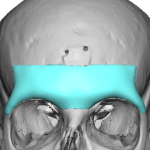
Forehead reshaping incorporates reduction of the prominence of the central glabellar region as well as the projection of the brow bones. The brow bones must not only be deprojected but should also have the tail of them near the lateral orbit reshaped to have more of a sweeping effect up and towards the temples. Since this procedure requires an open scalp approach, this creates the oportunity to lower the frontal hairline as well. Together this type of foreheadplasty has a significant impact on the gender identification of the face.

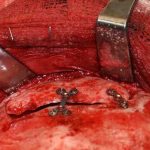
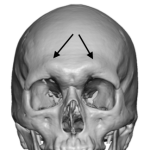
The prominent glabella and brow bones are always due to the pneumatization of the front sinus. In cases of minor protrusion, the outer table of the frontal sinus can be simply burred down. Unfortunately this rarely can be successfully done due to the thin bone thickness overlying the frontal sinus. A few millimeters of change is rarely enough to make a noticeable external change. Most patients require the anterior wall of the bone to be removed, reshaped and repositioned back into place with resorbable sutures or metal microplates and screws. This method sets back the bulging bony prominence while preserving sinus function. The outer brow bone areas that lie outside of the sinuses can be reshaped as desired by burring.

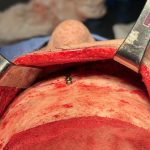
When significant brow bone reduction is done (flattening of the bone), there is the potential for an excess of overlying skin. Loose skin on the brows can result in sagging or overlying brow ptosis. This can be easily addressed at the time of the brow bone reduction by a comcomitant browlift using the transcoronal or hairline incision made for access to the brow bones. An alternative approach is a direct browpexy from the galea below the eyebrows to underlying bone holes or the fixation plates (if used) above the reshaped brow bones.

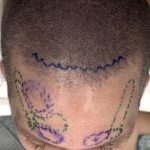
A final component of the feminizing foreheadplasty procedure is the potential to simultaneously lower the frontal hairline. A long forehead (> than 6.5 to 7 cms between the brow and hairline) is unaesthetic for any gender but is particularly so in the male to female transgender patient. If a hairline approach (trichophytic) is used, a simultaneous scalp advancement can be done by securing the galea of the advanced scalp by sutures to bone holes in the outer table of the skull. By bringing the scalp forward, the lifted forehead skin will need to be trimmed creating a combined forehead skin reduction and browlift.

Ultimate feminization of the forehead can be done by simultaneous brow bone reduction, browlift and hairline lowering.

Dr. Barry Eppley

Indianapolis, Indiana

Postoperative Instructions for Brow Bone Reduction Surgery

Tuesday, April 9th, 2013

Most brow bone reductions need to be done through an open scalp incision. Unless the amount of brow bone reduction is very minimal (a few millimeters) the underlying frontal sinus must be factored into the operative technique. Brow bone reductioin can be done by burring, burring and infracture and removal of the brow bone with reshaping and replacement.

The following are the typical instructions for brow bone reduction:

1. Brow bone reduction is associated with a only a very moderate amount of pain in the first few days after surgery.  Narcotic pain medications are prescribed and use them if you need them. In a few days, you may switch to Tylenol or Ibuprofen or alternate between doses with the narcotic medication.

2.  There will be a circumferential head wrap placed right after surgery. This is in place to control extreme swelling and does not play a role in maintaining the new position/shape of the brow bones. You may take it on the next day after surgery. If it should get loose or come off during the night, just leave it off. It is not a critical part of brow bone reduction surgery.

3.  The sutures in the scalp incision are dissolveable and do not need to be removed. There is no need to apply antibiotic ointment to the incisions as all it will do is make your hair greasy and be hard to shampoo out.

4. Bruising and swelling will develop around the eyes after surgery which is perfectly normal. In some patients the eyes may almost swell shut by the second day after surgery.

5. You may shower and wash your hair 48 hours after surgery. There is no harm in getting your sutures wet with soap and water.

6. Your forehead will feel stiff and may not move normally for up to a month after surgery. It will also feel numb for even longer. This is all normal and as the feeling comes back in the forehead you will experience strange sensations such as shooting pains or itching as the nerves recover.

7. You may wear any type of hat around your forehead whenever you feel comfortable doing so.

8. There are no restrictions on normal daily activities after the surgery. You may do light exercise anytime afterwards that you feel comfortable. But no strenuous exercise that involves bending over for three weeks after surgery.

9.   You may drive within several days after the procedure, provided you are off pain medication and can react normally to driving conditions.

10.  If any redness, tenderness, or increased swelling develops on the forehead or around the eyes after the first week of surgery, call Dr. Eppley and have your pharmacy number ready.

Consent for Plastic Surgery – Brow Bone Reduction

Monday, April 8th, 2013

Every plastic surgery procedure has numerous issues that every patient who is undergoing a procedure should know. These explanations are always on a consent form that you should read in detail before surgery. This consent form, while many perceive as strictly a legal protection for the doctor, is actually more intended to improve the understanding of the brow bone reduction procedure. The following is what Dr. Eppley discusses with his patients for this procedure. This list includes many, but not all, of the different outcomes from surgery. It should generate both a better understanding of the procedure and should answer any remaining questions that one would have.

ALTERNATIVES

There are no alternatives to surgical reduction of he prominent brow bones. One potential alternative is to build up the forehead above it to make the whole forehead smooth.

GOALS

The goal of brow bone reduction is to reduce the brow bulging and bring the brow bones back into a smooth contour with the forehead that lies above it, if possible.

LIMITATIONS

The limitations of brow bone reduction is the thickness of the overlying anterior table of the frontal sinus and the size of the frontal sinus that lies beneath the bone. (inner half of the brow) The outer half of the brow bone is limited is reduction only the thickness of the skull bone.

EXPECTED OUTCOME

Expected outcomes include the following: temporary swelling and bruising of the forehead and eyes, a temporary or permanent numbness of the forehead and scalp, temporary weakness of the forehead muscles, and permanent scalp scars. It may take four to six weeks before the final shape and appearance of the brow bones is seen.

RISKS

Complications may include bleeding, infection (wound or frontal sinusitis),  poor scalp scarring, bone fixation palpability,  undercorrection of the brow prominences and brow asymmetry.

ADDITIONAL SURGERY

How the foerhead heals and the occurrence of complications can influence the final shape and appearance of the brows. Should complications or the desire to enhance the result further by additional surgery be needed, this will generate additional costs.

Endosopic Reduction of Prominent Brow Bones

Wednesday, March 13th, 2013


A prominent supraorbital or brow bone is known as bossing. While some degree of bossing is acceptable in men, it rarely is so in women. The shape of the lower forehead in men can have a brow bone prominence as evidenced by a brow bone break into the mid-forehead area. In contrast, women desire a smooth transition from the brow area into the forehead which requires no bossing.

While the brow bone looks and feels like solid bone, it is not. The brow bone and its outer shape is determined by the size or aeration of the underlying frontal sinus cavity. This creates a comparatively thin layer of bone over an underlying air space. Reducing frontal bossing, therefore, requires a knowledge of the thickness of the outer bone comprising it to determine how much it can be reduced and what is the best technique to do it.

The most common method of brow bone reduction is an open approach using either a burring reduction, an infracture technique or osteotomies and reshaping. Simple burring can be effective if the outer table of the brow bone is thick enough. This then raises the question of whether a burring procedure can be done short of using an actual open scalp method.

In the March 2012 issue of the Plastic and Reconstructive Surgery journal, an article was published entitled ‘Endoscopic Correction of Frontal Bossing’. In this paper, the authors performed a retrospective review of 10 patients who had the endoscopic procedure done over a seven year period. The degree of frontal bossing correction was rated as moderate improvement. No violation of the frontal sinus occurred in any patient. The limiting factor in achieving better outcomes was the thickness of the outer table of the brow bone.

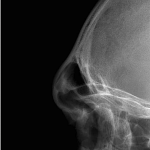
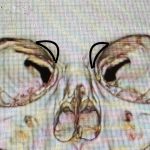
Endoscopic reduction of the prominent brow bone requires two things; proper endoscopic instrumentation and frontal bossing that has thick enough bone. Adequate bone thickness has to be at least 5mms in thickness as determined by a lateral skull x-ray. A 1 or 2mm reduction is not going to make a noticeable difference. But a 3 to 4mm reduction will make a discernible reduction in the amount of frontal bossing. This determination can be done beforehand by tracing out the frontal bossing outline and seeing how the soft tissue profile changes as the bone is thinned.

Endoscopic reduction of the prominent brow bone is a safe and effective procedure. Its use, however, is restricted to a very few patients whose brow bone thickness allows visible improvement with a burring technique.

Dr. Barry Eppley

Indianapolis, Indiana

Case Study: Reduction of Prominent Brow Bones in Men

Monday, January 30th, 2012

Background:One important aesthetic area of the forehead is the brow region situated at its lowest extent above the eyes. Men and women have different brow and forehead shapes that are considered desireable and gender specific. Females have non-protrusive brow bones that taper towards the temples on the sides and give a smooth rounded forehead appearance with no slope. In contrast, men have slightly more prominent brow bones that transition into a forehead that has more of a retroclined vertical slope. In essence, the masculine forehead is characterized by heavier more prominent eyebrows due to the greater growth of the brow bones.

The brow bones, while called a bone, is really not one at all. They are caused by the growth and size of the frontal sinus which lies beneath it. Surprisingly the outer layer of the brow bones, known as the outer table of the frontal sinus, is remarkably thin. While a big brow bone looks quite stout, it is usually only just a few millimeters thick. The bigger and more prominent the brow bones, the bigger is the air cavity of the frontal sinus.

While some brow bone prominence is desireable in a man, it can become too extreme. When the frontal sinus cavity grows too big, it causes a large amount of brow bone protrusion. Jutting out from the forehead in a very conspicuous manner, it gives the appearance often unflatteringly called the ‘Neanderthal’ or Cro-Magnon’ look. This can be reduced to a more aesthetic appearance but can not be done by a bone burring techniqiue.

Case Study: This 35 year-old male from Los Angeles California had been bothered by his large brows since he was a teenager. Even though he was successful at many levels from professional to personal, he still remained sensitive about his facial appearance, particularly in a profile view. He fully realized that reduction would require more than just bone burring and also understood that a scalp incision would be needed to do the procedure.

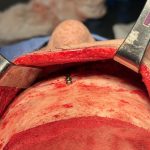
Under general anesthesia, a bicoronal scalp incision was made to expose the entire forehead and the large brow bones. The supraorbital neurovascular bundles were seen exiting the outer aspect of the brow bones and were dissected out and preserved.

The base of the brow bones was marked out where it joined the forehead bone. A burr was used to take down the bone at the base of the protrusion around its entirety with the exception of the lower edge. A reciprocating saw made an osteotomy at the base of the brow bossing and the entire anterior table of the frontal sinus was then removed.

The removed frontal bone flap was reshaped by multiple osteotomy cuts. This allowed the bone flap to be made straight by gentle pressure through microfractures. The bone flap was made completely flat from its natural convex shape.

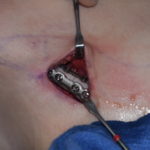
The frontal sinus bone flaps were stabilized and then secured over the open sinus cavity with multiple microplates and screws. (1.0mm) The numerous small bone defects between the osteotomy cuts was filled in with a demineralized bone paste on top of a netting of resorbable collagen sheeting. The scalp flap was repositiond, 1 cm. of scalp skin and hair across the top removed for a coronal browlift and closed with resorbable sutures over drains.

The head dressing and drains were removed the next day. While there was some mild swelling, he had no periorbital bruising. Even being just one day after surgery and with brow swelling, his improvement was very visible. Further improvement would be expected over the next month as the swelling resolves and the tissues shrink down and adapt to the newly shaped brow bones.

Case Highlights:

1) Significant brow bone bossing or protrusion in men is a result of overgrowth or excessive pneumatization of the frontal sinus.

2) Reduction of large brow bones, brow bone reduction, can only be done by an osteoplastic bone flap technique with reshaping and repositioning with microplate stabilization.

3) Male brow bone reduction should not be overdone and some small amount of brow protrusion should remain.

Dr. Barry Eppley

Indianapolis, Indiana

Common Questions on Forehead Reshaping and Contouring

Monday, February 8th, 2010
  1. What influence does the forehead have on one’s appearance?

The forehead is a very prominent and visible facial area. While it is not the most dominant facial feature, it does have an influence on one’s appearance in numerous ways.

The forehead does have an influence on gender appearance. In men, the brow ridge (bossing or prominence above the eyes) is stronger and the forehead angles more steeply away from the eyes. In women, the forehead does not have a prominent brow ridge, tends to be more round, and angles more vertical above the brow rather than more backward sloping as in men.

A forehead can often be seen as too ‘big’ because of the distance between the eyebrows and the frontal hairline. When more than 6.5 cms exists between the two, the forehead will look elongated or large. This may be the result of frontal hairline recession in men or the natural position of the hairline in women. 

2. How is forehead reshaping done?

Changing the shape of the forehead can be done in three ways. Brow ridge (bossing) reduction, brow ridge augmentation, or altering the slope or shape of the forehead between the brow bone and the top of the skull under the hairline are the common changes requested.

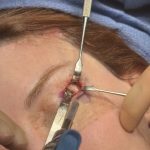
They all share one common theme, the need to use a coronal or scalp incision for access to do the procedure. This is a more significant aesthetic consideration in men. Surgically changing the brow bone uses different techniques depending upon whether one is reducing or building it up. While some minor bone alterations may be able to be done endoscopically (from above) or through the upper eyelids (from below), major changes require the liberty of unfettered access by the turn down of a scalp flap.

3. How is brow bone reduction done?

In brow bone reduction, the anatomy of the prominent brow must be appreciated. The cause of a prominent brow is that the underlying frontal sinus cavity is expanded. (pneumatized) Because the frontal sinus is air-filled, the prominent brow ridge only has  thin bone covering it. It can not just be burred or shaved down in most cases. Only the tail of the brow ridge, where the frontal sinus does not exist, can be simply reduced by shaving.

In the setback of frontal bossing, the thin plate of overlying must be removed, reshaped, and put back in place with small titanium plates and screws (1mm profile) to hold the bone in place while it heals.

A plain lateral skull film or cephalometric x-ray will show how much frontal bossing is caused by air vs. actual bone. 

4. How is brow bone augmentation done?

Building up a deficient or over-reduced brow ridge requires the use of synthetic materials which are added on top of the bone. The two most commonly used cranioplasty materials are acrylic (PMMA) and hydroxyapatite. (HA) Each material has its own advantages and disadvantages and either one can work in experienced hands.

PMMA incurs less cost to use and has a very high impact resistance. HA is more expensive with a lower impact resistance to trauma. Both can be impregnated with antibiotics and shaped during the procedure. How much material to add and where to place it is very much like sculpting and requires a thorough discussion before surgery with the patient.

Solid implants, composed of silastic, Gore-tex, or Medpor, can also be used. They require more effort at shaping and must be held in place with tiny titanium screws. Their cost is intermediate between PMMA and HA.

5. Can other areas of the forehead be reshaped besides the brow bone?

The forehead (frontal bone) between the brow ridge and the front of the hairline can also be reshaped. It can be made flatter, more round, narrower, or wider. Changes can be done in either profile, width, or both. This is done through either burring of the prominent areas, adding material on deficient areas, or a combination of both.

6. What is the recovery after forehead reshaping? What complications can occur?

Aesthetic forehead surgery is usually done as an outpatient procedure. Depending upon what other procedures may be done with it, it may require an overnight stay in the surgical facility. A wrap-around forehead dressing is put on at the end of surgery and is removed the next day. In some cases, a drain may be removed (not commonly) and it is removed the next day also. Ther6e is some mild pain afterward but much of the forehead skin will be numb for awhile. Pain is easily controlled by pills. There will be some swelling afterwards which is driven downward by the dressing and gravity which affects the eyes and upper cheeks. It is most evident by two days after surgery and is largely gone within seven to ten days after surgery. Most patients return to work in two to three weeks. Dissolveable sutures are used in the scalp so there is no need for suture remocal. One can return to working out in two weeks after surgery.

Complications of significance are very rare with forehead surgery. The forehead skin will be numb but normal feeling will return in most patients within six to eighty weeks after surgery. It is possible to not get back all of your feeling. The biggest concern is aesthetic…did we achieve what our goal was? Is the forehead contour smooth and even? Is it too much or too little?

7. What can I do if my forehead is too long?

Usually a long forehead is a female concern. It is evident when the distance between the eyebrows and the frontal hairline is aesthetically too long, usually greater than 6.5 or 7cms in length.

The length or size of the forehead skin can be reduced by a scalp advancement (hairline lowering. This is conceptually a ‘reverse browlift’. An incision is made at the frontal hairline and the scalp behind it is loosened and brought forward over the fixed forehead skin. The underlying forehead skin is then removed and the hairline closed in its new lower position. A frontal hairline can be advanced between 1 and 2.5 cms, which often makes for a significant difference. 

Dr. Barry Eppley

Indianapolis, Indiana

Facial Bone Reduction Surgery

Monday, February 1st, 2010

Changing one’s bony prominences is the primary method for altering the shape of the face. The face is composed of a variety of bones which have convex and concave contours. The external appearance of the face is highly influenced by the convex bone contours. From the brow bone down to the long curvilinear shape of the mandible, there are numerous key bony projection points. (e.g., cheeks, chin, jaw angles)

Most commonly, a variety of plastic surgery operations exist to enhance or increase their projections. Chin, nose, cheek and jaw angle implants are prime examples. It is almost always easier to increase facial bone projection by adding to the bone rather than actually moving the bone.  There are also, however, operations that work in reverse…to reduce or deproject these very same prominences.

Facial bone reductions are not as well known and are less commonly done. Unlike augmentations, facial reduction procedures require modification or shortening of the bony prominences. While some can be shaved down, others require actual cutting off or out of bone sections to change the amount of bony projection.

Brow bone reduction is requested when the brows have a very prominent or ‘Neanderthal’ appearance. Mainly this procedure is done in men and in male to female conversions. (facial feminization surgery) This must almost always be done through a frontal hairline or scalp incision. In some cases, the brow bone may be simply burred down but this is unusual. The underlying frontal sinus occupies much of the width of the brow bone so the overlying bone is quite thin. Only if one is modifying the tail of the brow can it be just burred down. The outer table of the frontal sinus must be removed, reshaped, and then put back with tiny plates and screws. The scar from the incisional approach is the key decision in deciding to undergo this operation.

Cheek reduction is about modifiying the front edge of the cheek bone and its arched form back to where it attaches to the temporal bone. Most patients that want cheek reduction are often Asians in an effort to improve their wider face appearances. A vertical bone cut is made through the body of the malar bone and a wedge of bone is removed. The reduced cheek bone is then attached to the maxilla with a four-hole plate and screws. To get the more posterior part of the arch to move inward, the thin attachment of the posterior part of the zygomatic arch is cut with an osteotome and allowed to move inward (by muscle pull) without the need to secure it.

Nasal reduction is achieved by conventional rhinoplasty techniques. A significant part of a nasal hump is actually cartilage and not bone. The key in reductive rhinoplasty is not to overdo it, creating a saddle nose or pinched upper and middle vault appearance. This can result in nasal airway breathing difficulties. When it comes to helping a face look less wide and more sculpted, the nasal dorsum often is better elevated and not reduced.

Chin reduction is done by burring down the genial prominence. While this bone area is simple to get to through a submental incision, chin reductions are notoriously prone to cause soft tissue problems if not done correctly. This is the only facial bony prominence where the soft tissue does not just ‘snap back’ over the bone. If the excess skin and muscle is not removed and readapted back to the reshaped bone, it will sag resulting in the classic ‘witch’s chin deformity. Also, unlike chin bone advancements which can be brought forward 10 to 12 mms or more, retropositioning of the chinbone can not be done as dramatic and is more in the range of 4 to 6mms at best. Going back further than that can have adverse effects on the neck causing undesired fullness.

Jaw angle reduction is most commonly done in Asians like cheek reduction. Through an incision inside the mouth, the angle of the jaw is blunted by an oblique bone cut removing the prominent tip. How much of the tip or angle area is removed is a matter of intraoperative judgment. There is a fine balance between removing too little and completely having no angle at all. A nearly straight line from below the ear to the chin is not desireable either. This is the most uncomfortable of all the facial bony prominences to reduce because the large master muscle must be raised, causing considerable swelling after also.     

Barry L. Eppley, M.D., D.M.D.

Indianapolis, Indiana

Options for Brow Bone Reduction in Men and Women

Sunday, September 28th, 2008

The need to change the shape of the forehead or brow bone is very uncommon. Reshaping the forehead or the brow bone  (the bone below the eyebrows) is possible but  there are different procedures that can be done based on the shape of the forehead and the brow bone.

The shape of the skull between a male and a female is often quite different .The male forehead often has fullness over the brow bone known as brow bossing or a supraorbital prominence with a flatter forehead above this area. The female forehead, conversely, has a more convex or curved forehead shape and little or no significant supraorbital bossing. Such forehead shapes confer a masculine or a feminine look.


The degree of brow bossing and the forehead shape helps determine what type of surgical recontouring needs to be done. With the exception of one other important consideration…the frontal sinus. The frontal sinus, an air-filled bone cavity,  sits right under the brow bone and how developed it is will affect surgical choices. For this reason, any surgical efforts at forehead/brow modification should have a simple skull x-ray (side view) prior to surgery.


In those patients with mild to moderate brow bossing and thick skull bone over the frontal sinus (or are missing a frontal sinus), bone reduction  by burring can be done with a nice result. When brow bossing is present but the bone thickness over the frontal sinus is thin, simple bone reduction contouring is impossible without entering the frontal sinus. Many try just a little bone reduction, without entering the sinus, but this does not make enough difference to justify the effort. Removal of only 1 or 2 mms of bone is not enough to make a difference.  In these situation, one option is to open the frontal sinus, burr down the edges of the bone and put the ‘outer lid’ back in a more inward contour, thus preserving the frontal sinus. The other option is to obliterate and fill the sinus with a bone substitute material, making a more flatter brow  contour with the bone paste or cement. (and not put the outer table of bone back) I have done both and both of them will work. If I can get a good brow contour and still leave the frontal sinus present and functioning, that is my preferred choice.


Any forehead and brow contouring requires an open approach through a scalp or hairline incision. The forehead skin must be ‘peeled back’ to get good access for the surgery. An endoscopic approach or more limited approach is not adequate to do a good job. In most females, the hairline and hair density patterns make an open approach possible. When this procedure is considered in  males, the hair issue makes an open scalp approach potentially more problematic.


The most common patient, in my experience, for brow bone reduction is in female feminization surgery (FFS) where reducing the prominence of the brow bone helps in the overall facial conversion of the male to a female appearance. In a few select males with very prominent brow bones, this procedure can make a big difference in softening the more ‘neanderthal’ facial appearance.

Dr. Barry Eppley

Indianapolis, Indiana


Dr. Barry EppleyDr. Barry Eppley

Dr. Barry Eppley is an extensively trained plastic and cosmetic surgeon with more than 20 years of surgical experience. He is both a licensed physician and dentist as well as double board-certified in both Plastic and Reconstructive Surgery and Oral and Maxillofacial Surgery. This training allows him to perform the most complex surgical procedures from cosmetic changes to the face and body to craniofacial surgery. Dr. Eppley has made extensive contributions to plastic surgery starting with the development of several advanced surgical techniques. He is a revered author, lecturer and educator in the field of plastic and cosmetic surgery.

Read More


Free Plastic Surgery Consultation

*required fields


Pricing

The cost of any type of elective plastic surgery plays a major role in the decision to undergo the procedure(s).

Get Your Quote Here


My Plastic Surgery Story

Military Discount

We offer discounts on plastic surgery to our United States Armed Forces.

Find Out Your Benefits


Categories