EXPLORE
Plastic Surgery
Dr. Barry Eppley

Explore the worlds of cosmetic
and plastic surgery with Indianapolis
Double Board-Certified Plastic
Surgeon Dr. Barry Eppley

Archive for the ‘breast implants’ Category

Textured Anatomic (Teardrop-Shaped) Silicone Implants for Breast Augmentation

Saturday, June 8th, 2013


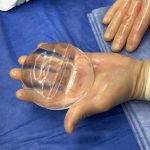
The concept of an anatiomically shaped breast implant is not new and dates back for over a decade. Simplistically, it is an implant where the retaining shell has a shape that allows more implant volume to be in the lower half than in the upper half. The inexact ratio is about 2/3s volume lower half and 1/3 third volume upper half. This volume distribution remains the same whether the patient is standing or laying down. This shaped implant has become known as a teardrop geometry and is associated with having a more natural look than a round breast implant by virtue of less upper pole fullness.

Besides the shape, there are several unique features of an anatomic implant. For cosmetic breast augmentation it is only available in silicone gel and not a saline fill. It is also only available in a textured and not a smooth implant surface. This is because it is critically important that the implant does not move in the pocket, otherwise it will create an odd shape to the externally viewed breast. The textured implant surface allows the surrounding tissues to grab onto and create tissue adhesion, this not allowing the implant to move. This is unlike a smooth round implant which can roll around in the pocket like a ball bearing and not cause any adverse change in the external breast shape.

The textured surface of the anatomic breast implant causes two important and necessary modifications (restrictions) in its surgical placement. First, it can only be placed through an inframammary or lower breast fold incision. It has to be placed so that it is correctly oriented and this must be visually seen. Secondly, the implant pocket, specifically the inferior or lower end of the pocket must be made and the implant placed in exactly the final implant position that one desires. Textured implants will not drop due to the tissue adhesion and, even if they do, it will take much longer than with smooth round implants.

Another feature, and one that is often confusing to patients, is that of the geometry of the textured shape breast implant base. They are available in either circular, oblong or oval base shapes. These differing implant shapes are designed to be used for the three different body types, ectomorph, mesomorph and endomorph, which have been shown by studies done long ago that the shape of the breast base largely follows the shape of the torso. This means that a mesomorph or athletic torso needs a round implant base, an ectomorph orĀ  asthenic torso needs an oval (vertical elliptical shape) implant base and an endomorph or pyknic torso needs an oblong (horizontal elliptical base) implant base.

Textured silicone gel breast implants are a very useful device option in the breast augmentation patient and have largely been underutilized until recent times. Part of reason has been the limited availability of anatomic implant shapes unlike the rest of the world where they are more widely used and has been available for a much longer period of time. The other reason is the near complete unawareness by patients and plastic surgeon unfamiliarity with their potential benefits.

In the properly selected patient, textured anatomic-shaped silicone breast implants can produce very natural looking and soft to the feel larger breasts.

Dr. Barry Eppley

Indianapolis, Indiana

Capsular Contracture Rates in Breast Augmentation

Thursday, May 23rd, 2013

Despite the success and high patient satisfaction with breast implant surgery, it is not a complication-free operation as it uses a device to achieve its effect. Historically the most well known breast augmentation complication was hardening of the breast (capsular contracture) due to excessive circumferential scar formation around the implanted spherical device.

While once the risk of capsular contracture formation was signfiicant, it dropped precipitously when only saline implants were available and most breast augmentations were done in a submuscular location. It is a complication that I do discuss with my breast augmentation patients but whose incidence in my experience that is far less significant than many other potential aesthetic complications.

But what is the real risk of capsular contracture around breast implants in more recent times? In the May 2013 issue of the Aesthetic Surgery Journal, that very question was addressed in a published paper entitled ‘Capsular Contracture Rate in a Low-Risk Population of Primary Breast Augmentation’. Looking at over 800 patients whom underwent first-time placement of breast implants over a ten year period, the authors reported on their incidence of seeing capsular contracture. Their overall incidence was just under 3% with follow-ups that averaged just over one year. The highest incidence was seen in smokers with essentially a 5% rate vs 2% in non-smokers. In surgeries where antibiotic irrigation was used the rate ws decreased from 4% to roughly 0.5%. The greatest association of capsular contracture occurrence was seen in the use of saline implant which were nearly 8X more likely (4.5% vs 1.5%) to have it develop than in silicone implants.

The authors conclude that early capsular contracture rates in breast augmentation can be less than 1%. Using a silicone gel implant placed under the muscle with antibiotic irrigation is associated with the best chance of avoiding this breast implant problem.

Capsular contracture is one breast implant problem that most patients don’t really think or, quite frankly, can really grasp what it is all about. That is not entirely their fault since this scar problem is yet to be well understood by plastic surgeons. We know that it is very real and has always been associated with higher rates of occurrence when the implant is placed above the muscle or develops a hematoma or an infection. It is surprising that in this study the use of saline implants had a higher occurrence since, historically, it was usually seen more in silicone implants. (albeit those that had ruptured)

Dr. Barry Eppley

Indianapolis, Indiana

Case Study: Transaxillary Silicone Breast Augmentation

Monday, May 20th, 2013


Background: The use of the transaxillary (armpit incision) for breast augmentation has been historically limited to the use of saline implants. Because saline implants are inserted deflated, they are rolled into a tight ‘burrito’ and inserted through an incision that is usually no bigger than an inch or 2.5 cms. in most cases. This creates a ‘scarless’ breast augmentation as defined by not having a visible scar on the breast.

The use of the Funnel device for inserting breast implants has created a whole new way of looking at the options. Besides creating a true ‘no touch’ technique for the implant, it has made the use of a smaller incision for silicone breast implants possible. This has now made it possible to use the transaxillary incision for silicone breast implant insertion.

Case Study: This is a 26 year-old female who wanted silicone breast implants but did not want a lower fold incision if possible. She had a small but good breast shape with no sagging or ptosis, an ideal candidate for a transaxillary breast augmentation method.

Under general anesthesia, 3 cm long incisions were made below the border of the pectoralis muscle in a high armpit skin crease. Blunt instrument dissection was used to make the desired implant pockets and air-filled sizers were initially used to check the size and symmetry of the eventual implant positions. After the sizers were removed, a Funnel device was used in which 400cc high profile silicone Sientra implants were easily ‘squirted’ into the pockets. The skin incisions were then closed in two layers with resorbable sutures.

Her postoperative course was typical for any woman that has had a transaxillary breast augmentation. There was upper arm tenderness on movement and upper chest fullness. She was placed on a Rapid Recovery Breast Augmentation program which included beginning arm exercises the night of surgery. By three weeks after surgery, she had a complete recovery with good breast implant positioning and softness beginning to return to the breasts.

The Funnel device now makes it possible to place most ‘standard’ sized silicone breast implants through an armpit incision. It is critical during the procedure, however, that the implant pocket be as perfectly developed as possible prior to insertion. Unlike saline, there is no reversibility and limited capability for additional implant pocket adjustment once the silicone implants are placed.

Case Highlights:

1) The historic restriction of having to place silicone breast implants through a lower fold or nipple incision can now be obviated.

2) Using a Funnel device, silicone implants can be inserted through an armpit incision of under 3.5 cms in length.

3) There are limits of silicone implant size that be inserted through a Funnel using a small armpit incision which has been up to 500ccs in my experience.

Dr. Barry Eppley

Indianapolis, Indiana

Shaped Anatomic Implants for a Natural Breast Augmentation Result

Sunday, May 5th, 2013


The number of women who are undergoing breast augmentation on an annual basis shows no sign of decreasing anytime soon. It is a popular body changing/improvement operation because it creates an instantaneous change with the insertion of a breast implant. The size of the implant plays an obvious major role in enlarging the breast and a wide variety of sizes in saline or silicone implants is available from all three U.S. manufacturers. But in addition to sizes, breast implants are also available today in various projections (profiles) and shapes.

Breast implant projections and shapes are confusing terms even though they are quite different. Projection refers to the relationship between the base (width) of the implant and its height. Every size (volume) of implants can have various projections conceptually thought of as low, medium or high, although the manufacturers use terms like moderate, moderate plus, high and even ultra high to describe projection. These are all round-shaped implants that differ in width:height ratios. Projection determines how much a breast implant sticks out from the chest and far it extends toward the side of the chest wall.

The shape of a breast implant is quite different from its projection. There are only two types of breast implant shapes available; round and tear-drop. A round breast implant is the most commonly used shape and has been around for decades. It looks round when laid on a flat surface even though it may not have this shape in a woman’s chest when standing up.

A shaped breast implant has one side fuller than the other, hence the tear drop or anatomic name, and is of more recent use in cosmetic breast augmentation. It maintains the same shape when it is laid on a flat surface or when it is implanted and the patient is standing upright.

What is the role of a shaped implant in contemporary breast augmentation? For the woman who does not want a round-looking breast after augmentation and desires a more ‘natural’ result, the shaped implant would be the preferred device. For the woman who desires a rounder breast shape, even one that looks like it has been implanted, then they should have a round shaped device used of a high projection style.

When selecting a shaped anatomic breast implant, there are several caveats with their use. They all have a textured surface to allow for tissue adhesion to prevent any rotation or shifting of the implant in the breast pocket. Unlike a round breast implant, movement of a shaped implant will result in external changes in the breast shape. Because of their textured surface and the importance of precise placement and vertical alignment of the implant in the breast pocket, an inframammary fold incision must be used. Also because of the textured implant surface, there will be little chance that the implant will drop significantly after surgery. This requires careful attention during surgery that the exact implant position wanted after surgery is achieved before incisional closure.

A tear-drop shaped breast implant is a good choice for those women that want the most natural breast augmentation result that is defined by more of the implant volume in the lower breast pole.

Dr. Barry Eppley

Indianapolis, Indiana

Case Study: Breast Augmentation in Widely Spaced Breasts

Saturday, April 27th, 2013

Background: The desire for larger breasts is very effectively achieved through the placement of implants behind the breast tissue/mound. This will create a larger and rounder breast mound but that is usually the limit of what it actually achieves. Implants have little capability to do much breast lifting and it can not change the position of the breast mound on the chest wall. In essence, implants take many of the natural features of one’s breast and just make it bigger. (which may or may not be necessarily better)

Of the many favorable breast shape features is the desire for cleavage. Few natural breasts actually have cleavage outside of a bra. But when women undergo breast augmentation they often expect that cleavage will result. But this actually uncommonly happens unless one has breasts that are naturally very close together, very large implants are placed or the implants are placed above the muscle in the subglandular position close to the sternum.

Before breast augmentation surgery, it is very important to look at the spacing between the breast mounds. This can be somewhat difficult in very small breasts where little mound tissue in present. But the key is the position of the nipple-areolar complex in reference to an imaginary vertical line dropped down from the middle of the clavicle bone. If the nipple-areolar complex sits along this vertical line, some cleavage may potentially result. But if it sits outside of this line, cleavage can not result because the breast mounds are just too far apart.

Case Studies: This 42 year-old female wanted larger breasts through implants. Her breasts had gotten a little smaller and slightly saggy after she had children and was a little older now. Besides her slight breast sagging was the more noticeable finding of very widely positioned nipple-areolar complexes. Her breast mounds were pointed to the sides of her chest with a large intramound sternal gap. It was pointed out to her that any amount of cleavage would not be the result of her surgery.

Under general anesthesia, she had silicone gel breast implants of 400cc size placed through an inframammary fold incisional approach. They were placed in a submuscular position with some release of the lower muscular attachments so that the implants could be placed as close to the sternum as possible.

Her postoperative course was typical for any breast augmentation patient. While the implants were initially a little high, they settled into the best position as possible given her natural breast mounds. There remained a large spacing between the augmented breast mounds as predicted before surgery. Because of her preoperative education, she was not surprised nor unhappy about her breast augmentation result.

While cleavage is a desired result from any breast augmentation procedure, it often is not possible. In the very widely spaced breasts not only will cleavage not be created but the focus is on preventing implant placement too far to the side of the breasts which would magnify the breast mound spacing even further.

Case Highlights:

1) Breast implants make larger breasts but will not usually make cleavage without the use of a bra.

2) The spacing of one’s natural breasts determines whether implant placement will have a cleavage effect.

3) Cleavage can be more effectively created by implants placed above the pectoralis muscle if that is an important breast shape feature.

Dr. Barry Eppley

Indianapolis, Indiana

Fat Injections for the Treatment of the Double Bubble Deformity in Breast Augmentation

Sunday, April 21st, 2013


Breast augmentation is the ‘simple’ procedure of placing an implant to increase the size of the breast. It does so by pushing out the overlying soft tissue and creating a bigger mound. While the increase in breast size is always completely predictable, the final shape that the breast will achieve is not.

The breast may not necessarily mimic the shape of the implant that is pushing it outward. One’s breast has its own natural shape controlled by the amount of skin and the thickness of the underlying breast tissue. Thus when pushed outward any irregularities and asymmetries in the breast will ultimately be seen.

This is particularly true in such deformities as the tuberous breast or the breast with the very short nipple to fold distance. When an implant is placed in this type of breast shape, the lower pole of the breast is tight and the original inframammary fold remains, creating a crease across the enlarged lower pole. This creates what is known as a ‘double bubble’ deformity.

The double bubble deformity is a well recognized problem in certain breast augmentation patients. When recognized during surgery, and it often is, release of the lower quadrant of the breast is done by making releasing cuts or sections in the breast tissue. With this manuever the double bubble will improve immediately or will relieve itself in the early postoperative period. This is most easily done when a lower breast fold or an inferior areolar incision is used. It can also be done, although less effectively so, through a transaxillary incisional approach by an endoscopic technique.

Another treatment option for the double bubble breast augmentation deformity that fails to improve with the aforementioned techniques is fat grafting. Fat grafting helps correct the double bubble by providing additional tissue to the lower breast pole and adds a remodeling effect. By injecting autogenous fat into the constricted and tight lower pole, some degree of immediate soft tissue expansion occurs.The additional cellular material (fat and stem cells) also provides a matrix for tissue regeneration to aid the postoperative stretching of the tissues so that scar is not the only tissue formed.

Fat injections for the breast double bubble breast deformity can be done either at the time of implant placement or for the refractory double bubble problem secondarily. That is a judgment that is made during surgery. The fat injections are done by placemen just under the skin by a small cannula technique.

Dr. Barry Eppley

Indianapolis, Indiana

Plastic Surgery Product Review: Keller Funnel for Silicone Breast Augmentation

Friday, April 19th, 2013


Despite the different types and sizes of breast implants and the different incisions used to place them, all these breast augmentation issues share one factor…implant insertion. With a prefilled and fully inflated silicone breast implant, there is increased difficulty in getting the implant into place because of the mismatch between the diameter of the implant and the length of the incision. Historically silicone gel implant insertion has been done by the manual method. The plastic surgeon must physically handle the implant and push it through the incision into the created submuscular or subglandular pocket. The actual handling of the implant by the surgeon adds another source of potential infection as well as stresses the shell of the implant as it usually needs to be ‘forced’ through the incision.

A novel breast implant insertion device is available that overcomes all of the concerns about manually handling and manipulating the implant. Known as the Keller Funnel, it is a cone-shaped device with an internal silicone lining. This allows the breast implant to be opened and placed directly into the funnel right out of the sterile box. Then by twisting the backside or larger end of the funnel, the silicone implant can be squeezed out of the end of the smaller end of the implant and through the incision right into the created breast pocket. The implant shell is less stressed as the forces of distortion or pressure on it are more evenly distributed throughout the entire implant shell. The silicone lining allows the implant to be lubricated so it can flow smoothly out of the funnel when under manual compression.

The Keller funnel is a significant advance for silicone breast augmentation. While it does add a very small cost to the procedure, it reduces the risk of infection and potentially even adds to the longevity of the implant’s durability.

Dr. Barry Eppley

Breast Augmentation Incisions – Does It Make A Difference?

Thursday, April 18th, 2013


Breast augmentation requires the placement of an implant to create its desired effects. To put the implant in place, a skin incision is needed of which the three standard options are the inframmary crease (lower breast fold), the areolar area (nipple) and a transaxillary (armpit) location. Each of these breast implant incisions have their own unique advantages and disadvantages but does this location play any role in increasing or lowering the risk of breast augmentation complications?

Plastic surgeons usually have their incision preference and patients often do as well. Surgeons choose their choice of incision based on experience, comfort and the type of breast implant. Patients are exclusively focused on their concern about the visibility of the scar.

In the October 2012 issue of the Aesthetic Plastic Surgery (Journal of the International Society of Aesthetic Plastic Surgery), a paper was published on this issue entitled ‘ Comparison of Breast Augmentation Incisions and Common Complications’. Over a five year period, the authors reviewed over 600 women who had an isolated primary breast augmentation comparing incision location, implant type and location and postoperative complications. No statistically significant association was found between incision location and complications such as infection, hematoma, implant rupture or capsular contracture. They conclude that all three incision locations are safe for breast augmentation.

Surveys of common practices in breast augmentation surgery show that that nearly two-thirds of plastic surgeons choose the inframammary incision. The periareolar and the transxillary incisions make up the remaining one-third with most of these being the periareolar. Most of the time patients do not have a particular preference and will go with the incision the plastic surgeons recommends. In those patients that have a preference it is almost always the transaxillary approach and it is because they have opted for a saline-filled implant.

While the plastic surgeon and the patient may have their incisonal preferences in breast augmentation, the lack of complication differences between any of them allows each approach to be used based on perceived other advantages.

Dr. Barry Eppley

Indianapolis, Indiana

Case Study: Breast Implant Size Exchange For Bigger Breasts

Monday, April 15th, 2013

Background: The choice of implant size is often the most important issue that every women ponders before her breast augmentation procedure. While there is no exact science to making that selection, important considerations include breast and implant base diameters, the amount of breast mound skin and what final breast shape (round vs. tear drop) does the patient desire.

Despite the many variables involved and its inexact science, the majority of breast augmentation patients are usually happy with their final breast size and shape. For those who aren’t, it is usually due to too small of a breast implant size rather than one that is too large.

When a breast augmentation implant size turns out to be too small, what size increase should one go to? In theory, changing an existing breast implant size should be more predictable as their is a known effect based on what the existing implant has created. But thinking that going up in implant size 25 or 50ccs is going to make a visible difference will be disappointed. That may create more firmness or a little more roundness but not a visible size change.

Case Studies: This 44 year-old female had saline breast implants of 350cc placed two years previously. She had always been unhappy with her implant size and wanted to go up at least a 1/2 cup size if not more. When discussing a new implant size, she did not want to go bigger than 425cc (+75ccs or a 21% volumetric change) of which she was advised that would not be enough. She did not take thsi advice and ended up unhappy again…and this time with no more funds for further surgery.

The lesson in this case is that a 20% volumetric change surprisingly, does not make a big difference in visible breast size. That is simply too small of a difference to see.

This 35 year-old female had silicone breast implants of 400cc placed a year previously. While she was initially pleased with the size, given that she started with virtually a flat chest, she came to realize she wanted a D cup breasts not small C cup breasts. She opted for 700cc implants (+300ccs or a 75% volumetric change) and was very pleaed with the result.

The lesson in this case is that a cup size change takes a lot more volume than one would think. A minimum of a 30% to 40% change is needed and often at least a 50% volume increase is needed. One must remember that the breast tissues have been stretched out with the original implants and it will take a lot more volume to create a change that it did the first time.

Case Highlights:

1) Primary breast augmentation achieves a satusfactory size result in most cases.

2) Unhappiness with breast implant size is most commonly due to be less full than desired not bigger in most cases.

3) When exchanging breast implants for a bigger size, think ratios of change and choose a minimum of a 30% to 50% volumetric increase.

Dr. Barry Eppley

Indianapolis, Indiana

The Risk of Breast Implants Falling Out

Sunday, April 7th, 2013


A recent story from the New York Daily News reports on a young woman who had a breast implant ‘fall out of her body’. While very unfortunate for this young lady, this very concern is one that prospective breast augmentation patients often ask if it can happen. Since the most common location for the incision for inserting breast implants is the inframammary fold area, it would seem logical that it could happen if the incision came apart.

But is that what actually happened in this unfortunate young lady’s breast implant? Not exactly. In reading her story what she had actually developed was a severe form of capsular contracture, a well known complication that can happen to breast implants. While described in the newspaper story as the body rejecting the implant, this is not accurate at all.

Capsular contracture is when the body surrounds the breast implant with too much scar. When a lot of scar forms around an implant it can contract and make the breast hard. This happens because the breast implant is round and when the surrounding scar tightens, like a drawstring on a pair of sweatpants, it makes the scar shrink around the implant.

While what causes capsular contracture around most breast implants is not well understood, it is usually mild when it does occur. It is historically more common when old-style silicone breast implants were placed above the chest muscle. But most breast implants today are placed below the chest muscle and this has dropped the occurrence of capsular contracture significantly.

But when capsular contracture does occur it usually displaces the breast implant higher, not lower…and particularly not through the insertion incision. How did that happen in this patient? Multiple surgeries and weakness in the incisional closure make it possible for the weight of the implant to push open the incision and cause the lower end of the implant to stick out through the incision. The implant can not fall out of the incision because the width of the breast implant is bigger than the length of the incision. But it does make for a good headline even if it is a bit misleading.

Is this ‘implant falling out of the breast’ something a woman should fear if she she gets breast implants? No. This is a rare phenomenon that requires an extraordinary set of circumstances to occur. As long as the breast implant is not too big and its size does not exceed the breast tissue needed to support it, this is not a problem that is going to occur.

Dr. Barry Eppley

Indianapolis, Indiana


Dr. Barry EppleyDr. Barry Eppley

Dr. Barry Eppley is an extensively trained plastic and cosmetic surgeon with more than 20 years of surgical experience. He is both a licensed physician and dentist as well as double board-certified in both Plastic and Reconstructive Surgery and Oral and Maxillofacial Surgery. This training allows him to perform the most complex surgical procedures from cosmetic changes to the face and body to craniofacial surgery. Dr. Eppley has made extensive contributions to plastic surgery starting with the development of several advanced surgical techniques. He is a revered author, lecturer and educator in the field of plastic and cosmetic surgery.

Read More


Free Plastic Surgery Consultation

*required fields


Pricing

The cost of any type of elective plastic surgery plays a major role in the decision to undergo the procedure(s).

Get Your Quote Here


My Plastic Surgery Story

Military Discount

We offer discounts on plastic surgery to our United States Armed Forces.

Find Out Your Benefits


Categories