EXPLORE
Plastic Surgery
Dr. Barry Eppley

Explore the worlds of cosmetic
and plastic surgery with Indianapolis
Double Board-Certified Plastic
Surgeon Dr. Barry Eppley

Archive for the ‘temporal implant’ Category

Postoperative Instructions for Temporal Implants

Thursday, February 7th, 2013


Temporal augmentation with implants is done by inserting them through a small vertical incision in the temporal hairline. They are placed on top of the muscle but below the overlying fascia. They are composed of a very soft and flexible silicone material that feels like soft tissue (muscle or fat) and not hard like bone. Different shapes and thicknesses of implants are available to best fill out esch patient’s temporal defects.

The following postoperative instructions for temporal implants are as follows:

1.  Most temporal implant procedures have no discomfort. Patients usually only feel the need to use Tylenol or Ibuprofen for just a few days after the procedure, if any medication at all. You may also feel free to use ice packs on the temples for discomfort relief and swelling reduction the first night after surgery if you desire.

2. In all cases of temporal implants, there will be a circumferential wrap around the head for the first night after surgery. You may remove this wrap the day after surgery. It does not need to be used thereafter.

3. The sutures used in the incision in the temporal hairline will be dissolveable. There is NO need to apply antibiotic ointment on them. They require no topical care.

4. You may shower as normal the following day and you may wash your hair as normal 48 hours after surgery. There is no harm in getting the temporal suture lines wet.

5. Temporal implants may cause some swelling and bruising the eyelids or cheeks in some patients. You may was your face and apply make-up over any bruised areas the following day.

6. There are no limitations to any physical activities after temporal implant surgery. You may feel free to run, workout and do any non-contact sporting activity as soon as you feel comfortable.

7. You may eat and drink whatever you like right after surgery.

8.  You may drive the next day after surgery when you feel comfortable and are not on any pain medication.

9.  You may wear regular or sunglasses when the temporal swelling permits and it feels comfortable to do so.

10. If any temporal redness, increased tenderness or swelling, or incisional drainage develops after the first week of surgery, call Dr. Eppley and have your pharmacy number ready.

Consent for Plastic Surgery: Temporal Implants

Wednesday, February 6th, 2013


Every plastic surgery procedure has numerous issues that every patient who is undergoing a procedure should know. These explanations are always on a consent form that you should read in detail before surgery. This consent form, while many perceive as strictly a legal protection for the doctor, is actually more intended to improve the understanding of temporal implant augmentation. The following is what Dr. Eppley discusses with his patients for this procedure. This list includes many, but not all,of the different outcomes from surgery. It should generate both a better understanding of the procedure and should answer any remaining questions that one would have.

ALTERNATIVES

Alternatives for improving the appearance of a depressed or hollowed temporal area include synthetic injectable fillers, fat injections, or augmentation using a variety of bone cements.

GOALS

The goal of temporal augmentation is to improve its appearance from a hollowed (concave) profile to a flatter one. In rare cases, the patient may even have a more convex profile if they desire.

LIMITATIONS

The limitations of temporal augmentation with implants is the size and shape of the implanted material. The thickness of the implant and its height and length determine how much augmentation is achieved.

EXPECTED OUTCOME

Expected outcomes include the following: temporary swelling and bruising around the temples and eyes, temporary numbness of the overlying temporal skin, and four to six weeks after surgery to see the final temporal shape.

RISKS

Significant complications from temporal implants are extremely rare. More likely risks include infection, permanent temporal hairline scars, overcorrection or undercorrection of the temporal profile, and implant/augmentation asymmetry. Any of these risks may require revisional surgery for improvement.

ADDITIONAL SURGERY

Should additional surgery be required for temporal implant revision and/or replacement, this will generate additional costs.

Implants for Temporal Augmentation

Friday, February 1st, 2013


There are a large number of available implants that seemingly provide aesthetic augmentation for every conceivable facial location. Most facial implants are made of a soft flexible silicone elastomer material whose physical properties allow them to be relatively easy to surgically place and remove if necessary. Also, a silicone elastomer material allows for any size and shape of a facial implant to be made at an economical cost.

While most sites of facial implant augmentation are done to augment skeletal convexities and concavities, facial soft tissue augmentations can be desired as well. One such soft tissue area is that of temples. The aesthetic boundaries of the temples is bounded by four sides, the anterior temporal hairline, the top part of the zygomatic arch, the lateral wall of the orbit and a small portion of the lateral forehead. The contour of the temples is either flat or slightly concave. This contour is controlled by the thickness of the underlying temporalis muscle and fat pad and not by the temporal skull bone as if often thought.

When the temples are excessively concave (sunken in), treatment is often sought for augmentation. Most temporal augmentations are done by injections of either synthetic materials (IJuvederm, Radiesse, Sculptra) or fat. While an injectable temporal augmentation approach can be effective, they often have to be repeated for maintenance of the augmentative effect. Fat injections can also be unpredictable in terms of volume survival and may also have to be repeated to create a more pronounced and/or more prolonged effect.

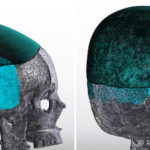
For a permanent effect, a new silicone implant is now available for aesthetic temporal augmentation. (Temporal Shell Implant, Implantech, Ventura, CA) Composed of a very soft and low durometer silicone material, it feels very similar to muscle or fat tissue. Its shape matches the typical borders of the temporal region. It is thicker at its bottom portion where more augmentation is needed and has upper feathered edges to blend into the upper temporal area without visible edge demarcation. As a soft tissue implant, it should be placed under the temporalis fascia on top of the temporalis muscle through a small vertical incision in the temporal hairline. While it can be placed on top of the temporalis fascia, there are increased risks of implant visibility and injury to the frontal branch of the facial nerve.

Temporal Shell implants are currently available in two sizes. The implants have radiating lines on them, not only for flexibility, but also for implant shaping if needed. Scissors can be used to quickly shape and customize the implant for any patient’s temporal dimensional needs.

Temporal implant augmentation is very straightforward and could be even be done under local or sedation anesthesia. Subfascial pocket dissection is rapid and risks no injury to any blood vessel or nerves. There is very little swelling and usually no bruising after the procedure. Patients report no pain afterwards.There are no physical restrictions or care needed after surgery.

Temporal Shell Implants are now available to provide permanent soft tissue augmentation for aesthetic concave deformities of the temporal region. They can be used when either an injectable temporal augmentation has failed or a more assured one-time permanent effect is desired. The implants are uniquely made to create a soft tissue effect rather than a more firm bony augmentation commonly used for facial skeletal augmentation.

Dr. Barry Eppley

Indianapolis, Indiana

Implant Augmentation For Aesthetic Temporal Hollowing

Sunday, April 22nd, 2012

Soft tissue augmentation of the face has gained popularity due to the use of a wide diversity of injectable fillers. From synthetic materials to fat, any soft tissue zone of the face can be injected. While facial implants have been around for many years for hard tissue augmentation, such as the chin, cheeks and jaw angles, there are many more soft tissue zones than there are hard tissue ones.

One of the facial soft tissue zones that has become possible to reliably treat is that of the temples. The temporal zone is very much like the submalar-lateral facial zone in that it is a ‘trampoline’ facial zone. It is surrounded by bony margins that support skin and underlying fat and muscle. The superior margin is the anterior temporal line, the transition area into the bony forehead. Its anterior margin is the lateral orbital wall and its inferior border is the zygomatic arch. Its posterior border is not significant in most cases because it is obscured by the hairline and temporal scalp.

The contour shape of the temples is primarily influenced by how much fat and muscle lies underneath. Skin laxity is not an issue. Most commonly there is a slight concavity to the temples. But too much concavity or even excessive convexity is obvious and disrupts the shape of the overall face. How much temporal concavity is aesthetically acceptable is a matter of debate and belies any known established measurements. But when excessive the bony margins become obvious and presents an appearance of aging or even illness.

I have observed that placing a ruler or straight instrument between the anterior temporal line and the zygomatic arch, most people will have 1 to 3mms of concavity at the central or deepest area of the temples. When it exceeds 5mms or more, most people would view it as excessive temporal concavity.

For temporal hollowing, the most common treatments to date are injectable fillers. Treatment options include hyaluronic acid, PLLA and HA fillers as well as fat injections. Most of these injectable fillers are placed in the subcutaneous space between the skin and the superficial temporalis fascia. While this is where the frontal branch of the facial nerve passes, the risk of injury is low. Some do place fillers directly under the fascia into the temporalis muscle but this is less commonly done. In theory the muscle is a better place for longevity of fillers, particularly that of fat, but the push on the skin from under the temporalis fascia is weakly transmitted because the stiffer fascia pushes back against the soft filler.

While injectable fillers can be effective for temporal hollowing, they are not permanent and the volume needed for a single treatment is costly. It usually takes 2ccs of filler per side to have a visible effect. An alternative treatment for temporal hollowing is that of a synthetic implant. Made out of a flexible and very soft silicone material, temporal implants are inserted under the deep temporal fascia. It produces a result that is more significant that any injectable filler treatment and will create a permanent augmentation.

The surgical technique for placement of a temporal implant is very simple and can be done under local anesthesia if desired. Through a small vertical incision in the temporal hairline, the deep fascia is incised and the pocket quickly and easily made. Different sizes of temporal implants exist depending upon the depth of the concavity and the use of preoperative sizers. Adjustments to implant size can be easily done by trimming with scissors. There is no need for implant fixation as the pocket on top of the muscle controls its position. There is minimal discomfort afterwards and no bruising. The swelling is mild and there is no discomfort on chewing.

The simplicity and the permanence of specific shapes of synthetic implants should be considered as an option for the treatment of aesthetic temporal hollowing.  

Dr. Barry Eppley

Indianapolis, Indiana   

Temporal Augmentation with Fat Injections

Sunday, March 4th, 2012

A recent news story out of the UK in London headlined the transfer of fat from a man’s stomach to his head to reshape it. Given that fat injections to the face, breast and buttocks have become so popular over the past decade, such a story is at the very least noteworthy.

The patient was a young 32 year-old man had some of his skull removed and surgery to reconstruct a shattered eye socket, cheekbone, and leg, following injuries sustained when he fell while climbing up a drainpipe outside his house. To ease brain swelling caused by his fall, a piece of his skull was initially removed which is standard practice in these type of injuries. Also he had titanium plates inserted to fix his broken eye socket and hold the bones together.Six months after his initial injury, the missing piece of his skull was reconstructed with a computer-generated titanium plate based on the shape of his opposite normal skull. Despite restoring the bony shape of the skull, his temple area still remain indented. This is common after such skull procedures as the temporalis muscle, which needs to be raised off of the bone to perform the procedure, will shrink down in size during the healing process.

This ‘temporalis muscle atrophy after a craniotomy’ is well known and has been treated over the years by many methods. In this patient’s case, the surgeons used stomach fat harvested by ljposuction which was then injected into the temporal skull defect to fill it out for a smoother contour. How well the fat survived and adequately reconstructed the temporal defect months later was not described in the news story.

Reconstruction of a cosmetic temporal defect can be done with either a synthetic implant, allogeneic tissue grafts or fat injections. There are advantages and disadvantages to any of these approaches. Fat injections, just like they do for every other face and body application, offers a minimally-invasive procedure with a cannula harvest and a needle injection technique. Its disadvantage is in how much of the injected fat will survive. Experiences with temporal fat injections vary widely with some reporting good volume retention and others near complete absorption. I have seen both outcomes in my temporal augmentation with fat. For assured temporal augmentation results, a simple insertion of a specially-designed silicone temporal implant provides a permanent solution.

Dr. Barry Eppley

Indianapolis, Indiana

A New Shaped Implant for the Treatment of Temporal Hollowing

Saturday, July 2nd, 2011

The temporal region of the face, technically the side of the head, occupies an often overlooked aesthetic area. It is bounded superiorly by the anterior temporal line of the forehead, anteriorly by the lateral edge of the bony brow and eye socket, inferiorly by the zygomatic arch and posteriorly by an indistinct margin in the temporal scalp hair. It is not a bony-supported region by rather one of soft tissue, the temporalis muscle and the deep fat pad. The temporalis fascia  covers the muscle and acts like a taut trampoline attached to the surrounding bony edges.

The aesthetic shape of the temple is determined by whether it has a convex, flat or concave appearance. There is no uniform standard or anthropometric measurement to judge what is its ideal shape. A flat or slightly concave temple area appears most common. A bulging or overlying convex appearance is unusual and unappealing and is rarely seen. An overlying concave appearance suggests a sickly or ill appearance. The shape and prominence of the forehead also influences how concave the temporal region will appear.

The most common aesthetic deformity of the temporal region is excessive concavity or depression. It can be caused from surgery (temporalis muscle wasting after a craniotomy), a medical condition (fat atrophy from extreme weight loss or medications) or one’s natural genetics. (congenital lipoatrophy) Regardless of its etiology, some form of an implanted material is needed to build out the temporal depression.

Methods for temporal augmentation have included injected fat, dermal grafts, bone cements or cranioplasty materials and various synthetic implants. Each has their own advantages and disadvantages and have different locations of placement, either above the fascia, below the fascia, intramuscular or on top of the temporal bone. Depending upon the cause for the temporal deformity, there may be benefits to one method of augmentation over the other.

While differing synthetic materials have been used, there has not been few if any preformed temporal implants available. A new preformed temporal implant is now available made out of flexible silicone rubber. Its shape mirrors the natural contours of the inferomedial bony boundaries where the greatest temporal concavity occurs. Its beveled shape allows differential augmentation to be achieved in an anteroposterior dimension so the augmentation is not too excessive near the hairline. Two different sizes are currently available.

Besides the innate flexibility of silicone, the implant is also designed with cross-cut ridges of material underneath to allow even greater three-dimensional implant adaptability. This could be a useful feature to allow the implant to not impede the excursion of the temporalis muscle with mastication.

In aesthetic augmentation, a temporal implant is best placed in the subfascial plane. This is easily done by a small vertical incision in the temporal hairline. This location allows the implant to be placed in a position that maximizes its shaped design. The curved form of this new temporal implant allows it to be rotated in through an incision that is smaller than its widest part. It can also be placed above the fascia but this places the frontal branch of the facial nerve at risk.

In augmentation of temporal defects from craniotomies, the temporalis muscle may be very scarred or severely atrophied. Placing it under the temporalis muscle in these craniotomy-induced defects may be preferable.

This new implant offers another treatment option for temporal hollowing. Its unique shape, flexibility and well-established tolerance to the material is a welcome addition to the expanding number of available cranial and facial implants.

Dr. Barry Eppley

Indianapolis, Indiana


Dr. Barry EppleyDr. Barry Eppley

Dr. Barry Eppley is an extensively trained plastic and cosmetic surgeon with more than 20 years of surgical experience. He is both a licensed physician and dentist as well as double board-certified in both Plastic and Reconstructive Surgery and Oral and Maxillofacial Surgery. This training allows him to perform the most complex surgical procedures from cosmetic changes to the face and body to craniofacial surgery. Dr. Eppley has made extensive contributions to plastic surgery starting with the development of several advanced surgical techniques. He is a revered author, lecturer and educator in the field of plastic and cosmetic surgery.

Read More


Free Plastic Surgery Consultation

*required fields


Pricing

The cost of any type of elective plastic surgery plays a major role in the decision to undergo the procedure(s).

Get Your Quote Here


My Plastic Surgery Story

Military Discount

We offer discounts on plastic surgery to our United States Armed Forces.

Find Out Your Benefits


Categories