EXPLORE
Plastic Surgery
Dr. Barry Eppley

Explore the worlds of cosmetic
and plastic surgery with Indianapolis
Double Board-Certified Plastic
Surgeon Dr. Barry Eppley

Archive for the ‘necklift’ Category

Necklifts for the Younger Patient

Sunday, December 2nd, 2012


While the face in theory ages evenly, one’s concerns about different facial changes is not. Besides the eyes, the neck is a frequent target of aging dissatisfaction. While the neck is composed of various tissues, one wants see is loose and hanging skin. This makes one yearn for the days when the skin between the chin and neck was firm and taut and a more defined neck angle existed. While styles and fashion have changed over the years, a sharp and clean neckline has always been a youthful image.

While the neck has always been a physical disdain of aging, what has changed is the age at which these concerns arise. Turkey necks and wattles are understandable neck concerns, but they represent older patients often in the sixth, seventh and eighth decades of life.  Ever since Nora Ephron’s book ‘I Hate My Neck’ was published, it was like a light bulb when off for many younger people.  Younger people, women and men alike, now appear in the fourth and fifth decades, to do something about their loosening neck skin. The reality is that the publication of the book was merely coincidental to this interest. The wide spread use of Botox and fillers has filled many a plastic surgeon’s office with early aging patients where the opportunity to discuss these concerns can easily happen.

The interest in addressing the earlier changes in neck aging has led to a variety of surgical and non-surgical treatments. A host of energy-driven devices exist for neck tightening, like Exilis and Ultherapy, but these are really bridging therapies until the time comes when one is ready for a more definitive surgical approach. Some fat shrinkage and skin tightening may work well for more minor neck droops, but really significant and and longer-lasting results requires tightening the muscle and skin to resist the never-ending effects of gravity.

Necklifting options today range from under the chin approaches (submental incisions) that use skin tightening caused by fat removal and/or muscle tightening and more traditional approaches (facelift) that use skin shifting and excision by incisions around the ears. Most younger aging neck patients are going to usually benefit by submental approaches and these are of the greatest interest because they are ‘less’ surgery with a quicker recovery. By definition a submental approach involves a small and inconspicuous incision right under the chin. It can be just a few millimeters when only liposuction is used. The heat created by the use of Smartlipo is a reall complement to the any fat removal done. For someone with a full neck but good thick skin, this could be all that is needed to create a better neck contour.

The most unknown necklift is that of the submentoplasty or platysmaplasty. Through a slightly larger submental incision, fat is first removed from under the skin but the cornerstone of the procedure is the muscle tightening. The sagging platysma muscles are sewn either back together or folded onto themselves in an up and down fashion creating an effect like a corset on the waistline. (which is why this procedure is also known as a corset platymaplasty) This shortens the vertical length of the muscle, pulling the neck angle upward  and with that the overlying skin as well. Other muscle innovations create slings from one side of the neck to the other using permanent sutures to create a hammock-like effect with special instrumentation for passing these sutures into the correction position.

While not as common, a few will have a neck problem that is not primarily fat but just loose skin. Skin laxity is a less frequent cause of younger patients but definitely becomes more of an issue as one crosses the half century mark. Loose skin in the neck, if not too severe, is managed by a smaller neck-jowl tuck-up or one of the many variations of short scar or limited facelifts. While less skin is removed than in a traditional facelift, the tightened on both sides of the jawline creates a hammock-like effect across the midline of the neck pulling it tighter.

The revolution in sagging necks is that more and more younger patients are turning to necklifts as stand alone procedures…changing for some the title of their own book ‘I Love My Neck!’

Dr. Barry Eppley

Indianapolis, Indiana

Case Study: The Simplicity Of The Direct Necklift In Older Men

Monday, January 2nd, 2012

Background:While the face in men ages just like in women, their primary concern is often largely that which occurs in the neck. As the male neck ages, it often hangs down like a wattle. While it does contain fat and the platysma muscle has separated in the midline, the loose skin makes up the biggest part of the sagging neck tissues. Often called a turkey neck or neck wattle, this neck appearance not only shows one’s age but gets in the way of any neck conforming clothing.

While there is little question that a traditional neck-jowl lift (aka facelift) is the aesthetically preferred approach for neck correction, many older men simply don’t want it. There are a lot of reasons why including extent of the surgery, amount of recovery, visible scars around the ears and cost. While some plastic surgeons may be uncompromising about a facelift only approach, there are older men who will rather live with their neck problem than undergo a facelift.

The direct neck lift has been around for a long time. I suspect that its history goes back to the infancy of facelift surgery where direct loose skin removal was the only surgical option. In an era of limited anesthesia and rudimentary surgical techniques and instruments, the easiest and fastest solution was used. In today’s world, the easiest approach is chosen when recovery and cost are the limiting factors.

Case Study: This 62 year-old male was bothered by his loose and floppy neck skin. He otherwise felt good about his age and appearance and was not concerned about any other aging facial areas. Besides its moving when he turned his head, he had trouble buttoning his shirts which accentuated the visible loose skin. He was on a limited budget and could take little time off work. Furthermore, he did not want anyone to know especially his coworkers.

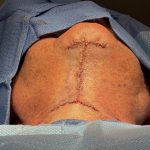
Under general anesthesia, he underwent a direct necklift using a ‘candelabra’ skin excision design. While most think only of a vertical elliptical excision, this will leave a bunching of skin under the chin and particularly around the adam’s apple area. The extra skin at both ends of the vertical excision must be accounted for in the skin excision design. With the removal of the skin, all the fat underneath it is simultaneously removed. The platysma muscle is then always seen widely separated and it is sewn with interrupted sutures from under the skin down as far as it can be brought together. No drain is used. The skin is closed with dermal resorbable sutures and interrupted permanent skin sutures. Only tapes are applied over the incision lines and no other dressings are used.

His skin sutures were removed in 10 days. There was the typical neck mild bruising, very minimal swelling and a red suture line for weeks after suture removal. The result was immediate with a 90 degree angulation of the neck at the time of skin closure that did not change at any time after surgery. Within a few months, the neck scar faded and was only perceptible on the closest inspection.

Interestingly, he stated that no one ever noticed that he had undergone any surgery or asked about it. I suspect his goateehelped distract or hide anything that happened in the neck But everyone did say he looked refreshed and more youthful.

Case Highlights:

1)Older men with neck wattles or turkey necks desire a simple solution to their aging neck concerns. They do not want a traditional facelift.

2)The direct neck lift provides a simple and extremely effective neck contouring procedure with minimal recovery.

3)The aesthetic liability of the direct neck lift is a scar but this is minimized due to the hair-bearing skin of the male neck.

Dr. Barry Eppley

Indianapolis, Indiana

Turkeynecks, Older Men and the Direct Necklift

Monday, November 14th, 2011

Facial aging affects everyone but men almost always delay considering its treatment until the condition is more advanced. Many more women undergo some form of a facelift than men. No one knows the exact average of men vs. women who undergo a facelift, but it would be fair to say that the age difference is at least ten years if not more.

What really drives a man to consider a facelift is the aging changes in the neck. A sagging neck, often called a turkeyneck, is the most compelling reason for men to undergo some plastic surgery improvement. The droopy neck skin and tissue bands, besides making for an older appearance, also interfere with the comfort of wearing shirts. By the time a man has presence of a real turkey neck they are usually at least 65 years of age or older.


A facelift, with its incisions in and around the ears, is a very effective changer of the jowl and neck area. The greatest benefit achieved with a facelift is in the neck and this is why the terms facelift and necklift are often used interchangeably. But a facelift in men poses challenges when it comes to hiding scars around the ears and getting complete elimination of a significant neck wattle. In addition, many older men do not want to undergo the extent of the surgery and recovery of a traditional facelift procedure.


An alternative to a facelift in the older man is a direct neck lift. Rather than chasing the neck skin back to the ears for its removal in a standard facelift operation, the direct necklift removes the skin and fat of the turkeyneck by removing it where it hangs. This greatly simplifies the operation and makes for virtually no real recovery. And, interestingly, the change in the neck is nothing short of dramatic and will last longer than that of a traditional facelift. When done over age 65 it will largely last the rest of one’s lifetime with the reappearance of a central neck wattle as unlikely. This is also an operation which can be done fairly comfortably under local anesthesia with oral sedation. This means that men of any age, almost regardless of their medical condition, can be successfully treated.

The trade-off to all of these direct necklift benefits is that there will be a fineline scar down the center of the neck. While no such scar should be taken lightly, the beard skin of men is a particularly favorable area for such scars to heal inconspicuously. It also helps that most men perform daily microdermabrasion scar therapy, also known as shaving. And if one wears a beard then the scar is particularly irrelevant.


For an older male with a significant neck waddle, a direct neck lift can be a very simple and uncomplicated procedure that can quickly get the results many men desire. A direct neck lift produces an immediate tightening of the neck and makes it look like it did twenty years ago in many cases. Such an operation easily fits into the lifestyle of the older male who is looking for a neck change that is both quick and simple.

Dr. Barry Eppley

Indianapolis, Indiana

Options in Neck Reshaping and Contouring

Friday, October 21st, 2011

The shape of the neck is an important aesthetic structure of the face. When it is well defined with a sharp angle definition (between 90 to 120 degrees in profile), it makes the chin and jawline more prominent and flattering. When the neck angle is obtuse or completely open (straight), the jawline becomes obscured and less aesthetically pleasing. The neck can be seen to have a major influence on how the entire lower third of the face looks. As one begins to age, the neck tissues become loose and begin to sag.For some, even at a young age, they have a naturally full with an obtuse angle due to a thicker fat layer and a lower positioned hyoid bone.

While genetics, gravity and time work against a shapely neck with a good angle, there are a number of plastic surgery procedures to improve the aesthetic appearance of the neck. First, however, a few comments on non-surgical reshaping methods. While creams and exercises are touted to improve the shape of the neck, none have been proven effective for making noticeable changes. Some modest changes can be made in the appearance of jowls and neck skin sagging in those who have good skin elasticity withvarious transcutaneous energy therapies. (e.g., BBL or Skin Tyte) These are not to be confused with surgical results but there can be visible improvement. Injectable Botox can also be used to treat prominent vertical platysmal neck bands. These are best viewed as treatments neck for those that don’t have enough of a problem to justify surgery or for those who do but prefer to try a non-surgical approach first.

Full thicker necks with good skin can be treated solely by liposuction. Removing fat allows the skin to shrink and tighten up to reveal the shape of the underlying platysma muscle. While traditional liposuction is effective,the additional use of a laser-assisted technique can help improve the results. Smartlipo, which uses a fiberoptic laser probe, creates heat which not only helps melt fat but can create a skin tightening effect as well. While neck Smartlipo is ideal for younger patients due to their better skin quality, I have seen a few older patients with impressive neck changes as well.

The next level beyond neck liposuction is a submentoplasty. This is a neck tightening operation that not only removes fat by liposuction but tightens the platysma muscle as well. It is performed through a submental incision in which some small amount of loose upper neck skin can also be removed. Also known as a submental tuckup, it can be effective for the very beginnings of neck sagging in younger patients with good skin. It is also historically used after a facelift when some submental skin sagging develops (rebound relaxation) in the first year after surgery.

Facelifts are the primary procedure that can create the most effective change for the aging neck. Facelifts, also called necklifts, can be thought of as being two fundamental types either a limited and full type. Both use incisions around the ear but the length of the incisions and what effects they create in the neck and jowls is different. A limited facelift, which goes by a lot of marketing names (Lifestyle Lift, Quicklift etc), has as its main effect the smoothing out of sagging jowls with a more limited effect in lifting neck skin. It is best used in patients whose primary complaints are about their droopy jowls and not their necks. Full facelifts are used when the neck problem is more significant and its improvement is the main objective of the surgery. It is the most powerful changer of both the neck and jowls and usually also incorporates liposuction of neck fat and tightening of the platysma neck muscles. Chin augmentation with a facelift can also be helpful in giving a more defined jawline.

One other approach to the sagging neck is that of the direct necklift. Unlike facelifts in which the incisions and the direction of skin lifting is based around the ears, the direct necklift removes loose neck skin by excising it down the center of the neck…directly if you will. This is a simpler approach to a necklift and is a very powerful reshaping method of the neck but it does so with the trade-off of a midline neck scar. This can be a preferred procedure for older men (greater than age 65) who prefer the least recovery and have large hanging neck wattles. Male beard skin heals remarkably well and I have not found the neck scar to be a visible concern after it heals.

The last area of neck reshaping, which has nothing to do with age, is the prominent Adam’s apple or thyroid cartilage. For those that have too strong of a neck bulge caused by the strength of the paired cartilages of the Adam’a apple, this can be reduced by shaving the prominence down. This is done through a small horizontal neck incision directly over the prominence. It is a virtually painless procedure with no recovery and a result that is immediate. Most patients obtain results where the size of the bulge is dramatically reduced and a few will end up with a completely smooth neckline.

Dr. Barry Eppley

Indianapolis, Indiana

iGuide Neck Contouring – A Minimally Invasive Approach To Improve The Neck Angle

Wednesday, February 9th, 2011

One of the defining facial features that casts an impression about one’s appearance is the neck, or more specifically the neck angle or neck profile. Whether one is young or old, an obtuse or poorly defined neck angle is not aesthetically desireable. If one is young with a full neck, liposuction alone will increase the neck angle as the skin retracts upward. When one is older, however, a dropping or poor neck angle is associated with muscle and other tissue changes. This is why a facelift, or some variation of it, is needed to make a significant change in the neck angle through a suspension effect of ear to ear skin flaps.

Short of an open facelift approach, there has not been any other method to help tighten the neck and jowl SMAS. The SMAS is an acronym for a layer of tissue above the muscle which most confuse as a facial muscle which it is not. But tightening the loose SMAS can help improve the neck angle. A new device, called the iGuide, has now become available to help create a firmer and more youthful neckline.

The iGuide is an FDA-approved device that is for soft tissue approximation and elevation of subdermis and muscle. It provides a less invasive technique to improve the neck and jawline with minimal incisions (unlike a traditional facelift) while at the same time shortening recovery time. By not doing wide elevation of neck skin flaps, the swelling and bruising is much less and the need for the skin to ‘stick back down’ is eliminated.

The iGuide allows soft tissue to be elevated and defined by essentially creating a ‘neck trampoline’ using dissolveable sutures. Through a series of needle punctures placed along the jawline, a dissolveable suture is weaved back and forth from side to side to create a trampoline-like structure. This suture weave creates a low-tension support which elevated the skin, muscle and the SMAS as a combined soft tissue unit. This suture is not to be confused with different facial rejuvenation techniques in the past that have have used barbed sutures.

From a neck recontouring standpoint, the iGuide has multiple potential uses. For the younger patient with a fuller neck where liposuction alone is not completely satisfactory, a suture weave can provide additional neck angle improvement. For the early signs of neck and jowl aging, a short scar facelift is great for the jowl area but may not always optimally treat the neck angle. The trampoline effect of the suture weave upgrades the surgical outcome.

The iGuide neck contouring system is touted as being able to be done under local anesthesia and that is most certainly true. But that would only be relevant if one was doing an isolated neck procedure which often is not the case. But for those patients interested in a most minimalistic approach, an office procedure under local anesthesia with oral sedation is easily done. Neither the tiny incisions nor the weaving of the sutures requires the use of any sharp needles.

The iGuide provides a clever minimally invasive approach to redefining one’s neckline. As its tagline states, it is ‘The Neck’s Big Thing’. Time will tell whether this technique will find its way into the standard repertoire of successful neck contouring procedures or go the way of the barbed suture.  

Dr. Barry Eppley

Indianapolis, Indiana

The Zipper Necklift For Neck Wattle Removal

Tuesday, December 28th, 2010

The neck wattle is one of the most bothersome of aging facial features, particularly for the older male. Men are often much more concerned about their turkeyneck than they are about the bags and hanging skin around their eyes. That neck wattle not only flops around but really stands out in a shirt and tie as it hangs down onto the collar. It is an unfortunate sign of a man’s age.

The traditional and most effective correction for the neck wattle, at any age, is a facelift. While highly successful, some men seek out a less invasive approach with a quicker recovery. The direct necklift may be an attractive alternative provided one is willing to accept a central neck scar. Such a necklift scar usually does better in a male than a female due the improved scar results that occur in bearded skin.

While the direct necklift involves the simplistic concept of a vertical cutout of central neck skin, the operation is actually more sophisticated and involves numerous nuances in technique. Not only is skin removed but the attached underlying fat down to the platysma muscle is removed as well. With a very wide diastasis of the platysma muscle, all subplatysmal fat down to the strap muscles can also be removed from under the chin down to the thyroid cartilage. The intramuscular platysmal gap is then closed by a vertical row of muscle plication sutures. These maneuvers help to compliment the skin closure in getting a much improved and often dramatic change in the neck angle that not even a full facelift can approximate.

Despite the striking improvement in the neck angle with these deeper tissue steps, the outward appearance of the neck scar is also critically important. While there may be some horizontal scars from the closure under the chin and in a lower horizontal skin crease above the sternal notch, the most important and visible scar is the vertical one. Historically, the vertical necklift scar is done as either a straight line or a straight line with a central z in the middle of it.

The problem with a vertical neck scar is that it runs perpendicular to the horizontal skin tension lines in the neck and is under tension. This poses the risk of hypertrophic scar formation. This is why in some cases a z-plasty is made in the central area of the scar. An alternative option that I have explored for vertical necklift closure management is a running broken line closure of a symmetrical fashion. Known as a running w-plasty, this is a common scar revision technique that can also be called a ‘zipper line’. This breaks up the tension along the scar line and reduces the risk of poor scar outcomes.

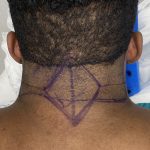
In the cutout design of a vertical necklift, the edges of the excision are marked and then a running w-plasty pattern drawn on the outside of it. The skin is then incised along the marks and the deeper portions of the necklift carried out in the usual fashion. This creates a saw tooth-edge appearance along the skin margins.

At closure, the limbs of the skin edges is interdigitated to create the zipper line closure. This requires a meticulous closure with fine sutures done under loupe magnification.

The zipper necklift is another option for direct neck wattle removals. It appears to be a good choice when the skin excess is not significant enough to require horizontal excision and closure extensions under the chin and in a low skin crease…if only a completely vertical excision is needed. It could also serve as an option for hypertrophic neck scar management should that be necessary from a previous direct necklift.

Dr. Barry Eppley

Indianapolis, Indiana

Case Study: The Direct Necklift for Female Turkeynecks and Neck Wattles

Sunday, November 21st, 2010

Background:Changes in the neck is one of the most bothersome facial changes that occurs as one ages. A sagging neck can ‘grow’ into a really significant neck wattle by the time one reaches their sixties and seventies. When the neck sags to this degree, it literally flops from side to side and hangs down from the chin all the way to below the thyroid cartilage. (adam’s apple) This neck wattle is often referred to as a ‘turkeyneck’.

The traditional treatment for any sagging neck problem is that of a facelift. The benefits to the neck in a facelift is that the hanging skin is freed and chased back to the ears where it can be removed and the resultant scars placed in the hidden crevices and skin folds of the ear. While this is a highly successful operation, certain patients may seek an alternative approach that is less extensive , more cost effective and has a quicker recovery.

This alternative approach is the direct necklift. While uncommonly done, it removes the neck wattle by directly cutting it out. The tradeoff for this more simpler neck solution is that of a scar running down the center of the neck. This scar in the older male usually does quite well because of its location in bearded skin. The hair follicles in the skin and the daily use of shaving (microdermabrasion) leads to good scar outcomes. Women, however, have a different quality of neck skin that is usually thinner and the creation of a neck scar is more of a potential concern.

Case: This 63 year-old female could no longer stand the hanging skin from her neck as it gradually became bigger. She was offered a traditional facelift but declined and wanted a direct necklift instead. She was also offered a chin augmentation to complement her necklift but she declined.

The markings for a direct neck lift is more than just a simple vertical elliptical excision pattern. This would create skin redundancies or dogears under the neck and below the adam’s apple. Smaller horizontal excisions are needed at both ends of the vertical wattle removal, creating more of a candelabra excision pattern.

The neck wattle is removed along the combined vertical and horizontal excision skin pattern, taking all of the underlying fat. This exposes the widely split platysmal muscle edges which are then tightened with individual sutures to create and support a sharper neck angle. This exposure provides a unique view of the deeper muscle anatomy of the aging neck.

The skin edges from the sides of the neck are then brought together in the midline after first bringing together the horizontal areas under the chin and low in the neck above the sternal notch. The deeper layers are closed with resorbable sutures while the skin is closed with sutures that will need to be removed a week later. The only dressing that is used are small tapes which are glued on over the stitches. There are no restrictions after surgery including showering the very next day.

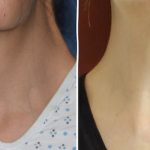
She had a near painless recovery other than some tightness of the neck when trying to look up. She had her tapes and sutures removed a week later. This photo shows her appearance at the time of her suture removal ten days after surgery.

Case Highlights:

1) The direct necklift is a good option for the older woman with a significant neck wattle if one can accept the trade-off of amidline neck scar.

2) The direct necklift provides a dramatic tightening of the neck angle through platysmal muscle tightening and generous removal of the hanging neck wattle.

3) Widening and tightness of the central position of the midline neck scar may require revision through a simple z-plasty or steroid injections.

Dr. Barry Eppley

Indianapolis Indiana

Case Study: Direct Necklift Wattle Removal in Men

Sunday, September 19th, 2010

Background: The most troubling facial feature in many older males is that of the neck. The development of a neck wattle is bothersome in many ways. It interferes and looks worse in buttoned shirts as it hangs over the collar. It moves and swings unflatteringly as one moves the head from side to side. While many of the aging male features may be perceived as distinguished, the hanging neck wattle is not one of them and seems disproportionately ‘aged’ compared to the rest of the face.

The classic treatment for the aging neck in men is that of a facelift. This is a procedure with a long history of neck improvement that relocates the loose skin from the central neck up and back to the jowl area and side of the face. It does so to place scars in a less conspicuous area around the ears. But for some men this operation has some concerning issues. The hair pattern around the ears for many men can make the concept of hidden scars more difficult. The heavy and thick skin of the male neck is not as easy in which to get a real significant neck change and is very prone to postoperative relaxation. There is also the reality that some older men simply do not want to go through a facelift operation and the recovery that is involved.

Case: This is a 68 year-old male who found that his growing neck wattle was increasingly bothersome. He was not bothered by the rest of his aging face, the neck was his only concern. While his entire face showed the effects of a life well lived, the size of the hanging neck wattle was hard to miss. While he wanted it removed, he was emphatic about not having a facelift. He was an avid golfer and wanted to return to the links as soon as possible after surgery. As a medical confounding factor, he was on Coumadin for the treatment of atrial fibrillation.

He underwent an excisional necklift through a vertical cutout approach. Under the chin and at the lowest neck skin crease at the adam’s apple area, the vertical excision was combined with horizontal skin removals to avoid unsightly skin redundancies. (dogears) With this skin excision is the removal of full thickness fat down to the split platysma muscle. With the platysma muscle fully exposed, it is sutures together in the midline as part of the direct necklift procedure. Under IV sedation, the procedure was performed in around one hour. The skin was closed with small sutures and covered with small tapes. No drains or other dressings were used. He could shower and shave the next day. His only restriction was not to extend his head backwards for several weeks. He reported at his suture removal a week later that he never had any pain or significant swelling.

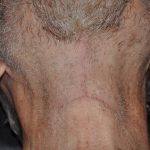
The most important question from a patient’s perspective about the direct necklift is the scar. While men accept that there will be a scar, they want to know how ‘bad’ it will be. As seen in his postoperative results, the scar is not particularly visible. This is a mature scar and there is a period of redness until it gets to this point. On average, it is about three to four months until it fades. Beard skin heals better than skin without hair. The effects of daily shaving (microdermabrasion)may also be of scar benefit.

Case Highlights:

1) The direct necklift in the older man is a simple and very effective operation that has very little recovery.

2) The vertical and two horizontallimbs of the direct necklift scar heals extremely well in the bearded skin of the older male. While scar revision of the central part of the neck scar may occasionally be needed, the need for it is not common.

3) The central part of the neck is dramatically changed with this operation. It also provides some secondary improvement in the jowls by tightening them inferiorly.

Dr. Barry Eppley

Indianapolis Indiana

The Scar from the Direct Necklift

Wednesday, September 1st, 2010

The aging neck is one of the most bothersome features of facial aging, whether it be a man or a woman. This is very evident as patients get older (greater than 55 or 60) and often is the sole focus regardless how the rest of the face is aging. For many men, the sagging neck is often their only facial aging concern.

Often a surprise to many patients is that the traditional facelift is the primary surgery to improve the sagging neck. While many perceive that a facelift is a total facial rejuvenation, they erroneously believe that the neck is treated differently with a ‘necklift’. Understanding that a facelift and a necklift is the same operation is a revelation for many.

For some older patients with severe neck sagging or a ‘turkey neck’, they simply do not want to go through a facelift. In most men in particular, the facelift concept and the lack of significant hair around their ears motivates them to pursue a different option. Rather than try and persuade patients to go through a procedure they don’t really want or can’t afford, I have used in my Indianapolis plastic surgery practice an uncommon option.

The direct neck lift is one limited form of facelift that just deals with the neck only. By cutting out the neck wattle directly, a dramatic change in one’s neck contour is achieved. It would be fair to say that the direct necklift produces a more dramatic neck profile change that is strongly resistant to future aging concerns caused by skin relaxation. Rather than shifting skin back in a traditional facelift, inches of skin and fat are permanently removed and platysmal muscles strongly tightened in the direct neck lift. It is simpler, faster, has next to no pain, and involves very little recovery of any significance.

But the beauty of the direct necklift is marred by one potential concern, which is why it is rarely done, that of neck scarring. That is the price that is to be paid for its simplicity and effectiveness. But how bad is this scarring? Is it slight or is it significant? Many who have never actually performed the procedure believe that the risk of poor scarring makes the direct necklift not a viable treatment option. That has not been my experience.

When speaking about necklift scarring, it is important to point out that the vast majority of patients I have treated are older men, age 65 or older. That is an important point for two reasons. The bearded skin of men allows for the most favorable s exposed scar location. Between the thickness of the skin, the healing potential of hair follicles and sweat and oil glands and the daily shaving (microdermabrasion scar treatment) that most men do, scars are set up to heal favorably. Secondly, this male population is very motivated as the other alternative (facelift) is even less appealing.

The scar pattern from a direct necklift is not a straight line. Vertical excision alone will leave redundant tissue under the chin above and along the thyroid cartilage below. Rather it is a vertical excision pattern that is combined with horizontal ellipses at either end, forming a ‘candlestick’ or ‘fishtail’ pattern. The very center of the closure in the middle of the neck will bear the zone of greatest tension. This is often relieved with a z-plasty to prevent central scar hypertrophy or widening. This is done in about half of the cases. Such an excision pattern has shown to produce remarkable neck changes in profile.

The scars from a direct necklift usually settle quite quickly and the typical early redness of scars fades by three months or so. While a very fine line vertical neck scar can be seen on very close inspection, it is largely inconspicuous in all men. The horizontal submental and low neck line scars become invisible. The redness of the scar persists longer in women and may be more visible which is why it is usually a gender-biased procedure.

While the potential scarring is an appropriate concern in the direct necklift, careful patient selection can make for a very satisfied patient. I have yet to formally revise any neck scars but have injected several raised scars of a cm or so in the tight central neck zone.

Dr. Barry Eppley

Indianapolis, Indiana

The Scar of the Direct Necklift

Tuesday, March 23rd, 2010

The neck wattle is a common sign of facial aging and often one of the most bothersome. Even in the presence of many other facial changes that occur with time, some patients find the sagging neck to be the first and, sometimes only, area they want addressed. This is particularly seen in older men.

While a facelift is the traditional approach to the neck wattle, there are numerous reasons why some patients do not want to undergo that operation. Cost, recovery, and lack of hair or a good hairline in and around the ear are the most common.

An alternative approach to neck wattle reduction is the direct necklift. While uncommonly done, this operation removes the neck wattle by cutting it out right down the middle of the neck. A small but powerful operation, excess skin and fat are removed and the platysmal separation sewed together…directly. While there are a lot of advantages to the direct neck lift (minimal recovery, short operative time, little to no bruising or swelling), it comes with the trade-off of an unnatural location for the resultant scar. Patients must balance that disadvantage with its other advantages.

To help with that determination, an appreciation of the scar in the direct necklift is critical. The ultimate question is…how does the scar look and is it a bad scar? The scar pattern is really an H-shape that is turned on its side. A small horizontal limb is right under the chin (hidden and is inconsequential), a longer vertical limb that runs between the underside of the chin and a low horizontal skin crease (the scar concern) and a low horizontal scar just under the thyroid cartilage. (adam’s apple, that usually heals imperceptibly in older thin skin)

I have used three types of direct necklift incisional approaches. They differ in how the vertical scar line is placed. The vertical scar can be a straight line, a straight line with a central Z in it (z-plasty), and a running W-pattern. The purpose of the breaking up the straight line with a Z or a lot of W cuts is to prevent scar contracture and tightening at the cervicomental angle. I have seen good scar results with all of them and this probably has a lot to do with patient selection. (older male patients 60 years and up) Currently, I favor the straight line approach for the vertical scar and will usually defer the need for a central z-plasty until later. In some cases, but not all, a hypertrophic scar will develop in the tightest part of the closure (cervicomental angle) with the straight line closure. Depending upon how the closure feels during surgery, a z-plasty may be placed if it is felt to be advantageous and this is usually done in women as opposed to men.

For the well-informed patient, a direct necklift can be a better operation for their neck wattle. The scar does particularly well in men because of their beard skin, daily microdermabrasion treatments that they do (shaving) and the value of a re-established sharp cervicomental angle when wearing shirts. Its value in women lies in its simplicity and minimal recovery, particularly in the face of older age and comproming medical conditions.

Dr. Barry Eppley

Indianapolis, Indiana


Dr. Barry EppleyDr. Barry Eppley

Dr. Barry Eppley is an extensively trained plastic and cosmetic surgeon with more than 20 years of surgical experience. He is both a licensed physician and dentist as well as double board-certified in both Plastic and Reconstructive Surgery and Oral and Maxillofacial Surgery. This training allows him to perform the most complex surgical procedures from cosmetic changes to the face and body to craniofacial surgery. Dr. Eppley has made extensive contributions to plastic surgery starting with the development of several advanced surgical techniques. He is a revered author, lecturer and educator in the field of plastic and cosmetic surgery.

Read More


Free Plastic Surgery Consultation

*required fields


Pricing

The cost of any type of elective plastic surgery plays a major role in the decision to undergo the procedure(s).

Get Your Quote Here


My Plastic Surgery Story

Military Discount

We offer discounts on plastic surgery to our United States Armed Forces.

Find Out Your Benefits


Categories