EXPLORE
Plastic Surgery
Dr. Barry Eppley

Explore the worlds of cosmetic
and plastic surgery with Indianapolis
Double Board-Certified Plastic
Surgeon Dr. Barry Eppley

Archive for the ‘lip augmentation’ Category

Case Study: Adult Primary Cleft Lip Repair

Monday, May 6th, 2013


Background: Cleft lip and palate deformities are a well recognized birth defects that affects around 1:1000 births. In the U.S., they commonly undergo a primary repair of the cleft lip in the first three to six months of life. Outside of the U.S., American plastic surgeons are well known to travel all over the world to use their skills to repair cleft deformities at all ages. (e.g., Operation Smile) Many of these international cleft patients are often older, some even adults, as they have never had access to plastic surgery care before.

Case Study: This 28 year-old male from Mexico presented for a cleft lip repair. He was born with a right incomplete cleft lip with no cleft palate component. He had never had any surgical efforts at repairing his obvious cleft lip.

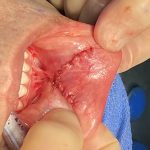
Under general anesthesia, he underwent a full rotation-advancement type cleft lip repair. The medial lip segment was rotated down and the orbicularis muscle was repaired from the base of the nose down to the vermilion. The lateral lip segment was advanced into the upper lip defect left by the downward rotation of the medial lip segment. The vermilion-cutaneous border was realigned and the full length of the lip vermilion vertically closed.

His lip sutures were removed one week later. He was not seen again for a year after his surgery. At that time his lip was fully healed and the scars matured. The vermilion-cutaneous border was well-aligned and he had good vertical lip length along the philtral column. There was some vermilion indentation along its vertical length which was going to have a revision to add some volume by fat grafting.

Case Highlights:

1) Unrepaired or poorly repaired cleft lip and palate deformities are become more common in the U.S. with an increasing immigrant influx.

2) Cleft lip repairs in adults are just as successful as in infants with a large amount of tissue in which to work.

3) Adult cleft lip repair patients are tremendously grateful for any surgical efforts of improvement. But like infants, most primary cleft lip repairs benefit by a secondary revision for the best possible result.

Dr. Barry Eppley

Indianapolis, Indiana

Case Study: Male Lip Implant Augmentation

Saturday, December 8th, 2012

Background: Lip augmentation is a popular procedure that is most commonly done with the use of injectable fillers. Any of the family of hyaluronic-acid based fillers offers an immediate improvement in which the material can be placed in a variety of lip locations to create both increased size and/or enhancement of various lip features. Its only downside is that it is temporary and must be repeated for the effects to be maintained.

The overwhelming number of lip augmentations is done in women with only an occasional man ever having the procedure. The reasons for this is the obvious preference for fuller and larger lips in women from a fashion and beauty perspective. While fuller lips in men can also be attractive, it is not a primary facial feature that necessarily makes for a strong masculine appearance. The other reasons lip augmentations are done a lot less in men is that they, in general, are less tolerant of the injectable experience.

Lip implants offer a permanent option for lip augmentation. Over the years, a variety of implant types have been available for subcutaneous tissue implantation, all of which have been different forms of polytetrafluorethylene materials. All of these materials have been withdrawn from the market with mixed clinical results. Permalip (Surgisil, Plano, Texas) is a relatively new implant designed for the lips made of a very soft (low durometer) formed silicone material. Because of its very smooth surface and tapered design, it is easily reversible should that be desired in the future.

Case Study: This 45 year-old male was undergoing a variety of procedures for facial enhancement and was interested in doing a permanent lip augmentation at the same time. Options discussed included fat injections, a lip lift, an internal mucosal advancement and silicone lip implants. He wanted the simplest but the most reliable method that would ensure a sustained augmentation effect.

At the completion of his other facial procedures, both the upper and lower lips were infiltrated with a lidocaine solution that contained epinephrine. Small 5mms incision were inside the corners of both sides of the mouth in the mucosa and scissors used to make an intramuscular tunnel to the midline in both the upper and lower lips. A fine curved grasping instrument was then passed from one side of the lip to the other through the incisions and a 5mm implant was placed in the upper lip and a 3mm implant in the lower lip. Both implants were 65mms long. The incisions were closed with small dissolveable sutures.

After surgery he did develop the typical significant lip swelling that is typical from implant passage through the lips. Some bruising occurred on the left upper lip but in other lip quadrants. His lip achieved their final size at 3 weeks after surgery which remained unchanged three months later.

Case Highlights:

1)      Lip augmentation in men is uncommon and they are less likely to choose temporary injectable fillers.

2)      Silicone implants (PermaLip) offers a permanent option for lip augmentation when one has tried and/or does not prefer injectable fillers.

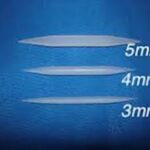
3)      Silicone implants slide easily into place through small incisions at the corners of the mouth and are available in sizes of 3, 4 and 5mms diameters with lengths from 55mm to 65mms. Men will almost always need the longest lengths.

Dr. Barry Eppley

Indianapolis, Indiana

PermaLip Implants For Permanent Lip Augmentation

Friday, May 18th, 2012

Lip augmentation is one of the most popular minimally-invasive cosmetic procedures of the face. Done almost exclusively with injectable fillers, it produces instantaneous augmentation of the vermilion-cutaneous junction or the lip body proper. Of last year’s nearly 2 million injectable filler treatments performed in the U.S., a significant percent of them was for lip enhancement.

 While there is a wide variety of injectable filler options, those fillers that are comprised of hyaluronic acid compositions work best in the supple and sensitive lip tissues. The immediate and usually satisfying results of injectable lip augmentation  is why its drawbacks are tolerated. Lip injections have to be repeated for maintenance at a frequency based on the absorption of the material. With most hyaluron-based fillers, that can be expected to be anywhere from 3 to 9 months. In addition, there is some level of discomfort with injections which makes each treatment session a tolerated but not a pleasant experience.

The alternative to lip augmentation by temporary-lasting injections is through the use of synthetic implants. There has been a history of a variety of synthetic materials used as lip implants since the mid-1990s, most of which have gone out of favor. The most common material has been that of PTFE or Gore-Tex. Initially used as a multi-strand implant, it developed an unacceptable level of complications such as stiffness, bunching, nodules and lip distortion with movements. Another PTFE material, known as Advanta which is a dual-porosity soft tube, had better clinical results but is now no longer commercially available. I had used it for over a decade and had very good clinical results with it with few negative experiences.

The newest synthetic lip implant is that of PermaLip. (SurgiSil, Plano Texas) Composed of a very soft silicone elastomer materal that is shaped like a tube with tapered ends, it offers a very supple and flexible implant that feels quite natural. It is a smooth non-porous implant that can never rupture or deflate. It is available in thicknesses up to 5mms and lengths of 6.5cm. The typical distance from one mouth corner to the other is usually around 7 cms or less.

The surgical technique to place the PermaLip implant can be done in the office under local anesthesia. Through small incisions placed just inside the mouth corners, the implant is slide into place using a small instrument. One of the biggest problems to overcome in the placing of lip implants is even placement at the right level in the lip from one side to the other. The technique for placing PermaLip implants largely overcomes the problem of lip asymmetry. One will experience some lip swelling for a week or so and occasionally some lip bruising may occur.

The physical features of this lip implant is what is most appealing to me. Its smooth surface means that it easily be reversed should one so desire. That has been the biggest problem with synthetic lip implants in the past, they were difficult to remove.

The success of any lip implant is both material and technique-based. It is important to place the implant in an intramuscular position and not immediately subcutaneous or submucosal. It is also important to not stress the lip tissues by placing too big of an implant. While PermaLip has sizes up to 5mms, a small (3mm) or medium (4mm) size is best for most patients. The implant volume/tissue ratio is important. A moderate lip size increase that has long-term success is better than a large lip size result that develops complications.

Dr. Barry Eppley

Indianapolis, Indiana   

Getting Good Results with Injectable Fillers for Lip Augmentation

Wednesday, February 15th, 2012

Valentine’s Day evokes many images, one of which is juicy full lips. While once only achievable by genetics, plumper and more full lips can be obtained by almost anyone thanks to a variety of  cosmetic procedures and products that are available today. Between celebrity news and photos, endless models in magazines and a plethora of  plumper and lipstick products,  lip augmentation has become one of the most sought after office procedures for women.

By far the most common method of lip augmentation is injectable fillers. While they are fairly quick and easy to do (notice I didn’t say completely painless), and effective for the majority of patients, they are several insights for a successful outcome and a satisfying experience.

While there are over a dozen commercially-available injectable filler products in the U.S., not all are appropriate for injection into the lip. The only ones that should be used are those composed of hyaluronic acid or hyaluron. These natural sugar products flow evenly and smoothly and have the less chance of causing  problematic nodules and lumps afterwards. Many such options exist (e.g., Juvederm, Restylanse) and the fundamental difference between them is how much they cost and how long do they last. Currently only Restylane is formally FDA-approved for use in lip augmentation but all other similar hyalurons can be safely used off-label. Though they may last lomger, avoid fillers that contain granules or crystals as they are more prone to foreign-body type reactions.

Not every lip can be made beautifully plump and full. As fillers work by expanding the size of the vermilion (pink part of the lip), one has to have enough of it to be expanded to create a fuller lip appearance. Very fine and thin lips simply can not be made two to three times their size to create a sensually full appearance. Trying to do so will make the vermilion expansion more horizontal than vertical, creating the classic and well recognized ‘duck lip’ appearance. Quite frankly, the most ideal and sensuous lip augmentation results occur in those women who already have what many people would consider good-sized lips. This doesn’t mean thin lips shouldn’t undergo a trial of lip injections to determine the results as some women will find the outcome acceptable. (anything is better than what I have concept) But if unsatisfactory results are obtained, it is time to consider surgical enhancement methods.

Lip injections are done by placing linear fills at either the vermilion-skin junction, into the body of the lip, or both. Most lips benefit by increasing the size of the white roll of the lips (vermilion-cutaneous junction) which creates a natural highlight. This is always good place to start. But size increase may also require direct vermilion body injection as well as augmenting the central pout of the vermilion or even the philtral columns of the skin of the upper lip. Good outcomes are a function of the skill and artistry of the injector as much, if not more, than the type of injectable filler product used. All lip augmentation results and injectors are not the same.

No matter how good a lip augmentation result can be, one will not be tempted to repeat it if the experience was uncomfortable. While there is no way to make lip injections pain-free, there are methods to make it more tolerable. Much is made today of some injectable fillers containing the local anesthetic lidocaine. While this does make the lip numb once it is injected with it, it is still necessary to get it in there in the first place. The choices are to either take a few injections directly into the lip to start to get it numb or to have a dental block done first. A recent innovation, known as a blunt-tipped cannula (e.g., Dermasculpt), is the best way in my opinion as it truly feels more comfortable than a beveled sharp needle of the same gauge (30 gauge) inside the lip.

Lip augmentation with fillers can have very a highly satisfying result and experience if one understands these basic concepts.

Dr. Barry Eppley

Indianapolis, Indiana   

Buttock Implants, Silicone Lip Injections and Facial Threadlifts

Wednesday, August 24th, 2011

In today’s world of internet and TV shows, plastic surgery is a frequent topic of great interest to the public. While I have seen very few of such shows, I do hear of them from time to time as patients ask me specific questions on procedures that they have been presented on them. Today one of my patients asked me about a show on Dr. Oz that appeared last week. She stated it was about the ‘three plastic surgery procedures you should not have’. These included buttock implants, silicone lip augmentation and facial threadlifts.

One of the two established ways to increase buttock size is either the placement of an implant or by fat injections. The popularity of buttock augmentation today is primarily due to the use of fat injections. Known as a Brazilian Butt Lift, it offers the simultaneous benefit of unwanted fat reduction elsewhere since donor fat is needed. But before fat injections, buttock implants were the only option. The use of such implants is actually very successful and it offers permanent volume retention. But it was never widely popular because the recovery is significant due to the submuscular placement of the implant. On the Dr. Oz show it was stated that you shouldn’t have this procedure because you can not sit for weeks after surgery. This is not true. The buttock implant is actually not placed on where you sit, the lower buttocks or ischium. It actually sits higher in the upper half of the buttocks region so you never actually sit on the implants.

Lip augmentation has become both possible and very popular due to injectable fillers. Largely done through the use of hyaluronic acid-based fillers, the increase in lip size is both immediate and very visible. Its only downside is that the results are not permanent and lasts only as long as the material’s properties permit. (between four and eight months) Silicone oil is a permanent injectable soft tissue filler but it is not FDA-approved. It also has a long history of known soft tissue problems that date back from the late 1960s. It is true that the material today (Silikon 1000) is a medical-grade material which is FDA-approved for eye fluid replacement. Some injectors use it employing a micro-droplet technique that purportedly eliminates the soft tissue problems of the past. I would have no doubt that a better material and injection technique is much more likely to be successful. But when the successful use of any permanent implantable material is highly technique-dependent, a significant rate of complications will ensue. Stay with the more temporary injectable fillers which have a proven track record of safety.

Threadlifts were very popular in the mid-1990s as a minimally invasive facial rejuvenation procedure for lifting of the brow, cheeks and neck. It has faded in use because it was realized that it could only produce a limited lifting effect and the results were not long-lasting. More traditional soft tissue excision and lifting procedures (e.g., Lifestyle lift, Quicklift etc) are more effective and offer a much better value. As one ages, it is possible that the subcutaneous linear location of these threads could become obvious due to fat atrophy and tissue thinning. Apparently the show stated that the removal of these implanted threads, if needed, was very difficult. I have removed numerous of these threads over the years and have not found their removal difficult or a particular problem. The reason to avoid threadlifts is because they do not work well. Because these facial threads are no longer manufactured, avoiding this procedure is no longer a concern.

Dr. Barry Eppley

Indianapolis, Indiana

Case Study: Philtral Column Augmentation with Dermal Grafts in Lip Enhancement

Tuesday, January 11th, 2011

Background: The lips have become a significant focus of facial enhancement, largely attributed to not only existing cultural standards but the use of injectable fillers. Adding volume and increasing the size of the lips has become relatively easy and immediate with a few simple sticks of a needle. Increasing the height and volume of the lip’s vermilion can make a previously obscure mouth area much more noticeable and attractive

While both upper and lower lips have vermilion to be augmented, the upper lip has other features that the lower lip does not. The central region of the upper lip, known as the prolabium, is composed of two raised vertical columns of skin and an intervening depression or dimple between them. This area in combination with the vermilion beneath it makes up the central pout of the upper lip. Often many lips, particularly those smaller in size, have near flat philtral columns. Increasing the height of the philtral columns provides an additional, but often forgotten, area of upper lip enhancement

While injectable fillers can be similarly used in the philtrum just like the rest of the lip, the search for morepermanent methods of lip augmentation is ongoing.

Case Study: This 50 year-old female was undergoing rhinoplasty and wanted some lip refinements as well. As part of her lip enhancements, she wanted more prominent philtral columns so there would be a more evident upper lip dimple.

After her rhinoplasty, small vermilion incision were made below the height of the cupid’s bow where the philtral skin columns join the upper lip. Small tunnels were made up to the base of the columella. Inserted into the tunnels were allogeneic dermal grafts (Dermacell) which were stood on their sides to provide visible philtral height.

The immediate results of the procedure showed much improved philtral heights. When seen one year later, no loss of philtral height had occurred.

The history of dermal grafting in the vermilion of the lips has been one of near or complete resorption of the material. Whether it is the type of tissue into which it is implanted or the sphincteric muscle action of the lips, collagen-based materials just don’t last for lip augmentation. Why would a dermal graft have much better retention in the philtral columns? Implantation under the skin may be better for survival than in the lip vermilion. If so, the reason is obscure. Placing the grafts vertically in the lip as opposed to perpendicular may resist the effects of muscular contraction better.

Case Highlights:

1) Lip enhancement is more than just a bigger vermilion or more vermilion exposure. Accentuation of the philtral columns and the intervening dimple can also improve the beauty of the upper lip.

2) Increasing the prominence of the philtral columns, which also deepens the philtral dimple, is done by vertical filling underneath them.

3) Inserting dermal grafts underneath the philtral columns provides an immediate and permanent method of augmentation.

Dr. Barry Eppley

Indianapolis

Dermal Grafting for Upper Lip Philtral Augmentation (Philtroplasty)

Thursday, October 21st, 2010

The desire for fuller and more shapely lips has been achieveable for some time through injectable fillers. The ability to spot place plumping volume anywhere on the lips can really allow for some true sculpting of certain lip areas. The lips are comprised of numerous anatomic areas which are commonly injected, mainly along the vermilion-cutaneous junction (white roll) and into the body of the lip itself. That will certainly make the overall size of the lips bigger.

The central part of the lips is a main focal area. Known as the prolabial or central part of the upper lip, it is comprised of the horizontal cupid’s bow and the vertical philtral columns. Most injectable filler treatments focus on the cupid’s bow to give the lip more pout. But highlighting the philtral columns by vertical filler placement brings some additional lip accentuation. Injection of the philtral columns along with the cupid’s bow is frequently overlooked.

While injectable filler lip treatments are both immediate and dramatic, they are only temporary. Even in the most ardent and motivated patient, lip injections are not fun and can be the most uncomfortable of any facial injection treatment. (unless done under local intraoral vestibular infiltration…better but still not fun) Permanent solutions to lip augmentation have been tried with varying success. For permanent lip volume augmentation, I have found the use of Advanta soft tissue round or oval implants effective when placed in the body of the lip for horizontal volume fill.

Synthetic implants in the philtrum, however, have not been as successful. They are prone to contracture and distortion with resultant philtral asymmetry. This is because they are not rigid and are placed in the very moveable and often manipulated part of the upper lip. Think about how many times you touch and rub your upper lip…not to mention stretching and pulling it down.

A more effective alternative philtral methods of augmentation is allogeneic dermal grafting. These soft collagen implants can be cut into small strips and placed through a vertical vermilion fissure or crack incision. Depending upon the thickness of the graft (usually 1 to 2mms thick), they can be inserted in either a single or double stacked fashion. Fine tunnel dissection is done just under the philtrum up to the columellar base. The grafts are quickly inserted and the incision closed with one or two small sutures which are removed a week later. (dissolveable sutures can also be used. The change in philtral height and definition is immediate.

Several of the really nice things about dermal grafts in the lip is that they are soft and, because of their collagen makeup, will integrate and become part of the philtral tissue. That is especially important in the upper lip where vertical stretching and compression is part of repetitive daily lip movements.

This simple procedure can be done as part of any other lip procedure, usually as part of surgical augmentation procedures such as lip lifts and advancements. It is done under local anesthesia in the office with minimal swelling and rarely any bruising. There is no visible scar from the  small incision in the vermilion.

The only concern with dermal grafts in general is their volume persistence. While a significant issue in the past, improved tissue processing methods have dermal grafts today offering improved long-term persistence.

Upper lip philtral augmentation (philtroplasty) is an additive component to lip enhancement procedures that helps provide further definition to the central upper lip. Dermal grafts provide a simple, effective, and natural method to accomplish refined upper lip sculpting.

Dr. Barry Eppley

Indianapolis, Indiana

Case Study: Extreme Lip Augmentation with Vermilion Advancements

Monday, August 2nd, 2010

Background:  Lip augmentation is a very common office-based cosmetic procedure that is done by commercially-available injectable fillers. Despite the immediate and dramatic effects of injectable fillers in the lips, their results are not permanent. These lip treatments must be repeated if the results are to be maintained. There are some patients who tire of these repeated treatments or can not get the lip results they want with injections alone.

The lip (vermilion) advancement is a permanent alternative to lip injections. Fuller or larger lips are evident when more of the vertical height of the vermilion (pink portion of the lips) is seen. Injections accomplish this by pushing from the inside out. Lip advancements achieve this by moving the border of the vermilion further out through skin removal.

Case Study: This is a 40 year-old female who has received injectable fillers into her lips for years. She tired of the discomfort and cost of the repeated injection sessions. While her lips could not be construed as thin to begin with, she sought a very full lip look. She felt that even the injections did not get them large enough. In these before surgery pictures, the lines (mounds) of her existing fillers can be seen around her lips.

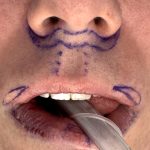
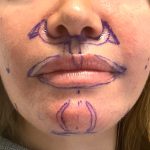
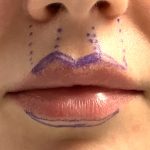
At the time of the procedure, the position of the desired new edge of the vermilion was initially lined with a marker. Since the upper lip is usually smaller than the lower lip in most patients, the upper lip line is about 4 to 5mms above the existing vermilion edge and about 3mms below the lower lip vermilion edge. Dental blocks (infraorbital nerve upper and mental nerve lower) were initially performed. This provided anesthesia so that a next set of injections could be done directly along the line of the lip cutouts for absolute comfort and control of any bleeding during the procedure. The previously marked skin was removed along the upper and lower lips as marked. A two-layer closure was then done. For patients that live close, I use very fine 7-0 sutures to be removed a week later. For faraway patients, fine dissolveable 6-0 plain sutures are used. Antibiotic ointment is the only dressing. Some significant lip swelling will initially be seen, accentuated by the previous injection of the local anesthetic.There are no dietary or oral hygiene restrictions. Lipstick may be applied after one week.

Her lip advancement results were very satisfactory to her. She achieved the more extreme lip augmentation result that she had long desired. Her lip scars were very fine and not easily seen even on close inspection.

Case Highlights:

1)      Permanent lip augmentation can only be achieved with a lip or vermilion advancement. The trade-off for this permanency is a fine line scar.

2)      How much vermilion any particular patient wants increased is marked before surgery with their approval. Like drawing lip liner, the exact result can be known before surgery.

3)      Lip advancements should be reserved for those patients who have previously tried injectable fillers or have very thin lips that do not respond well to injections.

Dr. Barry Eppley

Indianapolis

Common Questions about Lip Augmentation and Lip Lifts

Tuesday, January 19th, 2010

1.      What is the difference between lip enhancement and lip augmentation?


Most people, including plastic surgeons, often use these lip terms interchangeably. While one could argue no matter what you call it, the idea is to make the lip look better… which usually means fuller. However, there are some subtle differences between lip augmentation and enhancement. Lip augmentation adds or restores fullness to the lips. This can be done with either temporary injectable fillers or permanent materials. Enhancement procedures do not really add fullness, although they do make the lip look bigger. These are  skin removal procedures that change the position and shape of the vermilion, thus enhancing the appearance of the lip.


2.      What is the best injectable filler for lip augmentation?

 
There are nearly a dozen injectable filler materials but not all are appropriate for the lips. The lips are unique in that they are not covered with skin but a thinner and more sensitive tissue. (vermilion) In addition, the lips must remain very flexible and soft. For this reason, the best injectable filler for the lips is either collagen-based or composed of hyaluronic acid derivatives. (e.g., Restylane, Juvaderm) Fillers that contain particles, resorbable or permanent, are more likely to cause reactivity and delayed reaction problems.


3.      Are there any permanent options for making my lips bigger?


The desire for a permanent lip ‘filler’ is a common one and there are some options. There is no easy injectable method, however, for lip augmentation that is absolutely permanent. None off-the-shelf injectables are permanent. At best, some may last as long as nine to twelve months.


Fat is often injected into the lips because it is your own tissue and particularly if one is in the operating room for other procedures anyway. The downside to fat injections into the lips is that its survival is unpredictable. I have seen some patients in my Indianapolis plastic surgery practice who have done really well with it while many others have gone on to near complete resorption. It’s worth a try if you are already in the operating room but any long-term retention should be thought of as a bonus, not an absolute. It is not a procedure that can be done in the office.


Implants have been tried over the years in the lips as a permanent filler, of which Gore-Tex (polytetrafluoroethylene) is the most commonly used. Different variations and designs of this material have been used over the years. The best one that I have used is Advanta, which is a very soft and spongy tube of various diameters. When well placed deep in the lip, it can be a very reliable and effective method for permanent lip enlargement.


4.      I have very thin lips that have no shape. I have tried injectable fillers but they didn’t work. Is there anything I can do?


Injectable fillers work when there is sufficient vermilion or lip tissue to expand. In very thin lips, fillers can often make for an unnatural ‘duckbill’ look because there is not enough vermilion to expand out naturally. Unless the filler is done in small amounts, the lips can assume an unusual bloated appearance.


One option for very thin lips is to treat the underlying problem, not enough vermilion exposure. This can be done through two types of skin excisional or removal procedures. The vermilion advancement is done by removing a strip of skin directly along and above the lip line and moving the vermilion upward (upper lip) or downward. (lower lip) For the upper lip, the cut out of skin can be done so that the cupid’s bow is more accentuated with a more defined shape. The vermilion advancement has the advantages of being able to affect the entire lip, from corner to corner, and being truly permanent. Its disadvantage is that it creates a fine line scar at the junction of the lip and skin.


The other vermilion changing procedure is the lip lift, also known as the ‘bullhorn’ lip procedure.In an effort to avoid a lip scar, the skin removal is done right under the nose placing the scar in the hidden crease between the lip and the nose. By removing skin in this area, the vermilion of the lip below is pulled up increasing its pout. The disadvantages of the lip lift is that it affects only the central part of the lip and it will lose some percent of the created lip fullness after surgery. (due to gravity)


5.      Can lip procedures be done in the office?


Any type of lip procedure, injection, implant, or surgery, can easily be done in the office. The lips can very effectively be numbed by the injection of local anesthetics, just like in the dental office. For patients who are anxious about those type of injections, oral sedation medications can be provided which will definitely alleviate any apprehension that one may have. If you take sedation, you will need someone to drive you home.


Injection procedures take about 15 minutes to perform. The placement of lip implants takes about 30 minutes. Lip lifts or lip advancements will take about 60 to 90 minutes to perform.


6.      Is there much pain and swelling after lip augmentation procedures?

Depending upon the technique used, the amount of swelling and discomfort afterwards changes. Injectable fillers result in no pain and very little swelling after. Lip implants cause considerable swelling for a week or so and have some mild discomfort from fullness and stiffness. Lip lifts and advancements cause much less swelling than implants and virtually no pain.

Recovery from lip procedures is essentially ‘social’, meaning how you look. There are no restrictions of any activities including eating and drinking.

Dr. Barry Eppley

Indianapolis, Indiana


Case Study: Lip Advancement for Permanent Lip Augmentation

Tuesday, January 12th, 2010

Background: Lip augmentation continues to be a very popular non-surgical facial enhancement procedure. It is done in almost every case with some form of injectable filler. But fillers do not work well in very thin lips and some patients do tire of repeated injection sessions as fillers last only a limited amount of time..

Case Study:This is an interesting but different case of a 45 year-old female who had reasonably sized lips with a defined cupid’s bow in the upper lip. She had been having lip augmentation with injectable fillers for the last three years in both the upper and lower lips. But she wanted to have a permanent procedure which would eliminate the expense and pain of periodic lip injections.

Her surgical lip options included a non-resorbable lip filler (Advanta), lip advancement, lip lift, and a mucosal roll-out. (i.e., V-Y mucosal advancement) She did not want any foreign material in her lip nor did she want the prolonged swelling and unpredictability of a mucosal-based procedure. This left her with the skin excisional procedures of either an advancement or a lift. The difference between the two is that a lift procedure does not exist for the lower lip and it will only make the central part of the upper lip fuller. (even though it hides the scar along the base of the nose) Because she wanted fuller lips, particularly as they tapered into the corners of the mouth, a lip advancement was her only acceptable surgical option. She was willing to accept fine line scars at the junction of the lip and skin for both lips.

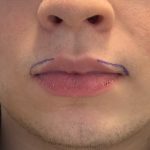
The operation was performed as an office-based procedure under local anesthesia. She did receive oral sedation one hour prior using Valium and Phenergan. Using a mirror, the new lip borders were marked out to her satisfaction. (how much skin to be removed and how much more vermilion would be exposed) Intraoral dental blocks were first done prior to actual anesthetic injections into the lips.

 The skin was then precisely cut out along the marks and the vermilion advanced out and sutured into its new position in multiple layers. The skin sutures were removed one week later.

The lip advancement is a very effective procedure that provides a permanent solution for fuller lips. It does exactly what creates a bigger lip (increased vermilion height or exposure) without making it look unnatural. (sticks out) For very thin lips this is often the only procedure, injection or otherwise, that creates a significant change. Because of the scar, a lip advancement is not a procedure that should not be used recklessly without careful consideration of the permanent scar.

Even though many patients may tire of having their lips injected, the scar may not be a good trade-off for many. If one has some lip fullness already, the use of a lip implant may be a better option than a fine surgical scar.

Case Highlights:

1)   Skin excision is a permanent option for lip augmentation. It creates a very significant amount of lip fullness, particularly when done on both the upper and lower lips.

2)   It is rarely used as a substitute for injectable fillers because of potential scar concerns. It is more commonly used for thin lips that do not respond well to injectable fillers.

3)  When the scar concern is not an issue, it can be done as an office procedure with minimal recovery marked mainly by temporary lip swelling.

Dr. Barry Eppley

Indianapolis, Indiana


Dr. Barry EppleyDr. Barry Eppley

Dr. Barry Eppley is an extensively trained plastic and cosmetic surgeon with more than 20 years of surgical experience. He is both a licensed physician and dentist as well as double board-certified in both Plastic and Reconstructive Surgery and Oral and Maxillofacial Surgery. This training allows him to perform the most complex surgical procedures from cosmetic changes to the face and body to craniofacial surgery. Dr. Eppley has made extensive contributions to plastic surgery starting with the development of several advanced surgical techniques. He is a revered author, lecturer and educator in the field of plastic and cosmetic surgery.

Read More


Free Plastic Surgery Consultation

*required fields


Pricing

The cost of any type of elective plastic surgery plays a major role in the decision to undergo the procedure(s).

Get Your Quote Here


My Plastic Surgery Story

Military Discount

We offer discounts on plastic surgery to our United States Armed Forces.

Find Out Your Benefits


Categories