EXPLORE
Plastic Surgery
Dr. Barry Eppley

Explore the worlds of cosmetic
and plastic surgery with Indianapolis
Double Board-Certified Plastic
Surgeon Dr. Barry Eppley

Archive for the ‘gynecomastia’ Category

Case Study: Gynecomastia Reduction by Horizontal Excision and Nipple Transposition

Friday, May 17th, 2013

Background: Gynecomastia is a common male problem that affects men of all ages. While it is most commonly recognized in teenagers after puberty, it actually affects middle-aged and older men almost as frequently…and often not less aesthetically bothersome. The older man with obvious breast tissue jiggling in their shirt is a well known phenomenon that is quite easy to find.

When gynecomastia becomes significant, the enlarged breast tissue creates a visible mound. If it is large enough or in an older man where the chest skin is more lax, an actual breast ptosis can occur. This is where the breast mound actually hangs off of the chest wall laying on or over the inframammary fold. While this is bothersome enough for a woman, it is particularly unsettling in a man. No amount of weight loss or exercise will solve this significant ‘man boob’ problem.

The most frequently used gynecomastia surgery techniques include liposuction of all types and open excisions done through an areolar incision. But this more advanced degree of gynecomastia is not going to be corrected by even a combination of areolar excision and liposuction. This is because neither can adequately treat a significant part of the gynecomastia problem…extra or loose skin.

Case Study: This is a 47 year-old male who wanted to get rid of his ‘breasts’. He was also an athletic male who used to work out a lot but had not done so over the past several years. He had gained weight, he developed breasts and his chest dropped. This was a great source of embarrassment for him.

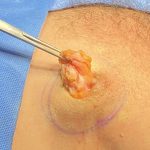
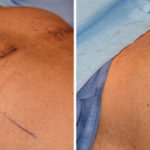
Under general anesthesia, overall liposuction of the chest was initially performed removing about 250cc of aspirate per side. A horizontal elliptical excision of skin was then removed along his inframammary folds but staying below the nipple-areolar complex. Incisions were then made around the areolas and the upper chest skin flap undermined. This allowed the remaining breast mound carrying the nipple-areolar complexes to be pushed upward as the chest skin flap was brought down and closed along the inframammary fold. The skin overlying the buried nipple-areolar complexes was removed and the complexes brought out and sewn to the skin in a more elevated position.

His postoperative course included the use of a drain in each chest for five days. All incision lines had been taped and they were removed a week later. He wore a compression wrap for several weeks after surgery. He went on to heal uneventfully with a dramatic change in the appearance of his chest, being flatter, absent of a breast mound and the nipples back in an elevated and more aesthetically pleasing location.

Gynecomastia surgery that includes wide horizontal excision and nipple-areolar transposition is one of the most extensive treatment methods. But when a large and hanging breast mound exists, this is the only effective approach. While it involves bigger incisions, the recovery time is not much longer than most other gynecomastia surgeries.

Case Highlights:

1) Large gynecomastias that involve breast mounds that hang off of the chest wall with a low nipple position will not respond to traditional gynecomastia treatment methods.

2) Breast tissue and skin must be removed but traditional breast reduction methods in men introduce unacceptable amounts of chest scarring.

3) A horizontal excision of breast tissue and skin with superior nipple transposition can effectively lift and flatten the chest with an acceptable scar location and a preserved nipple in large male gynecomastias.

Dr. Barry Eppley

Indianapolis, Indiana

Adolescent Gynecomastia and Its Negative Psychological Effects

Monday, April 8th, 2013


The number of gynecomastia surgeries has been steadily increasing over the past few years for a number of reasons. One of these is that more teens and older men are aware that there is a surgery for it and are not afraid to ask for it. Another reason is that smaller types of gynecomastia are being treated as the aesthetic desire for a completely flat chest, including the nipple, has become more prevalent.

The psychological embarrassment of having gynecomastia at any age is well known and begins as early as the teenage years. This is borne out by a recent published study in the April issue of the journal Plastic and Reconstructive Surgery. In this article, the researchers gave psychological tests to nearly 50 teenage boys with gynecomastia who averaged 16 years of age and compared them to teens without gynecomastia. Nearly two-thirds of them had mild to moderate gynecomastia and were also overweight. The study results showed that boys with gynecomastia had lower scores on a quality of life assessment. Even after adjustment for weight, their scores were lower for general health, mental heath and social functioning.

There are no surprises in this psychological study as I know full well how much breast enlargement of any size in a male is tremendously bothersome. And the concerns about having enlarged breasts is not just related to being overweight as many of the non-gynecomastia study patients with higher test scores were overweight as well.

Because teenage gynecomastia will often resolve as they mature, a wait and see approach is usually justified. But there is a point where its psychological impact exceeds the patience to justify waiting it out. I don’t have a magic age at which gynecomastia surgery should be done if it is particularly bothersome. Early puberty at age 12 or 13 would be too young but age 15 or 16 seems very justified in treating unremitting or only partial resolution of a problematic gynecomastia.

An aggressive approach to treating adolecent gynecomastia is warranted given its documented psychological impact. In many cases, liposuction alone or combined with some limited open excision through the areola can produce a very satisfying flattening of the chest and nipple. Given the relatively quick recovery from gynecomastia reduction and a low risk of any serious complications, the benefits of the surgery can be obtainjed fairly quickly.

Despite the psychological evidence that gynecomastia is adolescent boys has a very negative psychological effect, parents should not expect insurance to pay for the surgery to reduce it. Insuracne companies are focused on the physical or functional alterations that occur from a medical problem and gynecomastia has none. They place little to no significant that the medical condition is psychologically bothersome and thus label gynecomastia surgery as a cosmetic procedure.

Dr. Barry Eppley

Indianapolis, Indiana

Postoperative Instructions for Gynecomastia Reduction

Sunday, January 27th, 2013


Gynecomastia reduction surgery is done to create a flatter male chest and near zero nipple-areolar projection. It can be done with liposuction alone, by breast tissue excision through an areolar incision or both procedures combined. In some larger gynecomastias, skin may need to be removed from around the entire areola as well.

The following postoperative instructions for excisional lip enhancement surgery are as follows:

1.  Gynecomnastia reduction surgery has a minimal to moderate amount of postoperative discomfort. Pain medications are prescribed and you should take them as directed on the label, usually 2 tablets every 3 to 4 hour as needed.

2.  There will be a circumferential chest binder applied at the end of the procedure. This is to be worn fairly continuously for the first week after surgery. You may take it off the next day to shower and then put it back on thereafter.

3. In some cases of gynecomastia reduction surgery, drains will be used for a few days after surgery. These are small tubes that come out of the side of the chest and are connected to a small bulb which collects any fluids. Empty the bulb as directed and there is NO need to measure the amount of fluid that comes out. You only need to apply antibiotic ointment where the drain comes out of the skin. No dressings are needed, You may shower and get the drain wet.

4. The areolar incisions at the nipples will be covered with glued-on tapes that you do not need to remove. They will be removed in the office at your first postoperative visit. You may get them wet when showering.

5. All sutures at the areola are under the skin and covered by the tapes. They will not need to be removed. Incisions at the side of the chest for liposuction will have one small stitch that will need to be removed at your first postoperative visit.

6. Your chest will be sore for several weeks after surgery. This is not the time to be working out or returning to any chest exercises or lifting weights. That should not be done for three to four weeks after surgery.

6. You may eat and drink whatever you like right after surgery.  Focus on liquids and soft foods for the first few days after surgery.

7. After sutures are removed and the incision lines healed (several weeks), massaging the lips and stretching them gently will help make them feel softer sooner and regain their normal suppleness again.

8.   You may return to work and any non-strenuous physical activity as soon as you would like based on your comfort level.

9.   You may drive when you feel comfortable and can react normally and are off pain medication.

10. If any chest or incisional redness, tenderness, or drainage develops after the first week of surgery, call Dr. Eppley and have your pharmacy number ready.

Consent for Plastic Surgery: Gynecomastia Reduction

Sunday, January 27th, 2013


Every plastic surgery procedure has numerous issues that every patient who is undergoing a procedure should know. These explanations are always on a consent form that you should read in detail before surgery. This consent form, while many perceive as strictly a legal protection for the doctor, is actually more intended to improve the understanding of the various lip enhancement procedures. The following is what Dr. Eppley discusses with his patients for these procedures. This list includes many, but not all,of the different outcomes from surgery. It should generate both a better understanding of the procedure and should answer any remaining questions that one would have.

ALTERNATIVES 

There are no effective alternatives to surgical gynecomastia reduction. There are no exercises, drugs or weight loss strategies that will work. In very young male teenagers, further physical development may cause some lessening of the size of the breasts in some individuals.

GOALS

The goal of gynecomastia reduction surgery is to decrease the size of the breast tissue to make the chest as flat as possible. This includes the overall shape of the chest as well as the projection of the nipple-areolar complex.

LIMITATIONS

The limits to the amount of gynecomastia reduction is how much chest skin exists and the size of the nipple-areolar complex. The shape of the chest will ultimately be determined by how well the overlying skin shrinks down and adapts to the reduced breast tissue. Excess chest skin, chest skin with stretch marks and a large nipple-areolar complex may fail to produce a completely flat chest based on his elasticity and the amount of skin retraction.

EXPECTED OUTCOME

Expected outcomes include the following: temporary bruising and swelling of the chest, temporary chest skin numbness, temporary vs permanent nipple numbness, permanent scars around the areola and at the side of the chest (if liposuction is used), undercorrection (residual gynecomastia), overcorrection (indentation of the nipple-areolar complex, chest skin irregularities and asymmetry if bilateral gynecomastia reduction is done. Healing of the scars and settling of any chest irregularities is a process that may take months (6 to 12) to see the very final result in many cases.

RISKS

Significant complications from gynecomastia reduction surgery are very rare but could include infection and bleeding. (hematoma) More likely complications could include aesthetic deformities such as asymmetry and irregularities of the chest skin, scar deformities of the areola and chest wall, too little breast tissue removed, too much breast tissue removed and nipple-areolar deformities.Any of these risks may require revisional surgery for improvement.

ADDITIONAL SURGERY     

Should additional surgery be required to adjust chest symmetry, remove further breast tissue, correct a nipple-areolar deformity or for scar revision will generate additional costs.

Case Study: Large Tumor Gynecomastia Reduction in Young Male

Sunday, December 23rd, 2012


Background: Gynecomastia is a well known condition of breast tissue enlargement that most commonly occurs in teenage and young males. Its incidence appears to be increasing in numbers based on surgeries performed for its correction although this may reflect increased awareness of surgical treatment and a fashion trend amongst young men with little tolerance for any areolar protrusion. While historically gynecomastia reduction was more frequently done for one-sided breast enlargement, it is more common today to do bilateral gynecomastia surgery. (perhaps due to the change in young male awareness of a pleasing chest appearance)

Gynecomastia reduction can be done using either liposuction removal or an open excisional approach. In some cases, both techniques are combined for optimal reduction. Which technique is needed can usually be determined before surgery by physical examination. Soft non-nodular gynecomastias can be removed by liposuction, firm masses which are almost right under the nipple-areolar complex which need to be cut out through an areolar incision. The patient’s description of their concerns is also helpful, it is just around the nipple or does it extend over a larger chest area?

The one thing that has become apparent in gynecomastia surgeries in my experience is that open excision is needed more times than not. Even in cases where the breast tissue appears soft there almost always is some nodular tissue right under the nipple. Failure to get this tissue will leave am areolar protrusion afterward that may result in the patient’s desire for revisional surgery for complete flattening. When the enlargement of the breast is mainly nodular, liposuction is not going to be effective at all.

Case Study: This 20 year-old college student had a unilateral left breast enlargement since he was an early teenager. Contrary to earlier medical opinions, it never resolved on its own. While the breast development was significant (a true B-cup), he never underwent surgery in high school due to his active participation in sports year round. While it always bothered him tremendously, he lived with it and covered it up as much as possible. Now that he was in college, he no longer did any organized athletic activities,m so he had the time to finally treat his gynecomastia.

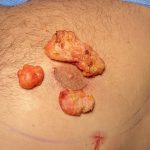
Physical examination before surgery showed a remarkably-sized breast mound for a male that felt fairly firm but without any palpable nodules. Under general anesthesia, his gynecomastia was initially treated by liposuction with minimal fat extracted. It became apparent that much of the breast mound was a large fibrotic mass through which the liposuction cannula would not penetrate. Then through a lower areolar incision, the entire mass was excised using a facelift scissor technique. The large mass was able to be delivered in one large piece through this small 2 cm incision. This produced a complete and immediate resolution to his entire breast mound enlargement.

After surgery, a drain was kept in place for three days and then removed. When seen at three weeks after surgery, no fluid accumulation had occurred and the chest was completely flat and matched the opposite side. No areolar inversion was seen. Pathology of the removed specimen showed benign breast tissue.

This case represents an uncommon form of gynecomastia in which the entire breast mound was one large fibrous tumor. Removal of it produced a dramatic one-stage cure without fluid accumulation and good skin retraction back down onto the chest wall.

Case Highlights:

1)      Large unilateral breast development in young males may represent a single solid tumor rather than simple breast tissue hypertrophy that makes up most gynecomastias.

2)      Firm nodular gynecomastias will not respond to liposuction extraction and must be excised by an open technique

3)      Excision of even very large solid gynecomastias can be done through a small areolar incision without the need for visible scars on the chest skin.

Dr. Barry Eppley

Indianapolis, Indiana

Plastic Surgery’s Did You Know? King Tut and Gynecomastia

Sunday, September 16th, 2012


The most well known or at least the most publicized ancient pharaohs of Egypt, King Tut, ruled and died early. The demise of the young pharoah has always been a mystery and much speculation has centered around his cause of death from murder to accidents. But a recent theory based on medical evidence suggests that he died from a genetic condition of temporal lobe epilepsy. Based on art and figurines of how he was depicted, King Tut is consistently shown with highly feminine features, including enlarged breasts. His enlarged breasts indicates that he suffered from gynecomastia. What is the connection between the temporal lobe of the brain and gynecomastia and other feminized features? The temporal lobe is connected to parts of the brain that are involved in the release of hormones. Epileptic seizures are known to alter the level of hormones involved in sexual development. This might well explain the development of the pharoah’s large breasts. Scans of his body showed that he died from a fracture of his leg at the time of death. People with epilepsy have a much higher incidence of dying from accidents and falls and are more likely to die young. The art of the time also depicted him with a walking stick, also suggestive of leg injuries or impairment. Further clues is that King Tut’s predecessors and relatives also had early deaths as well as similar body features, including gynecomastia.

Plastic Surgery’s Did You Know? Gynecomastia and Marijuana Use

Saturday, August 4th, 2012


The development of breast tissue in young men (gynecomastia) goes by a lot of unflattering names such as man boobs and bitch tits. For the overwhelming majority of men affected, there is no identifiable cause. Clearly there is some hormonal influence but the exact trigger is not clear for most patients. Some of the young men that I treat for gynecomastia often sheepily say that they smoke marijuana and that is why they probably developed it. That belief is well known and frequently stated as fact but is it really true? The unequivocal answer is…maybe. The main active ingredient in marijuana is THC which has been shown to affect testosterone production. Presumably this could cause a man’s estrogen levels to increase causing a stimulatory effect on breast tissue. But what levels of THC are needed and how long does it take to cause this adverse effect? No one knows for sure and how a man may be affected is undoubtably different. There also other compounding factors such as being overweight, taking steroid or muscle building supplements and using Propecia for hair loss, all of which can also decrease testosterone levels. Gynecomastia is a multifactoral problem as many men smoke marijuana and never develop gynecomastia while a few do. It is a risk factor but its inhalation does not assure that gynecomastia will develop.    

Plastic Surgery’s Did You Know? Contemporary Gynecomastia Reduction Surgery

Sunday, July 8th, 2012


Male breast enlargement or gynecomastia (Greek derivation, gyne = female and mastos = breast) is a common male chest condition. According to the American Society of Plastic Surgeons, gynecomastia accounts for more than 65% of all male breast disorders. While occurring most commonly in teens, it can affect all men throughout their life due to hormonal fluctuations and certain medications. Once not talked about and treated with an old-style approach that left large scars, gynecomastia reduction today has evolved into a highly successful surgery that can be quickly done with minimal scarring. Using a combination of liposuction and gland removal through a peri-areolar incision, most gynecomastia conditions can be resolved without recurrence. Whether it is just a puffy nipple or a more visible breast mound, there is no reason teenage boys or adult men have to forever worry about taking off their shirts or having their nipples or breast mounds show through their shirts.

Case Study: Correction of Supplement-Induced Gynecomastia in Athletes and Body Builders

Friday, March 2nd, 2012

Background: Gynecomastia, or male breast growth, has numerous causes. When occurring in very young males going through puberty the cause is a natural one over which one has not control. Fortunately, many puberty-induced gynecomastias are self-resolving. But when occurring in non-teenage males there is almost always a specific exogenous influence.

Gynecomastia is well known to be the result of certain drug uses. Precriptions drugs such as Prilosec, Tagamet, Zantac and Propecia are some recent examples. They exert their adverse effect by stimulating estrogen production. Anabolic steroids, which are generally used in non-prescription or illegal fashion in the body building industry, causes an equal if not greater number of gynecomastia cases through their aromatization effect and subsequent conversion to estradiol. Certain supplements in muscle building can also cause gynecomastia although which ones are a bit controversial.

Drug or supplement-induced gynecomastia almost always presents as firm glandular enlargement underneath the nipple-areolar complex. It makes the nipple protrude outward with a very discrete palpable mass. Because of the good muscular definition and lean body mass of most amateur and professional body builders, the protrusion caused by the breast lump is aesthetically obvious.

Case Study: This 22 year-old male from Bloomington Indiana had developed nipple protrusion over a one year period. He never had it before age 20 when he started to lift weights regularly. He purchased and took a muscle-building supplement purchased over the internet to help get bigger more quickly as part of his program. After a year, he had developed hard masses under his nipples. He stopped taking the supplement but the nipple lumps failed to go away. After six months of no improvement, he sought a surgical solution to his small ‘man boobs’.

Under general anesthesia, the breast lumps were approached through a lower areolar half-moon incision. A large amount of hard glandular breast tissue was cut out and removed. The removal was done until more normal soft chest fat was left. While getting every bit of abnormal gland tissue removed is important, some fat on the underside of the nipple and on the pectoralis fascia if possible should be preserved to prevent the risk of a sunken-in nipple later. Drains were placed and the incisions closed. A chest compression wrap was placed. This was performed as an outpatient procedure that took one hour to complete.

He wore a chest compression wrap for two weeks after surgery. By three weeks after surgery, all bruising and swelling had resolved. His chest was completely flat with a smooth nipple-areolar complex contour. He returned to exercise and weight lifting, without supplements, one month after surgery.

Most cases of steroid or supplement-induced gynecomastia in athletes and body builders present as discrete firm masses just under the nipple. The rest of the chest rarely has enlargement or needs contour reduction. This type of gynecomastia can usually be cured satisfactorily in a single procedure with a low risk of the need for revisional surgery. But it is important that no working out, specifically chest exercises, be done within the first month after surgery. Doing so will cause a fluid collection or seroma which will require drainage and may induce scar formation. Such scar formation may result in a mass that is just as big as the breast tissue that was removed.

Case Highlights:

1) Gynecomastia can be caused by any drug or supplement which has a stimulatory effect on breast tissue. This is a well known effect of numerous supplements used in body builders.

2) Supplement or drug-induced gynecomastia is glandular in nature and usually requires direct excision with or without contouring liposuction

3) Direct glandular breast excision is done through a lower areolar excision and must be done carefully to avoid a concave contour deformity. It is a completely curable gynecomastia problem.

Dr. Barry Eppley

Indianapolis, Indiana

Case Study: Gynecomastia Reduction with Smartlipo

Wednesday, February 22nd, 2012

Background:  Enlargement of the breast tissue in a teenage or adult male, well known as gynecomastia, is a challenging aesthetic chest problem. It is comprised of several components including the amount of breast tissue, the size of the areola, and the position of the nipple-areolar complex on the anterior chest wall. Much of the focus of gynecomastia surgery, understandably, is on the reduction of the size of the breast mound whether it is throughout the whole chest or just limited to around the nipple-areolar complex.

Reduction of the breast tissue in gynecomastia can be done by either liposuction, direct excision through a lower areolar incision or both. Which of these approaches is best is determined by the size and quality of the breast tissue. Male breast tissue can be simplistically divided into ‘soft’ and ‘hard’ types. Hard breast tissue is known as glandular tissue and is very firm, lump-like and largely relegated to underneath and around the nipple-areolar complex. Soft breast tissue is largely comprised of fat with some fibrous tissue, known as fibrofatty tissue. It can occupy the entire chest or be an extension beyond the zone of glandular tissue underneath the nipple.

As a general rule, hard gynecomastia responds best to direct excision as it needs to be cut out. Soft gynecomastia can be extracted without excision by liposuction. Many gynecomastia conditions require both methods given the mixed hard and soft tissue make-up. If glandular tissue is not recognized before surgery, residual lumps or areolar fullness may be left behind by liposuction.

Case Study: This 35 year-old male from Indianapolis had developed increasing chest fullness which started when he was a teenager. It continued to grow as he got older and gained some weight. Exercise did not make it get smaller. He finally resolved to himself that he had to get rid of his ‘man boobs’ by surgery. Examination showed that he had generalized breast mound fullness of which all of the tissue was soft and non-glandular. Even under the nipple-areolar complexes no lumps or firm tissue could be felt.

Under general anesthesia, the chest was first infiltrated with a Hunstad solution. Then through small stab incisions at the side of the chest wall, each breast mound was first treated by a Smartlipo probe to heat all of the fatty tissues. Suction aspiration then removed a total of 1300cc of aspirate from both sides of the chest, a large amount by gynecomastia standards. The chest areas became flat and well contoured on both sides without any residual lumps of breast tissue under the nipples.

He wore a chest compression wrap for two weeks after surgery. By three weeks after surgery, all bruising and most of the swelling had resolved. By six weeks after surgery, the chest had a completely flat appearance and the chest skin and underlying tissues felt soft again.

Most cases of gynecomastia surgery require excision if small and a combined excision and liposuction approach when larger. It is not common to find a gynecomastia patient in which a completely flat chest can be obtained in one surgery by liposuction alone. In either case, Smartlipo provides a good method of liquefying the fatty breast tissue in gynecomastia.

Case Highlights:

1)      Male gynecomastia responds to different treatment approaches based on the type of breast tissue and the size and position of the nipple-areolar complex.

2)      In ‘soft’ forms of gynecomastia without significant glandular tissue, liposuction can be very effective at chest contouring/reduction.

3)      Liposuction of gynecomastia, specifically using Smartlipo, can be done with very small incisions and without the need for drains.

Dr. Barry Eppley

Indianapolis, Indiana


Dr. Barry EppleyDr. Barry Eppley

Dr. Barry Eppley is an extensively trained plastic and cosmetic surgeon with more than 20 years of surgical experience. He is both a licensed physician and dentist as well as double board-certified in both Plastic and Reconstructive Surgery and Oral and Maxillofacial Surgery. This training allows him to perform the most complex surgical procedures from cosmetic changes to the face and body to craniofacial surgery. Dr. Eppley has made extensive contributions to plastic surgery starting with the development of several advanced surgical techniques. He is a revered author, lecturer and educator in the field of plastic and cosmetic surgery.

Read More


Free Plastic Surgery Consultation

*required fields


Pricing

The cost of any type of elective plastic surgery plays a major role in the decision to undergo the procedure(s).

Get Your Quote Here


My Plastic Surgery Story

Military Discount

We offer discounts on plastic surgery to our United States Armed Forces.

Find Out Your Benefits


Categories