EXPLORE
Plastic Surgery
Dr. Barry Eppley

Explore the worlds of cosmetic
and plastic surgery with Indianapolis
Double Board-Certified Plastic
Surgeon Dr. Barry Eppley

Archive for the ‘forehead recontouring’ Category

Forehead Augmentation in Men

Thursday, October 11th, 2012


The forehead occupies a major part of one’s appearance, comprising the entire upper third of the face. The variable part of anyone’s forehead is the hairline, particularly in men. Most male foreheads get longer with age for the obvious reason of a receding hairline. The relative constant features of the forehead that are easily discernible are the eyebrows and the shape of the underlying brow bones. There is also the intervening territory of the skin and the natural contour of the frontal bone between the hairline and the brows, even though it is frequently overlooked.

While the forehead may seem to many an irrelevant facial feature, there are well known differences in forehead shapes between women and men. Like the jawline, the forehead is a significant structural feature of gender.  The male forehead has more of a sloped appearance in profile with the edge of the frontal hairline being more protrusive to the eyebrows in profile. It may also have more of a square shape in the front view. Men will have more prominent brow ridges with a brow break point above the eyebrows before the forehead slopes backward. Women usually have no brow ridges and lack a backward slope. The female forehead has more of a vertical inclination with a rounded or convex shape.

The most common form of forehead reshaping surgery is augmentation of the brow ridges and frontal bone. Many more women than men undergo forehead reshaping surgery, most likely because of hairline and hair density issues. But some few men still have the procedure as they value the improvement of their frontal skull/forehead as more important than a scalp scar. Most commonly these men have a severe sloping inclination to their forehead in profile, an inclination that exceeds the more aesthetically acceptable inclination of 10 to 15 degrees and lack of significant brow ridges.

Besides the all important scalp scar issue in male forehead augmentation is the choice of augmentation material. There are four implantable forehead materials to be considered. By far the most common is methylmethacrylate or PMMA. A self-curing plastic polymer, it is mixed during surgery as a liquid and powder and molded into shape and allowed to set. Its popularity is due its low associated cost in an area of craniofacial augmentation in which often at least 60 or more grams of material is needed. It is the easiest cranioplasty material to shape and becomes as hard as bone. Another material option is hydroxyapatite (HA), a synthetic ceramic material. It is also a liquid and powder composite that is used like PMMA during surgery. It is slightly harder to work with and good experience is needed when using it as an onlay augmentation material. But it is the ultimate biocompatible augmentation material because it is composed of the inorganic component of natural bone, calcium phosphate. Its high cost limits it use in large augmentations for some patients.

There are also a few preformed forehead augmentation implant s available as an off-the-shelf option. But their sizes and shapes are very limited and I find them completely impractical for the unique forehead aesthetic needs for most patients that I see. The last option is to prefabricate a custom forehead implant. This requires a 3-D model made from a CT scan from which a mold is hand fashioned. It is then sent for manufacture in either silicone or a special form of PMMA known as HTR polymer. HTR is a sintered bead implant that is comprised of PMMA coated with pHEMA, a very hydrophilic material. This gives it unique properties of tissue ingrowth. The HTR polymer material is preferred over silicone as it is not only porous to allow fibrovascular ingrowth but has a long history in skull reconstructions in over 100,000 cases for the past 20 years with an incredibly low rate of implant complications.

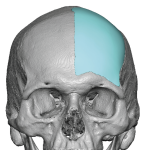
Regardless of the material used, it needs to be shaped to create an improved male forehead. There is no exact science to forehead sculpting and it is more art than anything else. Besides the vertical inclination and the creation of a visible brow ridge, the often overlooked part of forehead augmentation is the transition into the temporal area. A patient has to appreciate that you can not extend the implanted material beyond the anterior temporal line which is the end of the width of the forehead bone. This is much more narrow that most people realize. Therefore, one has to decide to have a visible and palpable edge to the width of the forehead which can be acceptable in men but never in women.

Dr. Barry Eppley

Indianapolis, Indiana

Case Study: Forehead Reconstruction with Hydroxyapatite Cement

Friday, September 28th, 2012


Background: Loss of the frontal or forehead bone can occur for a variety of reasons, usually from depressed fractures or loss of a craniotomy flap from infection. With removal of the protective bone cover, the brain and its dural covering sit directly up against the skin not only creating an obvious depression but pulsating with each heartbeat. Forehead reconstruction carries the highest aesthetic demands of any skull defect because it is the most visible in a non-hair bearing area and may involve the brow bone and brow ridge area.

There are almost a dozen methods of forehead skull reconstruction from split-thickness cranial bone grafts to computer-generated custom implant pieces. When skillfully done, any of these reconstructive methods will work satisfactorily. Their various advantages and disadvantages change based on the size of the forehead defect. The larger the bone defect becomes the more a synthetic approach becomes an appealing option.

One well established synthetic cranioplasty material for reconstructive use is hydroxyapatite. Consisting of the inorganic mineral content of natural bone, it is highly biocompatible although it does not get replaced by bone. It ends up creating a dense firm bone-like material that blends smoothly into the surrounding bone edges. It does not have the same strength as the normal double cortical layer skull bone but is strong enough to be an adequate skull substitute.

Besides the aesthetics of forehead skull defects, it is the only skull area which is contiguous with the air-filled frontal sinus cavity. This is a potential source of contamination and is a frequent source of forehead infections if a tissue layer is not created between it and the bone reconstruction material.

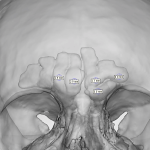
Case Study: This 13 year-old teen age boy was involved in a motor vehicle accident and sustained a severely depressed frontal forehead fracture and a large laceration down the center of his forehead. This required an urgent neurosurgical procedure with bone removal and repair of the dura. After three months of healing, he was left with a large depressed central forehead area (10 cm x 6 cm) that extended from the scalp down to the brows with a well healed vertical forehead scar. A 3-D CT scan shows the size of the defect and its involvement with the brow area and the frontal sinus.

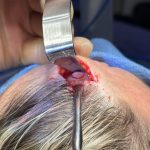
Under general anesthesia, the forehead bony defect was accessed through his existing vertical scar from the scalp down to the area between the brows. The skin was lifting off of the dura and the surrounding bone edges. Near the brow area, the frontal sinus cavity was encountered as a 2cm x 2cm hole above the level of the dura.

The frontal sinus was clean and healthy with normal mucosal lining. A large pericranial tissue patch was sutured around all edges to create a thick tissue partition between the frontal sinus and the reconstruction site.

After the pericranial patch was placed, a floor was created for the reconstruction using titanium mesh. Thin 1mm titanium mesh was cut just larger than the bone defect and its edges were slipped under the defect to become a self-locking floor. This not only provided a containment method for the hydroxyapatite cement but keep the dural pulsations off of the hardening reconstruction.

Using a well known hydroxyapatite cement (Mimx, Biomet Microfixation, Jacksonville, FL), the activating liquid and calcium hydroxyapatite powder were mixed together into a putty consistency. This was then poured into the bone defect and molded into shape, recreating the lost brow bone area and the forehead above it.  The forehead skin was then closed and scalp scar removed prior to its closure in the hair area.

His surgery was done as an outpatient and he went home the same day. His head dressing was removed the next day and his sutures in the scalp removed ten days later. He had a smooth forehead result right with elimination of the forehead depression and the dural pulsations.

Case Highlights:

1)      Reconstruction of the bony forehead can be done by a variety of techniques and hydroxyapatite is a well established cranioplasty material for full-thickness skull defects.

2)      Frontal bone reconstruction which extends down into the brow area must take into account the frontal sinus and have a plan to keep it separate from any implanted material.

3)       The properties of hydroxyapatite in a full-thickness skull defect needs reinforcement or a floor to add both strength and a containment method for the material.

Dr. Barry Eppley

Indianapolis, Indiana

Gender Differences in Forehead Recontouring Surgery

Tuesday, February 8th, 2011

The forehead occupies a major part of the face, up to one-third of its total length. It is a major contributor to facial aesthetics even though it appears largely as a blank slate. Because it has few identifiable features (only the eyebrows) other than wrinkles, it is often overlooked as a facial feature which can be modified. Botox and browlifts affect change in the overlying soft tissue, but the bony shape of the forehead  

The forehead is outlined by three features which create the visual impression of its overall size. The top of the forehead is marked by the variable position of the frontal hairline which differs greatly by female vs. male gender. The bottom of the forehead is evidenced by the eyebrows and the supraorbital rims, which is the ridge of skull bone just above the eyes. The sides of the forehead are defined by the temporal ridges, the edges of the bony forehead where it meets with the large temporalis muscle.

It is the shape of the bony forehead (amount of convexity) and the prominence of the brow ridges that help define a more masculine or feminine appearance. In times past, its shape was also thought to impart the degree of intellect of an individual. This is most commonly portrayed in movies where the villians, monsters and other evil-doers will usually have big and bulging foreheads, often being grotesquely distorted.

As a gender marker, the forehead has some well-defined features. The forehead differs in the areas of the brows and the mid forehead and the skull’s shape affects the drape and contour of the skin. A long forehead is generally more acceptable in a male, largely because the variability of a receding hairline (particularly in an M-shaped pattern) is well known and expected. The bone ridge running across the forehead above the eyes, known as brow bossing (supraorbital rims), is more pronounced in males. The degree of acceptable brow protrusion is not well-defined and it can certainly become excessive causing an over-masculinized or Neanderthal appearance. Male brow protrusion should be enough to create a noticeable break between the brow ridge and the forehead bone above it. It may also extend off to the side tapering down onto the lateral orbital rim.

While a long forehead is generally acceptable for the male, it is not in a female. Females have almost no discernable brow bossing because their foreheads are more rounded with a fairly flat front. In profile, female foreheads are more vertical instead of backward sloping. This means that some brow bossing may be aesthetically acceptable but there is no break between the brow ridge and vertical forehead bone above it, it should flow very confluently without a noticeable transition. The amount of convexity in profile view, however, is important and it should not stick out further than the lowest edge of the brow ridge. The sides of the brow ridges are also more tapered towards the temples unlike the male which can be more boxy or square-shaped.

These aesthetics considerations are critical when it comes to performing recontouring of the forehead in men and women. While forehead reshaping is often thought of as exclusively being done in facial feminization surgery, it is not in my experience. I have done as many if not more forehead surgeries in gender-stable patients. It is the nuances of the brow shape and how it flows into the upper forehead in both frontal and profile views that can make the difference between a good vs. an unhappy surgical outcome.

Dr. Barry Eppley

Indianapolis, Indiana

Brow Bone Forehead Augmentation

Thursday, October 8th, 2009

The forehead has a variety of shapes that do differ based on gender. Men will tend to have flatter fuller foreheads with more prominent brow bones (supraorbital ridges) while women’s foreheads will usually be softer, less full, and with flatter brow bones that tend to angle off into the temporal region. Whether it be by a congenital deformity (such as craniosynostosis), frontal tumor resection (craniotomy flap) or from prior contouring purposes (FFS, facial feminization surgery), there are rare instances when one desires to have a fuller or more prominent brow definition restored.

Brow bone augmentation (BBA) is one form of forehead reshaping that can be done. Using synthetic materials as a building material, the bone can be ‘thickened’ and recontoured to alter how the brow looks. Since the eyebrow and the upper part of the eyelid is affected by its underlying bony support, such changes can produce subtle to dramatic differences.

One of the key issues of brow bone augmentation is which material to use. Currently, hydroxyapatite (HA) and acrylic (PMMA) are the only two moldeable materials of choice. Your own bone is usually not a good option since you have to harvest it and how it survives as an onlay is unpredictable. Both HA and PMMA have their advocates but I have gotten good results with both. Either one can do the job. PMMA is much cheaper from a material cost standpoint and is very hard once it sets, being hard if not harder than natural bone. HA is much more expensive, a little harder to work with, and is more fragile to impact. But it is closer to the mineral of natural bone so it has greater compatibility and less risk of long-term body reaction concerns.

There is also the option of a synthetic implant carved out of silicone or polyethylene. (Medpor) This requires a greater degree of skill and time to get all the edges flat and flush with the surrounding bone. It is easy to see how an edge step-off can be felt through the skin unless it is done perfectly. Feathering edges and blending into the surrounding bone is much more assured with the moldable materials. 

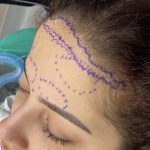
The other important consideration of BBA is access. For the most part, an open scalp approach provides the best vision and control of the shape. But this is understandably problematic for most men unless they have a pre-existing scalp scar to use. For most women, this is not a significant issue as a hairline (pretrichial) approach can be done and that scar can really be quite fine and unnoticeable. I know this from a lot of experience with pretrichial (hairline) browlift procedures done for cosmetic purposes.

A non-open scalp approach (endoscopic) can be used in select cases of forehead augmentation. When it is the central or more upper parts of the forehead that are being augmented, the endoscopic approach using PMMA as an injectable material can be done. PMMA can be injected and pushed around as a congealed putty and shaped by external molding through the forehead skin. HA is a quite different material and its handling properties do not permit anything but an open approach scalp approach. But working down at the brow area, which is a very low point for endoscopic visualization, is even difficult with PMMA. Therefore, I would advocate an open approach for any amount of brow bone augmentation.

Dr. Barry Eppley

Indianapolis, Indiana 


Forehead Contouring and the Coronal Incision

Thursday, August 27th, 2009

Contouring of the forehead is an uncommon procedure in plastic surgery but the techniques to do it are not. Whether it is to reduce frontal bossing, soften prominent brow bones, or change the slope of the forehead, the forehead can be reshaped in a variety of dimensions. Most reduction changes are more subtle to moderate due to the limitations of the thickness of the skull and the presence of the underlying brain or frontal sinuses. Building up the forehead can produce changes that are more significant as there are no such anatomic restrictions.

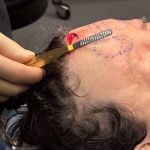
Forehead contouring developed from craniofacial plastic surgery techniques. One of the basic craniofacial tenets is that of the approach and using direct vision to see the entire surgical field. Using a coronal or scalp incision, the forehead tissues are degloved or peeled back from the scalp down to the orbital rim. With this amount of access, forehead bone manipulation is fairly straightforward. Whether it is bone reduction by burring, sinus osteotomies for reduction, or adding synthetic materials for augmentation, one is unrestricted in options with this exposure.

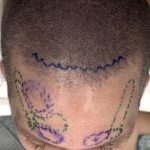
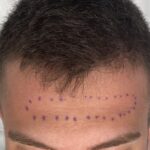
 More males than females desire forehead and skull reshaping in my Indianapolis plastic surgery practice experience. The limiting factor for males fulfilling that desire is the scalp scar. Males are more limited in having a hidden scar due to the location of their hairline and hair density. Most plastic surgery procedures are about making trade-offs…trading off one problem for another. The trade-off of a scalp scar for a better shaped forehead must be considered carefully in most males. This is rarely such an issue for females.

As craniofacial surgery techniques has evolved, more limited incisional or endoscopic approaches have been tried. In general, these are not particularly effective for most forehead procedures. They can be used to remove small osteomas or soft tissue masses and are very effective for cosmetic browlift and supraorbital nerve decompressions. But the access is too limited and the instrumentation is not sufficiently developed to allow for much bone manipulation. I have done a few synthetic augmentations endoscopically but only partial or subtotal areas can be done satisfactorily this way.

The only other incisional option is an upper eyelid incision but this can only be used for brow bone shaping. The eyelid incision provides good access to the mid- and lateral brow. But the inner brow area is blocked by the important sensory nerves that exit out from the bone there.

The bottom line is…most forehead contouring must be done using the full coronal incision. The magnitude of the deformity will determine whether the scalp scar is a reasonable aesthetic ‘problem’ to replace it. The forehead deformity and one’s concerns about it should be sufficiently significant to make coronal incision worth it.

Dr. Barry Eppley
Indianapolis, Indiana


Dr. Barry EppleyDr. Barry Eppley

Dr. Barry Eppley is an extensively trained plastic and cosmetic surgeon with more than 20 years of surgical experience. He is both a licensed physician and dentist as well as double board-certified in both Plastic and Reconstructive Surgery and Oral and Maxillofacial Surgery. This training allows him to perform the most complex surgical procedures from cosmetic changes to the face and body to craniofacial surgery. Dr. Eppley has made extensive contributions to plastic surgery starting with the development of several advanced surgical techniques. He is a revered author, lecturer and educator in the field of plastic and cosmetic surgery.

Read More


Free Plastic Surgery Consultation

*required fields


Pricing

The cost of any type of elective plastic surgery plays a major role in the decision to undergo the procedure(s).

Get Your Quote Here


My Plastic Surgery Story

Military Discount

We offer discounts on plastic surgery to our United States Armed Forces.

Find Out Your Benefits


Categories