EXPLORE
Plastic Surgery
Dr. Barry Eppley

Explore the worlds of cosmetic
and plastic surgery with Indianapolis
Double Board-Certified Plastic
Surgeon Dr. Barry Eppley

Archive for the ‘ear reshaping’ Category

Case Study: Otoplasty for Protruding Ears

Saturday, March 30th, 2013

Background: The shape of the ear, like the nose, is one of the most variable features of one’s face. While it is chocked full of hills and valleys composed of cartilage and has an array of anatomic convolutions, the human ear is nonetheless very recognizeable. Any gross abnormalities in its shape and size is easily observed.

While the ear may seem to be the least important part of one’s face because of its lateral location, it takes on great signficance when its shape is abnormal and easily seen. The most common ear abnormality is also the most visible, the protruding ear. As the ear moves from its more streamlined position on the side of the head (an ear-head angle greater than 30 degrees) to stick out, it becomes instantly more prominent.

Known by a multitude of names such as dumbo ears or elephant ears, these very names indicate that it is not viewed as a favorable facial feature. While it may provide a better eyeglass resting place or a more effective method of holding one’s ear back, the social stigma that comes with prominent ears overrides whatever functional benefit that it may provide.

Surgery for the protruding ears, most commonly called ear pinning (there is no pins used in the surgery however), has been around for over 100 years. When it was originally introduced long ago, only skin was removed from the back of the ear to pull it back. This did not work well and it was eventually recognized that the actual shape of the cartilage needed to be changed to produce a better and more permanent result. Many otoplasty cartilage techniques have evolved over the years but the use of permanent sutures to make the fold remains as a main component of the operation.

Case Study: This 26 year-old female had long been bothered by her protruding ears and finally decided to have them reshaped. She had a 65 degree auriculocephalic angle and lack of an antihelical fold cartilage prominence. Her ears were also very stiff and did not fold back very easily.

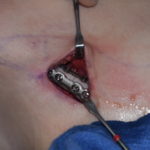
Under general anesthesia, her otoplasty procedure was done from the backside of the ears. A very small strip of skin was removed from the middle portion of the back of the ear. The ear cartilage was exposed by lifting up the skin from the outer rim down to the mastoid region. Because of the stiffness of her cartilages, a small wedge of cartilage was removed from the back of the concha area to weaken it. Horizontal mattress sutures of a permanent braided variety were used to create an antihelical fold from the top of the ear down to just above the earlobe. A total of 5 sutures were placed. The skin as then closed with resorbable sutures.

She wore a small head dressing for the first night after surgery and it was removed the next day. She showered and washed her hair 48 hours after surgery. While the result initially looked good, there was some asymmetry between the right and left ears. She returned to the operating room for a left ear adjustment to bring it back further three months after the initial surgery.

Otoplasty surgery for the protruding ears is incredibly effective and produces a dramatic change in the shape of the ear. How far the ear should be respositioned back along side of the head is a matter of intraoperative judgement.Overcorrection and undercorrection is always a concern but the most likely reason for revisional otoplasty surgery is asymmetry. Getting both ears in the indentical position with the cartilage reshaping is challenging and is alspo affected by how well the sutures hold and how the ears heal.

Case Highlights:

1) Ears that stick out are because the shape of ear cartilage is not adequately folded onto itself.

2) Otoplasty or ear reshaping is done by creating a fold in the main cartilage of the ear to bring back the outer helix closer to the side of the head.

3) The most common complication with otoplasty surgery is asymmetry which may require revisional surgery.

Dr. Barry Eppley

Indianapolis, Indiana

Earwell – Neonatal Ear Molding System

Wednesday, May 30th, 2012

One of the most common birth defects involves the ear. The ear is a complex array of hills and valleys of cartilage and skin that give each ear its unique shape. How all the ear structures coalese together from many small hillocks in utero and form an ear is a miracle of embryology. But given its complexity and that it is a very flexible structure with many folds and indentations, it is no surprise that it can become misshapen during the developmentn and birth process. If one fold or bend of the ear is off or absent (e.g., lidding, cup ear, lop ear), then an ear defect is obvious at birth. It is estimated that as many of 10% of births have some minor ear shape abnormality or asymmetry.

Historically, surgery is the only option for the deformed ear correction or improvement in its shape. This must often wait until the child is five or six years of age until the ear has grown and reached a more mature size before any surgery is attempted. Unless the ear is partially or competely absent (microtia), any corrective ear surgery is viewed as cosmetic as it does not improve any ear function such as hearing.

One of the very unique features of the neonatal ear is that it is very malleable. The cartilage has not stiffened yet and the ear can be molded into a new shape. This has been known for a very long time and numerous methods of ear molding have been tried, particularly for the protruding ear that lacks an antihelical fold. These device attempts in the past have largely been unsuccessful due to the difficulty in keeping any ear dressing or molding appliance in place.

Since 2010, a more effective device for neonatal ear molding has been available. Known as the EarWell Correction System, this is a non-surgical device that can reshape numerous ear deformities into a more normal appearance. In a matter of weeks, the infant’s ear cartilage can be reshaped. The key, however, is early initiation of therapy. It should ideally begin within two weeks after birth when the ear cartilage is most malleable. The ear cradle is initially placed, which is then followed by a change in cradle every two weeks with a total of three ear cradle sets used. This would project to treatment completion in 6 to 8 weeks after it is started. By two to three months after birth, the ear cartilage has stiffened and is not longer externally moldable.

The EarWell system has four components. A posterior or scalp cradle that sites behind the ear and adheres to the scalp skin. (1) A retractor that shapes the ear cartilage. (2) A conchal former that shapes the inner ear. (3) And an external cradle that holds all the parts together. (4) Despite looking a bit uncomfortable, it is actually painless to the infant. They wear it without any problems. Currently, this device is covered by most medical insurance plans. Whether it will continue to be so in the future is unknown.

The EarWell system has a high success rate. But the key to this success is early initiation of treatment. It will not work or not very well if it is begun after the first month of life. This is usually the hard part as by the time most parents are aware that this non-surgical ear molding approach exists, the best time for treatment has passed.

Dr. Barry Eppley

Indianapolis, Indiana

Revision of the Overcorrected Otoplasty

Wednesday, August 10th, 2011

Otoplasty correction of the protruding ear can be one of most satisfying plastic surgery procedures one can undergo. The immediate change of prominent ears that stick out to an instantaneous normal appearance is often nothing short of dramatic. While the cartilaginous cause of the prominent ear can be easily determined, its correction involves a lot of artistic technique in its reshaping. As a result, undesireable otoplasty results can occasionally happen as the surgery is not an exact science.

In the August 2011 issue of Plastic and Reconstructive surgery, a good article on the secondary correction of the unfavorable result after otoplasty was published. The article covers both the secondary treatment of undercorrection and overcorrection. The section on undoing overcorrection of an otoplasty (ears pinned back too far) interested me the most as this is by far the more difficult problem.

While often lumped into the name, ‘telephone ear deformity’, ear overcorrections are apparent as the outer aspect of the ear touches or nearly touches the side of the head. This makes the outer edge of the concha being the visible outer edge of the ear rather than the helical rim. This could happen because the sutures used to create the antihelical fold are pulled too tight or back too far, the conchal hypertrophy cause of the prominence is left untreated, or too much skin has been removed from the back of the ear.

Ear overcorrections essentially take an ear, which has too much tissue or cartilage that is abnormally shaped, and turns it into a situation of relative tissue deficiency. As the authors point out in their revision description, the ear needs to be released from a postauricular approach and can often reveal a skin deficiency and a need for cartilage grafts. These two issues must be taken into consideration before surgery. If skin on the back of the ear is deficient, either a sliding skin flap from a sulcus incision or ‘finger flaps’ from the mastoid must be used to replace the missing skin. The donor site will require a small skin graft.

Once the ear cartilage is released, cartilage grafts will be needed to stent open a collapsed antihelical fold or to reinforce areas of cartilage fracture that have occurred from the release. Such cartilage grafts can only come from two sources, the ear concha itself or a small rib graft. The choice will be based on how much cartilage reinforcement is needed.

Reconstructing an overcorrected otoplasty can be difficult but almost always needs tissue grafts. If an overcorrection is treated very early after the initial otoplasty, suture release alone may be sufficient. But once scar and tissue adhesions is established, months to years later, the issue becomes of one of cartilage release and reinforcement and skin flaps or grafts.

Dr. Barry Eppley

Indianapolis, Indiana

Otoplasty For Protruding Ears: Matching The Cartilage Problem With The Surgical Technique

Monday, July 18th, 2011

Even though the ears are located off to the side of the face, they can have an influence on one’s facial appearance. Being made up of a collection of ridges and grooves with a dangling earlobe hanging off of a cartilage framework, the ear is often not appreciated for its complex shape…until it is abnormal. The most common ear shape anomaly is when it sticks out too far.

The ear should not be a dominant structure on one’s head. With a geometry that is as individual as one’s fingerprint, it remains obscure as long as it sits at an angle of less than 30 degrees from the side of the head. Once going beyond this angle, the ear becomes too prominent.This prominence is caused by an alteration in the shape of the ear cartilage. The two most common causes of the protruding ear are absence of the antihelical fold and a large concha.

The two primary folds of the ear are the helix and the antihelix. The second inward fold of the ear is the antihelix. Situated inside of the outer rim (helix) of the ear, this fold brings back the entire outer edge of the ear. When it is absent, the ear protrudes much like the inside of a cup. Complete absence of the antihelical fold accounts for the most dramatic of protruding ears…ears that stick out dramatically. This is the classic type of otoplasty correction in which horizontal mattress (Mustarde) sutures are placed from the back of the ear to create this ear fold. The result is easy to see before by folding back the outer helix and manually creating this ear fold.

The most inner component of the ear is the concha. It has a bowl shape that surrounds the ear hole or external auditory meatus. The size of this bowl can also be a source of ear protrusion. If it is very large, it pushes out the the antihelical and helical ear folds away from the size of the head. A large concha usually causes a less dramatic protrusion than an absent antihelical fold. A large concha makes the ear stiff when pushed against as it is a thicker cartilage and has more surface area than the outer ear folds. Correction of the conchal hypertrophy protruding ear involves pulling back the concha through sutures between it and the mastoid fascia. Often the stiffer concha needs to be weakened by thinning it or removing some cartilage.

Many protruding ear problems are a combination of both a large concha and the lack of an antihelical fold. Often there may be a weak antihelical fold and a slightly large concha. The use of combined antihelical fold sutures and a conchal reduction/setback is often needed. These are the hardest protruding ear problems to treat and require a careful eye beforehand to make the diagnosis and intraoperative artistry and persistence to get the best ear shape.

One of the most overlooked problems in the protruding ear is the earlobe. Since it is not part of the cartilage structure of the ear, it will not lay back when the cartilage is reshaped if it is also protrusive. Often the earlobe must also be folded back by skin removal on the back of the earlobe as part of the otoplasty procedure.

In reshaping of the protruding ear, it is important to match the corrective technique with the cartilage shape problem. Failure to do so results in many of the postoperative otoplasty problems which consist of unnatural shapes and bends of the ear’s cartilages. Once the ear cartilages are resected, unnatural bends created, or set back too far, secondary correction can be difficult.

Dr. Barry Eppley

Indianapolis, Indiana

Secondary Correction of Otoplasty Deformities

Tuesday, April 19th, 2011

Otoplasty is a cosmetic ear reshaping procedure that has been around for over a hundred years. While there have been numerous modifications to its surgical technique, it fundamentally involves cartilage manipulation to bring the protruding ear back to a more normal angle or relationship to the side of the head.

Outside of the earlobe, the ear is composed only of skin and cartilage and its shape is a complete result of whatever the cartilage dictates. In reshaping the ear, it is important to have a clear idea of what an ideal ear shape is and what creates it. The ear is composed of numerous convexities and concavities that appear complex and random. In reality, there is a precise arrangement of the cartilage that makes a recognizeable ear. The cartilage arrangement consists of three tiers, like steps. The outer or upper tier is the helix, the second tier is the antihelical fold, and the third or inner tier is the concha. From the front view, these tiers are aligned so that each one can be seen like a series of steps. It is also important to know that the concavities of the ear do not need cartilage support unlike the convexities.

Cosmetic or shaping complications in treatment of the protruding ear is the result of how the cartilage has been manipulated whose new shape violates ear aesthetics. One of the most common complications is the ear that is set back too far. Almost always this is the result of the antihelical fold which has been bent back too far. This occurs because the horizontal mattress sutures (Mustarde sutures) have either been tied too tight or placed incorrectly. This ends up placing the outer helical rim behind the profile of the antihelical fold. This otoplasty deformity is well known given that it has a name, the telephone ear deformity. It may also occur because the concha has been sutured too tightly down to the mastoid fascia.

Similarly, undercorrection of the protruding ear can be due to inadequate placement or tying of the antihelical fold sutures. Or it can be due to the knots of these sutures which have become unraveled fairly soon after the surgery allowing the ear shape to spring back out close to its original shape. But the most common reason for otoplasty undercorrection is not recognizing the contribution of a large concha to why the ear sticks out. When one has a large ear bowl (concha) the strength of this piece of cartilage will overcome any effort to pull the ear back unless it is weakened and reshaped itself. Sometimes sewing the concha to the mastoid fascia is enough but often it must be weakened by either scoring or cartilage resection and then sutured.

Even with good cartilage reshaping, some otoplasty results are marred by the protruding earlobe which juts out from its attachment to the cartilage framework afterwards. The position of the earlobe must be recognized either before or during surgery so it can be repositioned as well. This is done by removing a fishtail-shaped piece of skin behind the earlobe so that its outer skin margin can be brought into a smooth outer helical rim line.

When the ear shape from otoplasty is not ideal, secondary revision can correct most of these deformities. Timing is of critical importance for optimal secondary correction. Overcorrections should be operated on as soon as the problem is recognized. In this way the sutures can be released before substantial scar tissue makes for a more permanent change. Once scar tissue sets in, the constricted ear can still be reshaped but it may take cartilage grafts to hold the ear back out as it heals. When very early intervention is done, the ear can be reshaped just as easily as during the initial surgery. The timing in undercorrections is not as critical as the creation of scar tissue does not prevent secondary bending and reshaping. 


Dr. Barry Eppley

Indianapolis, Indiana

The Anatomy of the Protruding Ear and its Otoplasty Correction

Friday, November 27th, 2009

The ears make up a small and often unnoticed part of the face. Since they sit way to the side of the face and are often obscured by hair, they make little impact on one’s facial appearance. Unless they have a congenital alteration of its complex cartilage structure which causes them to become visibly prominent. The most common cartilage deformity is that which causes the protruding ear.

There is a certain amount of distance between the ear and the side of the head which makes it either indiscriminate or very noticeable. Known as the auriculocephalic (ear to head) angle, it should generally be no greater than 30 degrees. When the ear sticks out more than that, it becomes a facial focal point. Known by a lot of unflattering names, dumbo ears and elephant ears to name a few, protruding ears can be a source of poor self-image and ridicule.

Protruding ears are caused by a variety of cartilage malformations. The most common reason that an ear sticks out is that the antihelical fold is either absent or underdeveloped. (weak fold) The antihelical fold is the inner fold just inside the outer rim. (helix) It is the fold that turns the helical rim back in, preventing the ear from angling far outward. The other structure that can cause ear protrusion is the size of the concha. Known as the bowl of the ear, it is the cartilage structure that wraps around the ear hole and extends outward to meet the outer ear folds. If the concha gets too big, it can drive the outer rim of the ear to stick out.

Correction of the protruding ear  (otoplasty) has been around for nearly a hundred years. Many different plastic surgery techniques have been used but all are based on some manipulation of the cartilage problem. Most use suture creation of a more visible antihelical fold, reduction of the large concha,  suture setback of the prominent concha to the mastoid area, or some combination of two or more of them. While all of these methods are well known, it takes an artistic sense to mix and match them for each individual ear setback.

A good otoplasty result is one that does not trade-off one ear deformity for another. Overcorrection (setback too far) is known as the telephone ear deformity and looks like an ear plastered to the side of the head. Symmetry of the ear correction is relatively important even though both ears are not usually viewed at the same time. But patients will pay much more attention to their ears after surgery so intraoperative matching and attention to detail is important.

 One aspect of otoplasty that is often overlooked is the earlobe. While it does not have any cartilage in it, it often will stick out too far with the rest of the ear as well. I frequently will set it back with the cartilage of the ear through a fishtail pattern skin excision on its back surface. This simple otoplasty maneuver can make a good ear result look even better. The helical rim of the ear should be seen as flowing from the top down to the bottom of the earlobe without outward deviation.

Otoplasty surgery requires an appreciation of the cartilage problem and matching it with the correct cartilage manipulation techniques. Done through an incision on the back of the ear, it is a simple but eloquent outpatient procedure that produces immediate and dramatic results. In some protruding ear problems that are not severe, the surgery can be performed in the office under local anesthesia.   

Dr. Barry Eppley

Indianapolis, Indiana


Correction of the Cauliflower Ear Deformity

Saturday, September 12th, 2009

Cauliflower deformation of the ear has been known for over a thousand years since the Greeks in paintings and sculptures imaged pugilists and wrestlers. Its cause, however, has only become more recently known as the result of auricular trauma and subsequent hematoma. Once a bleed and hematoma occur under the perichondrium (from shearing trauma to the ear), if it is not removed in a timely manner, will result in new cartilage formation. The delicate framework of the ear with its many concavities and ridges does not have more than a few millimeters of thickness. Cartilage thickening can easily deform how the ear looks.

Ear trauma and hematoma is a common injury occurring among high school and collegiate wrestlers in particular. Incision and drainage followed by the immediate application of a pressure dressing sutured to the ear is the treatment approach. In my Indianapolis plastic surgery practice, I prefer to shape a xeroform bolster, like that used for securing a skin graft, over the evacuated hematoma area and use through and through ear sutures to hold it into place. This precisely adapts the overlying skin back down to the cartilage, eliminating any chance of recurrence and preventing neocartilage formation.This stays in place for about seven to ten days and is easily removed. It also allows a rapid return to athletic competition.

Once a cauliflower ear is established, successful treatment is more difficult. I have found one treatment approach that is successful. Skin flaps are initially raised over the deformed part of the ear. The easiest method is to place an incision along the antihelix and raise it towards the face. Most of the ear skin can be degloved without vascular compromise if needed by using an incision on the backside of the helical rim. Cartilage must next be removed. Since the goal is usually to recreate an obscured concavity, the deformed cartilage can be thinned down on its outer surface or a new concavity can be made by removing full-thickness cartilage. Like making an ear cartilage framework, structure is only needed for the tiers or prominent ridges. Once the ear shape is recreated, the skin is put back and bolsters applied over the new concave areas.

Both the primary and secondary treatment of the cauliflower ear deformity is based on removal of the underlying cause (blood and cartilage growth) and eliminating any space afterwards between the cartilage and the overlying skin. Custom-shaped bolster dressings are critical to the success of this form of ear reconstruction.

Dr. Barry Eppley

Indianapolis, Indiana

Otoplasty – Identifying and Reshaping Malformed Ear Cartilages

Monday, March 16th, 2009

Otoplasty, often referred to as ear pinning, remains as one of the most satisfying of all plastic surgery procedures above the shoulders. In a very short operative time, the ears can be dramatically reshaped to assume a less noticeable and more aesthetically pleasing appearance. Through an incision on the back of the ear, the otoplasty procedure is performed without visible scars.

The key to a successful otoplasty is identifying the cartilage deformity that makes the ear stick out too far. In most cases, the lack of an antihelical fold is the crux of the problem and this is the reason for the use of permanent horizontal mattress sutures known as Mustarde suturing. Bringing back the helical rim, particularly if it is largely absent, really pulls the protruding ear back. But in some cases, the lack of an antihelical fold is not the problem.

Some cases of protruding ears are the result of a large concha or bowl, not the antihelix. The inner tier, or third level, of the ear is shaped like a bowl and  helps capture sound to direct it into the ear canal to the ear drum. The concha forms the under support for the outer antilhelix and helix. When it is too large, it can be the primary source of a cosmetic deformity. When this is present, one will often have a good antihelical fold but the ear still sticks out too far. Without reduction of the large concha, other suturing methods will be unsuccessful. Removing a wedge of conchal cartilage and using sutures that pull back the concha towards the mastoid are needed to make the ear sit closer to the side of the head.

Many otoplasty procedures require a combination of antihelical and conchal manipulations to create a new ear position that does not look deformed or ‘crimped’. I have seen several cases of ears pulled back too far that had unusual or unnatural folds in them. This is the result of not identifying the total cartilage problem and trying to make one cartilage reshaping method (usually antihelical fold suturing) do too much. As a general rule, the helical rim should always stick out just beyond the antihelical trim in a frontal view. And there should always be a small vertical curve or slope from the antihelical rim to the base of the concha without a sharp transition or indent in the skin. Such deformities can be seen intraoperatively and one should not expect much relaxation of the ear shape after surgery. In short, don’t overcorrect counting on it ‘evening out’ after surgery.

The complex cartilage shapes of the ear usually defy a simple suture or two to adequately reshape them. Appreciating what cartilage abnormalities makes the ears stick out too much will enable the right combination of cartilage bending and resection to give the ear a better profile without deforming it. The repositioning of the cartilage through sutures allows scar tissue to form which is ultimately responsible for the long-term retention of their altered shape.

Dr. Barry Eppley

Indianapolis, Indiana


Dr. Barry EppleyDr. Barry Eppley

Dr. Barry Eppley is an extensively trained plastic and cosmetic surgeon with more than 20 years of surgical experience. He is both a licensed physician and dentist as well as double board-certified in both Plastic and Reconstructive Surgery and Oral and Maxillofacial Surgery. This training allows him to perform the most complex surgical procedures from cosmetic changes to the face and body to craniofacial surgery. Dr. Eppley has made extensive contributions to plastic surgery starting with the development of several advanced surgical techniques. He is a revered author, lecturer and educator in the field of plastic and cosmetic surgery.

Read More


Free Plastic Surgery Consultation

*required fields


Pricing

The cost of any type of elective plastic surgery plays a major role in the decision to undergo the procedure(s).

Get Your Quote Here


My Plastic Surgery Story

Military Discount

We offer discounts on plastic surgery to our United States Armed Forces.

Find Out Your Benefits


Categories