EXPLORE
Plastic Surgery
Dr. Barry Eppley

Explore the worlds of cosmetic
and plastic surgery with Indianapolis
Double Board-Certified Plastic
Surgeon Dr. Barry Eppley

Archive for the ‘chin implant’ Category

Case Study: Facelift with Chin-Prejowl Augmentation

Monday, June 17th, 2013


Background:  Aging of the face takes on many predictable changes but none is more evident than what occurs along the jawline. The once more discernible and sharp jawline becomes lost as jowls appear and the neck sags. The neck angle becomes more obtuse, the chin may appear shorter, and the transition between the face and the neck becomes obscured. This falling down of the facial tissues over the ledge of the jaw bone into the neck typically occurs due to loss of osteocutaneous ligament support to the skin.

The facelift operation reverses the soft tissue components of this aging process. A facelift is really an isolated neck-jowl procedure that removes fat from the neck, tightens neck muscles (platysma), lifts up the intervening layer of soft tissue between the muscle and the skin (SMAS) on the side of the face, and relocates and removes excess face and neck as it is elevated past the ears.

But often forgotten, and many patients do not see it themselves, is the bony support of the jawline. The strength of the chin and the jawline backs to the bony angles has an influence on how much and how quickly the facial aging process proceeds. Inherently weak chins and a shorter jawline with high mandibular angles indicates a weak system for the prevention of facial tissues from falling over the ‘ledge’ and lack of support to hold the neck tissues up.

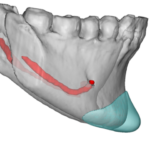
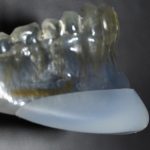
As part of any facelift, consideration should always be given to augmenting the jawline. Most commonly, this is seen a simple chin augmentation as weak chins are easy to spot. Chin implant augmentation adds length to the jawline and adds a complementary effect to the restoration of a more acute neck angle. In other cases, an extended implant that incorporates the prejowl area better defines the front half of the jawline.

Case Study: This 65 year-old female wanted to improve her saggy neck and jowls that had been slowly getting worse over the past decade. She was a very thin lady with very little subcutaneous fat. She had rolls of skin over the jowls and into the neck with prominent platysmal bands. Her chin had some horizontal shortness and her jaw angles were extremely high, creating a 45 degree angle to her mandibular plane.

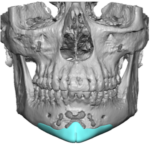
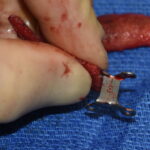
Under general anesthesia, a facelift was performed. Initially, a submental incision was made and skin flaps raised to expose the platysma muscle. The muscle edges were exposed with cautery and a sutured together from under the chin down to the thyroid cartilage. A combined chin-prejowl implant was placed on the chin bone back behind the mental nerve on the lower edge of the bone. Incisions were made around the ears in a retrotragal fashion and long skin flaps raised to connect with those previously made in the neck. Her SMAS tissue was very thin and imbrication by sutures was done rather than raising the flaps. Excess skin was brought back over the ears, the excess removed, and the outline of the ear re-established.

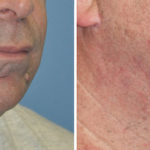
Her recovery was very typical for a facelift and she looked fairly non-surgical in just over two seeks after her procedure. Her jawline was sharp again and the chin had more projection although not overly so. Even the outline of her high mandibular angles could be clearly discerned.

Skeletal jawline augmentation is an underutilized technique in facelift surgery. Its use in patients that have a congenitally short jaw is extremely beneficial and will highly compliment the soft tissue rearrangement. But even in patients that do not have an obvious chin deficiency the jawline can be made more prominent with a prejowl implant that adds minimal horizontal chin projection.

Case Highlights:

1) The woman with a short jaw, as evidenced by a small chin and high mandibular angles, will develop considerable neck and jowl soft tissue sagging as she ages.

2) While a facelift is the standard approach to neck and jowl sagging, adding skeletal support through chin augmentation helps recreate a more visible jawline.

3) Chin and jawline implants can be a valuable addition to lower facial rejuvenation.

Dr. Barry Eppley

Indianapolis, Indiana

The Uniqueness of Male Plastic Surgery – Facial Procedures

Saturday, June 15th, 2013


The facial aging process is one that is well known as everyone will eventually see it on their face. The eyes get heavy, the brows descend, the cheek fall, jowls develop and the neck sags. Women become concerned earlier in the aging process and proceed to do procedures to treat or slow it down in an overall more comprehensive manner. Men take a much more delayed approach to it often waiting until one facial area becomes a major concern or until the facial aging process is fairly advanced.

While the face ages largely similar in both men and women, the facial procedures used to treat them are often done differently. Not as many men have facelifts as their aging neck and jowls are more tolerated. But in men that have facelifts they must be done very carefully, respecting the natural hairlines of the temples and behind the ears and being careful not to displace the beard skin into the ear canal. Incisions must be placed very inconspicously and often less of a tightening result must be accepted to keep the scars hidden. That is not a bad thing as men look better underdone than having their faces pulled too tight anyway.

While men also develop heavy upper eyelid skin and lower eyelid bags just like women, their eyelid lifts (blepharoplasties) need to be done more conservatively. Browlift options in men are more limited due to the frequent lack of adequate scalp hair and a well defined frontal hairline. The most common male browlift method is through the upper eyelid (transpalpebral browlift) using the endotine device to accomplish the lift. This produces a very modest browlift but creates no visible scars and with more conservative eyelid skin and fat removals can avoid overfeminizing the male face and creating an unnatural overdone look.

Men do not engage in as many Botox and injectable fillers treatments as women as some wrinkles and signs of aging are more tolerated. A more natural result for men is one that reduces the worst of the wrinkles but does not eliminate all of them. This is the same reason men, at best, will only do a bare minimum of facial skin care. Many men would rather seek more definitive surgical procedures, or do nothing at all, that engage in non-surgical procedures that require frequent efforts to maintain.

Facial reshaping surgery is vastly different in men than women. Male rhinoplasties must keep a high and straight dorsal line and avoid an overly upturned tip while most women desire a smaller less projecting tip and lower dorsal lines. The shape of the face in men is dominated by a strong jaw and requests for chin, jaw angle and even total jawline enhancements are not uncommon to pursue a more masculine appearance and even the so called ‘male model’ look. Men favor higher more angular cheek augmentations while women prefer a lower more anterior rounded cheek prominence. Men pursue brow bone surgery for either reduction of an overlying prominent one or for augmentation to create a more masculine brow prominence and a more backward sloping forehead profile.

Plastic surgery for men has its own unique requirements both in the type of surgeries and the demeanor of the patients. One should not assume that every plastic surgeon or plastic surgery practice is equally adept about meeting the needs of the male patient. Just like breast reconstruction for women or body contouring after massive weight loss, the male patient presents unique challenges for a satisfying surgical outcome.

Dr. Barry Eppley

Indianapolis, Indiana

Reducing the Risk of Complications in Chin Implant Augmentation

Thursday, April 18th, 2013


Chin augmentation is the original facial implant procedure and is still the most commonly one performed today. Several different materials of chin implants are available and a wide variety of styles and sizes exist from different manufacturers. Despite the apparent diversity of chin implant options, it is generally viewed as a ‘very simple and safe’ aesthetic facial operation.

But despite this seemingly simplicity, complications from chin implants are not rare. Infection, implant asymmetry/displacement and aesthetic dissatisfaction do occur and are probably more common than plastic surgeons care to know. Part of this is due to the fact that a synthetic material implanted anywhere in the body always has some risk and another reason for complications is also due to surgical technique.

While the chin bone has few vital structures around it, there is the mental nerves to the periphery and the mentalis muscle which drapes directly over the front part of the bone. To clarify the important anatomy that is involved in the placement of chin implants, an article was published in the April 2013 issue of the journal of Plastic and Reconstructive Surgery entitled ‘The Safe Zone for Placement of Chin Implants’. Using fresh cadaver dissections, the location of the exit from the bone of the mental nerves was consistently around 1.5 cms above the lower border of the jaw and located between the first and second premolar (bicuspid) teeth. The origin of the mentalis muscle was at the base of the anterior mandibular sulcus at the incisor roots (the level of the outer labiomental sulcus) and descends downward to insert into the chin soft tissue pad in a fan-shaped manner.

While this article provides no new anatomic information that hasn’t been known for some time, it helps the novice plastic surgeon be aware of the subperiosteal location in which to stay when placing chin implants. (below the muscular origin of the muscle and the mental nerves) Its relevance to the patient is in several issues to ponder when undergoing chin implant augmentation.

While some patients like to avoid a submental scar in placing the implant, one is at greater risk of mentalis muscle problems going from inside the mouth if the muscle is not put back together properly. The submental incisional approach is probably ‘safer’ in many cases and in most surgical hands. In addition, while a 1.5 cm pathway below the mental nerves is fairly generous for the wings of most chin implants, large implants and even custom jawline implants that are bigger are at greater risk of injuring the nerve during dissection and/or have an implant impinge on it afterwards causing lip and chin numbness/pain.

Dr. Barry Eppley

Indianapolis, Indiana 


Case Study: Strong Male Jawline Enhancement

Wednesday, March 6th, 2013

Background: A well-defined and strong jawline is a desireable male feature. While modern culture and media have made it seem a recent attractive male trait, it has been so for as far back in history as pictures have been drawn and sculptures have been created. A strong lower facial structure provides not only good aesthetic proportions but implies increased masculinity and facial attractiveness.

Total or complete male jawline enhancement can improve the structural shape of the lower jaw by increased chin and jaw angle projection through the use of implants. Since the mandible has somewhat of a parabolic curved shape, the front and back ends of the curve must be changed to give it greater angularity. The chin needs a more square form horizontally and the jaw angles need a more square form vertically as well as more outward horizontal flare.

The amount of ‘strength’ of the jaw line that any particular male wants is a very individual decision. There are some general guidelines as to how much chin and jaw angle flare is aesthetically acceptable. The square width of the chin should stay within a vertical line dropped down from the pupil of each eye. The outward flare of the jaw angles should not go past a vertical line dropped down from the midpoint of the zygomatic arch. The lower vertical edge of the jaw angle should sit above the lowest point of the chin in side view so that the mandibular plane angle is not flat.

While these aesthetic jawline guidelines stay within the proportions of the balanced face, some patients may desire a stronger jawline look. To achieve a very strong or extreme jawline enhancement, implants have to be selected that exceed these aesthetic facial boundaries but also stay proportionate.

Case Study: This 50 year-old male wanted to achieve more of a stronger facial look with greater skeletonization and prominence of his facial features. A big part of his desired look was a significant change to his jawline. While his chin was not unduly deficient, his jaw angles were significantly narrow, vertically short and ill-defined.

Under general anesthesia, his chin was changed by performing an intraoral vertical reduction osteotomy onto which was overlaid a medium silicone square chin implant to provide width and an additional 3mms of horizontal projection. Jaw angle implants were placed intraorally that added 10mms of vertical lengthening and 11mms of increased width. He also had cheek implants placed to his new jawline did not overwhelm his upper face.

He had the typical jawline implant recovery with a first week of significant swelling and trismus. (limited jaw opening) By three weeks after surgery, however, much of his swelling subsided and the outlines of the augmentations were more discernible. By six weeks the final shape of the jawline could be seen. While the time period of three months after surgery is the real final evaluation point, 90% to 95% of the result is evident by six weeks.

Strong jawline enhancement requires a square chin and prominent jaw angles. One of the key features to a stronger jawline is to increase the vertical length and flare of the jaw angles. To keep the face proportionate and to stay within its aesthetic boundaries, cheek augmentation may be needed to prevent too heavy of a lower facial look.

Case Highlights:

1) Total jawline augmentation involves chin and jaw angle implants.

2) Creating a strong and well defined jawline in men involves a more square chin and a three-dimensional change to the posterior jaw angles.

3) Strong jawline augmentation creates a prominent flair and vertical lengthening of the jaw angles and a square chin that will create more of a square shape to the face.

Dr. Barry Eppley

Indianapolis, Indiana

Square Chin Implants in Men

Wednesday, November 21st, 2012


The shape and dimensions of the chin has a huge impact on the appearance of the lower face. It is well known that weak vs strong chins give off different impressions of one’s personality, even though these impressions may not really be true. Most commonly, a ‘weak’ chin is treated by an implant which is based almost solely on an artistic assessment of increasing the amount of horizontal projection. But horizontal projection alone is but one dimension of a well proportioned and attractive chin and other dimensions needs to be assessed before surgery as well.

How is a chin assessed before surgery? How is a dimensional chin analysis done? The classic teaching is that one chin’s point should fall on a vertical line drawn down from the glabella on the Frankfort horizontal plane, particularly for a male. This is, of course, just a horizontal assessment. The vertical height of the lower third of the face and chin should be 1/3 of total facial height from the subnasale (base of the nose) down to the menton point. (bottom of the chin) This determination can be done in both the horizontal and frontal views. The width of the chin, however, is the obscure measurement and is not necessarily determined by the classic dividing the face into vertical 1/5s. There are no real established standards set for chin width, like anthropormetrics as done for chin height and length.

While the aesthetics of chin width are open to subjective assessment, there are some anatomic guidelines to use. The width of the chin in men is most aesthetically pleasing (stronger appearance) when it assumes one of two shapes. The first is that the squareness of the chin lies inside a vertical line drawn down from the corners of the mouth. This can be a good shape if one has noticeable jaw angle flare. This creates a jaw line with four distinct points in the frontal view. More square chin widths are also very acceptable but this width should never exceed a vertical line drawn from the center of the pupils in males. This is the greatest amount of chin squareness a man should have less they look cartoonish.

When choosing a chin implant in men, it needs to be determined if a square shape is aesthetically advantageous. The vast majority of chin implants are rounded, so called anatomic, and thus will only create a fuller chin that mimics the shape of the underlying bone. Only a chin implant that is so designated as a square style can broaden visible chin width. This can be done from 4.0 cms up to 5.5cms in square width. This is, in essence, the difference between achieving chin width that’s inside the vertical line from the mouth corners or extends out to or just beyond them. When in doubt about the size of a square chin implant, do not extend the measured width of the mouth in the implant.

The chin of males is characterized by larger sizes in three dimensions (horizontal, vertical and width, height and depth) due to the large underlying jaw. The greater inclination angle of the chin and smaller mentocervical angle also indicate a relatively protruding chin in males when compared to that of females. More careful assessment of chin width in men will find that many could benefit by the addition of some square width for an improved aesthetic result.

Dr. Barry Eppley

Indianapolis, Indiana

The Aesthetics of the Chin and Its Relationship to the Face

Tuesday, July 3rd, 2012

The chin creates the dominant effect on the appearance of the lower face. Thus, it has a major effect on facial balance and appearance. When out of proportion to the rest of the face, it can create a perception that other facial features are the culprit when it is really at fault. Understanding the proper relationship of chin shape and projection helps one plan for the right procedure when attempting to improve one’s facial appearance.

The most aesthetically pleasing chin is almost always simplistically perceived as falling on a vertical line that drops down from the nasion or junction of the nose and forehead. While this measure of chin position does have considerable value, today’s understanding of chin aesthetics is far more complex and truly three-dimensional. The ideal chin should have an oval shape in women and a more square shape in men. The upper part of the chin has a concave form that curves outward into a convexity (representing the thicker soft tissues of the chin pad) before it turns inward again at its lower edge.

The horizontal position of the chin should lie directly under where the lower lip pouts outward. With adequate projection, it can make the nose look smaller which is why it is frequently augmented in a reductive rhinoplasty. When a chin is weak or horizontally short, it can make other facial features look bigger, often creating a wider or more square facial shape. When the chin is too big or horizontally forward, the rest of the face can look recessed or more flat.

The frontal shape of the chin is very gender-specific. Women should have a more angular or narrow chin but not too pointy. (or too narrow) The greatest width of the chin should lie well within vertical lines drawn down from the canines or eye teeth. Men should have a wider or more square chin whose width can be out to vertical lines dropped down from the corners of the mouth. In the frontal view, the length of the chin is another important aesthetic element. To be in proper facial balance, the height of the lower face is always stated as being no greater than 1/3 of the total height of the face. But the lower 1//3 of the face is comprised of by more than the chin proper. By this standard, the height of the chin proper should constitute no more than ½ of the lower third facial height.

The appearance of the chin is also affected by the rest of the jawline and neck. Jowls or too much fat and hanging skin along the jawline makes the face look more square which is not the fault of the bony chin. It also makes the jawline heavy and can even create the illusion that one is overweight. This is particularly true when there is submental or neck fullness as well. The back part of the jawline or jaw angles impacts how the chin looks from the frontal view. Wide flaring jaw angles can make the chin look too narrow whereas diminuitive or non-flared jaw angles can make the chin look wide.

When considering any facial surgery, it is important to consider the aesthetics of the chin and how it impacts or is affected itself  by the rest of the facial features. Chin surgery can have a major impact on improving facial balance.   

Dr. Barry Eppley

Indianapolis, Indiana

Options in Aesthetic Jawline Enhancement

Sunday, May 13th, 2012

The jawline is the defining feature of the lower face. It is quite simple from a structural standpoint being a u-shaped arc and serving as the transition between the face and the neck. But it can have lots of aesthetic problems that are extremely common complaints. A weak chin, a sagging neck, a double chin, jowls, and weak jaw angles are the main jawline issues that manu people have. Whether one is young or old, male or female, these jawline concerns can affect all due either to aging or a congenital structural defect.

The strong or well-defined jawline has become an important component of facial beauty and attractiveness today. With the advent of the internet and other electronic media, a new cultural standard for jawline aesthetics has emerged. Males contact me today and almost always point to the jawline of Brad Pitt and numerous less well known models as to their goal. Women similarly point to actresses like Angelina Jolie or Reese Witherspoon as their desired jawline look.

What makes up a pleasing jawline that conveys both attractiveness and a more youthful appearance? This always refers to a well-defined  and visible inferior border of the mandible that is straight from the jaw angle to the chin. The jaw angles are slightly higher than the horizontal position of the chin and there is a slight flare from front to back. The chin is more square in men than in a women whose chin is more narrow. Soft tissue that hugs the lower edge of the jaw makes for a well-defined neck angle and the absence of any jowls. It can be seen that the bone structure is the key to a good jawline which will also affect how the soft tissue may sag with age off of the bone.     

While I suspect a good jawline has always been a desired facial feature, many recent improvements and advancements in plastic surgery have made it more achievable. But there is not a single jawline technique that will work for everyone. A variety of bone and soft tissue surgical procedures exist and often more than one is needed to get the best result.

Chin and to a lesser degree jaw angle implants have been around for decades. But new improvements in implant shapes have made them more versatile and adaptable to a variety of jawline problems and are available off of-the-shelf. Chin implants that extend posteriorly to cover the prejowl area and those that have increased width to create a more square chin are but a few of the newer options. Better chin implant designs are still needed, particularly those that may allow for increased vertical as well as horizontal projection. Jaw angle implants have largely been in one style, that of adding more lateral fullness. But newer jaw angle designs allow for vertical height increase and stronger lateral flare as well.

But off-the-shelf chin and jaw angle implants can often not make for a completely straight jawline because they are not connected in the middle between the two over the central body of the mandible. Custom jawline implants can now be made that can create a central jawline augmentation that unites the chin and jaw angle areas. Custom designs may also be used when the size of the chin or jaw angles desired has greater dimensions that what off-the-shelf implants can achieve.

Soft tissue techniques for an enhanced jawline include a variety of well known procedures. Fat removal by liposuction, loose skin tightening and removal through differing facelift techniques, and neck muscle tightening can better redrape the soft tissues around the bony jawline. Two uncommon but useful soft tissue procedures are the submentoplasty and the direct necklift. A submentoplasty works best in the younger patient with a full neck where extensive fat removal and muscle tightening are done without skin removal. In contrast is the direct necklift which is for the much older patient who is willing to accept a neck scar for neck wattle removal and platysmal muscle tightening.

Contemporary jawline aesthetic surgery is more than just a chin implant or a facelift. It needs to consider all anatomical elements and combine a variety of bony and soft tissue manipulations to get the best lower facial improvement.  

Dr. Barry Eppley

Indianapolis, Indiana   

Non-Facelift Options In the Aging Neck

Friday, March 16th, 2012


An improved neck shape is a desire for many aging men and women. With time, loose skin and sagging fat develop that create a full neck with a more obtuse angle. When seeing patients who seek a better neck and jawline, they are usually surprised when the concept of a facelift is presented. They may have come in for a ‘necklift’ or some other limited operation but they most certainly didn’t think they needed a facelift.

For some, the issue of a facelift vs a necklift is a matter of misunderstanding terminology. It is common that most people believe that a facelift alters everything from the forehead down to the neck, not just an isolated neck and jawline change. Once explained properly they are ready to proceed with what they called a necklift. But for others a facelift is simply more than they want to do even though it is the ideal procedure for their aging neck and jowls.

Besides a facelift, they are a variety of other smaller or less extensive procedures that can be used to reshape the neck. These include the options of liposuction, submentoplasty, chin implants and the direct necklift. Often putting together two of these procedures is done to optimize their effects. But none of these procedures should be confused with creating the same effect as a facelift in the aging neck and it is important to realize their limitations.

Liposuction of fat can be very effective in reducing neck fullness. But that is dependent on how much fat actually exists in the neck and, most importantly, the quantity of neck skin and its tone. Loose neck skin will not respond to liposuction the way many older patients would like. The neck may indeed get less full but the skin may retract poorly and leave more visible folds and irregularities. Even with liposuction technology such as Smartlipo, which aids the fat removal process by a heating effect, significant loose skin will not be dramatically tightened. While I have seen some surprisingly good results with its use in the older neck, it is not a replacement for an excisional or lifting procedure for loose skin. When using it patients have to be willing to accept these skin issues or be ready to have a facelift later if they want further improvement.

The submentoplasty procedure is another method of neck fat removal but does not rely on liposuction at all. It is the removal of fat from underneath the platysma muscle and is often done as part of a facelift. Through an incision under the chin, the fat is seen through the separated platysma muscles in the midline. When done in a facelift, I use a ‘kelly clamp’ technique to remove the upper portion of the fat pad and then close the muscles over it. For those fuller necks with a lot of subplatysmal fat, a submentoplasty can make a dramatic change in the neck angle in side view. But like liposuction, its success as an isolated procedure depends on how well the skin retracts, which is why it works best in younger patients. In older necks, such fat removal can create skin dimpling and a central neck indentation.

Skin removal in the neck can be done without a traditional facelift. It is not commonly done as one might expect due to the scars that are created. But for the right patient who is fully educated, the scar may be a worthwhile trade-off. The direct necklift uses a vertical removal of skin from the chin down to the lowest horizontal neck skin crease. But skin alone is not just removed. All of the fat underneath this skin and even subplatysmal fat can be removed. The platysma muscle is then sewn together in the most dramatic form of neck muscle tightening due to the visual exposure that the surgeon has. The direct necklift produces the most significant neck angle change, even compared to the traditional facelift. Other types of neck excision or lifts exist, such as a submental tuck or a necklift that uses incisions behind the ears only, but their effects are very limited.


A chin implant is often a surprising suggestion to many older patients when discussing their neck concerns. It is a complementary procedure that increases the prominence of the jaw and by so doing lengthens the upper neck. While not enough alone to change a neck as much as a patient would like, it is a common component of many facelift procedures. It can be used with any of the non-facelift neck procedures and is conveniently done through a submental incision.

While there are a variety of surgical options for neck rejuvenation in older patients, their effects are limited. What they can do should not be confused with that of a facelift (with the exception of a direct necklift) and should be chosen only because one is more interested in less cost and recovery. For the neck with a lot of sag and droop, none of these more limited procedures may be a good option.


Dr. Barry Eppley

Indianapolis, Indiana

Shaping The Male Face

Monday, October 17th, 2011

Superman has been an American cultural icon since he first appeared in comic books back in 1938. His appearance is absolutely distinctive, most notably that of his red, white and blue colors and the stylized S shield on his chest. The shield is so symbolic of his character than its appearance alone immediately brings image of the comic character.

But beyond the colors and the symbol, many of his other features are particularly iconic of what masculinity and attractiveness is supposed to be. His face is absolutely chiseled and proportioned and exudes strength and power. Such Man of Steel facial features appear to have galvanized one male fan to undergo numerous plastic surgery procedures to try and look like this popular superhero.

Hebert Chavez, a superfan of Superman from the Phillipines, has dramatically altered his face to look more like Superman. New agencies have reported that he has undergone a series of operations since 1995. These have included a chin implant to get a strong chin with a cleft, nose reshaping, injections for fuller lips, cheek and jaw implants and eyelid surgery. As bizarre as this sounds, his surgical results actually look pretty good and not as unnatural as one would think.

Such a plastic surgery story brings to mind another face changer, Michael Jackson, and there is no doubt that they both share the similar malady of Body Dysmorphic Disorder. In this mental illness, a person can’t stop thinking about how their appearance is flawed and that perfection is just a surgery away.

But beneath these extreme cases of facial plastic surgery lies some basic truths about what makes a male face more appealing. It starts with an overall facial shape that has more definition and a square to inverted triangular shape. The three bony highlights of the male face are the chin, cheeks and jaw angles. Some degree of prominence in all of them is important to create a sense of overall angularity. Therein lies the frequent use of chin, cheek and jaw angle implants to create those prominences if they are weak, flat or recessed.

In the more lean male face, creating these prominences with implants alone may be adequate. As the chin, cheek and jaw angles become more visible, the non-bony supported areas (submalar and lateral face and neck) will appear more concave as the amount of subcutaneous facial fat in these areas is thin. In the rounder or fuller face, however, some fat removal will need to be considered. This could include procedures such as buccal lipectomies, lateral face and neck liposuction to try and change a convex shape in these areas to at least one that is flat or ideally a little bit concave.

Not every male face can be made more ‘super’. These facial plastic surgery techniques work best in a face that is not too overly round or thick. Such facial shapes are the kryptonite for obtaining the well defined male face that is deemed in both comic books and in real life as desireable.

Dr. Barry Eppley

Indianapolis, Indiana

A Glass Chin Implant

Wednesday, October 5th, 2011

The term, glass chin, has been around for a long time. It is typically used in combat sports, such as boxing and martial arts, to describe a fighter who is susceptible to being knocked out or hurt by a punch to the front part of their jaw. Since the chin is a protruding facial structure that is the easiest part of the face to hit, a fighter’s chin casts an image as to their ability to tolerate physical trauma to the face. This is why a fighter with a good chin, aka granite chin or iron chin, is viewed as having the ability to absorb punishment without being knocked unconscious.

While this is interesting commentary on sporting lingo, it normally would have no relevance to plastic surgery. (unless I had to fix a broken jaw in a fighter) That is what I thought until just a week ago. During a surgical procedure to remove and replace a man’s chin implant, I came across a true glass chin.

I had an out of town patient who, amongst other procedures, wanted his existing chin implant removed. He said he never really thought he needed it anyway and was bothered by its very hard feel. It also made his chin feel stiff up under his lower lip. Through a submental incision, I dissected down through his chin tissues to the patient’s indwelling chin implant. Because it had been placed elsewhere through an intraoral approach, I knew it would be in a high position on the chin bone. It was at least a centimeter above the lower edge of the chin bone when I encountered the implant capsule.

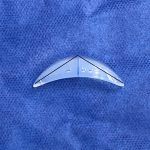
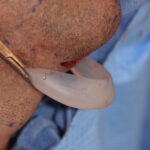
On cutting through the capsule with a cautery, the underlying implant felt unusually hard. Even though it was clear, a sign that it would normally be made of silicone, it was instead hard. So hard that tapping on it made it sound like glass. Unlike a silicone rubber chin implant, which folds on itself and makes it easy to remove, the implant was rock solid. It required the entire implant capsule to be opened for its removal.

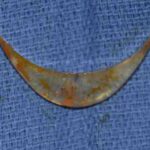
On its removal, it could be seen that it not only was made of a hard and inflexible plastic (glass??) but it was also a cleft chin style. I have never seen or even heard of a manufacturer who would make a facial implant out of this hard material. Nor can I envision why anyone would. It not only was hard and poorly shaped, it was very short in horizontal dimension. It was very hard and diminuitive compared to traditional silicone chin implants.

I can now say that I actually have seen a patient who truly had a glass chin.

Dr. Barry Eppley

Indianapolis, Indiana


Dr. Barry EppleyDr. Barry Eppley

Dr. Barry Eppley is an extensively trained plastic and cosmetic surgeon with more than 20 years of surgical experience. He is both a licensed physician and dentist as well as double board-certified in both Plastic and Reconstructive Surgery and Oral and Maxillofacial Surgery. This training allows him to perform the most complex surgical procedures from cosmetic changes to the face and body to craniofacial surgery. Dr. Eppley has made extensive contributions to plastic surgery starting with the development of several advanced surgical techniques. He is a revered author, lecturer and educator in the field of plastic and cosmetic surgery.

Read More


Free Plastic Surgery Consultation

*required fields


Pricing

The cost of any type of elective plastic surgery plays a major role in the decision to undergo the procedure(s).

Get Your Quote Here


My Plastic Surgery Story

Military Discount

We offer discounts on plastic surgery to our United States Armed Forces.

Find Out Your Benefits


Categories