EXPLORE
Plastic Surgery
Dr. Barry Eppley

Explore the worlds of cosmetic
and plastic surgery with Indianapolis
Double Board-Certified Plastic
Surgeon Dr. Barry Eppley

Archive for the ‘cheek reduction’ Category

Zygomatic Osteotomy Patterns in Cheek Reduction Surgery

Thursday, November 10th, 2011

The shape of the face obviously changes in different geographic regions and cultures. This is certainly true in facial aesthetics between Western and Asian cultures. One of the facial features that is really different between these two cultures is the cheek region. In the Western face a high or protruding cheek is regarded as both youthful and aesthetically pleasing. In contrast, high or prominent cheekbones is regarded as unaesthetic in the Asian face. In a face that is generally smaller overall, prominent cheekbones can look really big in an Asian face.

Because of the desire to not have protruding cheeks in an Asian face, cheek reduction or reduction malarplasty is a very common operation in Eastern Asian countries. It is an extremely uncommon facial operation in Caucasians although I have seen and done a few such cheek reductions over the years in my Indianapolis plastic surgery practice.

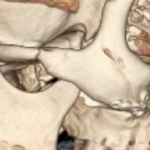
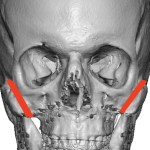
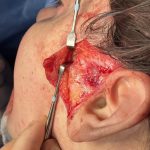
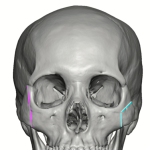
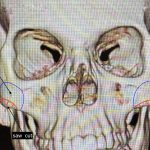
Most cheek reductions use both an anterior and posterior osteotomy. The anterior osteotomy goes somewhere through the body of the cheek or zygoma while the posterior osteotomy cuts the attachment of the zygomatic arch to the temporal bone. The posterior osteotomy has very little variation in performing it. But the anterior osteotomy cut has some variation in placement and design due to the different sizes and shapes of the zygomatic bone. How it is cut and how much bone is removed determines how much volume reduction is achieved and whether the area of maximum cheek protrusion is effectively reduced.

The easiest anterior approach to cheek reduction is to separate the front edge of the zygomatic arch where it attaches to the posterior body of the zygoma. This junction is certainly easy to see intraoperatively from the intraoral approach. While easily cut, however, shifting of the zygomatic arch medially can leave the protrusion point of the cheek bone in some patients unchanged. This can be remedied by burring the body of the zygoma down to be even with the repositioned zygomatic arch. However, it can be hard to get the junction between the bone edges smooth and it may also be structurally unstable.

When the protrusion point of the zygoma is more anterior than the junction, a different osteotomy pattern is used. An L pattern osteotomy design is used with two pairs of osteotomy cuts on the anterior surface of the zygoma. When it is cut this way and a sagittal section of bone removed, the zygoma and the attached zygomatic body are moved inward as a unit. This will ensure that a smooth zygoma will result and it will be more stable.

In an interesting paper published in the November 2011 issue of Plastic and Reconstructive Surgery, plastic surgeons from Tokyo studied the position of the ‘summit’ of the zygoma. The summit is just another name for the maximal point of cheek protrusion. Knowing where it is located in any patient is obviously important when planning the cheek reduction operation. Their study showed that the summit of the zygoma is located medial to the junction of the frontal process and the zygomatic arch. The bone incision line in cheek reductions, therefore, should be placed medial to the posterior edge of the frontal process to get effective reduction of the protrusion. Not surprisingly, the zygomatic summit is higher in men than women due to a bigger cheekbone and then so should the bone incision be placed also.

Prior to cheek bone reduction surgery, I like to get a simple submental facial x-ray to locate the the point of maximal bony cheek protrusion which can be easily seen on the film. This helps to determine the best cheek osteotomy type.

Dr. Barry Eppley

Indianapolis, Indiana

Facial Bone Reduction Surgery

Monday, February 1st, 2010

Changing one’s bony prominences is the primary method for altering the shape of the face. The face is composed of a variety of bones which have convex and concave contours. The external appearance of the face is highly influenced by the convex bone contours. From the brow bone down to the long curvilinear shape of the mandible, there are numerous key bony projection points. (e.g., cheeks, chin, jaw angles)

Most commonly, a variety of plastic surgery operations exist to enhance or increase their projections. Chin, nose, cheek and jaw angle implants are prime examples. It is almost always easier to increase facial bone projection by adding to the bone rather than actually moving the bone.  There are also, however, operations that work in reverse…to reduce or deproject these very same prominences.

Facial bone reductions are not as well known and are less commonly done. Unlike augmentations, facial reduction procedures require modification or shortening of the bony prominences. While some can be shaved down, others require actual cutting off or out of bone sections to change the amount of bony projection.

Brow bone reduction is requested when the brows have a very prominent or ‘Neanderthal’ appearance. Mainly this procedure is done in men and in male to female conversions. (facial feminization surgery) This must almost always be done through a frontal hairline or scalp incision. In some cases, the brow bone may be simply burred down but this is unusual. The underlying frontal sinus occupies much of the width of the brow bone so the overlying bone is quite thin. Only if one is modifying the tail of the brow can it be just burred down. The outer table of the frontal sinus must be removed, reshaped, and then put back with tiny plates and screws. The scar from the incisional approach is the key decision in deciding to undergo this operation.

Cheek reduction is about modifiying the front edge of the cheek bone and its arched form back to where it attaches to the temporal bone. Most patients that want cheek reduction are often Asians in an effort to improve their wider face appearances. A vertical bone cut is made through the body of the malar bone and a wedge of bone is removed. The reduced cheek bone is then attached to the maxilla with a four-hole plate and screws. To get the more posterior part of the arch to move inward, the thin attachment of the posterior part of the zygomatic arch is cut with an osteotome and allowed to move inward (by muscle pull) without the need to secure it.

Nasal reduction is achieved by conventional rhinoplasty techniques. A significant part of a nasal hump is actually cartilage and not bone. The key in reductive rhinoplasty is not to overdo it, creating a saddle nose or pinched upper and middle vault appearance. This can result in nasal airway breathing difficulties. When it comes to helping a face look less wide and more sculpted, the nasal dorsum often is better elevated and not reduced.

Chin reduction is done by burring down the genial prominence. While this bone area is simple to get to through a submental incision, chin reductions are notoriously prone to cause soft tissue problems if not done correctly. This is the only facial bony prominence where the soft tissue does not just ‘snap back’ over the bone. If the excess skin and muscle is not removed and readapted back to the reshaped bone, it will sag resulting in the classic ‘witch’s chin deformity. Also, unlike chin bone advancements which can be brought forward 10 to 12 mms or more, retropositioning of the chinbone can not be done as dramatic and is more in the range of 4 to 6mms at best. Going back further than that can have adverse effects on the neck causing undesired fullness.

Jaw angle reduction is most commonly done in Asians like cheek reduction. Through an incision inside the mouth, the angle of the jaw is blunted by an oblique bone cut removing the prominent tip. How much of the tip or angle area is removed is a matter of intraoperative judgment. There is a fine balance between removing too little and completely having no angle at all. A nearly straight line from below the ear to the chin is not desireable either. This is the most uncomfortable of all the facial bony prominences to reduce because the large master muscle must be raised, causing considerable swelling after also.     

Barry L. Eppley, M.D., D.M.D.

Indianapolis, Indiana

Zygomatic Osteotomies in Cheek Augmentation and Cheek Reduction

Thursday, August 27th, 2009

The cheek bone (zygoma) is a very valuable part of one’s appearance as it provides a prominent highlight and a width dimension to the face. It also provides support to the eyeball and serves as an attachment point to the tendons of the upper and lower eyelids.

Some people have naturally broad or narrow cheek widths, of which one component is caused by the development and shape of the dimensionally complex zygoma. The curvature of the zygomatic body and attached arch bone is responsible for some of this width.

The normal position of the zygoma cam also be altered through injury, with cheek or ‘tripod’ fractures being frequent. When the bone is fractured, it almost always is displaced downward and inward into the maxillary sinus cavity. As the pillar or support of it is lost, it can only fall in this direction. Technically, it rotates  (tilts, not just falls) and the cheek prominence is lost and the corner of the eye may be pulled down slightly also. While most of these zygoma fractures are repaired immediately, some never get fixed for a variety of reasons creating a secondary zygomatic deformity marked by a flatter cheek.

Zygomatic osteotomies are one potential method to improve these bone malpositions. Depending on the facial objective, the type of zygomatic osteotomy can differ which also influences the incisional approach.

In a purely cosmetic application, the zygomatic body (not arch) can have a wedge of bone removed for reduction or can be cut and expanded. (with or without grafting) By so doing, one can moderately help change the width of the face in this area. Because it is usually done on both sides of the face for cosmetic change, the total amount of change (by bone measurement) may be as much as 10 to 15 mms. Almost all cosmetic zygomatic osteotomies are done through an intraoral approach.

For reconstructive purposes, most zygomatic osteotomies are usually done on one side only. The objective being to match the opposite uninjured side. Deoending on how the bone must change position will determine what incisions are used. Usually the intraoral approach alone is not adequate as the zygomatic complex must be freed and rotated, not just changing one dimension of the zygomatic body. Thus two incisions are used, most commonly intraoral and lower eyelid. (blepharoplasty) Extensive three-dimensional complex movements may need a coronal (scalp) incision as well to fully mobilize the bone at each pillar of support. In my Indianapolis plastic surgery practice, I usually try to avoid the scalp approach as this is undesired by most patients and is reserved for those few patients who have had a more significant midface ‘crush-type- injury.

Zygomatic osteotomies will need bone fixation, using very small titanium plates and screws. These almost never need to be removed later and they rarely cause any problems.

When contemplating reconstructive zygomatic osteotmies, there is often an orbital component to the deformity that may require orbital floor reconstruction and repositioning of the lateral canthus to change the level of the corner of the eye as well.


Dr. Barry Eppley

Indianapolis, Indiana 

Different Methods to Narrow the Cheek Bones

Tuesday, September 30th, 2008

The need to reduce or narrow wide cheeks is a far less frequent request than making them bigger. Most commonly, cheek reduction surgery is requested by Asian cultures, notably Eastern Asians. East Asian cultures value a small face, and wide cheekbones appear to make the face bigger. In rare cases, a patient may have developed a wide cheek(s) due to a facial bone fracture from an injury or may simply have a more flat face appearance which makes the face look wide.

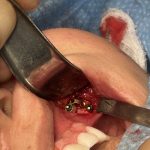
Cheek reduction can be done by two methods, Through an incision from inside the mouth, the prominence of the cheek bone can be burred down or a piece of cheek bone can be removed allowing it to become narrower. Burring down the cheek bone is rarely a good idea. It takes a lot of bone reduction to make a visible external difference and the soft tissues of the cheek may sag after if they do not heal back down to the bone. Taking  a vertical wedge of cheek bone out where it attaches to the main bone of the upper jaw, allows the entire cheek bone complex to fall in, narrowing the width of the face. I usually place a very small plate and screws to make sure the outer part of the cheek bone stays in the newly narrowed position permanently. The back end of the cheek bone, where it attaches to the skull (temple) , can also be cut as well as the front end. When both are done together, the face is further narrowed.

While cutting and removing a piece of cheek bone sounds like a complex procedure, it is really quite simple and quick to perform. It is similar to a chin osteotomy but it is easier on the patient as this part of the upper jaw is not responsible for jaw movement even though there are some muscles attached to it. It is far more effective than burring of the cheek prominence and poses no risk of the soft tissues of the cheek sagging after surgery.

Dr. Barry Eppley

Indianapolis, Indiana 


Dr. Barry EppleyDr. Barry Eppley

Dr. Barry Eppley is an extensively trained plastic and cosmetic surgeon with more than 20 years of surgical experience. He is both a licensed physician and dentist as well as double board-certified in both Plastic and Reconstructive Surgery and Oral and Maxillofacial Surgery. This training allows him to perform the most complex surgical procedures from cosmetic changes to the face and body to craniofacial surgery. Dr. Eppley has made extensive contributions to plastic surgery starting with the development of several advanced surgical techniques. He is a revered author, lecturer and educator in the field of plastic and cosmetic surgery.

Read More


Free Plastic Surgery Consultation

*required fields


Pricing

The cost of any type of elective plastic surgery plays a major role in the decision to undergo the procedure(s).

Get Your Quote Here


My Plastic Surgery Story

Military Discount

We offer discounts on plastic surgery to our United States Armed Forces.

Find Out Your Benefits


Categories