EXPLORE
Plastic Surgery
Dr. Barry Eppley

Explore the worlds of cosmetic
and plastic surgery with Indianapolis
Double Board-Certified Plastic
Surgeon Dr. Barry Eppley

Archive for the ‘submentoplasty’ Category

Necklifts for the Younger Patient

Sunday, December 2nd, 2012


While the face in theory ages evenly, one’s concerns about different facial changes is not. Besides the eyes, the neck is a frequent target of aging dissatisfaction. While the neck is composed of various tissues, one wants see is loose and hanging skin. This makes one yearn for the days when the skin between the chin and neck was firm and taut and a more defined neck angle existed. While styles and fashion have changed over the years, a sharp and clean neckline has always been a youthful image.

While the neck has always been a physical disdain of aging, what has changed is the age at which these concerns arise. Turkey necks and wattles are understandable neck concerns, but they represent older patients often in the sixth, seventh and eighth decades of life.  Ever since Nora Ephron’s book ‘I Hate My Neck’ was published, it was like a light bulb when off for many younger people.  Younger people, women and men alike, now appear in the fourth and fifth decades, to do something about their loosening neck skin. The reality is that the publication of the book was merely coincidental to this interest. The wide spread use of Botox and fillers has filled many a plastic surgeon’s office with early aging patients where the opportunity to discuss these concerns can easily happen.

The interest in addressing the earlier changes in neck aging has led to a variety of surgical and non-surgical treatments. A host of energy-driven devices exist for neck tightening, like Exilis and Ultherapy, but these are really bridging therapies until the time comes when one is ready for a more definitive surgical approach. Some fat shrinkage and skin tightening may work well for more minor neck droops, but really significant and and longer-lasting results requires tightening the muscle and skin to resist the never-ending effects of gravity.

Necklifting options today range from under the chin approaches (submental incisions) that use skin tightening caused by fat removal and/or muscle tightening and more traditional approaches (facelift) that use skin shifting and excision by incisions around the ears. Most younger aging neck patients are going to usually benefit by submental approaches and these are of the greatest interest because they are ‘less’ surgery with a quicker recovery. By definition a submental approach involves a small and inconspicuous incision right under the chin. It can be just a few millimeters when only liposuction is used. The heat created by the use of Smartlipo is a reall complement to the any fat removal done. For someone with a full neck but good thick skin, this could be all that is needed to create a better neck contour.

The most unknown necklift is that of the submentoplasty or platysmaplasty. Through a slightly larger submental incision, fat is first removed from under the skin but the cornerstone of the procedure is the muscle tightening. The sagging platysma muscles are sewn either back together or folded onto themselves in an up and down fashion creating an effect like a corset on the waistline. (which is why this procedure is also known as a corset platymaplasty) This shortens the vertical length of the muscle, pulling the neck angle upward  and with that the overlying skin as well. Other muscle innovations create slings from one side of the neck to the other using permanent sutures to create a hammock-like effect with special instrumentation for passing these sutures into the correction position.

While not as common, a few will have a neck problem that is not primarily fat but just loose skin. Skin laxity is a less frequent cause of younger patients but definitely becomes more of an issue as one crosses the half century mark. Loose skin in the neck, if not too severe, is managed by a smaller neck-jowl tuck-up or one of the many variations of short scar or limited facelifts. While less skin is removed than in a traditional facelift, the tightened on both sides of the jawline creates a hammock-like effect across the midline of the neck pulling it tighter.

The revolution in sagging necks is that more and more younger patients are turning to necklifts as stand alone procedures…changing for some the title of their own book ‘I Love My Neck!’

Dr. Barry Eppley

Indianapolis, Indiana

Options in Aesthetic Jawline Enhancement

Sunday, May 13th, 2012

The jawline is the defining feature of the lower face. It is quite simple from a structural standpoint being a u-shaped arc and serving as the transition between the face and the neck. But it can have lots of aesthetic problems that are extremely common complaints. A weak chin, a sagging neck, a double chin, jowls, and weak jaw angles are the main jawline issues that manu people have. Whether one is young or old, male or female, these jawline concerns can affect all due either to aging or a congenital structural defect.

The strong or well-defined jawline has become an important component of facial beauty and attractiveness today. With the advent of the internet and other electronic media, a new cultural standard for jawline aesthetics has emerged. Males contact me today and almost always point to the jawline of Brad Pitt and numerous less well known models as to their goal. Women similarly point to actresses like Angelina Jolie or Reese Witherspoon as their desired jawline look.

What makes up a pleasing jawline that conveys both attractiveness and a more youthful appearance? This always refers to a well-defined  and visible inferior border of the mandible that is straight from the jaw angle to the chin. The jaw angles are slightly higher than the horizontal position of the chin and there is a slight flare from front to back. The chin is more square in men than in a women whose chin is more narrow. Soft tissue that hugs the lower edge of the jaw makes for a well-defined neck angle and the absence of any jowls. It can be seen that the bone structure is the key to a good jawline which will also affect how the soft tissue may sag with age off of the bone.     

While I suspect a good jawline has always been a desired facial feature, many recent improvements and advancements in plastic surgery have made it more achievable. But there is not a single jawline technique that will work for everyone. A variety of bone and soft tissue surgical procedures exist and often more than one is needed to get the best result.

Chin and to a lesser degree jaw angle implants have been around for decades. But new improvements in implant shapes have made them more versatile and adaptable to a variety of jawline problems and are available off of-the-shelf. Chin implants that extend posteriorly to cover the prejowl area and those that have increased width to create a more square chin are but a few of the newer options. Better chin implant designs are still needed, particularly those that may allow for increased vertical as well as horizontal projection. Jaw angle implants have largely been in one style, that of adding more lateral fullness. But newer jaw angle designs allow for vertical height increase and stronger lateral flare as well.

But off-the-shelf chin and jaw angle implants can often not make for a completely straight jawline because they are not connected in the middle between the two over the central body of the mandible. Custom jawline implants can now be made that can create a central jawline augmentation that unites the chin and jaw angle areas. Custom designs may also be used when the size of the chin or jaw angles desired has greater dimensions that what off-the-shelf implants can achieve.

Soft tissue techniques for an enhanced jawline include a variety of well known procedures. Fat removal by liposuction, loose skin tightening and removal through differing facelift techniques, and neck muscle tightening can better redrape the soft tissues around the bony jawline. Two uncommon but useful soft tissue procedures are the submentoplasty and the direct necklift. A submentoplasty works best in the younger patient with a full neck where extensive fat removal and muscle tightening are done without skin removal. In contrast is the direct necklift which is for the much older patient who is willing to accept a neck scar for neck wattle removal and platysmal muscle tightening.

Contemporary jawline aesthetic surgery is more than just a chin implant or a facelift. It needs to consider all anatomical elements and combine a variety of bony and soft tissue manipulations to get the best lower facial improvement.  

Dr. Barry Eppley

Indianapolis, Indiana   

Non-Facelift Options In the Aging Neck

Friday, March 16th, 2012


An improved neck shape is a desire for many aging men and women. With time, loose skin and sagging fat develop that create a full neck with a more obtuse angle. When seeing patients who seek a better neck and jawline, they are usually surprised when the concept of a facelift is presented. They may have come in for a ‘necklift’ or some other limited operation but they most certainly didn’t think they needed a facelift.

For some, the issue of a facelift vs a necklift is a matter of misunderstanding terminology. It is common that most people believe that a facelift alters everything from the forehead down to the neck, not just an isolated neck and jawline change. Once explained properly they are ready to proceed with what they called a necklift. But for others a facelift is simply more than they want to do even though it is the ideal procedure for their aging neck and jowls.

Besides a facelift, they are a variety of other smaller or less extensive procedures that can be used to reshape the neck. These include the options of liposuction, submentoplasty, chin implants and the direct necklift. Often putting together two of these procedures is done to optimize their effects. But none of these procedures should be confused with creating the same effect as a facelift in the aging neck and it is important to realize their limitations.

Liposuction of fat can be very effective in reducing neck fullness. But that is dependent on how much fat actually exists in the neck and, most importantly, the quantity of neck skin and its tone. Loose neck skin will not respond to liposuction the way many older patients would like. The neck may indeed get less full but the skin may retract poorly and leave more visible folds and irregularities. Even with liposuction technology such as Smartlipo, which aids the fat removal process by a heating effect, significant loose skin will not be dramatically tightened. While I have seen some surprisingly good results with its use in the older neck, it is not a replacement for an excisional or lifting procedure for loose skin. When using it patients have to be willing to accept these skin issues or be ready to have a facelift later if they want further improvement.

The submentoplasty procedure is another method of neck fat removal but does not rely on liposuction at all. It is the removal of fat from underneath the platysma muscle and is often done as part of a facelift. Through an incision under the chin, the fat is seen through the separated platysma muscles in the midline. When done in a facelift, I use a ‘kelly clamp’ technique to remove the upper portion of the fat pad and then close the muscles over it. For those fuller necks with a lot of subplatysmal fat, a submentoplasty can make a dramatic change in the neck angle in side view. But like liposuction, its success as an isolated procedure depends on how well the skin retracts, which is why it works best in younger patients. In older necks, such fat removal can create skin dimpling and a central neck indentation.

Skin removal in the neck can be done without a traditional facelift. It is not commonly done as one might expect due to the scars that are created. But for the right patient who is fully educated, the scar may be a worthwhile trade-off. The direct necklift uses a vertical removal of skin from the chin down to the lowest horizontal neck skin crease. But skin alone is not just removed. All of the fat underneath this skin and even subplatysmal fat can be removed. The platysma muscle is then sewn together in the most dramatic form of neck muscle tightening due to the visual exposure that the surgeon has. The direct necklift produces the most significant neck angle change, even compared to the traditional facelift. Other types of neck excision or lifts exist, such as a submental tuck or a necklift that uses incisions behind the ears only, but their effects are very limited.


A chin implant is often a surprising suggestion to many older patients when discussing their neck concerns. It is a complementary procedure that increases the prominence of the jaw and by so doing lengthens the upper neck. While not enough alone to change a neck as much as a patient would like, it is a common component of many facelift procedures. It can be used with any of the non-facelift neck procedures and is conveniently done through a submental incision.

While there are a variety of surgical options for neck rejuvenation in older patients, their effects are limited. What they can do should not be confused with that of a facelift (with the exception of a direct necklift) and should be chosen only because one is more interested in less cost and recovery. For the neck with a lot of sag and droop, none of these more limited procedures may be a good option.


Dr. Barry Eppley

Indianapolis, Indiana

Options in Neck Reshaping and Contouring

Friday, October 21st, 2011

The shape of the neck is an important aesthetic structure of the face. When it is well defined with a sharp angle definition (between 90 to 120 degrees in profile), it makes the chin and jawline more prominent and flattering. When the neck angle is obtuse or completely open (straight), the jawline becomes obscured and less aesthetically pleasing. The neck can be seen to have a major influence on how the entire lower third of the face looks. As one begins to age, the neck tissues become loose and begin to sag.For some, even at a young age, they have a naturally full with an obtuse angle due to a thicker fat layer and a lower positioned hyoid bone.

While genetics, gravity and time work against a shapely neck with a good angle, there are a number of plastic surgery procedures to improve the aesthetic appearance of the neck. First, however, a few comments on non-surgical reshaping methods. While creams and exercises are touted to improve the shape of the neck, none have been proven effective for making noticeable changes. Some modest changes can be made in the appearance of jowls and neck skin sagging in those who have good skin elasticity withvarious transcutaneous energy therapies. (e.g., BBL or Skin Tyte) These are not to be confused with surgical results but there can be visible improvement. Injectable Botox can also be used to treat prominent vertical platysmal neck bands. These are best viewed as treatments neck for those that don’t have enough of a problem to justify surgery or for those who do but prefer to try a non-surgical approach first.

Full thicker necks with good skin can be treated solely by liposuction. Removing fat allows the skin to shrink and tighten up to reveal the shape of the underlying platysma muscle. While traditional liposuction is effective,the additional use of a laser-assisted technique can help improve the results. Smartlipo, which uses a fiberoptic laser probe, creates heat which not only helps melt fat but can create a skin tightening effect as well. While neck Smartlipo is ideal for younger patients due to their better skin quality, I have seen a few older patients with impressive neck changes as well.

The next level beyond neck liposuction is a submentoplasty. This is a neck tightening operation that not only removes fat by liposuction but tightens the platysma muscle as well. It is performed through a submental incision in which some small amount of loose upper neck skin can also be removed. Also known as a submental tuckup, it can be effective for the very beginnings of neck sagging in younger patients with good skin. It is also historically used after a facelift when some submental skin sagging develops (rebound relaxation) in the first year after surgery.

Facelifts are the primary procedure that can create the most effective change for the aging neck. Facelifts, also called necklifts, can be thought of as being two fundamental types either a limited and full type. Both use incisions around the ear but the length of the incisions and what effects they create in the neck and jowls is different. A limited facelift, which goes by a lot of marketing names (Lifestyle Lift, Quicklift etc), has as its main effect the smoothing out of sagging jowls with a more limited effect in lifting neck skin. It is best used in patients whose primary complaints are about their droopy jowls and not their necks. Full facelifts are used when the neck problem is more significant and its improvement is the main objective of the surgery. It is the most powerful changer of both the neck and jowls and usually also incorporates liposuction of neck fat and tightening of the platysma neck muscles. Chin augmentation with a facelift can also be helpful in giving a more defined jawline.

One other approach to the sagging neck is that of the direct necklift. Unlike facelifts in which the incisions and the direction of skin lifting is based around the ears, the direct necklift removes loose neck skin by excising it down the center of the neck…directly if you will. This is a simpler approach to a necklift and is a very powerful reshaping method of the neck but it does so with the trade-off of a midline neck scar. This can be a preferred procedure for older men (greater than age 65) who prefer the least recovery and have large hanging neck wattles. Male beard skin heals remarkably well and I have not found the neck scar to be a visible concern after it heals.

The last area of neck reshaping, which has nothing to do with age, is the prominent Adam’s apple or thyroid cartilage. For those that have too strong of a neck bulge caused by the strength of the paired cartilages of the Adam’a apple, this can be reduced by shaving the prominence down. This is done through a small horizontal neck incision directly over the prominence. It is a virtually painless procedure with no recovery and a result that is immediate. Most patients obtain results where the size of the bulge is dramatically reduced and a few will end up with a completely smooth neckline.

Dr. Barry Eppley

Indianapolis, Indiana

Submentoplasty For Witch’s Chin Deformity in Denture Patients

Wednesday, July 13th, 2011

The chin is a portion of the jaw bone that not only juts outward but is also enveloped by soft tissue attachments. The mentalis muscle is one of the dominant muscles of the chin. It is a paired central muscle which has a significant effect on the lower lip. It has fibers which attach below the mandibular vestibule, known as the incisive fossa of the mandible, and then descends vertically downward to insert into the skin of the skin. It is a muscle of facial expression as it raises and pushes up the lower lip and causes wrinkling of the chin, making a pout.

While this facial expression function seems rather trivial, if the mentalis muscle loses it bony attachments one will have something to pout about. This is an unfortunate occurrence that occur from intraoral chin procedures and, most commonly, after a chin implant has been removed or from multiple chin surgeries. When the mentalis muscle loses its superior bony anchoring point, the entire chin soft tissue pad can droop. This has a classic name which well defines its appearance, known as a ‘witch’s chin’, with the chin pad falling off of the end of the bone.

The correction of the witch’s chin deformity has been well described with the mainstay treatment approach of mentalis muscle resuspension. Multiple methods of how to fix the muscle to the chin bone have been described. While it is a relatively straightforward procedure from a technical standpoint, getting a stable result with tight tissue adaptation across the convex chin is not always easy or successful.

While the common origin of a witch’s chin is chin implant surgery, many older patients who have never had chin surgery have it. It is actually exceedingly common and everyone has seen someone with it. It is the result of a natural process that largely affects older individuals….tooth loss.

.

With loss of the teeth of the lower jaw and the wearing of dentures, the top portion of the jaw bone known as the alveolus resorbs away. This is the result of no teeth as well as the pressure of wearing dentures on top of this bone. In the front part of the mandible, when the alveolar loss becomes severe, the bone resorbs down to the attachments of the mentalis muscle. If severe enough the bone loss resorbs down to the level of the mentalis muscle’s upper attachments…and the chin pad falls downward.

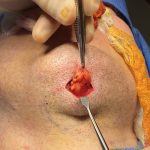
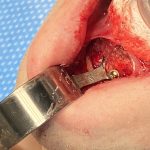
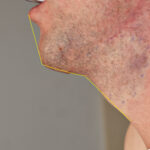
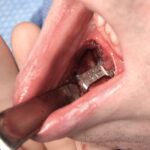
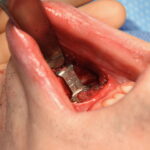
This is a well recognized facial look in many older individuals. This edentulous witch’s chin is not correctable by mentalis muscle reattachment since there is no bone on which to anchor it. Rather it has to be treated from underneath through a submentoplasty approach. The excessive hanging tissues have to be excised, tightened, and secured to the bottom edge of the chin bone. This will get rid of the inverted v-deformity seen in profile under the chin.

The edentulous witch’s chin deformity is the result of a natural aging process rather than one caused by surgery and cosmetic manipulation. It can be successfully treated by removing the loose hanging tissues rather than muscle resuspension.

Dr. Barry Eppley

Indianapolis, Indiana

Neck Rejuvenation with Liposuction vs. Submentoplasty

Monday, July 4th, 2011

A lower facelift, technically a neck-jowl lift, is the standard approach for improving an aging neck or an obtuse cervicomental angle. This has been historically true but as the average age of people seeking neck and jawline improvement continues to lower, some altered approaches are needed. Younger people do not want a ‘facelift’or an extensive procedure but seek something less invasive with a quicker recovery. In the properly selected patient, liposuction of the neck or a submentoplasty may just be what they are looking for.

These minimally invasive neck procedures are usually best done for patients in their 30s and 40s, although I occasionally have treated older patients as well with them. The key is the quality and amount of neck skin and how much fat there is. This can be determined by feeling the neck, pinching the neck skin and having the patient swallow. Full necks or those with an obtuse cervicomental angle usually have fat both above and below the platysma muscle. Knowing whether the removal of fat is needed below the muscle is important in determining whether liposuction alone or a submentoplasty is needed.

What is the difference between liposuction and submentoplasty? Liposuction is well recognized and exclusively removes fat through a small skin nick under the chin. It can effectively remove supraplatysmal fat in the central neck, jowls and out close to the anterior border of the sternocleidomastoid muscle. A submentoplasty incorporates liposuction but goes further. Through a larger submental ckin crease incision, a skin flap is raised with facelift scissors after liposuction has been initially done. The platysma muscle is then opened down the middle with a ‘cautery clamp’ technique. Subplatysmal fat is then removed and the muscle edges put together with sutures. (others have described their method of submentoplasty, this one is the way I prefer to do it)

Like liposuction, a submentoplasty ultimately shows its degree of improvement by the contraction of the overlying skin. This is why the thickness and elasticity of the neck skin is so critical in determing how successful these procedures will be in improving neck and jawline definition without a lot of irregularities. This is also why the use of neck compression through circumferential garments (facelift bra) is important during the first week after surgery.

With any neck reshaping procedure, it is important to look at chin projection as well. Many full neck with an obtuse cervicomental angle have a weaker or poorly projecting chin. The use of a chin implant can make a dramatic improvement, in some cases as significant as the improvement in the neck angle. This ‘ying and yang’ approach, bringing the chin forward as the neck comes back, can have a very rejuvenating look to the neck.

While neck liposuction or a submentoplasty do not replace the need for a lower facelift, they can produce significant change in the right patient. Age (less than 50 years old) is one of the best indicators of whom these procedures work best in but not exclusively so.

Dr. Barry Eppley

Indianapolis, Indiana

Treating Facelift Rebound Neck Relaxation with a Submentoplasty

Sunday, July 25th, 2010

The facelift remains as the definitive procedure forimproving the undesired changes that occur in the neck and jowls with aging. Using techniques consisting of liposuction fat removal, elevation of a neck skin flap, and posterior tightening of the platysma, the neck can reliably be improved. While most necks will not achieve the purported 90 degree angle, a more natural 100 to 110 degrees is sufficient formost patients.

Despite all of these facelift maneuvers, the neck shape may not always be stable afterwards. Aging will obviously change the neck with time but I am referring to the phenomenon of rebound relaxation. This is the change in the neck that will happen to some patients six to twelve months after their initial facelift. This may appear as looseness of the central neck skin, the appearance of lumps or fat areas along the jowls and submandibular areas, and recurrence of platysmal bands. These developments are unsettling to patients as they understandably believed that their relatively recent effort physical and economic sacrifices would provide a more long lasting effect.

In reality, and I advise all my Indianapolis facelift patients, that bothersome rebound neck relaxation will happen in about 10% to 15% of patients. It is more likely in patients with fuller necks and more severe neck sagging but not exclusively so.

The treatment of these neck changes can be very effectively done through a secondary submental lift. Often called a submentoplasty, it uses the same techniques that are done in the initial facelift with the exclusion of the need for further platysmal muscle tightening. Liposuction helps remove any residual fat lumps and pockets which often occur right below the submental incision and along the jowl lines. Addressing the submental neck skin is usually the most important issue as irregularities and bunching are caused by a relative skin excess. Since the skin under the chin is the furtherest from the primary pull area of the ears in a facelift, some excess may remain there.

Sometimes the skin excess may be satisfactorily worked out by the wide undermining of the skin from the liposuction. But is most cases, removal of submental skin will be needed. This can be done one of two ways. The submental incision can be extended slightly and a horizontal ellipse of skin can be removed provided an anterior tightening and keeping the scar parallel to the mandibular border. The other approach is to excise a vertical limb of skin, creating a T-shaped submental scar. As long as the this vertical scar does not exceed 2 cms, it is not seen and will heal in an inconspicuous manner.

A secondary submentoplasty can help touch up a facelift that has developed some rebound neck relaxation or a visible bunching of tissues under the chin. It is a simple procedure that can be done under either local or IV sedation and has a minimal recovery. If the initial facelift is a 10 on the recovery scale, a submentoplasty would be a 1. Any patient undergoing a facelift should be aware that this secondary procedure may be needed to help achieve or maintain the desired neck result.

Dr. Barry Eppley

Indianapolis, Indiana

Submentoplasty for Neck Wattle Reduction – Who is a Good Candidate?

Tuesday, December 1st, 2009

Many people want to improve the appearance of their neck without having to resort to their concept of a facelift. Getting rid of their neck wattle would return them to a younger look and be able to wear ties, turtlenecks or jewelry more comfortably. The fear of a facelift is a near universal one. Whether one feels that they are too young or too old for surgery, do not have time for any significant recovery, or cannot afford it, many potential patients are drawn to any procedure or method that offers an alternative.


Some fuller necks or neck wattles may benefit from targeted treatment just to the neck. Such neck rejuvenation, known as submentoplasty, only works on the neck removing fat and tightening muscles. No incisions are around the ears are needed unlike traditional facelift surgery.

As we age, definition and smoothness under the chin and along the jaw line is lost. This occurs due to fatty deposits, weakening muscles and the appearance of loose skin. This results in the obliteration of a sharp neck angle, where the neck and chin meet. Often this just becomes a straight line angling obliquely down from the chin to the lower neck.

Neck skin is different from the rest of facial skin. It generally has much more elasticity and can actually contract or shrink upward after being released from the underlying muscle and fat. Given that the neck skin lies on the underside of the chin, many would think that it would fall downward and hang more after being released. But this does not generally occur unless one’s neck skin is paper thin.

The submentoplasty procedure is done through an incision under the chin. First, fat removal in the neck is done with liposuction. This is followed by midline platysmal tightening and wide freeing of the neck skin from the muscle. Whether liposuction alone or the complete submentoplasty procedure is needed will depending on the age of the patient and the quality and amount of loose neck skin that is present.

Younger patients (less than age 35), who generally have more skin elasticity and have a skin wattle because of too much fat underneath the skin, usually just need liposuction only. Middle-aged patients (ages 35 to 55) have fat deposits also but in addition have a loose or split plastysmal neck muscle and skin. This requires the full submentoplasty method of treatment. Older patients (age 55 and over) almost always need extensive neck recontouring and a facelift is needed where loose skin is actually removed.

In my Indianapolis plastic surgery experience, I have found that adequate neck rejuvenation for many patients requires some version of a facelift. But age is a key factor in determining the suitability of a submentoplasty. In patients under age forty-five, about half of them can get good results with a submentoplasty and avoid a facelift. Over the age of forty-five, however, that number drops to less than one in ten. And over the age of fifty-five that numbers drops to essentially zero.

While submentoplasties are a primary treatment for certain neck issues, it can also be used as a secondary tuck-up after a facelift. Some facelifts, particularly with really saggy necks, will often get some rebound relaxation in the submental region which is furtherest from the point of skin pull way back at the ears. A submentoplasty allows further neck refinement when the results of the facelift begin to relax.

A submentoplasty is a simple one hour procedure that is done as an outpatient. Other than wearing a chin strap for a few days, recovery is quick being one week or less.

Dr. Barry Eppley

Indianapolis, Indiana


Dr. Barry EppleyDr. Barry Eppley

Dr. Barry Eppley is an extensively trained plastic and cosmetic surgeon with more than 20 years of surgical experience. He is both a licensed physician and dentist as well as double board-certified in both Plastic and Reconstructive Surgery and Oral and Maxillofacial Surgery. This training allows him to perform the most complex surgical procedures from cosmetic changes to the face and body to craniofacial surgery. Dr. Eppley has made extensive contributions to plastic surgery starting with the development of several advanced surgical techniques. He is a revered author, lecturer and educator in the field of plastic and cosmetic surgery.

Read More


Free Plastic Surgery Consultation

*required fields


Pricing

The cost of any type of elective plastic surgery plays a major role in the decision to undergo the procedure(s).

Get Your Quote Here


My Plastic Surgery Story

Military Discount

We offer discounts on plastic surgery to our United States Armed Forces.

Find Out Your Benefits


Categories