EXPLORE
Plastic Surgery
Dr. Barry Eppley

Explore the worlds of cosmetic
and plastic surgery with Indianapolis
Double Board-Certified Plastic
Surgeon Dr. Barry Eppley

Archive for the ‘lip lifts’ Category

Plastic Surgery’s Did You Know? The Beauty of Upper Lip Length

Sunday, March 17th, 2013


A lot of attention has been paid to how to create more attractive and sensuous lips. From injectable fillers to lipsticks and lip plumpers, enhancing the lips has much to do with altering the appearance of the pink portion of the lip. (vermilion) But an often overlooked area of the lip is what lies above it…the amount of skin between the nose and the upper lip. If this distance is too long, which often happens with aging, the lip looks smaller and less perky. While there are some dental strategies to help the lip look fuller (tooth lengthening), this produces at best a minimal improvement. The most aesthetic skin distance along the philtral columns of the upper lip (Upper Lip Length, ULL) is anywhere between 11 to 13mms for most women. (for men it can be a few millimiters longer) If you do not have an aesthetic ULL, it can be made by a procedure known as a subnasal lip which actually removes a strip of skin right underneath the nose. Shortening this distance also lifts up and makes the cupid bow’s area more full.

Case Study: The BullHorn Lip Lift in Men

Tuesday, February 19th, 2013

Background: While lip enhancement has long been desired by women, it is not an exclusive female procedure. While men make up a relatively small minority of patients who undergo cosmetic lip procedures, it is not as rare in men as it once was. I see an increasing number of men who recognize that a thin upper lip is not attractive for them and desire a more appealing size.

While the procedures available for lip enhancement in men are no different than in women, there are several subtle differences. Injectable fillers are the most common form of lip augmentation and are highly successful, but it remains of little appeal to many men. Most men do not find the use of needles on a recurrent basis as very motivating. Men are often more interested in a one-time ‘fix’ to their concerns than the need for a recurring treatment. In addition because men do not wear lipstick, the use of the vermilion advancement procedure (even though it is very effective and affects the lip from one corner to the other) may be approached with extreme caution in them.

This leaves the subnasal or bullhorn lip lift as the only surgical option for lip enhancement in men. Putting the scar along the nasal-lip groove at the base of the nose places it in a relatively inconspicuous location in a natural skin crease. As the thin upper lip is almost always associated with vertical skin excess, some reduction in the upper lip skin length is also a benefit.

Case Study: This 50 year-old male wanted to improve his ‘weak’ upper lip. He felt his lip was very thin and it gave him a more aged appearance. Since he was undergoing numerous other facial procedures, he felt this was an opportune time to address his lip concerns as well.

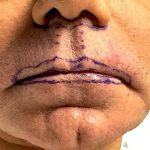
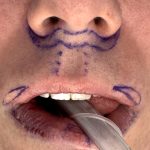
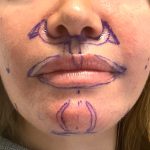
Prior to surgery, subnasal markings for the lip lift were made with a calipers and a fine marking pen. Initially the vertical philtral columns were marked from the nose to the height of the cupid’s bow and measured. (18mms in length). A wavy incision in the subnasal crease was then made from one nostril to the other across the columella in the midline. At 5mms down from the crease along the philtral lines, the lowest extent of the planned excision was marked. The lower skin lip excision line was then marked paralleling the wavy line in the subnasal crease but in a feathering fashion as it came to join the upper incision at the sides of the nostrils.

At the completion of his other facial procedures under general anesthesia, the subnasal skin segment was excised sparing the underlying orbicularis muscle. The upper lip was then lifted and closed, creating an immediate cupid’s bow enhancement effect.

His postoperative course was typical for a subnasal lip lift procedure with minimal swelling and no bruising for the first week after surgery. Sutures were removed at one week after. By three weeks after surgery (as seen here) he looked non-surgical even though the scar was very slightly red. While somewhat visible in a picture taken with a flash, it was not visible in normal room lights or at a speaking distance. Full scar maturation takes months to completely fade.

Subnasal lip lifts can be done successfully in men without creating an abnormal appearance. The key to a natural looking result is to not remove too much upper lip skin. A safe amount of skin to remove in men is either 1/4 to 1/3 of the vertical philtral length presurgical measurement. It is always better to be conservative (1/4) as men have little tolerance for even a small amount of excessive central lip show even if it will settle down 4 to 6 weeks later. While no one wants to have revisional surgery, it is always better to have to do a second stage for further improvement than to remove too much skin which is an irreversible problem. It canc be striking how much difference 1 or 2mms can make in a lip lift.

Case Highlights:

1) The thin upper lip in the male has limited enhancement options, either injectable fillers or a subnasal lip lift.

2) The subnasal lip lift enhances the prominence of the cupid’s bow and shortens the skin distance between the nose and the lip.

3) A key to a subnasal lip lift, particularly in a man, is to not remove too much skin and avoid the’ chipmunk look’.

Dr. Barry Eppley

Indianapolis, Indiana

Postoperative Instructions for Lip Lifts, Lip Advancements and Corner of Mouth Lifts

Sunday, January 27th, 2013


Surgical lip enhancements involve removing select areas of skin to increase the vermilion show of the lips or change the angle of the corner of the mouth. These are precise and measured amounts of skin removal that result in fine line scars either under the nose, along the lip edges or extending out from the corner of the mouth slightly.

The following postoperative instructions for excisional lip enhancement surgery are as follows:

1.  Lip lifts/advancements and corner of the mouth lifts have a minimal amount of postoperative discomfort. Few patients ever require pain medication and a few Tylenol or Alleve are all that most patients need for a few days after surgery.

2.  There are no dressings applied after lip and corner of mouth surgery. Only antibiotic ointment is used to keep the suture lines soft and supple, whose primary intent is to make suture removal eventually easier.

3. Be aware that your lips will get increasingly swollen over the next few days after surgery. This is normal and not a cause for concern. Lip swelling does not start to go down until three days after surgery and will take a week or two to go away completely. The use of ice packs on the lips is very useful the first day after surgery to control swelling and improve comfort. You may use them as long as you like. Corner of the mouth lifts have little to none of this after surgery issues.

4. The lips and corner of the mouth suture lines may get wet without any danger of increasing the risk of infection. So feel free to wash your face and shave (men) as needed.

5. The incision lines at the base of the nose (subnasal lip lift), lip lines (lip advancement) or corner of the mouth lift will have sutures that need to be removed in a week after surgery. (unless you are an out of town patient). Apply antibiotic ointment to them three times a day to keep them slightly moist. If any blood has accumulated on the suture lines during the first day after surgery, clean it off with a little water or hydrogen peroxide on Q-tips. There is no need, however, to use hydrogen peroxide on clean suture lines. Just apply the antibiotic ointment.

6. Your lips will feel a little tight when you open your mouth widely. That will take several weeks to a month to return to normal. You may stretch open your mouth and lips as much as feels comfortable. You may eat whatever you like.  Focus on liquids and soft foods for the first few days after surgery.

7. After sutures are removed and the incision lines healed (several weeks), massaging the lips and stretching them gently will help make them feel softer sooner and regain their normal suppleness again.

8.   You may return to any physical activity and work as soon as you would like based on your comfort level with pain and your facial appearance

9.   You may drive when you feel comfortable and can react normally and are off pain medication.

10. If any lip redness, tenderness, or drainage develops after the first week of surgery, call Dr. Eppley and have your pharmacy number ready.

Consent for Plastic Surgery: Lip Lifts, Lip Advancements and Corner of Mouth Lifts

Sunday, January 27th, 2013


Every plastic surgery procedure has numerous issues that every patient who is undergoing a procedure should know. These explanations are always on a consent form that you should read in detail before surgery. This consent form, while many perceive as strictly a legal protection for the doctor, is actually more intended to improve the understanding of the various lip enhancement procedures. The following is what Dr. Eppley discusses with his patients for these procedures. This list includes many, but not all,of the different outcomes from surgery. It should generate both a better understanding of the procedure and should answer any remaining questions that one would have.

ALTERNATIVES

Enhancements of the lips can be done by a variety of synthetic or fat injectable fillers to increase the size of the pink part of the lip. (vermilion) Whether the results achieved by injection techniques is comparable to that of tissue excision and lifting should be thoroughly understood before surgery.

GOALS

The goal of lift lifts and advancements is to shorten the distance between the base of the noses and the upper lip and increase the amount of vermilion show. A lip lift will increase the central lip pout and vermilion show. A lip advancement will increase vermilion throughout the whole lip from one mouth corner to the other. The goal of a corner of the mouth lift is to lift up the sagging mouth corners and create a more horizontal smile or lip line.

LIMITATIONS

There are limits as to how much the lip can be lifted or advanced and how much the corners of the mouth can be changed. The limits to these changes are based on trying to keep the lips looking natural and not overdone and to not making excessive visible scarring.

EXPECTED OUTCOME

Expected outcomes include the following: temporary bruising and swelling around the lips and the corner of the mouth, temporary lip numbness, permanent scars at the junction of vermilion-skin junction (lip lifts and advancements) and away from the corner of the mouth. (corner of mouth lift) All excisional lip procedures may create some temporary stiffness on movement and mouth opening. Healing of the scars and settling any scar irregularities is a process that takes months (6 to 12) to see the final result in many cases.

RISKS

Significant complications from lip surgery are very rare but could include infection. More likely complications could include aesthetic deformities such as asymmetry and irregularities of the vermilion-skin junction (lip lines) asymmetry of lip (vermilion)sizes or mouth corners, suture reactions along the incision lines, and under vs. overcorrection of the desired lip sizes or corner of the mouth changes. Any of these risks may require revisional surgery for improvement.

ADDITIONAL SURGERY     

Should additional surgery be required to adjust the  shape of the lips or corner of the mouth, this will generate additional costs.

Durability of Excisional Lip Lifts

Thursday, November 1st, 2012

Excisional methods of lip rejuvenation, known as lip lifts, are an historic treatment. While pushed aside with the introduction and widespread adoption of injectable fillers, they are making a comeback with the realization that fillers can not solve all insufficient or aging lip problems. They are beginning to reappear in publications and at meetings as a viable method for making lips bigger by increasing vermilion show and decreasing the vertical lip distance between the base of the nose and the upper lip.

Like any form of lifting, a good question is how long does it last? This is most relevant to the true upper lip lift known as the subnasal or bullhorn upper lip lift because it pulls the lip upward. The vermilion advancement also known as the gull wing lip lift involves less pull to create its effect although its sustained results are still relevant.

In the September 2011 issue of the Archives of Facial Plastic Surgery, a study was published in the long-term analysis of surgical correction of the senile upper lip. This was a retrospective review of 30 patients who had either a lip lift or a lip advancement performed for an aging upper lip. (15 lifts, 15 advancements) Digital imaging analysis was used to standardize each patient’s before and after results. The mean follow-up of the patients was just over four years. The revision rate was 7% with all revisions occurring in the vermilion advancement patients and none in the subnasal lip lift patients. Interestingly, all revision occurred in patients who were smokers. Besides significant improvement in lip appearance in all patients, both types of lip lifts showed sustained results out to the duration of the study.

Unlike synthetic injectable fillers and even fat, permanent lip augmentation is elusive. Lip lift and advancements are well known to offer significant improvement and this study supports the observation that those results are sustained and thus permanent. I do find it interesting that the study did not show a difference between subnasal lip lifts vs vermilion advancements as lip lifts have historically been known to have some degree of ‘relapse’ and secondary relaxation lengthening of the result. Based on this study and the technique used (no muscle manipulation or suturing) there is no need to overcorrect a lip lift since significant loss of the result is not seen.

Despite the durability of lip lifts, they still play a minor role in lip rejuvenation. Because of the scar burden that they create and the volumetric benefits of fillers, lip lifts are reserved as a salvage procedure for failed lip rejuvenation attempts by other methods. Even in a patient who has a very thin lip regardless of age and seems like a good candidate for a lip lift, I want them to try fillers first to prove that surgical modification of the lip is desired.

Dr. Barry Eppley

Indianapolis, Indiana

The Role Of Excisional Lifts in Lip Enhancement

Wednesday, October 31st, 2012


The lips, like the eyes and the nose, are central facial features that are also quite visible in facial expressions. Their size and shape determine their degree of attractiveness and contemporary pleasing lips are known to be full and have a well defined cupid’s bow. As the lips age numerous changes can take place including thinning of the vermilion, flattening of the cupid’s bow and vertical wrinkles of the upper lip. Naturally thin lips have no wrinkles but also lack vermilion height and have a flatter cupid’s bow.

Lip lift surgery has been around for decades but never achieved widespread clinical use due to scar concerns. With the introduction and widespread use of injectable fillers, lip lifts have almost been forgotten and seem like an ancient and out-of-date lip enhancing technique. While even though it is a method that will never replace injectable fillers, lip lifting techniques still have a very useful role in the properly selected patient. I would even argue that because of injectable fillers, lip lifts have been revived and are indicated that they ever were before. This is for the simple reason that injectable fillers can not solve all aesthetic lip problems.

Lift lift surgery involves two distinctly different techniques, the subnasal lip lift and the vermilion lip advancement. Both procedures lift the lips but change the upper lip differently and are thus used for different reasons.

The subnasal lip lift involves a wavy form excision of skin under the nose. Because of the shape of the skin excision it is often called the bullhorn lip lift. It’s primary use is to reduce the vertical height of the skin between the nose and the lip and I consider it a ‘white show’ reduction procedure. It will create more of an upper central lip pout and may even result in slightly more upper tooth show. But the sides of the lip beyond the philtral edges will not change. It is best used in those patients interested in a lip lift and want to keep the scar well concealed or even invisible. It is also the only lip lift that most men will find acceptable.

Complications from subnasal lip lifts can occur from too much skin excision (never greater than one-third of the philtral length), cutting into or suturing the orbicularis muscle, or violation of the natural nose-lip base shape with the line of the scar.

 The vermilion advancement involves an excision of skin just above the upper lip vermilion. The pattern of the skin excision because of the height of the cupid’s bow creates a pattern that has earned it the name of a gullwing lip lift. It’s primary use is to move the whole horizontal length of the lip upward, increasing the vertical vermilion height, which makes the entire lip look bigger. In the older patient, any wrinkles that are in the excisional pattern are removed. The shape of the cupid’s bow can also be accentuated. The vermilion advancement is the most powerful lip enhancement procedure known because of these predictable and very controllable changes. It is ideal in older women with very thin lips in which injectable fillers perform poorly. It is also useful in younger women who either do not get good results from fillers or want a more permanent solution.

Complications from vermilion advancements can occur from improper skin excisional patterns where the height of the cupid’s bow is too accentuated or exacting detail is not done in its execution, resulting  in visible vermilion irregularities.

Dr. Barry Eppley

Indianapolis, Indiana

Plastic Surgery’s Did You Know? Lip Lifting

Friday, July 6th, 2012


Lip augmentation is a very familiar and popular procedure. By injecting a variety of substances into the lips, they become bigger and more sensual. But not all lipissues can be adequately treated by injectable fillers alone, particularly older lips. Lips as they age often get longer, thinner and turn down at their corners. Adding volume rarely is the best solution. Facelift surgery does little to benefit the mouth area. But unlike the face, the lips can also be lifted. A lip lift can shorten the upper lip and give it more pout through an incision under the nose. The downturned corners can be reversed by a corner of the mouth lift. Volume through injectable fillers can also be done at the same time for additional rejuvenation. This look is consistent with what is portrayed in the sensous lips of models who have a short upper with a pout and a turned-up mouth. Such changes in the older lip can not be done with injections alone.

Case Study: Combining Rhinoplasty and Subnasal Lip Lift

Wednesday, June 29th, 2011

Background:Rhinoplasty is a structure-changing operation that draws considerable attention to the patient’s midface. Most rhinoplasties today are done through an open approach which requires a small horizontal incision in the middle of the columella. This scar heals very well due to the superb blood supply surrounding the columella with inflow from the septal mucosa and the skin at the base of the nose and upper lip.

A subnasal lip lift is a skin-reducing procedure that shortens the upper lip and creates more of a central lip pout. This is done by removing skin in an irregular wavy pattern under the nose so that the final scar is at the groove of the union of the base of the nose and the upper lip. The incision runs from one side of the nostril, across the base of the columella, to the side of the opposite nostril. When well placed and executed, this scar also heals well and inconspicuously.

When doing a rhinoplasty, patients will often focus on other potential facial changes as well. This is the result of surgical opportunity and convenience. It is not infrequent that lip augmentation is one of those combined procedures. Adding volume to the upper lip or even doing a lip (vermilion) advancement can easily and safely be done at the time of a rhinoplasty. Considering a subnasal lip lift with a rhinoplasty, however, places two incisions very close to each other and the blood supply to the skin between the two incisions must be considered.

Case Study:A 26 year-old female wanted reshaping done to her nose as well as a lip enhancement procedure. She was bothered by her thin upper lip. She had previously had injectable fillers but was unhappy with the lip look that it created. She wanted the lip lift by shortening the upper lip skin. She did not want, however, a scar along the skin and vermilion junction (vermilion advancement) and felt a lip lift (bullhorn lip lift) was a better procedure.

While she ideally and understandably wanted a rhinoplasty and subnasal lip lift done together, the risks of skin necrosis between the two incisions was not worth the risk in my opinion. Her open rhinoplasty was then done alone with an uncomplicated and successful outcome.

Four months later, a subnasal lip lift was performed in the office under local anesthesia. At its central portion, 6mms of vertical skin length was removed from the base of the nose and the central lip lifted. After three months, the scar was virtually undetectable and there was minimal relapse of any of the central lip pout.

While a rhinoplasty and subnasal lip lift can be performed at the same time…doesn’t mean it should. I suspect that the skin between the two incisions would not be affected in most patients. However should there be a skin necrosis problem, it is a difficult area to reconstruct well. Given that it is a procedure that can be performed in the office, a delay between the two procedures is the safest approach.

Case Highlights:

1) Rhinoplasty and lip lifts are midfacial procedures that are close in proximity and have incisions that are separated only by millimeters.

2) Because of the surgical opportunity provided by a rhinoplasty, it is very tempting and desired by the patient to perform both during the same procedure. The risk of skin necrosis between the two incisions should make one very cautious to do so.

3) To prevent any incision healing problems, an open rhinoplasty should be performed first. This can then be followed by a subnasal lip lift three or six months later.

Dr. Barry Eppley

Indianapolis, Indiana

Case Study: The Subnasal (Bullhorn) Lip Lift in Men

Friday, December 24th, 2010

Background:  Aesthetic concerns of the lips are largely a gender specific issue. By far, most cosmetic lip procedures are done in women. Men represent a very small percent (1 to 2%) of those patients who undergo lip modifications, whether it is injectable fillers or excisional lip modifications.

The long upper lip is often viewed as an undesireable aesthetic feature. Some people have it naturally, others develop it with aging as the upper lip lengthens. In those that developed it with aging they most likely had a pre-existing marginally long upper lip. When the distance between the base of the nose and the bottom of the upper lip is excessively long, the upper teeth are hidden. Lack of upper tooth show, at lip rest or in smiling, conveys an aging appearance suggestive of edentulism which is common in the elderly. The long upper lip not only changes the ideal aesthetic facial height ratios and proportions but can subtly creates a more ‘animal-like’ mouth appearance. Many animals have very long upper lips for eating purposes which are not needed in humans.

Case Study: This 48 year-old male presented for upper lip shortening. He was bothered by his lack of tooth show even in smiling. He was not really concerned about the size of his upper lip (vermilion show) or its shape. His vertical measurement from the base of his columella down to the height of the cupid’s bow along the philtral column was 22mms.

His subnasal lip markings were of the typical ‘bullhorn’ pattern. The vertical excision distance was 7mms as measured along the philtral column. Under local anesthesia in the office, a full-thickness skin segment was removed. The underlying orbicularis muscle was not excised or disturbed. The central upper lip was then lifted and closed in multiple layers with small dissolveable sutures and topical glue used for the skin.

His postoperative recovery was minimal. There were no restrictions after surgery such as eating or oral hygiene. No wound care was required due to the glue dressing. No suture removal was necessary.

The  biggest trade-off of this simple lip excisional lift is that of a fine line scar at the base of his nose. It is initially red but fades within a few months. It remains well hidden in this nasal base-lip skin crease. One can expect some relaxation of the subnasal lip lift results usually up to 1/3 of the amount of vertical lip skin removed. (1 to 2 mms) For this reason, an extra 1 to 1.5mm of lip skin should be initially removed accounting for this eventual vertical relaxation. It is also important to realize that this type of lip lift only affects the central part of the upper lip and not the sides.

Case Highlights:

1)      The long upper lip can be an aesthetic problem for men as well as women. Men are more concerned about the complete masking of the maxillary teeth, both at rest and in smile.


2)      The subnasal lip lift design is the typical ‘bullhorn’ pattern. This is the same in men as in women. No greater than 1/3 of upper lip length should be removed.


3)      The subnasal lip lift can be done in the office under local anesthesia. Men should refrain from shaving their upper lip for one week after surgery.


Dr. Barry Eppley

Indianapolis, Indiana

A Modified Subnasal Lip Lift for Columellar Retraction

Wednesday, December 1st, 2010

A long upper lip can be a sign of aging around the mouth. The distance between the base of the nose, known as the columella, and the pink part (vermilion) of the upper lip appears exaggerated. While there is no exact measurement to mathematically quantitate a long upper lip, the distance between the columella and thetop of the upper lip should be no more than one-third of the total lower facial height. (columella to lower chin point) When it exceeds that proportionate relationship, the upper lip will look too long.

In addition to the long upper lip, the base of the columella may be retracted or inwardly located in some patients. This may be particularly found in older patients who are edentulous or have a naturally more flat midfacial profile or have weak underlying paranasal bone support. When the columella is retracted, an optimal aesthetic improvement with the subnasal lip lift may not be realized even when the long upper lip is shortened.

While different types of grafts, synthetic and natural, may be used at the maxillary spine area to push out the base of the columella, they are not without their problems. Infection, extrusion and the need for a donor site are all potential issues. But most importantly it takes a fair amount of any graft type to provide a visible change in the nasolabial angle. The progressive vertical lip lengthening that accompanies aging provides a more direct, simpler, and less risky source of columellar graft material.

In the subnasal lip lift procedure, the flaps along the base of the nose are marked outbased on the amount of vertical upper lip shortening that is desired. Instead of just cutting this skin out, the marked skin area is initially de-epithelized leaving the underlying dermis. This dermis is then used to create a rolled union of flaps to build out the columellar base. Once tucked into the base of the columella, the upper lip is elevated and closed to the base of the nose. This not only shortens the upper lip but fixes a retracted columella as well.

The normally discarded tissue from a subnasal lip lift for a long upper lip can be used as bulk to open up the nasolabial angle and retracted columella. The centrally based transverse flaps from the lip and nostril base can be transposed from its horizontal orientation, after removal of its outer epithelium, into vertical flaps and placed into a subcutaneous pocket in the columella. By adding more volume into the columella, the base of the columella is brought forward (retraction correction) and the nasolabial angle opened up. Closure of the lip lift then shortens the upper lip and enhances the pout of the cupid’s bow area of the upper lip below.

Dr. Barry Eppley

Indianapolis, Indiana


Dr. Barry EppleyDr. Barry Eppley

Dr. Barry Eppley is an extensively trained plastic and cosmetic surgeon with more than 20 years of surgical experience. He is both a licensed physician and dentist as well as double board-certified in both Plastic and Reconstructive Surgery and Oral and Maxillofacial Surgery. This training allows him to perform the most complex surgical procedures from cosmetic changes to the face and body to craniofacial surgery. Dr. Eppley has made extensive contributions to plastic surgery starting with the development of several advanced surgical techniques. He is a revered author, lecturer and educator in the field of plastic and cosmetic surgery.

Read More


Free Plastic Surgery Consultation

*required fields


Pricing

The cost of any type of elective plastic surgery plays a major role in the decision to undergo the procedure(s).

Get Your Quote Here


My Plastic Surgery Story

Military Discount

We offer discounts on plastic surgery to our United States Armed Forces.

Find Out Your Benefits


Categories