EXPLORE
Plastic Surgery
Dr. Barry Eppley

Explore the worlds of cosmetic
and plastic surgery with Indianapolis
Double Board-Certified Plastic
Surgeon Dr. Barry Eppley

Archive for the ‘lip implants’ Category

Case Study: Male Lip Implant Augmentation

Saturday, December 8th, 2012

Background: Lip augmentation is a popular procedure that is most commonly done with the use of injectable fillers. Any of the family of hyaluronic-acid based fillers offers an immediate improvement in which the material can be placed in a variety of lip locations to create both increased size and/or enhancement of various lip features. Its only downside is that it is temporary and must be repeated for the effects to be maintained.

The overwhelming number of lip augmentations is done in women with only an occasional man ever having the procedure. The reasons for this is the obvious preference for fuller and larger lips in women from a fashion and beauty perspective. While fuller lips in men can also be attractive, it is not a primary facial feature that necessarily makes for a strong masculine appearance. The other reasons lip augmentations are done a lot less in men is that they, in general, are less tolerant of the injectable experience.

Lip implants offer a permanent option for lip augmentation. Over the years, a variety of implant types have been available for subcutaneous tissue implantation, all of which have been different forms of polytetrafluorethylene materials. All of these materials have been withdrawn from the market with mixed clinical results. Permalip (Surgisil, Plano, Texas) is a relatively new implant designed for the lips made of a very soft (low durometer) formed silicone material. Because of its very smooth surface and tapered design, it is easily reversible should that be desired in the future.

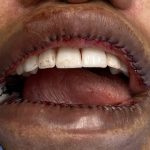
Case Study: This 45 year-old male was undergoing a variety of procedures for facial enhancement and was interested in doing a permanent lip augmentation at the same time. Options discussed included fat injections, a lip lift, an internal mucosal advancement and silicone lip implants. He wanted the simplest but the most reliable method that would ensure a sustained augmentation effect.

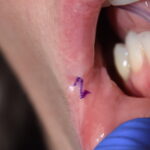
At the completion of his other facial procedures, both the upper and lower lips were infiltrated with a lidocaine solution that contained epinephrine. Small 5mms incision were inside the corners of both sides of the mouth in the mucosa and scissors used to make an intramuscular tunnel to the midline in both the upper and lower lips. A fine curved grasping instrument was then passed from one side of the lip to the other through the incisions and a 5mm implant was placed in the upper lip and a 3mm implant in the lower lip. Both implants were 65mms long. The incisions were closed with small dissolveable sutures.

After surgery he did develop the typical significant lip swelling that is typical from implant passage through the lips. Some bruising occurred on the left upper lip but in other lip quadrants. His lip achieved their final size at 3 weeks after surgery which remained unchanged three months later.

Case Highlights:

1)      Lip augmentation in men is uncommon and they are less likely to choose temporary injectable fillers.

2)      Silicone implants (PermaLip) offers a permanent option for lip augmentation when one has tried and/or does not prefer injectable fillers.

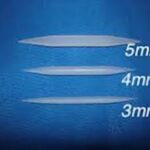
3)      Silicone implants slide easily into place through small incisions at the corners of the mouth and are available in sizes of 3, 4 and 5mms diameters with lengths from 55mm to 65mms. Men will almost always need the longest lengths.

Dr. Barry Eppley

Indianapolis, Indiana

PermaLip Implants For Permanent Lip Augmentation

Friday, May 18th, 2012

Lip augmentation is one of the most popular minimally-invasive cosmetic procedures of the face. Done almost exclusively with injectable fillers, it produces instantaneous augmentation of the vermilion-cutaneous junction or the lip body proper. Of last year’s nearly 2 million injectable filler treatments performed in the U.S., a significant percent of them was for lip enhancement.

 While there is a wide variety of injectable filler options, those fillers that are comprised of hyaluronic acid compositions work best in the supple and sensitive lip tissues. The immediate and usually satisfying results of injectable lip augmentation  is why its drawbacks are tolerated. Lip injections have to be repeated for maintenance at a frequency based on the absorption of the material. With most hyaluron-based fillers, that can be expected to be anywhere from 3 to 9 months. In addition, there is some level of discomfort with injections which makes each treatment session a tolerated but not a pleasant experience.

The alternative to lip augmentation by temporary-lasting injections is through the use of synthetic implants. There has been a history of a variety of synthetic materials used as lip implants since the mid-1990s, most of which have gone out of favor. The most common material has been that of PTFE or Gore-Tex. Initially used as a multi-strand implant, it developed an unacceptable level of complications such as stiffness, bunching, nodules and lip distortion with movements. Another PTFE material, known as Advanta which is a dual-porosity soft tube, had better clinical results but is now no longer commercially available. I had used it for over a decade and had very good clinical results with it with few negative experiences.

The newest synthetic lip implant is that of PermaLip. (SurgiSil, Plano Texas) Composed of a very soft silicone elastomer materal that is shaped like a tube with tapered ends, it offers a very supple and flexible implant that feels quite natural. It is a smooth non-porous implant that can never rupture or deflate. It is available in thicknesses up to 5mms and lengths of 6.5cm. The typical distance from one mouth corner to the other is usually around 7 cms or less.

The surgical technique to place the PermaLip implant can be done in the office under local anesthesia. Through small incisions placed just inside the mouth corners, the implant is slide into place using a small instrument. One of the biggest problems to overcome in the placing of lip implants is even placement at the right level in the lip from one side to the other. The technique for placing PermaLip implants largely overcomes the problem of lip asymmetry. One will experience some lip swelling for a week or so and occasionally some lip bruising may occur.

The physical features of this lip implant is what is most appealing to me. Its smooth surface means that it easily be reversed should one so desire. That has been the biggest problem with synthetic lip implants in the past, they were difficult to remove.

The success of any lip implant is both material and technique-based. It is important to place the implant in an intramuscular position and not immediately subcutaneous or submucosal. It is also important to not stress the lip tissues by placing too big of an implant. While PermaLip has sizes up to 5mms, a small (3mm) or medium (4mm) size is best for most patients. The implant volume/tissue ratio is important. A moderate lip size increase that has long-term success is better than a large lip size result that develops complications.

Dr. Barry Eppley

Indianapolis, Indiana   

Common Questions about Lip Augmentation and Lip Lifts

Tuesday, January 19th, 2010

1.      What is the difference between lip enhancement and lip augmentation?


Most people, including plastic surgeons, often use these lip terms interchangeably. While one could argue no matter what you call it, the idea is to make the lip look better… which usually means fuller. However, there are some subtle differences between lip augmentation and enhancement. Lip augmentation adds or restores fullness to the lips. This can be done with either temporary injectable fillers or permanent materials. Enhancement procedures do not really add fullness, although they do make the lip look bigger. These are  skin removal procedures that change the position and shape of the vermilion, thus enhancing the appearance of the lip.


2.      What is the best injectable filler for lip augmentation?

 
There are nearly a dozen injectable filler materials but not all are appropriate for the lips. The lips are unique in that they are not covered with skin but a thinner and more sensitive tissue. (vermilion) In addition, the lips must remain very flexible and soft. For this reason, the best injectable filler for the lips is either collagen-based or composed of hyaluronic acid derivatives. (e.g., Restylane, Juvaderm) Fillers that contain particles, resorbable or permanent, are more likely to cause reactivity and delayed reaction problems.


3.      Are there any permanent options for making my lips bigger?


The desire for a permanent lip ‘filler’ is a common one and there are some options. There is no easy injectable method, however, for lip augmentation that is absolutely permanent. None off-the-shelf injectables are permanent. At best, some may last as long as nine to twelve months.


Fat is often injected into the lips because it is your own tissue and particularly if one is in the operating room for other procedures anyway. The downside to fat injections into the lips is that its survival is unpredictable. I have seen some patients in my Indianapolis plastic surgery practice who have done really well with it while many others have gone on to near complete resorption. It’s worth a try if you are already in the operating room but any long-term retention should be thought of as a bonus, not an absolute. It is not a procedure that can be done in the office.


Implants have been tried over the years in the lips as a permanent filler, of which Gore-Tex (polytetrafluoroethylene) is the most commonly used. Different variations and designs of this material have been used over the years. The best one that I have used is Advanta, which is a very soft and spongy tube of various diameters. When well placed deep in the lip, it can be a very reliable and effective method for permanent lip enlargement.


4.      I have very thin lips that have no shape. I have tried injectable fillers but they didn’t work. Is there anything I can do?


Injectable fillers work when there is sufficient vermilion or lip tissue to expand. In very thin lips, fillers can often make for an unnatural ‘duckbill’ look because there is not enough vermilion to expand out naturally. Unless the filler is done in small amounts, the lips can assume an unusual bloated appearance.


One option for very thin lips is to treat the underlying problem, not enough vermilion exposure. This can be done through two types of skin excisional or removal procedures. The vermilion advancement is done by removing a strip of skin directly along and above the lip line and moving the vermilion upward (upper lip) or downward. (lower lip) For the upper lip, the cut out of skin can be done so that the cupid’s bow is more accentuated with a more defined shape. The vermilion advancement has the advantages of being able to affect the entire lip, from corner to corner, and being truly permanent. Its disadvantage is that it creates a fine line scar at the junction of the lip and skin.


The other vermilion changing procedure is the lip lift, also known as the ‘bullhorn’ lip procedure.In an effort to avoid a lip scar, the skin removal is done right under the nose placing the scar in the hidden crease between the lip and the nose. By removing skin in this area, the vermilion of the lip below is pulled up increasing its pout. The disadvantages of the lip lift is that it affects only the central part of the lip and it will lose some percent of the created lip fullness after surgery. (due to gravity)


5.      Can lip procedures be done in the office?


Any type of lip procedure, injection, implant, or surgery, can easily be done in the office. The lips can very effectively be numbed by the injection of local anesthetics, just like in the dental office. For patients who are anxious about those type of injections, oral sedation medications can be provided which will definitely alleviate any apprehension that one may have. If you take sedation, you will need someone to drive you home.


Injection procedures take about 15 minutes to perform. The placement of lip implants takes about 30 minutes. Lip lifts or lip advancements will take about 60 to 90 minutes to perform.


6.      Is there much pain and swelling after lip augmentation procedures?

Depending upon the technique used, the amount of swelling and discomfort afterwards changes. Injectable fillers result in no pain and very little swelling after. Lip implants cause considerable swelling for a week or so and have some mild discomfort from fullness and stiffness. Lip lifts and advancements cause much less swelling than implants and virtually no pain.

Recovery from lip procedures is essentially ‘social’, meaning how you look. There are no restrictions of any activities including eating and drinking.

Dr. Barry Eppley

Indianapolis, Indiana


Advanta (ePTFE) Implants for Lip Augmentation

Tuesday, August 18th, 2009

Fuller lips continue to be a desired cosmetic enhancement. Most commonly, the upper lip is augmented in an effort to increase its naturally smaller proportion to that of the lower lip. Injectable fillers continue to be the most common method of lip augmentation due to immediate result and lack of recovery.


Lip augmentation with injectable fillers, however, is not a permanent solution. Repeat treatments must be done to maintain the results. The frequency of repetitive injections will depend on the duration of the injectable filler used. At best, however, the longest lip filler will last in the range of 9 to 12 months. Many are of much shorter duration.


As an alternative, there is a permanent lip augmentation material. Because it is an implant, it is not injectable and must be surgically placed. This material, known as Advanta, is a modification of what most people know as Gore-Tex which is essentially a form of Teflon. Known as expanded polytetrafluoroethylene (ePTFE), this material is very soft, flexible, and compressible, much like a marshmellow. It does allow some tissue growth through its dual porosity composition but its most important characteristic to patients is its soft feel.


Advanta is easy to place as it comes preloaded on a trocar (big needle) and is available in a wide range of sizes from very small (2.5mms) to quite large  (8mms) in both circular and oval cross-sectional shapes.


They can easily be placed in the office under local anesthesia with infraorbital enrve blocks followed by direct lip infiltration. Going through a  small incision in the mouth corners, the trocar is carefully thread from one side of the mouth to the other. The biggest problem is to be sure that the implant is placed at the same tissue depth on both sides of the lip lest there be some asymmetry. I have found the best way to avoid this problem is to use a split-implant technique. By using a third central incision in the central vermilion of the upper lip, the implant can be thread half-way, cut, and then thread through the other side. This is also a good way to avoid the potential for a tight upper lip when one piece implant is used across the entire lip.


In my Indianapolis plastic surgery practice, I have used Advanta lip implants for years without an infection or extruding problems. I have seen occasional differing implant depths in the lip which is reflective of a placement technique issue. I have not seen that with a split-implant method.


Advanta lip implants is a very good material that works well in the lips as well as other facial areas. However, I do not employ it as a primary lip augmentation procedure. Patients must have a previous history of successful injectable filler treatments and be motivated to have a permanent implant in their lip. While that thought may seem disturbing to some, I have yet to have to remove a lip implant yet. While I am sure there will eventually be one that has to be removed, it is fair to say that the track history of Advanta in the lip is quite good provided the implant is not oversized and the placement technique is good.


Dr. Barry Eppley

Indianapolis, Indiana

Lip Enhancement Options

Sunday, February 3rd, 2008

Improving the size and shape of the lips is a frequent cosmetic request and a very commonly performed aesthetic procedure done in the office. While the vast majority of lip enhancements are done by injectable fillers, and most patients are only aware of this approach, there are other less common but equally effective options.

Injectable fillers are the most common lip enhancement method and the hyalurons such as Restylane and Juvaderm are usually used. The longevity of hyaluron fillers, while touted differently amongst manufacturers, is in the range of 4 to 6 months. While longer-lasting injectable fillers exist, such as Radiesse and Aretfill, these contain particles which may be prone to lumpiness and foreign-body reactions. Because of their predictability and safety, with very few complications, hyaluron lip enhancement is the current gold standard.

There other other types of non-injectable lip fillers. Over the years, many collagen-based implants have been tried, such as Alloderm and Fascian. Unfortunately, while conceptually appealing, their longevity has not been shown to be any greater than the hyaluron fillers. But they are more expensive and cause much more lip trauma to place. As a result, they have fallen into disuse.

Despite the frequent touting of your own fat as an injectable filler, and reports of great longevity and possible permanency, most plastic surgeons have not had that experience. Fat in the lip is simply unpredictable. I will still use it…..when I am performing other procedures in the operating room where the use of fat is ‘easier’ than in the office and there is little to lose by doing so. I suspect that repeat fat injections over time do consistently work but that is fairly traumatic for a patient to go through.

Permanent lip augmentation can be done by synthetic implants known as Permalip. These very soft silicone implants are threaded into the lips, corner to corner, by a metal trocar under local anesthesia. They are non-resorbable, fairly soft, and the volume added is permanent. They can definitely be felt in the lips but I have not had a patient yet who has reported that as a problem. I use Permalip when the patient is ‘qualified’, meaning they have tried injectable fillers first and want to move on to something permanent.

More surgical lip enhancement is known as vermilion advancements or subnasal lip lifts. While these are highly effective are making the lip bigger, they have a trade-off of permanent scars. A patient must be very willing to make this trade-off and accepting of fine-line scars. I use these in patients that have very thin lips and a very flat cupid’s bow and have ‘failed’ lip enhancement by fillers. (meaning it does not look good or do what the patient expected. Lip lifts are often most effective in the older patient whose lips (which were not big to start with) have shrunken with age.

As you can see, lip enhancement has lots of options. All work well at achieving larger lips….but not every enhancement procedure is for every patient.

Dr Barry Eppley

Indianapolis, Indiana


Dr. Barry EppleyDr. Barry Eppley

Dr. Barry Eppley is an extensively trained plastic and cosmetic surgeon with more than 20 years of surgical experience. He is both a licensed physician and dentist as well as double board-certified in both Plastic and Reconstructive Surgery and Oral and Maxillofacial Surgery. This training allows him to perform the most complex surgical procedures from cosmetic changes to the face and body to craniofacial surgery. Dr. Eppley has made extensive contributions to plastic surgery starting with the development of several advanced surgical techniques. He is a revered author, lecturer and educator in the field of plastic and cosmetic surgery.

Read More


Free Plastic Surgery Consultation

*required fields


Pricing

The cost of any type of elective plastic surgery plays a major role in the decision to undergo the procedure(s).

Get Your Quote Here


My Plastic Surgery Story

Military Discount

We offer discounts on plastic surgery to our United States Armed Forces.

Find Out Your Benefits


Categories