EXPLORE
Plastic Surgery
Dr. Barry Eppley

Explore the worlds of cosmetic
and plastic surgery with Indianapolis
Double Board-Certified Plastic
Surgeon Dr. Barry Eppley

Archive for the ‘facial reshaping’ Category

The Uniqueness of Male Plastic Surgery – Facial Procedures

Saturday, June 15th, 2013


The facial aging process is one that is well known as everyone will eventually see it on their face. The eyes get heavy, the brows descend, the cheek fall, jowls develop and the neck sags. Women become concerned earlier in the aging process and proceed to do procedures to treat or slow it down in an overall more comprehensive manner. Men take a much more delayed approach to it often waiting until one facial area becomes a major concern or until the facial aging process is fairly advanced.

While the face ages largely similar in both men and women, the facial procedures used to treat them are often done differently. Not as many men have facelifts as their aging neck and jowls are more tolerated. But in men that have facelifts they must be done very carefully, respecting the natural hairlines of the temples and behind the ears and being careful not to displace the beard skin into the ear canal. Incisions must be placed very inconspicously and often less of a tightening result must be accepted to keep the scars hidden. That is not a bad thing as men look better underdone than having their faces pulled too tight anyway.

While men also develop heavy upper eyelid skin and lower eyelid bags just like women, their eyelid lifts (blepharoplasties) need to be done more conservatively. Browlift options in men are more limited due to the frequent lack of adequate scalp hair and a well defined frontal hairline. The most common male browlift method is through the upper eyelid (transpalpebral browlift) using the endotine device to accomplish the lift. This produces a very modest browlift but creates no visible scars and with more conservative eyelid skin and fat removals can avoid overfeminizing the male face and creating an unnatural overdone look.

Men do not engage in as many Botox and injectable fillers treatments as women as some wrinkles and signs of aging are more tolerated. A more natural result for men is one that reduces the worst of the wrinkles but does not eliminate all of them. This is the same reason men, at best, will only do a bare minimum of facial skin care. Many men would rather seek more definitive surgical procedures, or do nothing at all, that engage in non-surgical procedures that require frequent efforts to maintain.

Facial reshaping surgery is vastly different in men than women. Male rhinoplasties must keep a high and straight dorsal line and avoid an overly upturned tip while most women desire a smaller less projecting tip and lower dorsal lines. The shape of the face in men is dominated by a strong jaw and requests for chin, jaw angle and even total jawline enhancements are not uncommon to pursue a more masculine appearance and even the so called ‘male model’ look. Men favor higher more angular cheek augmentations while women prefer a lower more anterior rounded cheek prominence. Men pursue brow bone surgery for either reduction of an overlying prominent one or for augmentation to create a more masculine brow prominence and a more backward sloping forehead profile.

Plastic surgery for men has its own unique requirements both in the type of surgeries and the demeanor of the patients. One should not assume that every plastic surgeon or plastic surgery practice is equally adept about meeting the needs of the male patient. Just like breast reconstruction for women or body contouring after massive weight loss, the male patient presents unique challenges for a satisfying surgical outcome.

Dr. Barry Eppley

Indianapolis, Indiana

Surgical Options for the Chubby Face (Fat Face)

Monday, February 15th, 2010

It is not uncommon to hear a patient’s concern about their chubby or ‘fat face’. For some of these patients their face matches their body habitus and some significant weight loss will do wonders for those concerns. But there are people who do have a chubby face that are not necessarily significantly overweight and they may seek a plastic surgery consult to see what their options are.

 The chubby face differs from other facial types in that the entire face appears full. From the cheeks down to the neck, the face assumes a definite round shape. Patients with a chubby face will often complain that the shape of their face makes them appear heavier than their body really is.

There are numerous non-surgical facial fat reduction methods that are marketed and sold. I can not comment on whether these work or are effective as they are not used in my Indianapolis plastic surgery practice. But should you try them and find them unsatisfactory, you can consider the following surgical options.

Almost all chubby face patients have thicker and elastic skin. This is a double-edged anatomic consideration. Such skin has the ability to shrink and contract (snapback if you will) which is good for getting better contours, particularly in the neck. Conversely, thick skin is also heavy and is prone to prolonged swelling.

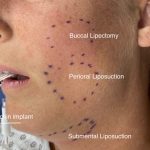
The strategy for the chubby face is not one of overall fat reduction through liposuction. This is not possible in the face contrary to the perception of many. Select or spot fat reduction must be done instead. This would include submental and neck liposuction and buccal (cheek) lipectomies. These are very consistent procedures that are effective but patients should not expect them alone to produce a dramatic facial change. Fat pockets around the eyes and excessive skin can also be helpful if they exist but these are complementary procedures, not a primary modification maneuver.

There are no other fat areas of the face that can be effectively reduced. While significant changes can be made, for example, through a superficial parotidectomy and submandibular gland removals, these are extreme procedures which are not justifiable for cosmetic changes. Attention must be turned to bringing out facial prominences to aesthetically work in the opposite direction.

The cheeks, chin and nose must be carefully look at to see if their accentuation would be beneficial. The chin is the easiest one to assess as a weak chin is readily seen. Chin augmentation, even if it is only a minor amount, can complement the contour pullback from the neck liposuction. Cheek augmentation is more difficult to determine its potential benefits as it is not a profile structure. Unlike the chin, cheek augmentation in some patients may actually make their face look fuller or heavier. A cheek implant to help make a face look thinner must be placed high on the cheekbone and not be overdone in amount and location of projection. Too much anterior or too much lateral projection creates undesired midfacial fullness.

A rhinoplasty with dorsal augmentation and tip narrowing can help make the face look thinner by an optical illusion effect. Thinning of the nose is the one procedure that affects the central face whose appearance is not based on how much fat is present. Patients with chubby faces rarely have a narrow nose or a nose with a high dorsum. Usually they have a broader dorsum with a wider tip to their noses.

To change the appearance of the chubby face, multiple soft and hard tissues procedures are needed. These can include neck and cheek fat removal, blepharoplasty, and facial bone prominence highlighting. Piecing together these procedures into an effective facial surgery plan is as much an art form as any definitive science.   

Dr. Barry Eppley

Indianapolis, Indiana

The Myth of Facial Liposuction

Saturday, November 28th, 2009

Liposuction is a very effective method of fat removal. While it can be used in almost any location of the body where there is fat, it does have limitations. And when applied to certain fat areas, it may even have the opposite effect of an undesired result.

The face is one such area where the concept of liposuction is largely more theoretical than practical. While the face does have fat below the skin, it is not easily removed like that in the trunk or extremities. Facial fat is more fibrous and has branches of the facial nerve lying deep to it. There are few very discrete collections which can easily be removed with the exception of the buccal fat pad and some of its numerous extensions.

Plastic surgeons frequently advertise and perform neck liposuction. And while the neck is part of the face, most patients do not think of the neck when they envision the concept of facial liposuction.

When you combine what is contained in the buccal space with the subcutaneous tissues in the neck, these are the only two facial areas where contouring can be done through fat removal. The neck can be liposuctioned while the buccal fat pad can be directly extracted through a small open incision. Removal of any other facial fat areas through liposuction  is not only ineffective but can cause a lot of tissue trauma and prolonged swelling.

When liposuction first became widely used in the 1980s and 90s, facial liposuction was both advocated and written about. It was used to try and reduce facial fullness in the lateral face and even reduce the prominent mound of tissue that develops above the nasolabial fold with aging. It was proven to be ineffective and has since become largely abandoned as a treatment for facial fullness.

For those seeking to reduce their ‘fat’ face or to deround their facial appearance, liposuction is not the answer. It simply can not do what can be done for the circumference of the thigh or the waistline. One cannot deflate the face so to speak.

Improving the shape of a very full and round face does include some fat removal which is accessible, the buccal and neck fat. But fat removal alone is inadequate as it can only change some of the contour. If a full neck is all that bothers someone, then liposuction alone is a good treatment. But for more total facial sculpting and definition creation,  it must be combined with other procedures that bring out or highlight facial prominences such as the chin, cheeks, or jaw angles. Using implants in these facial convexity areas can help bring shape to an otherwise amorphous face.         

Dr. Barry Eppley

Indianapolis, Indiana


Corrective Surgery for Lower Facial (Jaw) Asymmetry

Saturday, November 21st, 2009

Facial asymmetry is generally the norm, not the exception. The same may be said to be true for any paired body part. Few people have identical facial halfs but most such asymmetries are minor and essentially undetectable. With the asymmetry becomes more than minor (greater than five millimeters or more), however, it may become apparent to more than just the casual eye.

One of the most common reasons for facial asymmetry is the mandible or lower jaw. In my experience, I consider it the most likely facial bone to develop differences between the two sides during growth. This most likely is because of its hinged or joint attachments (TMJ) to the skull where jaw growth is highly influenced by condylar development. Any injury, even minor, to the condyle during growth can cause bone developments differences between the two sides.

When the lower jaw is not symmetrically developed, it can be quite apparent with obvious facial asymmetry and a potential malocclusion. (poor bite) More frequently, however,  the face and jaw may be asymmetric but one’s occlusion has good interdigitation. There are many known causes of mandibular asymmetry including a superior altered cranial base (craniosynostosis, torticollis, deformational plagiocephaly), condylar deformities (fractures, hyperplasia, hemifacial microsomia, arthritic degeneration) and external compressive deformation from overlying tumors causing a mass effect.

Most commonly, however, I see mandibular-based facial asymmetries in adults which do not have a clearly identifiable cause. Regardless of the reason, known or unknown, the diagnosis only matters from the standpoint of understanding where and how the mandible is asymmetric. While 3-D CT scans make great pictures and clearly show the problem, I find that a panorex film is just as helpful. It allows for tracing and precise measurements of the vertical height of the ramus, the differences in the inferior border of the mandible from side to side, and the symmetry of the two chin halfs.

When mandibular asymmetry exists with a bite discrepancy or significant cant to the face, strong consideration should be given to a combined treatment plan of orthodontics and corrective maxillary and mandibular osteotomies. This will produce by far the best long-term solution. However, for those patients that do not want or are not capable of going through this program or for more minor asymmetries, a camouflage treatment can be done.

Camouflage treatments for any form of facial asymmetry is largely based on using bone implants for augmentation or removing bone for reduction.  For the short posterior (back part) of the mandible, the use of jaw angle implants can be very useful to made it wider or longer…often both are needed. Those jaw angle implants which extend or wrap around the lower border are particularly useful as well as more stable. When the ramus is too long, jaw angle and inferior border ostectomies (bone removal) can be done to better match the other side. Both approaches are done intraorally.

When the asymmetry involves the chin implants are not usually the best option. Cutting and leveling the chin bone (one side reduction or expansion) is usually more effective and a better long-term solution.

Significant correction of mandible-based facial asymmetries can be done by a combination of jaw angle and chin manipulations. Choosing the best options can be done through a good facial analysis and patient discussion as well as a tracing assessment of a panorex.

Dr. Barry Eppley

Indianapolis


Correction of Facial Asymmetry in Adults from Occipital Plagiocephaly

Monday, October 19th, 2009

Occipital plagiocephaly is a well known congenital malformation of the back of the head marked by an oblique slant to the main axis of the skull. It is commonly corrected today by the early institution of either static or dynamic cranial orthotics or helmets. In rare cases if the skull is significantly deformed and does not respond to external molding influences, cranial reshaping can be successfully done.

Plagiocephaly is well known to affect how the face develops. What happens in the back of the skull will influence how the front of the skull and face looks. This occurs in a diametrically opposite manner. The side that is flat on the back of the head will be protrusive on the front….and vice versa. Even in cases where helmet therapy or even surgery has made a well rounded back of the head, the face may still show some of the residual effects as it develops resulting in facial asymmetry. When plagiocephaly goes untreated or was not adequately treated at a young age, this facial asymmetry may become quite apparent.

The facial asymmetry that results from a plagiocephalic influence appears as that of a ‘twisted’ face if one is looking from above. This is apparent by misaligned ears (the ear on the affected side may be pulled forward and down and be larger then the unaffected ear) and facial asymmetry, with the more forward side of the face having a fuller forehead, brow bone, and cheek. The jawbone will be tilted and one’s occlusion (bite) may have a cant to it. There may be differences in the position and shape of the jaw angles and the chin may be deviated toward the ‘weaker’ or more retrusive side.

When the facial asymmetry is very severe, complete facial bone repositioning incorporating orthodontics and multiple jaw orthognathic surgery is needed. But most of such facial asymmetry that I see in my Indianapolis plastic surgery practice is more mild and in late adolescence or adulthood. Patients are looking for less major methods for improving their facial asymmetry.

When one considers improving facial asymmetry, a careful analysis of the face must be done to determine exactly where the imbalances are. Of even greater importance is input from the patient as to which facial prominences they consider to be the good or the bad side. This is very important because weak areas can be built up with implants which is most commonly done because it is easier. But reduction of bone can be done in certain facial areas if they are too prominent.

Options in facial asymmetry correction include from top to bottom: forehead/brow augmentation, forehead/brow reduction, cheek and orbital implants, jaw angle augmentation or reduction, inferior border mandibular ostectomies, and chin osteotomies or implants. Such an array of procedures requires thoughtful and careful preoperative planning. When more than one of these is done during the operation (which is most common), the effects of facial rebalancing can be quite significant. In my experience, at least two or three facial areas are treated at the same time to get the best result.

 While complete or perfect facial symmetry is not obtainable in any case, significant camouflaging of the facial bony asymmetries can be made. Such surgical improvement provides great psychological relief to the facial asymmetry patient and can usually be achieved in a single operation.   

Dr. Barry Eppley

Indianapolis, Indiana


Dr. Barry EppleyDr. Barry Eppley

Dr. Barry Eppley is an extensively trained plastic and cosmetic surgeon with more than 20 years of surgical experience. He is both a licensed physician and dentist as well as double board-certified in both Plastic and Reconstructive Surgery and Oral and Maxillofacial Surgery. This training allows him to perform the most complex surgical procedures from cosmetic changes to the face and body to craniofacial surgery. Dr. Eppley has made extensive contributions to plastic surgery starting with the development of several advanced surgical techniques. He is a revered author, lecturer and educator in the field of plastic and cosmetic surgery.

Read More


Free Plastic Surgery Consultation

*required fields


Pricing

The cost of any type of elective plastic surgery plays a major role in the decision to undergo the procedure(s).

Get Your Quote Here


My Plastic Surgery Story

Military Discount

We offer discounts on plastic surgery to our United States Armed Forces.

Find Out Your Benefits


Categories