
EXPLORE
Plastic Surgery
Dr. Barry Eppley

Explore the worlds of cosmetic
and plastic surgery with Indianapolis
Double Board-Certified Plastic
Surgeon Dr. Barry Eppley

Archive for the ‘chin augmentation’ Category

Square Chin Implants in Men

Wednesday, November 21st, 2012


The shape and dimensions of the chin has a huge impact on the appearance of the lower face. It is well known that weak vs strong chins give off different impressions of one’s personality, even though these impressions may not really be true. Most commonly, a ‘weak’ chin is treated by an implant which is based almost solely on an artistic assessment of increasing the amount of horizontal projection. But horizontal projection alone is but one dimension of a well proportioned and attractive chin and other dimensions needs to be assessed before surgery as well.

How is a chin assessed before surgery? How is a dimensional chin analysis done? The classic teaching is that one chin’s point should fall on a vertical line drawn down from the glabella on the Frankfort horizontal plane, particularly for a male. This is, of course, just a horizontal assessment. The vertical height of the lower third of the face and chin should be 1/3 of total facial height from the subnasale (base of the nose) down to the menton point. (bottom of the chin) This determination can be done in both the horizontal and frontal views. The width of the chin, however, is the obscure measurement and is not necessarily determined by the classic dividing the face into vertical 1/5s. There are no real established standards set for chin width, like anthropormetrics as done for chin height and length.

While the aesthetics of chin width are open to subjective assessment, there are some anatomic guidelines to use. The width of the chin in men is most aesthetically pleasing (stronger appearance) when it assumes one of two shapes. The first is that the squareness of the chin lies inside a vertical line drawn down from the corners of the mouth. This can be a good shape if one has noticeable jaw angle flare. This creates a jaw line with four distinct points in the frontal view. More square chin widths are also very acceptable but this width should never exceed a vertical line drawn from the center of the pupils in males. This is the greatest amount of chin squareness a man should have less they look cartoonish.

When choosing a chin implant in men, it needs to be determined if a square shape is aesthetically advantageous. The vast majority of chin implants are rounded, so called anatomic, and thus will only create a fuller chin that mimics the shape of the underlying bone. Only a chin implant that is so designated as a square style can broaden visible chin width. This can be done from 4.0 cms up to 5.5cms in square width. This is, in essence, the difference between achieving chin width that’s inside the vertical line from the mouth corners or extends out to or just beyond them. When in doubt about the size of a square chin implant, do not extend the measured width of the mouth in the implant.

The chin of males is characterized by larger sizes in three dimensions (horizontal, vertical and width, height and depth) due to the large underlying jaw. The greater inclination angle of the chin and smaller mentocervical angle also indicate a relatively protruding chin in males when compared to that of females. More careful assessment of chin width in men will find that many could benefit by the addition of some square width for an improved aesthetic result.

Dr. Barry Eppley

Indianapolis, Indiana

The Rise In Chin Augmentation Surgery

Tuesday, April 24th, 2012

The chin has a prominent role in defining facial shape and its aesthetic look. Whereas a strong prominent chin has been associated with strength and increased masculinity, a short chin portrays the opposite appearance of weakness. As a result, cosmetic chin augmentation with an implant has been done in plastic surgery for more than four decades. It is as common to be done by itself as often as it is combined with other facial procedures to improve one’s profile.

While having been done for a long time, chin augmentation surgery has undergone a surge in the numbers of procedures performed. In 2011, a 70% increase in chin augmentations was reported compared to the previous year according to statistics published by the American Society of Plastic Surgeons. News outlets have picked on this increase in chin augmentation surgery and have credited it to such recent electronic device interactions such as Skype on the internet and Facetime on the iphone. It is theorized that seeing one’s face on web cameras and smartphone pictures has increased awareness of chin deficiencies.

While this explanation is intriguing and a bit trendy, it likely has little to do with why more chin augmentations are being done. There are better explanations that make more sense and are reflective of a variety of different factors. First, there are more chin implant options today than ever before. Most of them are made of silicone which makes it easy to create new styles and sizes. Go to any facial implant manufacturer and you will see that there are more chin implant options than almost all other facial implants combined. One of the more popular facial implant manufacturer has 14 different styles not to mention different sizes within each style. One may argue how really different many of these implant styles are but they give surgeons a lot of options. When more options are available, more procedures end up being done.

Another major driving force is the rise in two other specific facial procedures, rhinoplasty and facelifts. Both are being done by an increasing number of surgeons but facelifting treats a problem that eventually affects all of the population. The rise of numerous types of limited or less invasive facelifts has spurned a lot of attention in the younger patient with earlier signs of aging. This has drawn a lot more attention to how one’s face looks as it ages. Since facelifts focus on the shape of the jawline and the neck, any chin deficiency will be quickly recognized. Chin augmentation adds length to the jawline which helps in improving the smoothness of the jawline and the sharpness of the neck angle.

There may also be some influence, as had been suggested, that more people are seeing themselves than ever before. Whether by digital camera, smartphone or on Facebook, people are having to see more of themselves particularly in profile. When combined with an ever increasing desire to remain competitive in the workplace, change in social circumstances such as divorce and an ever increasing emphasis in society on looking and feeling younger, all types of facial rejuvenation procedures are increasing.

Put together, there are many reasons chin augmentation is increasing. But the main reason it continues to grow is because it is works. It is one of the most significant structural changes of the face, whether it is a small increase to complement a facelift or a major change to improve a naturally short jaw.  

Dr. Barry Eppley

Indianapolis, Indiana   

Plastic Surgery’s Did You Know? The Rise in Chin Augmentation

Wednesday, April 18th, 2012

The fastest growing cosmetic plastic surgery operation in 2011 was…chin augmentation. Done primarily with an implant, enhancing one’s profile by improving the projection of the chin increased over 70% last year. The rise in chin augmentation has been linked to the increasing use of Skype and FaceTime, applications where you are forced to look at yourself while talking to others. The distortion of webcams rarely improves one’s appearance and often makes the face look fatter. More likely the increase is due to new chin implant sizes and styles and the growing number of different types of facelifts which are often combined with chin implants to create a more defined and smoother jawline and neck angle.

Shaping The Male Face

Monday, October 17th, 2011

Superman has been an American cultural icon since he first appeared in comic books back in 1938. His appearance is absolutely distinctive, most notably that of his red, white and blue colors and the stylized S shield on his chest. The shield is so symbolic of his character than its appearance alone immediately brings image of the comic character.

But beyond the colors and the symbol, many of his other features are particularly iconic of what masculinity and attractiveness is supposed to be. His face is absolutely chiseled and proportioned and exudes strength and power. Such Man of Steel facial features appear to have galvanized one male fan to undergo numerous plastic surgery procedures to try and look like this popular superhero.

Hebert Chavez, a superfan of Superman from the Phillipines, has dramatically altered his face to look more like Superman. New agencies have reported that he has undergone a series of operations since 1995. These have included a chin implant to get a strong chin with a cleft, nose reshaping, injections for fuller lips, cheek and jaw implants and eyelid surgery. As bizarre as this sounds, his surgical results actually look pretty good and not as unnatural as one would think.

Such a plastic surgery story brings to mind another face changer, Michael Jackson, and there is no doubt that they both share the similar malady of Body Dysmorphic Disorder. In this mental illness, a person can’t stop thinking about how their appearance is flawed and that perfection is just a surgery away.

But beneath these extreme cases of facial plastic surgery lies some basic truths about what makes a male face more appealing. It starts with an overall facial shape that has more definition and a square to inverted triangular shape. The three bony highlights of the male face are the chin, cheeks and jaw angles. Some degree of prominence in all of them is important to create a sense of overall angularity. Therein lies the frequent use of chin, cheek and jaw angle implants to create those prominences if they are weak, flat or recessed.

In the more lean male face, creating these prominences with implants alone may be adequate. As the chin, cheek and jaw angles become more visible, the non-bony supported areas (submalar and lateral face and neck) will appear more concave as the amount of subcutaneous facial fat in these areas is thin. In the rounder or fuller face, however, some fat removal will need to be considered. This could include procedures such as buccal lipectomies, lateral face and neck liposuction to try and change a convex shape in these areas to at least one that is flat or ideally a little bit concave.

Not every male face can be made more ‘super’. These facial plastic surgery techniques work best in a face that is not too overly round or thick. Such facial shapes are the kryptonite for obtaining the well defined male face that is deemed in both comic books and in real life as desireable.

Dr. Barry Eppley

Indianapolis, Indiana

A Glass Chin Implant

Wednesday, October 5th, 2011

The term, glass chin, has been around for a long time. It is typically used in combat sports, such as boxing and martial arts, to describe a fighter who is susceptible to being knocked out or hurt by a punch to the front part of their jaw. Since the chin is a protruding facial structure that is the easiest part of the face to hit, a fighter’s chin casts an image as to their ability to tolerate physical trauma to the face. This is why a fighter with a good chin, aka granite chin or iron chin, is viewed as having the ability to absorb punishment without being knocked unconscious.

While this is interesting commentary on sporting lingo, it normally would have no relevance to plastic surgery. (unless I had to fix a broken jaw in a fighter) That is what I thought until just a week ago. During a surgical procedure to remove and replace a man’s chin implant, I came across a true glass chin.

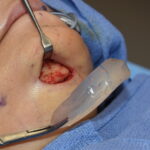
I had an out of town patient who, amongst other procedures, wanted his existing chin implant removed. He said he never really thought he needed it anyway and was bothered by its very hard feel. It also made his chin feel stiff up under his lower lip. Through a submental incision, I dissected down through his chin tissues to the patient’s indwelling chin implant. Because it had been placed elsewhere through an intraoral approach, I knew it would be in a high position on the chin bone. It was at least a centimeter above the lower edge of the chin bone when I encountered the implant capsule.

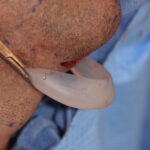
On cutting through the capsule with a cautery, the underlying implant felt unusually hard. Even though it was clear, a sign that it would normally be made of silicone, it was instead hard. So hard that tapping on it made it sound like glass. Unlike a silicone rubber chin implant, which folds on itself and makes it easy to remove, the implant was rock solid. It required the entire implant capsule to be opened for its removal.

On its removal, it could be seen that it not only was made of a hard and inflexible plastic (glass??) but it was also a cleft chin style. I have never seen or even heard of a manufacturer who would make a facial implant out of this hard material. Nor can I envision why anyone would. It not only was hard and poorly shaped, it was very short in horizontal dimension. It was very hard and diminuitive compared to traditional silicone chin implants.

I can now say that I actually have seen a patient who truly had a glass chin.

Dr. Barry Eppley

Indianapolis, Indiana

The Value of a Strong Jawline Appearance in Male Political Candidates

Friday, September 23rd, 2011

The shape and strength of the jawline is an essential component of male facial attractiveness. This is evidenced not only in the images that we see today in male models and advertisements but in many of our most popular male celebrities and actors. This is not only a contemporary desireable male feature but has been so for a long time. It is also fair to say that a weak chin or a short and poorly defined jawlone has never been viewed as a favorable male facial feature.

The value of a strong male jawline can be seen all around us through the use of facial hair. The styling of beards and goatees is often a reflection of the desire to create a stronger chin and jawline appearance. Some men grow it as a conscious effort to do so but other men do it because they feel it makes look better…but without really knowing why.

This brings me to a call I received today from a member of the media. The query was about whether someone who underwent jaw reconstruction for a medical reason could come out from surgery with a better jawline appearance. The answer to that depends on what type of jaw reconstruction was done. If it was done for orthognathic or jaw alignment reasons (e.g., bringing forward a short lower jaw and fixing a bad bite), then an improved jaw appearance will result. This occurs as a natural result of the surgery because the chin becomes more prominent afterwards as the jaw comes forward. However, if the jaw reconstruction is done to fix a fracture then the answer would be no as the jaw shape is returned to what it looked like before the injury.

As it turns out, the basis of the question had to do with a political figure…specifically Texas Governor and Presidential candidate Rick Perry. The reporter wanted to know if I thought he had ever undergone any jaw enhancement surgery. It was detailed to me that Governor Perry had at one time been involved in a plane crash and had suffered a broken jaw. He was treated by wiring his jaws together. (closed reduction of a mandible fracture) The reporter was comparing photos of how he looks today and what he looked like before this injury. He wanted my opinion on what he thought or suspected was a change in his jaw shape after surgery.

In looking at these same photos, it is apparent that Governor Perry does currently have a very masculine jawline and that is certainly a part of his physical appeal from a facial standpoint. However, photographs of him in the military and even at a younger age show that he has always had a well defined jawline. He has a strong chin and jaw angles and a smooth straightline connection between the two. Having done a lot of chin and jawline cosmetic surgeries, the type of jawline the Governor naturally has is sought after by many male patients. The Governor is blessed to have it naturally, numerous type of jaw implants are available for those men who are not so fortunate.

Dr. Barry Eppley

Indianapolis, Indiana

Case Study: Vertical Lengthening of the Short Chin by Bony Genioplasty

Sunday, August 28th, 2011

Background:The shape and projection of the chin is an important facial feature. As the chin sits as a prominence on the lower edge of the face, it has multiple dimensions associated with its shape. While commonly perceived as having only a horizontal component to it, and treated most commonly with an implant if it is too short, this overlooks its vertical and width dimensions. Chins can also be too vertically short or long as well as too wide or too narrow.

The lower face, of which the chin is a significant component, should ideally make up 1/3 of total facial height. When the lower face is vertically short, it is almost always because the bony height of the chin is too small. There are some uncommon exceptions, such as a small maxilla where the lower jaw over rotates with a resultant malocclusion, but this is easy to spot. The vertically short chin can occur regardless of its horizontal dimension presenting with either microgenia, normal chin projection or macrogenia.

The chin that is too vertically short is commonly seen in combination with some degree of horizontal deficiency. The amount of vertical and horizontal shortness determines whether an implant or an osteotomy is the better treatment. With just a few millimeters of deficiency in either dimension, an implant can readily treat both with good positioning on the lower end of the chin bone and proper implant style selection. Anything more than a minor deficiency is best treated by a lengthening osteotomy.

Case Study: This 35 year-old male wanted to improve his ‘weak’ chin. On examination he had both a vertical (8 to 10mms) and horizontal (5mms) chin deficiency. This made his lower face look short and gave his chin a short squat appearance. Computer imaging confirmed that a vertical chin lengthening procedure would improve his facial aesthetics.

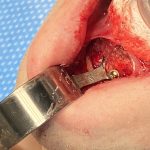
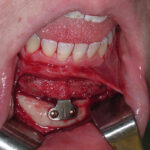
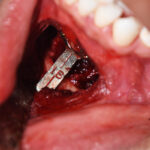
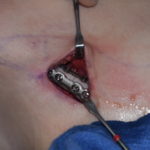
Under general anesthesia, a horizontal chin osteotomy was done through an intraoral approach. The downfractured chin segment was vertically lengthened by 8mms and brought forward 5mms. It was held into position with a modified step titanium chin plate to create these dimensional changes. A hydroxyapatite block was shaped with a burr to create a wedge fit between the upper and lower chin segments. It was put in place after the chin segment had been stabilized by the plate. The mentalis muscle was reapproximated over the plate-bone-block chin construct and the mucosa closed.

After a chin osteotomy, considerable swelling ensued which took close to three weeks to return to a more normal appearance. The lower lip had some temporary numbness which was expected and the chin felt very stiff and unnatural for about a month after surgery. It took a good six weeks until the chin felt more normal and a natural part of his face again.

While the improvement in the chin’s appearance was immediate, critical analysis at 3 months after surgery showed the final result. He had complete return of all feeling and lower lip and mentalis muscle movement at that point. In seeing him at two years after surgery, the improvement was maintained as expected.

Case Highlights:

1) The second most common chin deficiency is in the vertical dimension. It can be seen in both the frontal and profile views and will likely have a horizontal problem as well.

2) The only method for significant vertical lengthening of the chin is an osteotomy with or without an interpositional synthetic graft.

3) Vertical chin lengthening can be combined with other dimensional movements including horizontal advancement and width narrowing or expansion.

Dr. Barry Eppley

Indianapolis, Indiana

Surgical Facial Changes for the Male Model Look

Wednesday, August 3rd, 2011

Almost anyone in the world is aware of the recent tragedy in Norway with the mass killings of an incomprehensible number of Norwegian teens and young adults. The murderer Anders Breivik appears to have acted alone, driven by his white supremacist and anti-Muslin views. What has caught my attention as a plastic surgeon, however, is comments that have been written about his facial appearance.


According to the head of Norway’s intelligence agency, it is believed that he had undergone plastic surgery in the past to look more “Aryan.” The agency’s head has stated that “You do not have that Aryan look naturally in Norway”…”Hitler would have had him on posters. He has the perfect, classic Aryan face. He must have had a facelift.”


While I am not an expert on Norwegian facial structure, I do know that he would not have had a facelift to change his facial appearance. That is not what a facelift does. A facelift is what I call ‘anti-aging facial surgery’, where one is trying to return to one’s prior appearance. This does not change your face but rather makes it look rejuvenated and less tired like it did 10 or 15 years ago. But you still look like you, just a better you.


Rather he would have undergone ‘structural facial surgery’, where the foundational components of the face are altered. That can and often does change one’s appearance. Foundational facial procedures are done at the bone or cartilage level, not just the skin and soft tissues. This includes plastic surgery procedures such as rhinoplasty and facial bone augmentations. (forehead, brow, cheek, chins and jaw angles) According to reports, he supposedly underwent nose and chin surgery at age 21. This would make more sense as these can change the structure of the face and definitely can make one more Aryan in facial appearance, particularly if certain elements of the face are already there.


This raises the question of what is an Aryan facial appearance and why does it look so? The word Aryan, at least as it was perceived and used in Nazi Germany, specifically refers to being white, blond-haired and blue-eyed. But there is not necessarily a specific set or arrangement of facial features that are ascribed to an Aryan face. People talk about it and one would know if they saw it but may not be able to describe the details of it.  But what it undoubtably refers to is a strong and well-chiseled face. For a male this would be highlighted by well-defined facial bony prominences of the brows, cheeks, chin and jaw angles. The nose would have a strong and high dorsal line with a balanced ratio between the three nasal thirds.


The concept of an Aryan face continues to exist today but it is better known as the ‘Male Model Face’. Most young male models in any advertisement today almost all have this type of facial appearance. Whether they have it by genetics, plastic surgery or the use of good lighting and/or Photoshop, the strong and desireable male face has these consistent features.


Plastic surgery techniques today can help many men undergo these type of structural facial changes. Rhinoplasty, anatomical cheek implants, square chin implants, vertical lengthening jaw angle implants and occasionally select fat removal below the cheeks and in the neck can create a face that has more well-defined angles and is more masculine in appearance. For some men, this ‘Male Model Surgery’ can be very effective provided they don’t have a lot of facial fat and not an overly round face.  

Dr. Barry Eppley

Indianapolis, Indiana

Square Chin Implants For Male Chin Augmentation

Sunday, June 19th, 2011

Chin augmentation is a great way to enhance one’s facial profile if the lower facial prominence is recessed. The use of a chin implant is the most common method to make this facial change. It is typically perceived as a horizontal change or increasing the most anterior soft tissue point of the chin in the side view. This is of value in both men and women but, particularly in men, where a stronger chin creates a more masculine appearance.

But perceiving chin augmentation as just a horizontal change overlooks that it can also impact the frontal appearance of the chin as well. Its vertical length and horizontal width are other important dimensions of the chin that are frequently overlooked. These can also be changed by the type and size of implant selection.

In men, a strong chin can be a favorable facial trait. In the frontal view, one of the determinants of a strong chin feature is its width. Chin implants today can make significant width increases by their design. The square chin implant is one specific style that is intended to make a wider and less rounded chin. It is almost exclusively requested and used in male chin augmentation.

Square chin implants are designed so that there is a frontal ‘bumper’ or block square segment of material across its front. Rather than being rounded as it curves around the edge of the chin, it is squared off and then makes more of a right angle change into the side of the implant. Currently, there are several commercially-available square chin implant designs. In silicone materials, two styles of square chins exist with one having more square width than the other. In porous polyethylene (Medpor), an adjustable square chin is available. This is not only because it has an inherent square front shape but because there is a central connector tab between the two implant halfs. The amount of insertion of the tab between the two halfs allow for some degree of extra widening of the implant, up to an extra 10mms. (this also provides an opportunity to make a vertical chin cleft as well)

When it comes to a square chin, how much is enough? What is the aesthetically pleasing amount of ‘squareness’ that a chin should have if one so desires to make this change? As a general rule, a pleasing and balanced square chin should not exceed a vertical line dropped down from the corners of the mouth. The measurement of the width of the mouth from one corner to the other can be transferred to the width of the square component of the implant. When the right angle of a square chin goes beyond this line, it will cause a noticeable dip or divot to appear along the side of the jawline as it transitions backward. This creates an uneven and unnatural looking jawline.

Smaller versions of square chin implants can be made from any of the many larger non-square or round chin implants. The rounded front edge of an implant can be shaved down or made flat during surgery so the front edge of the implant is more square. How much horizontal augmentation needed must be carefully calculated so that in making the chin implant more square, the amount of desired horizontal increase is not dimnished. Custom square chin implants can also be made to allow for more extreme chin width increases.

Square chin implant augmentation is an aesthetic option for those men who want a stronger appearing chin in the frontal view. Whether this is a good option and looks reasonably natural depends on the shape of the rest of the face and that the implant is not oversized.

Dr. Barry Eppley

Indianapolis, Indiana

Narrowing The Width Of The Chin By Osteotomy

Tuesday, May 31st, 2011

Changes in the chin are traditionally perceived as the need for a horizontal increase or improved anterior projection. While many chin deficient patients need horizontal augmentation, there are other dimensions in which the chin may need to be changed. Vertical lengthening or shortening is the other most recognized alteration that can be done to the chin.

The least recognized and often overlooked chin change is in its width or transverse dimension. Increasing the width of the chin is done in male chin augmentation, usually using an implant to get a more square or wider masculine appearance. Narrowing the chin, however, can obviously not be done with an implant. Like vertical chin shortening, only a chin osteotomy can reliably make that change.

Burring of the sides of the chin from an intraoral approach can make for a more narrow or pointed chin but it has limits as to what can be achieved. This is best thought of some mild chin contouring. There is also the issue of extensive soft tissue release with a burring technique and there is no guarantee of good soft tissue readaptation afterwards. This is why a chin osteotomy may be preferred when a significant narrowing effect is aesthetically desired.

The chin osteotomy is done with a traditional intraoral vestibular incision. Once downfractured with an osteotomy cut below the mental foramen, the mobilized chin segment is brought forward for exposure. The amount of chin narrowing is then marked in the midline and bilateral sagittal osteotomies are made. A central bone segment is then removed based on the desired amount of chin narrowing. General 5mm to 7mms needs to be removed to make a visible external difference. The chin segments are then brought together and plated on their superior surface to hold them together. Plating superiorly is important so that the anterior surface is still available for plate fixation for an advancement or vertical lengthening which may still be done.

With a narrowing chin osteotomy, it is important to look for any palpable edges above or out laterally which may need to be burred to prevent any notching that can be felt through the skin. Good mentalis muscle resuspension/tightening is needed once the chin bone is stabilized even though the soft tissue has not been released from the inferior border of the mandible and chin.

While a chin osteotomy is needed when a significant narrowing effect is needed, there are other considerations for its use as well. Certain chin shapes when advanced by osteotomy may be still too wide in the frontal view. This can be seen with certain women’s chins. Changing the chin to one with less width can be aesthetically advantageous as it comes forward, resulting in more of a u-shape and creating the perception of some flare to the jaw angles as well.

Dr. Barry Eppley

Indianapolis, Indiana


Dr. Barry EppleyDr. Barry Eppley

Dr. Barry Eppley is an extensively trained plastic and cosmetic surgeon with more than 20 years of surgical experience. He is both a licensed physician and dentist as well as double board-certified in both Plastic and Reconstructive Surgery and Oral and Maxillofacial Surgery. This training allows him to perform the most complex surgical procedures from cosmetic changes to the face and body to craniofacial surgery. Dr. Eppley has made extensive contributions to plastic surgery starting with the development of several advanced surgical techniques. He is a revered author, lecturer and educator in the field of plastic and cosmetic surgery.

Read More


Free Plastic Surgery Consultation

*required fields


Pricing

The cost of any type of elective plastic surgery plays a major role in the decision to undergo the procedure(s).

Get Your Quote Here


My Plastic Surgery Story

Military Discount

We offer discounts on plastic surgery to our United States Armed Forces.

Find Out Your Benefits


Categories