EXPLORE
Plastic Surgery
Dr. Barry Eppley

Explore the worlds of cosmetic
and plastic surgery with Indianapolis
Double Board-Certified Plastic
Surgeon Dr. Barry Eppley

Archive for the ‘browlift’ Category

The Uniqueness of Male Plastic Surgery – Facial Procedures

Saturday, June 15th, 2013


The facial aging process is one that is well known as everyone will eventually see it on their face. The eyes get heavy, the brows descend, the cheek fall, jowls develop and the neck sags. Women become concerned earlier in the aging process and proceed to do procedures to treat or slow it down in an overall more comprehensive manner. Men take a much more delayed approach to it often waiting until one facial area becomes a major concern or until the facial aging process is fairly advanced.

While the face ages largely similar in both men and women, the facial procedures used to treat them are often done differently. Not as many men have facelifts as their aging neck and jowls are more tolerated. But in men that have facelifts they must be done very carefully, respecting the natural hairlines of the temples and behind the ears and being careful not to displace the beard skin into the ear canal. Incisions must be placed very inconspicously and often less of a tightening result must be accepted to keep the scars hidden. That is not a bad thing as men look better underdone than having their faces pulled too tight anyway.

While men also develop heavy upper eyelid skin and lower eyelid bags just like women, their eyelid lifts (blepharoplasties) need to be done more conservatively. Browlift options in men are more limited due to the frequent lack of adequate scalp hair and a well defined frontal hairline. The most common male browlift method is through the upper eyelid (transpalpebral browlift) using the endotine device to accomplish the lift. This produces a very modest browlift but creates no visible scars and with more conservative eyelid skin and fat removals can avoid overfeminizing the male face and creating an unnatural overdone look.

Men do not engage in as many Botox and injectable fillers treatments as women as some wrinkles and signs of aging are more tolerated. A more natural result for men is one that reduces the worst of the wrinkles but does not eliminate all of them. This is the same reason men, at best, will only do a bare minimum of facial skin care. Many men would rather seek more definitive surgical procedures, or do nothing at all, that engage in non-surgical procedures that require frequent efforts to maintain.

Facial reshaping surgery is vastly different in men than women. Male rhinoplasties must keep a high and straight dorsal line and avoid an overly upturned tip while most women desire a smaller less projecting tip and lower dorsal lines. The shape of the face in men is dominated by a strong jaw and requests for chin, jaw angle and even total jawline enhancements are not uncommon to pursue a more masculine appearance and even the so called ‘male model’ look. Men favor higher more angular cheek augmentations while women prefer a lower more anterior rounded cheek prominence. Men pursue brow bone surgery for either reduction of an overlying prominent one or for augmentation to create a more masculine brow prominence and a more backward sloping forehead profile.

Plastic surgery for men has its own unique requirements both in the type of surgeries and the demeanor of the patients. One should not assume that every plastic surgeon or plastic surgery practice is equally adept about meeting the needs of the male patient. Just like breast reconstruction for women or body contouring after massive weight loss, the male patient presents unique challenges for a satisfying surgical outcome.

Dr. Barry Eppley

Indianapolis, Indiana

Patient Satisfaction and Long-term Stablity of the Endoscopic Browlift

Saturday, May 18th, 2013


Elevation of low or aging brows can be done by a variety of browlift procedures. But since its introduction in the mid-1990s, the endoscopic browlift has remained a popular method. Its appeal is in the much smaller incisions and the lack of scalp morbidity, such as scar widening and alopecia and persistent numbness that occurs from a transverse scalp incision regardless of whether it is at or way back in the hairline.

The advantages of the endoscopic browlift has never been an issue of debate, the reduction or elimination of complications. What is not as clear is whether it offers similar aesthetic benefits as more open traditional browlift operations…is it effective and does it have lasting effects? Given how long the endoscopic browlift has been around, one would assume that the clarity of its aesthetic effectiveness is well established and documented. While plastic surgeons, including myself, find it to be very effective in the properly selected patient its longer-term stability is less clear.

In the May 2013 issue of the journal Facial Plastic and Reconstructive Surgery, a published study shows that the majority of patients who had endoscopic browlift procedures were satisfied with its long-lasting results. The study reviewed 143 patients over a 13 year period based on questionnaires of satisfaction and postoperative complaints as well as before and after pictures of eyebrow-to-eye measurements.

The study showed that the vast majority of patients were women (96%) who had an average age of 60 years and was rated successful by 93% of patients with 96% saying they would recommend the bprocedure. Three-fourths( 64%) said they looked younger and less tired. Some scalp numbness and itching persisted 3 to 6 months after surgery. Photographic analysis found that brow elevation was maintined to at least 2 years after surgery with an average elevation of over 5mms.

The endoscopic browlift significantly reduces the mobidity of scalp scars with a high patient acceptance rate. This study shows that there is long-term stability of the brow elevation. Thus scalp mobilization (epicranial shift) does work in lieu of forehead or scalp tissue excision. This study did not assess what happens to the frontal hairline, however, which I know moves back (lengthens) as the brows are lifted. For those patients that already have a long forehead, the open hairline browlift will need to be used instead.

Dr. Barry Eppley

Indianapolis, Indiana

Forehead Feminization with Combined Brow Bone Reduction, Browlift and Hairline Lowering

Sunday, April 21st, 2013


There are numerous surgical procedures to feminize a masculine facial appearance. They include jawline reshaping (chin and mandibular angle reduction), rhinoplasty, cheek reduction, tracheal shave and forehead reduction/reshaping. While every transgender patient’s face is different and may need just a few or all of these facial feminization procedures, the forehead is one of the top considerations for most patients. The female forehead has a very distinct shape with a rounded contour from the brows up to the hairline with no obvious bone break.

Forehead reshaping incorporates reduction of the prominence of the central glabellar region as well as the projection of the brow bones. The brow bones must not only be deprojected but should also have the tail of them near the lateral orbit reshaped to have more of a sweeping effect up and towards the temples. Since this procedure requires an open scalp approach, this creates the oportunity to lower the frontal hairline as well. Together this type of foreheadplasty has a significant impact on the gender identification of the face.

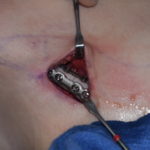
The prominent glabella and brow bones are always due to the pneumatization of the front sinus. In cases of minor protrusion, the outer table of the frontal sinus can be simply burred down. Unfortunately this rarely can be successfully done due to the thin bone thickness overlying the frontal sinus. A few millimeters of change is rarely enough to make a noticeable external change. Most patients require the anterior wall of the bone to be removed, reshaped and repositioned back into place with resorbable sutures or metal microplates and screws. This method sets back the bulging bony prominence while preserving sinus function. The outer brow bone areas that lie outside of the sinuses can be reshaped as desired by burring.

When significant brow bone reduction is done (flattening of the bone), there is the potential for an excess of overlying skin. Loose skin on the brows can result in sagging or overlying brow ptosis. This can be easily addressed at the time of the brow bone reduction by a comcomitant browlift using the transcoronal or hairline incision made for access to the brow bones. An alternative approach is a direct browpexy from the galea below the eyebrows to underlying bone holes or the fixation plates (if used) above the reshaped brow bones.

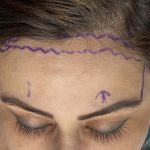
A final component of the feminizing foreheadplasty procedure is the potential to simultaneously lower the frontal hairline. A long forehead (> than 6.5 to 7 cms between the brow and hairline) is unaesthetic for any gender but is particularly so in the male to female transgender patient. If a hairline approach (trichophytic) is used, a simultaneous scalp advancement can be done by securing the galea of the advanced scalp by sutures to bone holes in the outer table of the skull. By bringing the scalp forward, the lifted forehead skin will need to be trimmed creating a combined forehead skin reduction and browlift.

Ultimate feminization of the forehead can be done by simultaneous brow bone reduction, browlift and hairline lowering.

Dr. Barry Eppley

Indianapolis, Indiana

Case Study: Combined Browlift and Eyelid Lifts in Severe Periorbital Aging

Wednesday, April 17th, 2013


Background: The aging process around the eyes is classic. The near continuous motion of the eyelids creates loose skin and, with enough time and motion, the eyebrows will fall over the supraorbital rims and sag downward.. For many patients today, they have eyelid surgery early in life and never progress to see the extreme aging changes that can occur around the eyes.

But in its most extreme form, eyelid aging will develop hooding where the loose and excessive skin will fall down and even over the eyelashes. The eyebrow can even lie completely under the brow bone further accentuating the hooding effect of the loose upper eyelid skin. While such severe changes are usually seen in the elderly, it can occur in younger patients due to their natural genetics.

When there is a large amount of loose upper eyelid skin, it is tempting to think that a dramatic change can occur with its excision alone. But this does not take into account the powerful negative effect of a low brow position and its influence on obscuring the vertical space between the lashline and the brow. Without such a space a supratarsal fold can not be created no matter how much eyelild skin is removed.

Case Study: This 57 year-old female wanted to improve the aging appearance of her eyes.  She has severe upper eyelid hooding, a low eyebrow position and significant obstruction of her upper visual field. While she initially resisted the idea of a browlift with her blepharoplasties, she eventually resigned herself to the fact that failing to deal with her eyebrow position would limit how much of a blepharoplasty result would be seen.

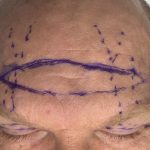
Under general anesthesia, a pretrichial (hairline) browlift was initially performed with a beveled incision along the frontal hairline. Eleven mms of forehead tissue was removed from the center of the hairline tapering out into the temporal area. The browlift was secured into position with suture fixation through outer cortical skull bone holes and sutures to the galea. An upper and lower blepharoplasty was then done, removing skin only in the upper eyelid and skin and fat from the lower eyelid.

Her postoperative course had the typical swelling and bruising around the eyes which ensues with some expected temporary foehead and frontal scalp skin numbness. She looked fairly normal at three weeks after surgery and completely normal by 6 weeks after surgery. She not only looked more refreshed by had a dramatic improvement in her field of vision.

With severe periorbital aging, oen has to consider a more comprehensive surgical approach around the eyes. This would include a browlift as well as the four eyelids. the choice of browlift is based on the existing length of the forehead and the degree of brow ptosis.

Case Highlights:

1) Severe upper eyelid hooding and brow ptosis produces an combined aesthetic and functional obliteration of the eyes.

2) When the brow is low, even aggressive upper eyelid skin removal will not produce an adequate result.

3) A combined browlift and 4-lid blepharoplasties is needed to open up the eyes in severe aging changes.

Dr. Barry Eppley

Indianapolis, Indiana

Plastic Surgery’s Did You Know? Female Eyebrow Beauty

Friday, February 1st, 2013


The eyebrow is an important part of female facial beauty. Unlike men who pay little attention to the size and shape of their eyebrows (unless they meet in the middle), women shape and color their eyebrows with great care. Like all fashion trends, the concept of the ideal shape of the female eyebrow has changed over the years. Eyebrow beauty consists of whether the hair density is thick or thin and where the maximal arch point exists. For example, the 1980s were known for thick eyebrows. That changed to more thinner ones during the 1990s and 2000s and now thicker eyebrows are coming back in vogue again. The arch point of the eyebrow, an entity that can be affected by both Botox injections and browlift surgery, has also changed. According to a recent study published in the Clinics of Plastic Surgery in September 2012, the arch of the eyebrow has been gradually moving outward from the lateral limbus of the eye (outer area of iris) to the lateral canthal area. (eye corner) In addition, the height of the arch of the eyebrow has also been decreasing over time. The ideal female eyebrow today  is defined as starting near or below the orbital rim near the nose with the maximal arch of the brow (peak) at the lateral canthus in younger patients (can be closer to the middle of the brow in older women) and the tail of the brow located an inch or slightly less (20mm to 25mms) above the lateral canthus.

Endoscopic vs. Transpalpebral Browlifts

Friday, January 18th, 2013


Repositioning of an aesthetically low eyebrow can be done by a variety of browlift procedures. Historically and most commonly, an approach from the scalp (coronal, hairline or endoscopic) is how many browlifts have and are done. This is the most logical approach because lifting up or pulling back seems the right direction for an eyebrow that is too low. A more recent and diametrically opposite approach to lifting the low brow is to push from below. This is known as the transpalpebral (through the upper eyelid) browlift technique that uses a device (endotine) to achieve its effect.

The origin of the transpalpebral browlift is based on three issues.  First, browlifting in men poses a unique challenge because of the dubious nature of their hairlines. Scalp approaches in men are usually unacceptable because of visible scar concerns. Coming from below through an eyelid incision is the only acceptable option for most men. Secondly, there are some women who may feel that the standard browlift approach is more than they want or need. They may desire a little browlifting but feel a scalp approach is too aggressive. Lastly, the sheer proximity of the upper eyelid to the brow bone makes the addition of a browlift through an upper blepharoplasty very convenient with very little additional risk and no extra incision.

An interesting question is  how similar are the results from these two very different approaches to browlifting. In the December 2012 issue of Plastic and Reconstructive Surgery, a paper entitled ‘Morphometric Long-Term Evaluation And Comparison Of Brow Position And Shape After Endoscopic Forehead Lift And Transpalpebral Browpexy’. Photographs of patients who had received either an endoscopic browlift or a transpalpebral browpexy were morphometrically evaluated for brow height and brow shape up to five years after surgery. Their results show a significant elevation of the brow done through the endoscopic approach is both higher and more sustained than the transpalpebral technique. The descent of the eyebrow after the transpalpebral browpexy is felt to be caused by a decrease of frontal hyperactivity after the simultaneously performed blepharoplasty.

It should be no surprise that an endoscopic browlift causes a greater change in the brow’s position and shape as it is a bigger and much more powerful procedure. By comparison, the transpalpebral technique is much more limited in subperiosteal elevation and forehead flap movement. In an endoscopic method the entire forehead is mobilized and moved in one large tissue flap. The transpalpebral approach only mobilizes the brow. This study merely confirms what is intuitively obvious that a bigger operation is more effective and sustained than a smaller one.

While the transpalpebral browlift is less effective than other browlift methods does not mean it has no periorbital rejuvenation value. Its very simplicity and more subtle effects makes it well suited for those who need just a little browlifting or want a less invasive method of doing it. This particularly applies to many male patients who desire a browlift result that does not look overdone with too much brow elevation change.

Dr. Barry Eppley

Indianapolis, Indiana

Patient Satisfaction and Long-Term Results with Endoscopic Browlifts

Wednesday, September 26th, 2012


Rejuvenation of the upper third of the face is based on improving the appearance of the upper eye and brow area. Besides an upper blepharoplasty to remove excess skin, lifting of the eyebrows may also be needed to improve upper eyelid hooding and elevate low hanging brows. The intent of both is to open the upper eye area for a more rested and refreshed look.

Browlifts can be done multiple ways and there are four basic techniques to do it. Three out of the four are done from far above the brows and use different scalp approaches. For the past 15 years, the endoscopic browlift has become one of the most common upper facial rejuvenation methods. Its advantages over scalp-based excisional approaches is the small amount of scar that is created as only enough incision is needed to introduce an endoscope and the instruments needs to work through it. This results in faster healing, less potential disruption of the hair follicles and decreased risk of permanent scalp numbness.

The appeal of the endoscopic browlift to a patient is obvious and plastic surgeons have embraced its use. But do patients find that it produces good results and are they happy they had it done? In the September issue of the Archives of Facial Plastic Surgery, a study reports on patient satisfaction and long-term results with the endoscopic browlift. Based on nearly 100 patients (almost all female patients with an average age of 60) who had the procedure between 1994 and 2007 with an average follow-up of over three years, the authors reviewed the incidence of complications and complaints as well as photographic measurements of before and after eyebrow-to-eye distances.

The endoscopic browlift had average satisfaction scores of 7 out of 10. It produced an average of just over 5.5mms of elevation after surgery with showed a gradual decline of almost 1mm per year out to the duration of the study. It is interesting to note that significant brow asymmetry existed between the eyes. Fully 63% of the patients said they would have the procedure again or recommend it to a friend while nearly 20% said they would not.

The study concludes that most patients find the procedure very satisfying. That being said one-third of the patients were not satisfied which I find to be a high percent for a cosmetic procedure. One of the reasons for not a higher rate of patient satisfaction may be the older age of the patients. The endoscopic browlift works on the basis of an epicranial shift, the brows are elevated because the entire scalp is moved backwards. (this is why the forehead gets longer with this type of browlift) This is fine if there is not too much brow ptosis (sagging) or a lot of horizontal forehead wrinkles. But when the patient is older, skin excision through an open browlift will produce a better result that will last longer. This relegates the endoscopic browlift, most of the time, to younger patients with earlier and less significant upper facial aging.

Dr. Barry Eppley

Indianapolis, Indiana

Plastic Surgery’s Did You Know? The Shape of the Eyebrows

Sunday, July 1st, 2012

The one patch of hair that both male and female share are the eyebrows. With few exceptions, everyone is born with a pair of them. Their functional role in mammals is to protect the eye from water and debris from above. But humans go to great lengths to modify their natural hair pattern. Unlike the Egyptians who frequently shaved off all of their eyebrow hairs as a sign of beauty, keeping them is a more contemporary part of facial aesthetics. The desireable shape of the eyebrows has changed over the years in many subtle ways for women. Female eyebrows should have an arch which is peaked at the center of the browline and has a tail which tapers off as it descends out toward the temples. Thin and thick eyebrows have been in and out of vogue for women but the desire for an arched form has largely remained unchanged. The shape of the male eyebrow is less aesthetically important other than being more of a straight line, not having a unibrow, and keeping longer wild hairs in check. Non-surgical procedures like Botox and browlift surgery can change the shape and position of the eyebrows on the brow bone in both favorable and unfavorable ways.

Scar Outcomes from the External Direct Browlift Procedure

Monday, April 30th, 2012


As one ages, many facial structures fall unless they are rigidly fixed to bone. One of these falling structures is that of the eyebrows. Normally the eyebrows are situated either directly in front of or slightly above the level of the supraorbital ridge bone. But with time, gravity and expressive movements, the brows may slide off of the bone and push down on the eyelids. This creates a low brow position which leads to a tired or angry appearance and makes the upper eyelid skin look more redundant and full.

Browlifting is always an option in periorbital rejuvenation surgery which is often combined with eyelid tucks or blepharoplasty surgery. Browlift surgery is unique, similar to a facelift, in that the lifting is done from a superior and far away location to keep scars hidden either at (pretrichial browlift) or within the scalp hair. (coronal or endoscopic browlift) But there is an alternative browlift option that is actually the most effective of all the available techniques, that of a direct or external browlift.

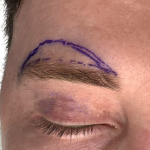
The external browlift or browpexy is where the eyebrows are lifted directly through direct skin excision along the upper edge of the eyebrow hairline. It is very effective because its lifting effect is directly at the eyebrow, thus creating a 1:1 ratio between skin removed and the amount of eyebrow lift. While this is far easier and more effective than any distant browlift technique, the issue is the visbility of the scar…a majoir concern in any cosmetic procedure where other options do exist.

In a recent 2012 issue of Ophthalmic Plastic and Reconstructive Surgery, a paper was published on a single surgeon’s experience with the external browpexy technique. Over a two year period, a total of 28 patients had the procedure of which the average age was 62 years old. (age range from 51 to 76 years of age) Eighteen of the patients were men (64%) with most of the patients having bilateral browlift procedures. The results of the scars were judged as good by patient satisfaction, all with the exception of a single scar. The author concludes that the exterbal browpexy is a straightforward procedure that produces high levels of patient satisfaction. The brow incision heals well without a perceptible scar in most cases and provides a reliable method of elevating the temporal brow. It is a good adjunct to enhancing upper blepharoplasty outcomes.

The key to a successful external browlift procedure is patient selection. The majority of patients in this clinical study were older and were mainly men. Browlifting in men is particularly challenging because the brows are heavy and there is usually no good superior browlift options because of their hairlines or lack thereof. The choices are either an internal browlift techniques, such as using the Endotine device, or the direct browlift as this paper described. With good incision placement and closure techniques, the scar along the upper edge of the browlift can be made aesthetically acceptable. But in younger patients, scars outcomes are not as likely to be as good and other browlift options should be considered.

Dr. Barry Eppley

Indianapolis, Indiana

Surgical Approaches For Glabellar Muscle Resection for Frowning

Thursday, April 12th, 2012

Successful browlift surgery is based on several key technical maneuvers. These include periosteal release, muscle resection and brow elevation with or without fixation. These steps allow for the brows to not only be elevated but hopefully reduce the amount of chronic muscle contraction in the glabellar region. Patients and some plastic surgeons hope that the muscle effect creates a result that is similar to a ‘Botox-like’ effect between the eyebrows.

But many patients that have excessive frowning, also known as 1s or the famous 11s, don’t need a browlift. While Botox is a tremendously simple and effective treatment for frowning, the need for regular injection treatments has some patients desiring a more permanent one-time surgical treatment. Surgical resection of the glabellar muscles would be an effective treatment but direct access to the muscle area is limited by scan and nerve location concerns. Resection of these muscles can be done either from above through an endoscope or from below through an upper eyelid incision.

Is the superior endoscopic or the inferior eyelid approach better for muscle resection in this area? There are surgeon advocates on both sides of that discussion. I have done it both ways and each method has its own unique advantages and disadvantages.

In the May 2012 Aesthetic Surgery Journal, a study out of Wisconsin compared the transpalpebral (upper eyelid) and endosopic approaches in the resection of the corrugator supercilii muscles. Using cadaver faces, the study looked at the completeness of resection of the corrugator muscle with the transpalpebral and endoscopic techniques. After the procedures were completed on both sides, the tissues were removed and the amount of corrugators muscle resection evaluated. In 95% of the cadaver halfs, complete muscle releaser was obtained. The only failed instance was in one case of endoscopic release. This report demonstates that either method can achieve good muscle release and is operator-dependent.

For the patient seeking a ‘surgical Botox’ procedure for frowning, either endoscopic or upper eyelid approach can be used for the muscle resection. For the majority of patients the upper eyelid approach is often more appealing particularly if they are in need of a blepharoplasty procedure as well.

Dr. Barry Eppley

Indianapolis, Indiana   


Dr. Barry EppleyDr. Barry Eppley

Dr. Barry Eppley is an extensively trained plastic and cosmetic surgeon with more than 20 years of surgical experience. He is both a licensed physician and dentist as well as double board-certified in both Plastic and Reconstructive Surgery and Oral and Maxillofacial Surgery. This training allows him to perform the most complex surgical procedures from cosmetic changes to the face and body to craniofacial surgery. Dr. Eppley has made extensive contributions to plastic surgery starting with the development of several advanced surgical techniques. He is a revered author, lecturer and educator in the field of plastic and cosmetic surgery.

Read More


Free Plastic Surgery Consultation

*required fields


Pricing

The cost of any type of elective plastic surgery plays a major role in the decision to undergo the procedure(s).

Get Your Quote Here


My Plastic Surgery Story

Military Discount

We offer discounts on plastic surgery to our United States Armed Forces.

Find Out Your Benefits


Categories