EXPLORE
Plastic Surgery
Dr. Barry Eppley

Explore the worlds of cosmetic
and plastic surgery with Indianapolis
Double Board-Certified Plastic
Surgeon Dr. Barry Eppley

Archive for the ‘back lift’ Category

Postoperative Instructions for Braline Backlifts

Tuesday, February 12th, 2013


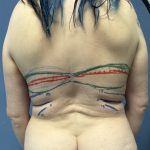
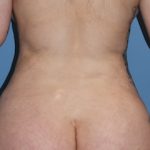
Braline backlifts eliminate back rolls that at or below the braline. The back roll is cut out, including skin and fat, and replaced with a horizontal scar that is designed to lay along or within the braline. This creates a flattening of the back for the trade-off of a scar.

The following are the typical postoperative instructions after the procedure:

1.  Most backlift procedures have  surprisingly little discomfort. The back may feel tight but not particularly painful. Patients usually only feel the need to use pain medication for just a few days after the procedure.

2. In all cases of backlifts, there will be a circumferential wrap around the area for the first night after surgery. You may remove this wrap the day after surgery. It does not need to be used thereafter unless it feels more comfortable to do so. You may wear a bra anytime after 48 hours.

3. The sutures used in the incisions of a backlift are all under the skin and will be dissolveable. The incisions will have glued on tapes that will stay in place until Dr. Eppley removes them. They require no topical care.

4. You may shower as normal within 48 hours of surgery. There is no harm in getting the back tapes wet.

5. Backlifts will cause some swelling and bruising around the incisions and usually lower in the back in most cases. This is normal. It is ok to lay on your back or on your sides.

6. In some cases, drains may be used in backlifts. They are usually removed in 1 to 2 days after surgery. Empty them directed. There is no need to record their output.

7. There are no limitations to normal everyday physical activities after backlift surgery. You may feel do what feels comfortable. You should not do any strenuous or exertional activities until three weeks after surgery.

8. You may eat and drink whatever you like right after surgery.

9.  You may drive the next day after surgery when you feel comfortable and are not on any pain medication.

10. If any incisional redness, increased tenderness or swelling, or drainage develops after the first week of surgery, call Dr. Eppley and have your pharmacy number ready.

Consent for Plastic Surgery: Braline Backlifts

Tuesday, February 12th, 2013


Every plastic surgery procedure has numerous issues that every patient who is undergoing a procedure should know. These explanations are always on a consent form that you should read in detail before surgery. This consent form, while many perceive as strictly a legal protection for the doctor, is actually more intended to improve the understanding of the braline backlift procedure. The following is what Dr. Eppley discusses with his patients for this procedure. This list includes many, but not all,of the different outcomes from surgery. It should generate both a better understanding of the procedure and should answer any remaining questions that one would have.

ALTERNATIVES

Alternatives for improving the appearance of braline back rolls instead of surgical  excision is liposuction.

GOALS

The goal of a braline backlift is to eliminate (flatten) the horizontal/oblique rolls of skin and fat that exist either above or below the braline and are accentuated by its wear.

LIMITATIONS

The limitations of the procedure are that only some much skin and fat can be removed and still obtain a competent wound closure. This may or may not completely flatten the back rolls.

EXPECTED OUTCOME

Expected outcomes include the following: temporary swelling and bruising around the incisions, temporary numbness of the surrounding back skin, permanent horizontal braline scars and up to one month after surgery to see the final back result.

RISKS

Significant complications from braline backlifts are extremely rare. More likely risks include infection, hematoma,  scars not completely within the braline, overcorrection or undercorrection of the back rolls, and asymmetry of scar placement. Any of these risks may require revisional surgery for improvement.

ADDITIONAL SURGERY

Should additional surgery be required for scar revision or further reduction of incompletely removed back rolls, this will generate additional costs.

The Braline Backlift For Removal Of Back Rolls

Monday, December 24th, 2012


One of the many evolutions in plastic surgery has been the tremendous expansion of excisional body contouring procedures. Spurned on by the prevalence of extreme weight loss patients, particularly those from bariatric surgery in which large segments of loose body skin develops, the need for innovative and expanded uses of body contouring have been developed. Many of these bariatric plastic surgery procedures are more like reconstructive surgeries than cosmetic surgery per se. As naturally happens in plastic surgery, what was once a reconstructive procedure soon finds some more cosmetic applications.

One of these areas is that of the back and the development of back rolls. Even in women of more normal weight, back rolls can develop from aging. They occur above or below the bra line. Women detest them and they are evident in clothes as visible rolls. Wearing a bra accentuates them and can make their rolled appearance even more evident. Unfortunately they can not be exercised off nor lost by any amount of weight loss.

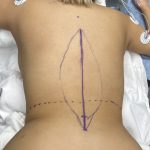
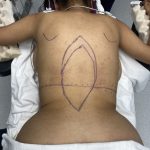
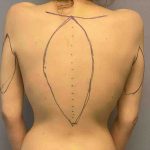
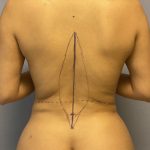
A modified bariatric plastic surgery technique, known as a backlift, can be very effective at getting rid of these back rolls. This is not a liposuction method that removes fat as this is not the major tissue component of most backrolls. It is the excision of loose back skin with some underlying fat that is oriented along the bra line. In an excisional pattern that looks similar to the infinity symbol, horizontal elliptical skin segments are removed from both sides of the midline spine. The vertical level of the ellipses is so oriented that skin is equally removed above and below so that their closure will place the final scar inside the cover of the braline. It is important to mark the outlines of the bra that the patient typically wears before marking the pattern of the skin excisions.

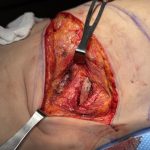
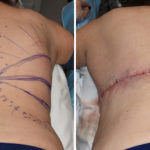
With skin closure after the excisions, a formal backlift is achieved effacing the rolls caused by the loose skin. This produces a dramatic tightening of the back at the price of a horizontal scar line. It is important that the excisional patterns do not cross the skin overlying the spine as this tissue is much tighter than that on the sides and will produce significant scar widening and hypertrophy. Usually drains are not used for backlifts due to the tightness of the closure and the fact that the patient provides natural compression of the surgical site by laying on it.

Like all excisional skin procedures, the scar tradeoff for a backlift must be carefully considered. While in a bariatric surgery patient, these scar concerns are often well worth it given the amount of loose skin and body dysmorphia that exists. But in more weight appropriate patients, which aesthetic concern is more relevant (backroll vs scar) will differ for each patient and that decision is never clear (or relevant)to an outside observer.

The recovery from a backlift is fairly rapid and one can return to work in just a few weeks. It will be sore for sure and will take up to a month until one can return pain-free to all physical activities. The back scar will be red for a while and can take up to six months for the redness to fade to a white scar line.

Dr. Barry Eppley

Indianapolis, Indiana

Back Lift Surgery in the Extreme Weight Loss Patient

Wednesday, January 7th, 2009

The back is not spared from the extreme weight loss process. While skin may sag worse in the front (abdomen) after a lot of weight loss, sagging in the back occurs as well. It tends to not sag as much as other areas due to three factors: the thickness of back skin (one of the thickest in the body), the back skin has more attachments to the underlying tissues which hold it up better, and it was never expanded as much as the abdomen due to less fat initially. Back skin sag is usually a concern more in women than men due to the skin rolls that occur underneath the bra, being noticeable through certain types of clothing. These skin rolls frequently extend down to the side of the waistline and may consist of at least two distinct rolls in many patients.

A common misconception is that liposuction or fat removal will help tighten this loose sagging skin. Nothing can be further from the truth. Only removing the rolls themselves by cutting them out can make the back more flat and tighter.

Back lift surgery involves the removal of an elliptical (football-shaped) cutout of skin and its underlying attached fat. The cutout pattern and the final scar which results can be placed either in a horizontal or oblique orientation on the back. If done horizontally, the final scar will lie higher up within the bra line (ideally) so it can be fairly camouflaged. The back skin removal can also be oriented along the way the skin rolls fall in an oblique fashion. While the resultant back scars will be more obvious, this approach removes more skin and tightens the back better in my experience. Either way, a surprising amount of skin can be removed in a back lift.

Back lifts do not cause much discomfort and are often done in conjunction with other body contouring procedures. Like many body contouring operations, a drain will be placed in surgery to remove fluid from the space left under the skin after closure. These drains will need to stay about a week when the fluid output has dropped significantly.

Back lift surgery does produce scars but they usually heal surprisingly well compared to some other areas of the body. Back lifts are usually done as one of the last body contouring procedures as patient’s concerns about them are secondary to abdomen, breast, arm, and thigh skin issues.

Dr. Barry Eppley

Indianapolis, Indiana


Dr. Barry EppleyDr. Barry Eppley

Dr. Barry Eppley is an extensively trained plastic and cosmetic surgeon with more than 20 years of surgical experience. He is both a licensed physician and dentist as well as double board-certified in both Plastic and Reconstructive Surgery and Oral and Maxillofacial Surgery. This training allows him to perform the most complex surgical procedures from cosmetic changes to the face and body to craniofacial surgery. Dr. Eppley has made extensive contributions to plastic surgery starting with the development of several advanced surgical techniques. He is a revered author, lecturer and educator in the field of plastic and cosmetic surgery.

Read More


Free Plastic Surgery Consultation

*required fields


Pricing

The cost of any type of elective plastic surgery plays a major role in the decision to undergo the procedure(s).

Get Your Quote Here


My Plastic Surgery Story

Military Discount

We offer discounts on plastic surgery to our United States Armed Forces.

Find Out Your Benefits


Categories