EXPLORE
Plastic Surgery
Dr. Barry Eppley

Explore the worlds of cosmetic
and plastic surgery with Indianapolis
Double Board-Certified Plastic
Surgeon Dr. Barry Eppley

Archive for the ‘arm lift’ Category

The Popularity of Excisional and Non-Excisional Armlifts

Friday, May 3rd, 2013


One of the more noteworthy items in the recent release of the annual 2012 statistics report from the American Society of Plastic Surgeons was in the number of armlifts that were performed. The greatest surge in all the body contouring procedures were arm lifts or brachioplasties with over 15,000 performed last year. While that pales in comparison to the millions of cosmetic surgeries performed during the year, this number represents a greater than a 4,000% increase in surgical arm reshaping since 2000 when just a few hundred were reported done.

Why this dramatic increase in armlift surgery? There are a variety of reasons which include new technologies and techniques to treat heavy and bigger upper arms as well as a societal trend towards more shapely upper arms. But a major factor has been the concomitant number of people who have undergo large amounts of weight loss as a result of bariatric surgery and other weight loss methods. The flappy arms that result from extreme weight loss can not be treated by any other method than surgery and the arms are always on the top three concerns of these patients.

The influence of weight loss on the rise of armlifts is reflected in the over 6,000 armlifts that were performed specifically after masssive weight loss, representing 42% of all armlifts done in 2012. The elasticity of arm skin between men and women is known to be different as very few  men ever get armlifts. Despite men who undergo large amounts of weight loss, they very rarely end up with flappy arms or ‘bat wings’. It is so uncommon that I in my Indianapolis plastic surgery practice have never even seen a weight loss male complain about their upper arms. This is corroborated by the scant few male armlifts reports with just over 300 done, representing a meager 0.02% of all armlifts done. The typical armlift patients is a female between the ages of 40 and 54.

Since nearly 60% of armlifts are done in non-weight loss patients, it is clear that there is a strong societal and fashion influence as well. While the female who is working out and getting their body toned may not be getting their desired result in their arms, the historic concept of a surgical armlift and its scar is not a worthwhile trade-off. The aesthetic standards of most more normal weight females is obviously quite different from that of the massive weight loss patient. And while improved suturing/wound closure techniques and scar treatments are available, it is just not a problem that most women want to acquire.

But the full or thick upper armed woman in the past who was not a good candidate for an armlift (brachioplasty) may now consider a variety of liposuction treatment methods. Upper arm fat can be removed using traditional, laser-assisted (Smartlipo) or power-assisted liposuction, to name a few, or even some non-surgical methods such as Cool Sculpting or Exilis. While none of these options will ever work as well as an armlift, they all avoid the need to end up with a long scar. And for the more normal weight female, some arm shape improvement is better even if it is not a dramatic circumferential reduction.

The coalescing of better methods of fat removal and the ability to create some degree of skin tightening, all with no to minimal scarring, has been a major impetus for the exponential increase in arm reshaping procedures. The concept of armlifts today no longer always mean that it requires a scar to achieve it.

Dr. Barry Eppley

Indianapolis, Indiana

The Outcomes of Armlift (Brachioplasty) Surgery

Friday, April 12th, 2013


Armlifts have a surprisingly long history dating back well over fifty years ago when it was initially described. While once only done as an occasional procedure for the diet-induced weight loss patient, the number of armlifts now done has virtually exploded since the increase in bariatric surgery procedures. While once done as an isolated procedure, armlifts are now more commonly done in conjunction with other body contouring procedures as part of a multiple-operation body contouring procedure.

While armlifts are very effective at reducing the circumferential size of the upper arm, they do place a scar in a disadvantageous location that is prone to wound breakdown, scar hypertrophy and prominent scar visibility. As a result, the desire for a revision of an armlift is not rare to improve the appearance of the scar or remove more arm tissue.

In addition, another change in armlift surgery has been the concomitant use of liposuction to get a better result. Removing fat from parts of the upper arm that are not affected by the tissue excision, as well as around the shoulder, helps produce a better upper arm contour. Whether concomitant liposuction increases the risk of armlift healing problems has not been well studied.

Since many armlifts today are done in conjunction with other body procedures, it would be relevant to know if this impacts their results, incidence of complications and need for revision. In the April 2013 issue of the journal of Plastic and Reconstructive Surgery, a review of armlift (brachioplasty) outcomes was reported. From a multipractice pool of 69 patients, half had an armlift done as part of a collection of body contouring procedures and half had arm liposuction done as part of their armlift. Major complications occurred in 18% of the patients and included hypertropic scarring and infection. Revisions of the armlifts were done in over 20% of the patients.

This study found that combining armlifts with other body contouring procedures did not increase the risk of complications. In addition, the use of liposuction in armlifts did not increase the risk of complications either. Higher complications rates were found, however, in patients who previously had bariatric surgery.

The revelance of this study supports what I counsel my Indianapolis armlifts patients in regards to what they can expect after surgery. Armlifts are easy to go through and are extremely effective…but at the price of a scar that can be problematic and may require a scar revision later if one is seeking the best apppearance of it as possible. The incisional closure is also prone to minor wound healing problems most commonly seen up near the armpit area. The change that I have done in my armlift surgery technique was to place the excision and scar on the back of the arm rather than on the inside of the arm where the skin is thinner.

Dr. Barry Eppley

Indianapolis, Indiana

Postoperative Instructions for Armlift Surgery

Tuesday, January 22nd, 2013

Armlifts, also known as brachioplasties, removes loose and hanging skin from the back of the arms and into and across the armpit if necessary. No muscle, fascia or any significant blood vessels or nerves are removed in the process. This will leave a straight line scar from just below the elbow and into or across the armpit in some cases. This will tighten the arms by reducing its circumferential measurement.

The following postoperative instructions for armlifts are as follows:

1. Arm lifts usually have a minimal amount of postoperative discomfort. After the first 24 hours, most patients no longer require pain medication.

2. Your arms will be wrapped in ace wraps after the operation. These are to be left in place for the first 48 hours. As your arms will swell after surgery, the ace wraps may feel too tight. You may loosen them or unwrap them and reapply them in a looser fashion. If your hands get tingly or numb, they are too tight.

3. After 48 hours, take off the ace wraps and take a shower. The incisions will be taped but do not worry about getting them wet. Reapply the ace wraps again after showering. Do not take a bath or submerge the arm incisions under water for two weeks after surgery.

4. Your forearms and hands will swell during the first week after surgery. This is normal and will return to normal within 10 -14 days after surgery. This is due to the new tightness of the upper arms and the mildly constrictive nature of the ace wraps. This temporarily obstructs lymphatic outflow and causes the swelling of the forearms and hands.

5. The tapes that are on your arm incisions will be removed by Dr. Eppley at your first follow-up visit. Should they come off before your first visit, do not be concerned. It is not necessary to reapply them. They can be left untapped and covered by the ace wraps.

6. You are to continue wearing the ace wraps on the arms for up to two weeks after surgery.

7. Numbness of the upper arm around the incisions is normal. Feeling will eventually return but it may take up to three months after surgery for it to feel normal.

8. Avoid exercise and strenuous use of your arms for four weeks after surgery so breakdown of the incisions can be prevented.

9. You may drive when you feel comfortable and can react normally and are off pain medication.

10. If any redness, tenderness, or drainage develops after the first week of surgery, call Dr. Eppley and have your pharmacy number ready.

Consent for Plastic Surgery: Armlifts

Wednesday, January 16th, 2013


Every plastic surgery procedure has numerous issues that every patient who is undergoing a procedure should know. These explanations are always on a consent form that you should read in detail before surgery. This consent form, while many perceive as strictly a legal protection for the doctor, is actually more intended to improve the understanding of the armlift procedure. The following is what Dr. Eppley discusses with his patients for this procedure. This list includes many, but not all,of the different outcomes from surgery. It should generate both a better understanding of the procedure and should answer any remaining questions that one would have.

ALTERNATIVES

The alternatives to arm lift surgery are liposuction to remove fat only (and hope the skin tightens) and non-surgical devices to shrink fat and tighten skin.

GOALS

The goal of armlift surgery is to reshape the circumference of the arms, making them smaller and less flabby on the triceps or backside of the arm area.. This is done cutting out loose skin and fat on the back of the arms from below the elbow to the armpit and, in some cases, below the armpit area as well.

LIMITATIONS

The upper arms can only be downsized so much, which is limited by how much skin and fat can be removed and getting the excised area closed without too much tension.

EXPECTED OUTCOMES

The following are all likely to occur: temporary pain, swelling, and bruising of the arms, possible need for several days to a week of drain tubes after surgery, permanent scars along the inside or back of the arms, temporary or permanent numbness of the skin of the arms, and up to one month after surgery for complete healing.

RISKS

Complications may include bleeding, infection, fluid accumulation (seroma) after drain removal, skin irregularities, poor scarring, incision separation after surgery (particularly close to the armpit), spitting of sutures for months after surgery, tightness of the arms, scar banding across the armpits and residual loose skin that may need further surgery to remove.

ADDITIONAL SURGERY

Additional or revisional surgery may needed to close open wounds or improve undesired scarring. These risks are not rare in armlifts with the risk of the need for scar revision as most likely with a 5% to 10% likelihood. This may generate additional costs.

Dr. Barry Eppley

Indianapolis, Indiana

Case Study: Long-Term Scar Outcome From Armlifts

Tuesday, November 6th, 2012


Background: The armlift, known technically as a brachioplasty, is the only skin tightening procedure that is done on the arm. Because of its long scar, it is an excisional procedure used almost exclusively in patients who have had a large amount of weight loss. Whether through bariatric surgery or by diet and exercise alone, weight loss that exceeds 75 to 100lbs will result in considerable loose upper arm skin that hangs down from the back of the arm. (most commonly in women but not men) There are no non-surgical skin tightening treatments that will reduce this amount of loose skin other than surgery.

An armlift is an extremely effective procedure that produces an extreme amount of arm tightening. But its use is restricted to severe excess skin on the upper arm because of the residual scar that is created. A long scar that runs the length of the upper arm from the armpit to the elbow is the trade-off that one must accept for the reduction of the arm circumference. This is why it is not casually used for lesser degrees  of arm sagging.

While an armlift creates a scar, where is the best location on the arm to place it? When I first started performing arm lifts, I used the traditional inner or medial part of the arm where it is supposedly well hidden.  This was historically taught to be the best location for the scar. But the inner arm skin is very thin and delayed wound healing and wide very noticeable scarring was a common outcome in my experience.

Case Study: A 35 year-old female came in who had lost nearly 100lbs on her own by diet and exercise. She was a firm believer in exercise and a teacher of Zumba. While she had reshaped many parts of her body with the weight loss, there was little she could do about her floppy arms. Given her daily Zumba, the flapping arm skin was a real bother and a source of embarrassment. In discussing her armlift, it was decided to put the armlift scar on the back of her arms which would be less noticeable to her.

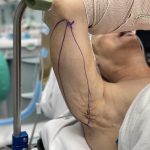
During surgery, her arms were placed on a crossbar so that they crossed high above her face. This allowed the back part of the upper arms to be positioned in a completely vertical plane with the backs easily exposed for surgery. A long and wide ellipse of skin and fat was removed from just behind the back of the elbow down to and across the armpit into the lateral chest wall. The excision as closed as a straight line.

Her postoperative course was marked by typical forearm swelling during the first week which resolved quickly. Her incision went on to heal without incident. She was back teaching Zumba one month after surgery.

Seeing her scars at one year after surgery, they were well healed. But they could not be considered fine line scars as they had a moderate amount of scar widening. In looking at numerous armlift scars over the years, I do consider the location on the back of the arm produces the best scars. But even the best armlift scars can never be considered great-looking scars in most cases.

Case Highlights:

1)      An armlift is the only effective treatment for loose flabby skin on the upper arms, particularly after a large amount of weight loss.

2)      The best location for excision of saggy upper arm skin is near the back of the arm where the skin is thicker and heals better.

3)      The long-term results of the scar from posterior armlifts is acceptable and not seen from the front or when the arms are raised.

Dr. Barry Eppley

Indianapolis, Indiana

Case Study: The Extended Armlift in the Bariatric Surgery Patient

Sunday, October 30th, 2011

Background:  The shape of the upper arm is primarily determined by the front (biceps) and the back (triceps) sides of it. While men are notoriously concerned about the biceps region, women are much more concerned about the opposing triceps region, particularly as they age. Loose and floppy skin on the back of the arm affects many women and a desire to undergo some treatment for it is common.

For minor amounts of upper arm fullness or loose skin, liposuction or non-surgical skin tightening can be effective. While armlifts create the most dramatic change in the shape of the arm, it should only be employed in the most severe sagging arm cases. The  scar of an armlift is simply not acceptable to most women, short of those who have had a lot of weight loss. This makes the bariatric surgery female the most likely to accept an arm scar as a better aesthetic problem than that of a low hanging skin on the back of the upper arm.

The severe sagging of many bariatric or extreme weight loss patients also presents another aesthetic problem. The amount of excess rarely stops in the arm or at the armpit. Rather it extends past the armpit down into the lateral chest wall to the side of the breasts. When planning an armlift in most bariatric patients, this excess skin outside of the arm must be factored into the excision pattern. Having a scar cross the armpit poses risks of tightening and restriction or painful abduction of the arm when lifted above shoulder level.

Case Study: This 40 year-old female had bariatric surgery (bypass) two years previously. She had lost over 120lbs. Besides her abdomen and waistline, her next most important concern was her arms. She was embarrassed by the floppy skin and how it swung back and forth with arm movement. She agreed to multiple body contouring procedures performed simultaneously including armlifts, an extended tummy tuck, and breast implants with nipple lifts.  

During her multiple bariatric plastic surgery procedures, an extended armlift was planned that had a cutout pattern that run from her elbow up to her armpit and then down to the side of her breasts. This was marked out just slightly in from the very backside of her arms toward the inner side of the arms. Skin and fat was excised down to the muscle fascia of the upper arm and into the subcutaneous fat of the armpit and the lateral chest wall. Closure of the long incision was done with subcuticular sutures without any z-plasty or break-up of the incision as it crossed the armpit. Drains were used for both sides.

Her drains were removed five days later and she wore compression wraps for three weeks after surgery. Her armlifts results were immediate and dramatically improved. At six months after her armlifts, she had scar that were still slightly red, had developed some widening but had no scar contracture or  restriction of movement across the armpits. Fading of the redness of her scars is expected to take up to one year after surgery.

The scar location could be seen to be completely on the back of her arms which was not apparent to her. But the scars can be seen from behind by others.

Case Highlights:

1)      Armlifts can produce a dramatic reduction in the circumference of the upper arm by removing excess skin and fat from the back (triceps) area.

2)      The most important consideration in an armlift is the patient acceptance of a scar trade-off. This scar is easy to accept in the bariatric patient who usually has a large amount of hanging arm tissue.

3)      The best location of the armlift scar is on the backside of the arm. This location also heals better with less scar widening than when it is placed on the inside or medial aspect of the arm.

Dr. Barry Eppley

http://www.eppleyplasticsurgery.com

Indianapolis, Indiana

The Differing Types and Indications for Armlift Surgery

Monday, April 4th, 2011

In youth, the upper arm has near equal proportions between the internal bone (humerus) and the skin on the front or back (arm held down by one’s side) or the top or bottom (arm held away from the body) of the arm. With age, the distance on the back of the arm (triceps) elongates and accumulates fat.  This change in the arm with age or weight gain has led to arm reshaping procedures, most commonly known as a brachioplasty.  

While once a very uncommon procedure, the armlift (brachioplasty) procedure is done routinuely today. Much of the reason is the popularity of bariatric surgery which has created a lot of loose floppy arm skin, unflatteringly referred to as batwings, as a result of extreme amounts of weight loss. In such large hanging arms, the trade-off of a long scar in the upper arm is very acceptable.

However, in non-weight loss patients where the upper arm shape is not so severely distorted, long arm scars are usually not acceptable. This has lead to the need to use more non-excisional technologies, such as liposuction and other light or radiofrequency-based energies, to help skin contraction. In the right patient, this may eliminate the need for any scars or at the least a much shorter arm scar.

Brachioplasty for the non-bariatric surgery patient (or for the bariatric surgery patient with more modest arm deformities) has evolved to use shorter segments of skin and fat removal. This leaves more limited scars restricted to the upper arm or no further than the middle third of the arm. By tightening the deeper tissues of the upper arm with superficial fascial plication, and using some liposuction, visible improvements in arm shape can be achieved.

 What are the criteria that can be used to determine whom is a good candidate for the different types of brachioplasty? Evaluation of the arm includes a determination of how much skin is present and its amount of elasticity and the ratio of fat to skin in the enlarged or hanging triceps area. In addition, it is critical that a thorough presurgical education be done with emphasis on realistic expectations as to how much smaller the arm can be made and the location of scars if excision of skin is needed.

A large amount of loose skin and a minimal amount of fat, which is typical of a bariatric weight loss patient, will require a traditional long scar armlift. Slight skin excess and laxity with little fat may respond to radiofrequency- or high-intensity pulsed light (e.g., SkinTyte) treatments with some modest improvement. These type patients are quite uncommon although many patients wished they fit into this group. Good skin tone with substantial fat (tight arm) may do well with Smartlipo (laser liposuction) alone. The combination of fat and skin excess with mild laxity will probably respond best to a combined liposuction and skin excisional procedure.

Of these options, the mini-brachioplasty (short scar armlift) requires the most thought and consideration. The limited scar can be either a shorter horizontal scar, restricted to no further than 1/3 way done the inner arm, or an ellipitical armpit removal which results in a fairly hidden scar high up in the armpit. Who best fits this more limited brachioplasty approach? I make that determination based on how the triceps area hangs when the arm is held away from the body at 90 degrees, whether the forearm is held parallel or perpendicular to it. If the lowest point of sag of the arm is located past the central point of the triceps (halfway between the armpit and the elbow) or lower, significant improvement will only be obtained by a long scar armlift. If the lowest point of sag lies central or above, shorter scar armlifts can be considered.

Dr. Barry Eppley

Indianapolis, Indiana

Case Study: The Posterior Armlift after Extreme Weight Loss

Tuesday, November 30th, 2010

Background:Most people pay little attention to the size and shape of their upper arms, unless they are too big or floppy. With extreme weight loss, aided by bariatric surgery or a very dedicated diet and exercise program, the upper arm skin will sag considerably. While the loss of fat deflates the volume of the upper arm, the enveloping skin will not usually shrink down in a linear fashion. This results in a flap of skin that hangs down off of the back of the arm.

Know affectionately as ‘bat wings’, this excess arm skin will usually extend beyond the junction of the arm and the armpit. It will not only go into the armpit but may reach all the way down into the side of the upper chest wall. This more commonly occurs in women and much less so in men. The greater the weight loss, the greater the bat wing will be.

The armlift procedure is the only approach to the bat wing problem that results from a lot of weight loss. While extremely effective, one has to be willing to accept the trade-off of a long scar in its place. While I have yet to find an extreme weight loss patient that it not willing to accept it as a replacement, it is still a goal to have the scar as less noticeable as possible. Armlifts scars can be placed either in inner or medial aspect of the arm, directly on the back of the arm (posterior), or between these two locations.

Case: This 38 year-old female was bothered most by her loose upper arm skin after her 150 lb. weight loss. While she had other loose skin issues, particularly on the breast, her arms were first priority probably due to her primary activity as a fitness instructor. Those outfits do not hide the upper arms very well.

The pattern of excision of the upper arm skin must be placed parallel to the desired final scar placement. Having done armlifts in all three arm locations, I have found that the best in my experience is betweenthe inner aspect (medial) and back of the arms. This makes arm positioning in the operating room not unduly stressful on the patient or the surgeon. And it puts the scar in skin quality (thickness) that does much better than on the medial side of the arm in terms of healing and visibility.

Her arm skin excision removed 11 cms of skin and fat at its widest in the middle of the upper arm. The excision carried well past the armpit into the upper chest wall. Because it crossed the axillary skin crease, a z-plasty was done to break up the linear scar line and decrease the risk of scar tightening and contracture in this area.

She had a virtually painless recovery and took no pain medications after the first postoperative night. Her arms did feel tight and this tightness was most felt in raising her arms above her head. She had her covering tapes and armpit sutures removed two weeks later. Even with some residual swelling, the change in the appearance of her arms was dramatic. This photo shows her appearance at the time of her two week postoperative visit

Armlifts create a unique but temporary problem in the forearms and hands, what I call the ‘Popeye syndrome’. Because of the tightness of the upper arms after surgery, the lymphatic outflow from the forearms and hands is slightly impeded. This can cause the forearm to be temporarily bigger than the upper arm which is certainly an unusual appearance. It will resolve as the swelling of the upper arm subsides and the surrounding skin relaxes.

Case Highlights:

1) Significant sagging of the upper arms is almost always created by weight loss, whether created by bariatric surgery or diet and exercise. Liposuction is not an adequate treatment for the loose skin of arm ptosis.

2) The armlift involves direct excision of the loose skin of the upper arm. This usually requires extending the excision into the armpit area and onto the lateral chest wall due to the amount of loose skin.

3) Better scars and less postoperative wound complications occur when the excision pattern and closure is oriented more towards the back of the arm. The traditional inner armlift results in wider scars and more problems with wound separations.

Dr. Barry Eppley

Indianapolis Indiana

Common Questions about Arm Lift Surgery (Brachioplasty)

Wednesday, January 6th, 2010

1.      How do I know if an arm lift is right for me?


Deciding about an arm lift (also known as a brachioplasty) is a balance between how much does a scar bother you versus how much does the way your arm looks now bother you. In other words, would a scar running down the inside of your arm be better than the floppy saggy skin that is there now? It is about trading off one ‘problem’ for another. You just have to make sure the new problem (scar) is preferable to the way the arm looks now.


2.      Would liposuction work as well as an arm lift?


In almost all cases, no. Liposuction only removes fat. And while some skin shrinkage (contraction) does occur with liposuction fat removal, that skin change is not nearly as much as the skin that is removed with an arm lift. When you look carefully at arms that are saggy, a lot of the problem for many patients is primarily loose skin which hangs down from the triceps area. While there certainly is some fat as well, the amount and stretched nature of the skin is usually the greater problem.


3.      Will an arm lift get rid of loose skin in my armpit or on the side of my chest?


In many upper arm problems, particularly after large amounts of weight loss after bariatric surgery, the skin problem extends beyond the arm into the armpit (axilla) and even down onto the side of the chest or breast. When this occurs, one needs a modification or extension of the traditional arm lift procedure. The cut out pattern must extend beyond the arm (horizontal component)to include this vertical excess as well. This is known as an extended arm lift. The transition area in the axilla poses the biggest potential postoperative problem as any scar that crosses a joint area is prone to developing a tight scar band. When this occurs in the axillary region, the full upward motion of the arm may be restricted and painful. Secondary scar revision may be necessary. 

4.      Where and how long is the scar on the arm?


The scar will be as long as the distance between your elbow and the armpit. In an extended arm lift, the scar will be double that length as the vertical length of the scar extending down from the armpit may be just as long as the horizontal arm scar. In my opinion, I would be less concerned about the length of the scar and more focused on how the scar will look. Arm scars do tend to get wide and be red for sometime after surgery. And I have rarely seen what I consider a great armlift scar. Because of the location of the scar and that it is closed under considerable tension, they never turn out to be great-looking scars. That being said, most armlift patients do not undergo scar revision as they usually feel that however the scar looks is preferable to what they had before. This is also the reason why one should not undergo an armlift unless the arm problem is fairly severe. These type of scars are not a good trade-off for a minor arm sagging problem.


5.      Is an arm lift painful?


Remarkably, no. The arm will feel tight and little sore, but there is no significant pain afterwards.


6.      How soon after can I shower and use my arms?


I have my patients remove their arm wraps and shower after 48 hours. All sutures are under the skin and the incision is covered with tapes. There is no harm in getting the tapes wet. They will be removed in one week. In some cases, I do place a drain which is usually removed in two or three days after surgery.


7.      Will insurance pay for my arm lift?


Unfortunately, no. While sagging arm skin is unsightly and does interfere with the wearing of certain clothes, its correction is not considered a medical necessity. The insurance companies do not see any medical benefit to be gained by its removal.


8.      How can I improve the arm scar if it looks bad?


Arm lifts scars can be revised six months to a year after surgery if a patient desires. Seconday revision always produces a better looking scar as the skin is more relaxed, less tissue is being removed compared to the original arm lift, and the incision is closed under much less tension. One can use topical scar creams after the original arm lift surgery but they tend to have limited benefit in the arm lift scar.

Dr. Barry Eppley

Indianapolis, Indiana

Different Approaches to Arm Lifts in Extreme Weight Loss Patients

Thursday, November 27th, 2008

Arm lifts or Brachioplasty is a plastic surgery procedure that removes excess skin and fat from the arm. The trade-off for this skin removal and tightening of the upper arm  is a long scar that runs down the arm. This cut out of skin and the resultant scar can be done on either the inside or back of the arm. There are advantages and disadvantages  to either approach and I always leave the decision up to each patient. The arm lift can be done successfully with either approach.

The most common location for the skin and fat cut out for an arm lift is the medial approach on the inside of the arm. In theory, this places the scar on the most hidden part of the arm. That point is debatable in my mind as the scar would only be hidden if your arm is down and by your side. Certainly if you raise your arm and are in short sleeves, the scar is not hidden. A fair amount of skin can be removed with this approach but cutting out too much is a possibility, making for a very tight closure and the likelihood of having wound separation problems after. It is easy to take too much with this approach and a tight closure with the very thin skin on the inside of the arm makes for some wound healing issues which are common.

The other approach for an arm lift is on the back of the arm. The skin and fat cut out and final scar runs down the backside of the arm. In theory, the patient doesn’t see the scar but everyone else does. (at least if they are behind you) I think that more skin can be removed and better arm tightening can be obtained with this approach. My experience is that less wound healing problems occur when the arm lift is done this way, probably because the skin is a little thicker and holds sutures better.

With either approach it is often necessary to extend the skin excision into the armpit and even beyond. This is unique to the extreme weight loss patient. The sagging skin usually extends into the armpit and into the side of the chest.  Either the inside or back of the arm lift approaches can be extended downward  to include this area. By doing so, both approaches run the risk of creating a scar contracture or tight band where it crosses the attachment of the arm skin to the chest skin. This is noticeable only when one raises their arm, particularly above the level of their shoulders or above their heads.

Despite their subtle differences, both the inside and back of the arm approaches to the arm lift are equally effective. One should choose either approach based on which scar location one finds the most acceptable.

Dr. Barry Eppley

Indianapolis, Indiana


Dr. Barry EppleyDr. Barry Eppley

Dr. Barry Eppley is an extensively trained plastic and cosmetic surgeon with more than 20 years of surgical experience. He is both a licensed physician and dentist as well as double board-certified in both Plastic and Reconstructive Surgery and Oral and Maxillofacial Surgery. This training allows him to perform the most complex surgical procedures from cosmetic changes to the face and body to craniofacial surgery. Dr. Eppley has made extensive contributions to plastic surgery starting with the development of several advanced surgical techniques. He is a revered author, lecturer and educator in the field of plastic and cosmetic surgery.

Read More


Free Plastic Surgery Consultation

*required fields


Pricing

The cost of any type of elective plastic surgery plays a major role in the decision to undergo the procedure(s).

Get Your Quote Here


My Plastic Surgery Story

Military Discount

We offer discounts on plastic surgery to our United States Armed Forces.

Find Out Your Benefits


Categories