
EXPLORE
Plastic Surgery
Dr. Barry Eppley

Explore the worlds of cosmetic
and plastic surgery with Indianapolis
Double Board-Certified Plastic
Surgeon Dr. Barry Eppley

Posts Tagged ‘forehead contouring’

Common Questions on Forehead Reshaping and Contouring

Monday, February 8th, 2010
  1. What influence does the forehead have on one’s appearance?

The forehead is a very prominent and visible facial area. While it is not the most dominant facial feature, it does have an influence on one’s appearance in numerous ways.

The forehead does have an influence on gender appearance. In men, the brow ridge (bossing or prominence above the eyes) is stronger and the forehead angles more steeply away from the eyes. In women, the forehead does not have a prominent brow ridge, tends to be more round, and angles more vertical above the brow rather than more backward sloping as in men.

A forehead can often be seen as too ‘big’ because of the distance between the eyebrows and the frontal hairline. When more than 6.5 cms exists between the two, the forehead will look elongated or large. This may be the result of frontal hairline recession in men or the natural position of the hairline in women. 

2. How is forehead reshaping done?

Changing the shape of the forehead can be done in three ways. Brow ridge (bossing) reduction, brow ridge augmentation, or altering the slope or shape of the forehead between the brow bone and the top of the skull under the hairline are the common changes requested.

They all share one common theme, the need to use a coronal or scalp incision for access to do the procedure. This is a more significant aesthetic consideration in men. Surgically changing the brow bone uses different techniques depending upon whether one is reducing or building it up. While some minor bone alterations may be able to be done endoscopically (from above) or through the upper eyelids (from below), major changes require the liberty of unfettered access by the turn down of a scalp flap.

3. How is brow bone reduction done?

In brow bone reduction, the anatomy of the prominent brow must be appreciated. The cause of a prominent brow is that the underlying frontal sinus cavity is expanded. (pneumatized) Because the frontal sinus is air-filled, the prominent brow ridge only has  thin bone covering it. It can not just be burred or shaved down in most cases. Only the tail of the brow ridge, where the frontal sinus does not exist, can be simply reduced by shaving.

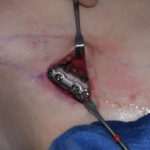
In the setback of frontal bossing, the thin plate of overlying must be removed, reshaped, and put back in place with small titanium plates and screws (1mm profile) to hold the bone in place while it heals.

A plain lateral skull film or cephalometric x-ray will show how much frontal bossing is caused by air vs. actual bone. 

4. How is brow bone augmentation done?

Building up a deficient or over-reduced brow ridge requires the use of synthetic materials which are added on top of the bone. The two most commonly used cranioplasty materials are acrylic (PMMA) and hydroxyapatite. (HA) Each material has its own advantages and disadvantages and either one can work in experienced hands.

PMMA incurs less cost to use and has a very high impact resistance. HA is more expensive with a lower impact resistance to trauma. Both can be impregnated with antibiotics and shaped during the procedure. How much material to add and where to place it is very much like sculpting and requires a thorough discussion before surgery with the patient.

Solid implants, composed of silastic, Gore-tex, or Medpor, can also be used. They require more effort at shaping and must be held in place with tiny titanium screws. Their cost is intermediate between PMMA and HA.

5. Can other areas of the forehead be reshaped besides the brow bone?

The forehead (frontal bone) between the brow ridge and the front of the hairline can also be reshaped. It can be made flatter, more round, narrower, or wider. Changes can be done in either profile, width, or both. This is done through either burring of the prominent areas, adding material on deficient areas, or a combination of both.

6. What is the recovery after forehead reshaping? What complications can occur?

Aesthetic forehead surgery is usually done as an outpatient procedure. Depending upon what other procedures may be done with it, it may require an overnight stay in the surgical facility. A wrap-around forehead dressing is put on at the end of surgery and is removed the next day. In some cases, a drain may be removed (not commonly) and it is removed the next day also. Ther6e is some mild pain afterward but much of the forehead skin will be numb for awhile. Pain is easily controlled by pills. There will be some swelling afterwards which is driven downward by the dressing and gravity which affects the eyes and upper cheeks. It is most evident by two days after surgery and is largely gone within seven to ten days after surgery. Most patients return to work in two to three weeks. Dissolveable sutures are used in the scalp so there is no need for suture remocal. One can return to working out in two weeks after surgery.

Complications of significance are very rare with forehead surgery. The forehead skin will be numb but normal feeling will return in most patients within six to eighty weeks after surgery. It is possible to not get back all of your feeling. The biggest concern is aesthetic…did we achieve what our goal was? Is the forehead contour smooth and even? Is it too much or too little?

7. What can I do if my forehead is too long?

Usually a long forehead is a female concern. It is evident when the distance between the eyebrows and the frontal hairline is aesthetically too long, usually greater than 6.5 or 7cms in length.

The length or size of the forehead skin can be reduced by a scalp advancement (hairline lowering. This is conceptually a ‘reverse browlift’. An incision is made at the frontal hairline and the scalp behind it is loosened and brought forward over the fixed forehead skin. The underlying forehead skin is then removed and the hairline closed in its new lower position. A frontal hairline can be advanced between 1 and 2.5 cms, which often makes for a significant difference. 

Dr. Barry Eppley

Indianapolis, Indiana

Forehead Contouring and the Coronal Incision

Thursday, August 27th, 2009

Contouring of the forehead is an uncommon procedure in plastic surgery but the techniques to do it are not. Whether it is to reduce frontal bossing, soften prominent brow bones, or change the slope of the forehead, the forehead can be reshaped in a variety of dimensions. Most reduction changes are more subtle to moderate due to the limitations of the thickness of the skull and the presence of the underlying brain or frontal sinuses. Building up the forehead can produce changes that are more significant as there are no such anatomic restrictions.

Forehead contouring developed from craniofacial plastic surgery techniques. One of the basic craniofacial tenets is that of the approach and using direct vision to see the entire surgical field. Using a coronal or scalp incision, the forehead tissues are degloved or peeled back from the scalp down to the orbital rim. With this amount of access, forehead bone manipulation is fairly straightforward. Whether it is bone reduction by burring, sinus osteotomies for reduction, or adding synthetic materials for augmentation, one is unrestricted in options with this exposure.

 More males than females desire forehead and skull reshaping in my Indianapolis plastic surgery practice experience. The limiting factor for males fulfilling that desire is the scalp scar. Males are more limited in having a hidden scar due to the location of their hairline and hair density. Most plastic surgery procedures are about making trade-offs…trading off one problem for another. The trade-off of a scalp scar for a better shaped forehead must be considered carefully in most males. This is rarely such an issue for females.

As craniofacial surgery techniques has evolved, more limited incisional or endoscopic approaches have been tried. In general, these are not particularly effective for most forehead procedures. They can be used to remove small osteomas or soft tissue masses and are very effective for cosmetic browlift and supraorbital nerve decompressions. But the access is too limited and the instrumentation is not sufficiently developed to allow for much bone manipulation. I have done a few synthetic augmentations endoscopically but only partial or subtotal areas can be done satisfactorily this way.

The only other incisional option is an upper eyelid incision but this can only be used for brow bone shaping. The eyelid incision provides good access to the mid- and lateral brow. But the inner brow area is blocked by the important sensory nerves that exit out from the bone there.

The bottom line is…most forehead contouring must be done using the full coronal incision. The magnitude of the deformity will determine whether the scalp scar is a reasonable aesthetic ‘problem’ to replace it. The forehead deformity and one’s concerns about it should be sufficiently significant to make coronal incision worth it.

Dr. Barry Eppley
Indianapolis, Indiana


The Concepts of Facial Feminization Surgery

Wednesday, July 15th, 2009

Facial feminization surgery (FFS) is an assortment of plastic surgery procedures that changes a genetically male face to bring its features closer in shape to that of a female. FFS is sought after largely by transsexual women and psychologically it is often more important than sex reassignment for social integration. FFS works on both the bone and the overlying soft tissues and, as a result, has much of its origins from craniomaxillofacial surgery as well as traditional cosmetic plastic surgery. For this reason, those few plastic surgeons who perform FFS usually have such backgrounds.

 I like to think of FFS as three potential zones of change… upper, middle, and lower face. Within these zones, the primary plastic surgery procedures include frontal hairline alteration/brow lift, forehead/brow recontouring, rhinoplasty, cheek/submalar augmentation, upper lip enhancement, jaw/chin modification, and thyroid cartilage reduction. To no surprise, many of these changes deal with facial prominences ….lessening the amount of bony and cartilage convexities. Each patient usually has one primary zone for change and two others for some modification. In essence, every patient has at least one dominant facial feature which must be changed onto which other procedures are complementary. While it is true that it takes many changes to create a  more convincing change of appearance, one or two of the procedures usually has a dominant effect.

FFS, philosophically, consists of a combination of reconstructive and cosmetic plastic surgery procedures. Changing the bony prominences, or changing the skeletal foundation of the face, is based more on the reconstructive heritage of the procedures. Modifying or lifting of soft tissues of the face encompasses more standard cosmetic procedures used for a primary anti-aging or more youthful effect.

Every FFS procedure has differing levels of difficulty and degrees of change. Some are easy to go through, while others are more extensive with prolonged swelling and social recovery. The procedures of tracheal shave, upper lip lift and cheek implants are very effective and relatively simple with little downside or complications. More difficult procedures are forehead contouring and brow reduction and the alteration of the chin and jawline. These have issues of surgical access and bone manipulation, of which makes for more swelling. Rhinoplasty and standard plastic surgery procedures such as facelift, blepharoplasty or browlift, falls between the two with a few weeks of relatively easy recovery.

The key to a successful FFS outcome is to plan a combination of facial procedures that can most effectively soften one’s appearance and make for a convincing change. There is no one standard set of procedures that will work for every patient. While some patients need just three or four, others may benefit by twice that many. Most patients have a good feel for what they think will be effective and a careful discussion and computer imaging is essential to create a reasonable working list of procedures. While some patients may want the most change possible by number of procedures, it is important to have a realistic outcome and work within one’s budget for maximal facial change.

Dr. Barry Eppley
Indianapolis, Indiana


Dr. Barry EppleyDr. Barry Eppley

Dr. Barry Eppley is an extensively trained plastic and cosmetic surgeon with more than 20 years of surgical experience. He is both a licensed physician and dentist as well as double board-certified in both Plastic and Reconstructive Surgery and Oral and Maxillofacial Surgery. This training allows him to perform the most complex surgical procedures from cosmetic changes to the face and body to craniofacial surgery. Dr. Eppley has made extensive contributions to plastic surgery starting with the development of several advanced surgical techniques. He is a revered author, lecturer and educator in the field of plastic and cosmetic surgery.

Read More


Free Plastic Surgery Consultation

*required fields


Pricing

The cost of any type of elective plastic surgery plays a major role in the decision to undergo the procedure(s).

Get Your Quote Here


My Plastic Surgery Story

Military Discount

We offer discounts on plastic surgery to our United States Armed Forces.

Find Out Your Benefits


Categories