
EXPLORE
Plastic Surgery
Dr. Barry Eppley

Explore the worlds of cosmetic
and plastic surgery with Indianapolis
Double Board-Certified Plastic
Surgeon Dr. Barry Eppley

Posts Tagged ‘custom facial implants’

The Role of Custom Facial Implants in Aesthetic Facial Surgery

Friday, August 17th, 2012


Implants provide a wide array of options for facial augmentation. While initially only a chin implant was available forty years ago, today there are over fifty different styles and shapes that are available in more than one material composition. From the chin to the forehead, the options for bony enhancement now cover such obscure areas as the tear trough, paranasal and geniomandibular  areas. Such facial implants play a very valuable role in aesthetic facial augmentation whether it is the younger patient seeking a structural facial change or the older patient  in which an implant complements soft tissue lifting procedures.

Despite the tremendous diversity of facial implants, off-the-shelf styles and sizes can not fill all patient aesthetic needs. There are certain types of aesthetic problems in which stock implants are inadequate such as facial asymmetries, congenital and traumatic deformities and failed results using commercially-available implants. While stock facial implants, particularly those composed of silicone, are easy to intraoperatively shape and ‘customize’, the judgment of how they are to be shaped is still a matter of artistic adaptation.

The use of custom facial implants offers real advantages in challenging cases of facial augmentation. I classify custom facial implants into four types; 1) intraoperative modification of stock implants, 2) preoperative stock implant modification on a standard anatomic model, 3) preoperative stock implant modification on a patient-specific anatomic model, and 4) fabrication of an implant on a patient-specific anatomic model. Type #1 and #2 custom facial implant approaches have been done for decades and may even be questionable as to whether they are truly custom implants. Types #3 and #4 are a truly custom implant approach.

The basis of a truly custom facial implant approach is a patient-specific anatomic model. This requires the patient to first receive a 3-D facial CT scan based on a 1mm slice-taken protocol. These images are then sent to a manufacturer of craniofacial models. The manufacturer that I use is  Medical Modeling (Golden, CO) although there are others. The model can be made in either an Osteoview style (opaque) or a Clearview style. (clear acrylic) In the Clearview style, teeth, nerves, plates and screws and other implants can be colorized (red) so they stand out from the clear bone structures. The Osteoview is satisfactory if a custom implant is needed and the patient has not had prior surgery. The Clearview model is preferred when prior bone or implant work has been done and the bony anatomy has been altered.

Off of these models, the custom facial implants are made. While most patients think that there is a computer program that makes the implants, and this certainly exists, the cost and availability of this technology makes it currently not practical in aesthetic facial surgery applications.  Custom implant designs and prototypes are made by hand. I mold, shape and carved them out of clay or silicone elastomer which air dries to a hard set. If needed, they are further shaped and contoured by diamond wheels on a small hand drill. Finally they are covered by a lacquer which dries to a clear coat.

As part of this process, I often share images with patients of their implants in the fabrication process by e-mail or they may come in to see and handle the implant prototypes. It is important in the custom implant fabrication process for patients to participate in the decision process about the design. Once the design is agreed upon, the implant(s) are sent to a manufacturer for fabrication. Most custom implants can only be made from silicone. For many custom facial implants this is the best material  because their differing shapes and sizes may make them difficult to place. Flexibility and lack of frictional resistance on insertion are important implant insertion properties in any facial implant but is of critical importance in many custom designs. Besides the obvious benefit of creating an implant design that is as accurately accurate and symmetric as possible, the custom design process can also add features that make them able to be more effectively secured to the bone by screw fixation.

From the time that a 3-D anatomic model is obtained, a three week period is usually needed from design until the sterilized implants are returned from the manufacturer and ready for surgery. Depending upon the number of implants, the cost of custom designed facial implants can be from $3500 to $7500 in addition to other surgical costs.

Dr. Barry Eppley

Indianapolis, Indiana

Semi-Custom Facial Implants From 3-D Models

Sunday, December 11th, 2011

The use of implants makes it possible for many cosmetic facial procedures to be done. The mere existence of some of these implants has created new possibilities for facial augmentation. A wide variety of preformed implants of differing materials are available which allows the plastic surgeon to enhance structures as diverse as the temporal regions to the jaw angles. But despite the dozens of implants available, there still remains certain aesthetic facial problems which are not adequately treated by their existing dimensions and sizes.

The use of custom facial implants is ideal for the truly unique aesthetic case, whether it be because of altered anatomy or that existing preformed implants are not adequately sized or shaped. The traditional use of custom facial implants begins with obtaining a 3-D model of the patient from a high resolution CT scan. From that model, either the plastic surgeon or a manufacturer creates the desired implant design. In my practice, I hand carve all implant designs myself out of clay based on this model. The final facial implant is then manufactured out of silicone material and sterilized by one of several major implant manufacturers.

While this custom approach to unique facial implants is ideal, it adds considerable expense and time to the final cost of the surgery. There are cases where the custom facial implant process can be streamlined and expenses reduced. In this custom approach, a 3-D CT model is still needed and used as a template for implant fabrication. But instead of making a new implant design from scratch, existing preformed implants are used as the ‘templates.’ They are placed on the patient’s 3-D model and carved down to the desired shape before surgery. This then becomes the final implant which is then sterilized for the patient’s surgery.

This modified custom approach obviates the need to have a new implant fabricated, saving presurgical time and cost. In an elective aesthetic facial case, however, time is not as important as cost. This concept only works when the size of the preformed implant is adequate but its shape or adaptation to the desired bone site is insufficient. If the preformed implant is too small, then the custom implant will have to be made in the traditional manner from a clay or silicone elastomer prototype.

I have found that this modification of preformed implant approach is effective for a variety of aesthetic facial situations. For the patient who is just not comfortable with the  traditional but ‘blinded’ approach to facial implant augmentation, the 3-D model can help create confidence in the implant selection process. It also allows any minor modifications to the implants selected. Where it can be tremendously helpful is in revisional facial implant surgery where the positions of the existing implants are ill-placed, asymmetric or otherwise of inadequate shape.  

Dr. Barry Eppley

Indianapolis, Indiana

Custom Facial Implant Design And Fabrication From 3-D Facial Models

Thursday, March 24th, 2011

Synthetic implants are commonly used for augmentation of numerous facial bone sites for cosmetic augmentation or reconstruction of defects and asymmetries. Facial implants are available in a wide variety of styles and sizes for such areas as the cheek, orbit, chin and jaw angle, to name the most common. Most of these implants are composed of materials that allow for relatively easy shaping, trimming and otherwise custom adaptation.

But some facial cosmetic and reconstructive needs can not ideally be met by using off-the-shelf implants, no matter how they are shaped and modified. In some more uncommon cases, only a custom designed facial implant will suffice. As uncommon as the need for such implants are, they are more frequently used in reconstruction of facial defects and more rarely for cosmetic augmentation.

The fabrication of custom facial implants is a process that initially begins by getting a facial skeletal model of the patient. This is initially done by the patient obtaining a 3-D craniofacial CT scan done with high resolution 1mm cuts. Such a scan can be obtained at just about any CT facility today as 3-D software is commonplace. Once the scan is obtained, it is then sent to a model fabrication manufacturer. I use Medical Modeling (Golden, CO) but there are numerous other manufacturers that can create similar models. They can make a patient’s model in numerous ways including an Osteoview (radiopaque) or a Clearview (translucent) model. For custom implant fabrication, I usually use an Osteoview model as the view of underlying structures such as nerve and teeth are not usually necessary and it is less expensive.

Once the patient’s facial model is obtained, a mock-up of the implant is then made. This is done by sculpting it by hand on the model. At one time, I used acrylic as the modeling material but this requires grinding after being set and that makes it a more difficult fabrication process. Currently, soft modeling clay is used but it is of the type that does not dry out with extended use and can be cured by baking once the final shape is obtained. Such modern clays are much easier to use than older clay materials for this purpose.

The cured clay implant(s) is then sent to a silicone manufacturer (e.g., Implantech) for the manufacture and sterilization of the final implant(s). Currently, custom facial implants can only be made in silicone. Other implant materials, such as Medpor and Gore-Tex, have to be machined and not poured and cured into a mold made from a custom implant design. (this makes them considerably more expensive)

Contrary to popular perception, custom facial implants for cosmetic facial enhancement are not made magically by some computer technology. They are done by hand by traditional sculpting off of a model made by computed tomographic scanning. It is a total process that takes about 6 to 8 weeks from the time the CT scan is obtained until the actual sterile implants are in hand. I have found them to be particular useful for mandibular augmentation (e.g., vertical lengthening) which, due to its large surface area of bone, has contours that may not be able to be met by conventional preformed implant shapes.    

Dr. Barry Eppley

Indianapolis, Indiana

3-D Implant Design and Engineering in Facial Reconstructive Surgery

Sunday, January 16th, 2011

Facial reconstruction patients can benefit today from custom-made bone replacements and bone fixation aids to optimize for the postoeprative form and function. High-resolution computed tomography (CT) modeling allows plastic surgeons to custom-design implants prior to reconstructive surgery. They are particularly useful for facial bone defects of the lower jaw (mandible), skull and the forehead and eye (orbital) areas.

Severe facial and eye (orbital) bone deformities and defects may be present at birth or can occur following facial trauma or, most commonly, facial tumor removal. Surgery to correct such defects aims to restore the original anatomy and the patient’s appearance by inserting an implant made either of the individual’s own bone and tissue or synthetic materials. The traditional use of implant materials in facial reconstructive surgery, which are shaped during surgery, often do not recreate ideal three-dimensional contours in the face and take a lot of time working with them as the patient is asleep. Designing synthetic implants beforehand improves theirprecision and contours and helps shorten the time of surgery.

I have looked at my series of ten facial reconstructive patients done over the previous nine years who received computer designed and generated custom implants and were more than one year after their surgery. The six men and four women were between the ages of 31 and 67 years, with an average age of 46.1 years. The defects were caused by either trauma (2), tumor resection (6), or a congenital deformity (2). Most of the patients (7) had a history of prior failed reconstructive efforts. The patients underwent three-dimensional high-resolution CT scanning of the face from which customized implants composed of either pure titanium (bone fixation device) or HTR (porous hard tissue replacement bone substitute) were made. All implants was surgically placed and fixed using titanium plates and screws.

Example #1

This 62 year-old female had a right mandibular angle bone resection secondary to an intraoral carcinoma. She never had any radiation treatments. The defect was only spanned by a reconstruction plate which had fractured three separate times over the past eight years. A 3-D CT scan showed the defect and the mandibular segment contraction. She did not want a fibular free flap reconstruction.

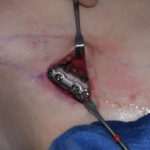
A custom titanium dual plate and mesh construct was designed to hold the bone segments apart in anatomic position and contain an iliac marrow graft. Through a neck incision approach, the old fractured plate was removed and the new 3-D engineered construct placed. The resultant mandibular form, occlusion and jaw opening was excellent.

Example #2

This 65 year-old male had a history of esthesioneuroblastoma with a resection by frontal craniotomy and removal of his left heminasal cavity and maxillectomy. He received radiation afterwards. Over the enduing ten years, he developedorbital floor bony resorption due to osteomyelitis and dropping of the eye downward. His orbital condition and eye position eventually stabilized as his osteomyelitis resolved. A 3-D CT scan shows the loss of orbital floor bone and the orbital dystopia.

A custom HTR orbital floor implant was manufactured to match the opposite orbital floor shape and volume. Through a lower eyelid incisional approach, the implant was placed and secured to the orbital rim with titanium plates and screws. He had much improved postoperative globe symmetry. He went on to have eye muscle surgery and a dermal fat graft to fill out the soft tissue atrophy of the lower eyelid and cheek region.

During an average of over four years of follow-up, none of the patients experienced any implant-related complications including infection, extrusion, or displacement of the implants. Healing around the implant sites was uneventful. All of the patients had sustained improvement of facial deformities including mouth opening in those that involved the lower jaw.

While numerous types of implant materials have been used for reconstructive facial surgery, one important aspect of their success is proper design and engineering. Time spent before surgery evaluating the exact dimensions of the bone defect and then custom designing the implant has numerous advantages. Having an implant that is not bigger or oversized for the defect lowers the risk of potential extrusion. A near perfect fit makes for good facial contour restoration. Oral function and occlusion is more assured if the lower jaw reconstruction is as precise as possible. Donor site pain and morbidity is eliminated or reduced with maximal use of synthetic replacement parts. Operative times can be reduced significantly, often cutting the length of an operation in half. Implants are also structurally stable and will not resorb or change their shape over time. Any synthetic implant no matter how well designed and engineered, however, has limitations. Good healthy soft tissue flaps over the synthetic reconstruction is extremely important to avoid potential infection and exposure problems.

Dr. Barry Eppley

Indianapolis Indiana


Dr. Barry EppleyDr. Barry Eppley

Dr. Barry Eppley is an extensively trained plastic and cosmetic surgeon with more than 20 years of surgical experience. He is both a licensed physician and dentist as well as double board-certified in both Plastic and Reconstructive Surgery and Oral and Maxillofacial Surgery. This training allows him to perform the most complex surgical procedures from cosmetic changes to the face and body to craniofacial surgery. Dr. Eppley has made extensive contributions to plastic surgery starting with the development of several advanced surgical techniques. He is a revered author, lecturer and educator in the field of plastic and cosmetic surgery.

Read More


Free Plastic Surgery Consultation

*required fields


Pricing

The cost of any type of elective plastic surgery plays a major role in the decision to undergo the procedure(s).

Get Your Quote Here


My Plastic Surgery Story

Military Discount

We offer discounts on plastic surgery to our United States Armed Forces.

Find Out Your Benefits


Categories